Choosing the right perimeter security system is an important decision for homeowners, businesses, property developers, warehouse operators and industrial facility managers in Uganda. A good security fence helps discourage unauthorised access, protects valuable property and strengthens the overall security of a building or compound.
Two popular perimeter security options are electric fencing and razor wire. Both are designed to discourage intruders, but they work in very different ways.
An electric fence uses a specialised energiser to deliver controlled electrical pulses through insulated conductors. Razor wire, on the other hand, uses sharp-edged metal blades attached to steel wire to create a physical obstacle that makes climbing or passing through a boundary difficult and dangerous.
So, when comparing electric fence vs razor wire, which is better for your property?
The answer depends on your security requirements, property layout, budget, maintenance expectations and safety considerations. Electric fencing may be more suitable when active electrical deterrence and potential alarm integration are important. Razor wire may be suitable where a passive physical deterrent is required without depending on electricity. In some installations, a professionally designed combination may provide additional layers of protection.
This guide compares electric fencing and razor wire in Uganda, explaining their differences, advantages, disadvantages, installation considerations, maintenance requirements and costs. It will help you make an informed decision before purchasing perimeter security products.
1. What Is an Electric Fence?
An electric fence is a perimeter security system that uses controlled electrical pulses to discourage people or animals from crossing a protected boundary.
The system operates using a specialised electric fence energiser connected to insulated fence conductors. The energiser converts power from a compatible electricity source into short-duration electrical pulses that travel through the fence wires.
When a person or animal touches an electrified conductor and completes the electrical circuit through the ground or an appropriate earth-return conductor, a brief electric shock is delivered.
The shock is intended to act as a deterrent and discourage further contact with the fence.
Electric fencing is commonly considered for:
- Residential homes and private compounds.
- Commercial buildings and business premises.
- Warehouses and storage facilities.
- Factories and industrial properties.
- Farms and agricultural properties.
- Institutions and selected restricted-access facilities.
Main Components of an Electric Fence
A typical electric fence system may include:
- Electric fence energiser.
- Multistrand fence wires.
- Fence stands.
- Insulators.
- Earthing components.
- Strainers.
- Under-gate cables.
- Gate contacts.
- Compatible warning devices such as sirens and strobes.
Each component has a specific function. The energiser, conductors, insulation, power supply and earthing arrangement must work together for reliable operation.
An electric fence can also be integrated into a wider security arrangement with compatible alarm systems, CCTV cameras and access-control equipment.
2. What Is Razor Wire?
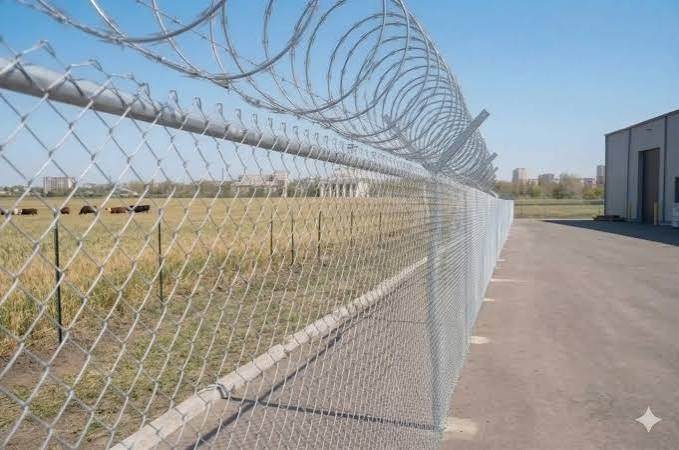
Razor wire is a type of physical security barrier made from sharp-edged metal tape attached to a supporting steel wire. It is commonly supplied in coils or other configurations and installed along suitable boundary structures.
Its sharp blades are designed to make climbing over or passing through the barrier difficult and to discourage unauthorised access.
Unlike electric fencing, razor wire does not require an energiser, battery or electricity supply to perform its basic deterrent function.
Razor wire is commonly considered for:
- Commercial property boundaries.
- Industrial facilities.
- Warehouses.
- Construction sites.
- Restricted-access compounds.
- Selected institutional and infrastructure perimeters.
Common Types of Razor Wire
Concertina Razor Wire
Concertina razor wire is supplied in expandable coils that form a three-dimensional barrier when installed. It is commonly used along suitable perimeter walls and security fences.
Flat Wrap Razor Wire
Flat wrap razor wire is arranged in a flatter configuration and may be suitable for installations where space and appearance are important considerations.
Razor Wire on Boundary Walls
Razor wire may be installed as an additional security feature above an existing wall or suitable physical fence. The supporting structure must be capable of carrying the installation safely.
Razor wire is a passive barrier. It does not automatically detect an intrusion, activate an alarm or notify a property owner unless separate compatible monitoring equipment is provided.
3. Electric Fence vs Razor Wire: What Is the Main Difference?
The biggest difference between electric fencing and razor wire is how each system discourages unauthorised access.
An electric fence provides an active electrical deterrent through controlled pulses. Razor wire creates a passive physical obstacle using sharp metal blades.
Here is a direct comparison.
| Feature | Electric Fence | Razor Wire |
|---|---|---|
| Security principle | Active electrical deterrent | Passive physical deterrent |
| Electricity requirement | Requires a compatible power source | Does not require electricity |
| Main components | Energiser, wires, insulators and earthing | Razor tape, supporting wire and suitable brackets |
| Intrusion alerts | Can be integrated with compatible alarms | Requires separate monitoring equipment |
| Maintenance | Requires electrical and physical inspections | Requires physical inspections |
| Power interruptions | Requires backup arrangements where continuous operation is important | Basic barrier remains in place during power interruptions |
| Physical injury risk | Can cause electric shock and injury | Sharp blades can cause serious cuts |
| Appearance | Often a more organised security installation | More aggressive industrial appearance |
| Typical application | Homes, commercial buildings, warehouses and farms | Industrial, commercial and restricted-access boundaries |
| Main limitation | Depends on correct installation, power and maintenance | Can be physically damaged or bypassed and does not provide active electrical alerts |
Neither option guarantees complete protection. Both should be considered as part of a wider security plan.
4. Advantages of Electric Fencing for Property Security
Electric fencing offers several advantages for properties that require an active perimeter deterrent.
4.1 Provides an Active Electrical Deterrent
An electric fence uses controlled electrical pulses to discourage people or animals from touching or crossing the protected boundary.
The visible wires and warning signs can also communicate that the property has an active security measure.
4.2 Can Be Integrated with Alarm Systems
One important advantage of electric fencing is its potential integration with compatible monitoring equipment.
Depending on the system design, an electric fence can be connected to alarms, sirens, strobes or other monitoring devices.
This may help alert security personnel or property owners when a configured fault or intrusion event is detected.
However, an alarm does not automatically come with every electric fence. The required monitoring equipment must be included in the system design.
4.3 Suitable for Different Property Types
Electric fencing can be considered for residential compounds, commercial buildings, industrial facilities, warehouses and agricultural properties.
The system should be designed according to the perimeter length, layout, security requirements and applicable safety standards.
4.4 Can Be Used with Different Power Options
Depending on the energiser specifications, electric fencing can operate using:
- Mains electricity.
- Compatible batteries.
- Properly designed solar-powered arrangements.
Solar-powered systems may be particularly useful where mains electricity is unavailable, provided the panel, battery and energiser are correctly matched.
4.5 Works as Part of a Layered Security System
Electric fencing can complement:
- CCTV surveillance.
- Security lighting.
- Burglar alarms.
- Automatic gates.
- Access-control systems.
- Security personnel.
Combining appropriate security measures can provide better overall protection than relying on a fence alone.
Disadvantages of Electric Fencing
Despite its advantages, electric fencing also has limitations.
- It depends on a suitable power source.
- It requires an appropriate energiser.
- It needs proper earthing.
- Vegetation touching conductors can reduce performance.
- Damaged insulators and loose connections can cause faults.
- Regular inspection and electrical testing are necessary.
- Poor installation can create safety risks.
- Repairs may require qualified technicians.
An electric fence should never be treated as a maintenance-free security system.
5. Advantages of Razor Wire for Property Security
Razor wire is a widely recognised physical perimeter deterrent. Its main advantage is that it creates a difficult and hazardous obstacle for anyone attempting to climb across a protected boundary.
5.1 Does Not Depend on Electricity
Unlike an electric fence, razor wire does not need a mains supply, battery or energiser.
Its basic physical deterrent remains present during power outages.
This can make it an option for selected properties where maintaining an electrical system is difficult.
5.2 Creates a Physical Barrier
Razor wire uses sharp-edged blades that make climbing or passing through a protected boundary difficult.
It can discourage casual trespassing and add a physical obstacle above a suitable wall or fence.
5.3 Can Be Used on Suitable Existing Boundaries
Depending on the structure, razor wire can be installed above suitable boundary walls or supporting fences.
This can strengthen an existing physical perimeter without necessarily replacing the entire boundary structure.
5.4 Relatively Simple Operating Principle
Razor wire does not have an energiser, electrical circuit or battery charging arrangement.
Its basic function is mechanical, although its supporting structure and condition still require inspection.
5.5 Useful for Selected Industrial and Restricted-Access Areas
Razor wire may be considered for selected industrial properties, storage compounds and restricted-access facilities where a strong physical deterrent is required and its use is permitted.
Disadvantages of Razor Wire
Razor wire also has limitations that property owners should consider.
- It can cause serious cuts and other injuries.
- It does not provide automatic intrusion detection.
- It does not activate an alarm by itself.
- It may corrode or deteriorate depending on material quality and exposure.
- Damaged coils or supporting brackets may require replacement.
- Its appearance may be unsuitable for some residential or customer-facing properties.
- Installation and maintenance require appropriate safety precautions.
- Local building, planning and public-safety requirements may restrict its use or positioning.
Razor wire should be installed only in appropriate locations, with consideration for neighbouring properties, public access, maintenance personnel and accidental contact.
6. Electric Fence vs Razor Wire: Which Offers Better Security?
There is no single answer for every property. The better option depends on what the owner needs the security system to achieve.
Electric Fencing for Active Deterrence
Electric fencing may be more appropriate when a property owner wants:
- An active electrical deterrent.
- Potential integration with compatible alarm systems.
- A modern perimeter security arrangement.
- A system that can complement CCTV and access control.
- An option suitable for different residential and commercial layouts.
It is particularly worth considering for properties where security monitoring and electrical deterrence are important.
However, its performance depends on correct equipment selection, a reliable power arrangement and regular maintenance.
Razor Wire for a Passive Physical Barrier
Razor wire may be appropriate when a property owner needs:
- A physical deterrent that does not depend on electricity.
- Additional protection above a suitable boundary wall.
- A simple mechanical barrier.
- A solution for selected industrial or restricted-access locations.
It can be useful where a physical obstacle is the main requirement, but it does not replace intrusion detection or active security monitoring.
Which One Is More Difficult to Bypass?
Both systems can be defeated by determined intruders if they are poorly designed, badly maintained or used as the property’s only security measure.
An electric fence may lose performance when its power supply fails, its conductors are damaged or its energiser malfunctions.
Razor wire can be damaged, cut or bypassed if the supporting wall or fence is weak.
The best security arrangement considers the entire perimeter, including the boundary structure, gates, access points, lighting, surveillance and response procedures.
7. Electric Fence vs Razor Wire: Cost Comparison in Uganda
Cost is one of the most important considerations when choosing between electric fencing and razor wire.
However, comparing only the price of the wire or coils can be misleading because the two systems have different components and operating requirements.
Electric Fence Costs
The cost of an electric fence depends on:
- Total perimeter length.
- Energiser capacity and specifications.
- Number of fence conductors.
- Fence stands and insulators.
- Earthing components.
- Gate contacts and under-gate cables.
- Power source.
- Alarm or monitoring equipment, where required.
- Installation and maintenance requirements.
A larger property may require more conductors and additional equipment than a small residential compound.
Solar-powered installations may also require a compatible panel, battery and charging equipment.
Razor Wire Costs
The cost of razor wire depends on:
- Type of razor wire.
- Coil dimensions and material specifications.
- Total perimeter length.
- Supporting brackets and mounting materials.
- Condition and height of the existing wall.
- Installation labour.
- Site accessibility.
- Safety and maintenance requirements.
The cost of razor wire alone does not represent the full project budget.
Which Is Cheaper?
Razor wire may have a lower initial equipment requirement in some applications because it does not need an energiser or electrical power arrangement.
Electric fencing generally requires additional electrical components, which can increase the initial project cost.
However, the actual cost difference depends on the fence design, perimeter size, materials, installation requirements and monitoring features.
For a fair comparison, request quotations for both systems using the same property perimeter and clearly defined security requirements.
Important: Do not assume that the cheapest option provides the best value. Consider installation quality, maintenance, safety, expected service life and the consequences of a security failure.
8. Electric Fence vs Razor Wire: Maintenance Requirements
Maintenance is another important difference between these two perimeter security options.
Electric Fence Maintenance
Electric fencing requires regular electrical and physical inspections.
Important maintenance activities include:
- Inspecting the fence wires for damage or loose connections.
- Checking insulators for cracks and deterioration.
- Managing vegetation around the conductors.
- Checking the energiser and power supply.
- Testing the earthing arrangement.
- Inspecting gate contacts and under-gate cables.
- Checking battery and solar equipment where fitted.
- Testing fence performance using suitable equipment.
A qualified technician should investigate persistent electrical faults and carry out energiser or earthing repairs.
Razor Wire Maintenance
Razor wire requires physical inspections to identify deterioration and damage.
Maintenance considerations include:
- Inspecting the wire for corrosion.
- Checking supporting brackets and fixings.
- Looking for loose, damaged or displaced coils.
- Inspecting the supporting wall or fence.
- Checking for physical interference.
- Replacing damaged components safely.
- Ensuring warning signs and access controls remain appropriate.
Because razor wire has sharp edges, inspection and repairs must be carried out by trained personnel using suitable protective equipment and safe working procedures.
Which Requires More Maintenance?
Electric fencing generally requires more attention to electrical performance, power supply and earthing.
Razor wire does not require electrical testing, but it still needs physical inspections and occasional repairs.
The maintenance workload depends on the installation environment, material quality and exposure to weather or physical interference.
9. Can You Combine Electric Fencing and Razor Wire?
Some property owners consider combining electric fencing and razor wire to create multiple layers of perimeter protection.
A layered security arrangement may involve a suitable physical boundary, an electric security fence and other independently designed physical deterrents.
However, combining electric fencing and razor wire requires careful technical planning.
Razor wire must never be electrified by an electric fence energiser or connected directly to an electrical supply. The electric fence conductors must be installed as a separate, properly insulated system in accordance with applicable safety requirements and manufacturer instructions.
The arrangement must also consider:
- Required separation between different fence components.
- Electrical isolation.
- Risk of accidental contact.
- Public access and warning signs.
- Safe access for maintenance personnel.
- Supporting wall or fence strength.
- Local planning and safety requirements.
A qualified electric-fence professional should assess the site before any combined installation is designed.
Is Combining Both Systems Always Necessary?
No. Combining electric fencing and razor wire may increase equipment and installation costs and may introduce additional safety and maintenance considerations.
A well-designed electric fence with suitable physical boundaries, CCTV, lighting and controlled access may be sufficient for some properties.
Other high-risk sites may require a different combination of physical barriers and monitoring systems.
The correct choice should be based on a professional assessment rather than simply adding more security products.
10. Which Is Better for Residential Homes in Uganda?
For residential homes, the decision should consider security requirements, appearance, neighbours, children, visitors and the location of the boundary.
Electric fencing may be considered where the homeowner wants an active deterrent that can form part of a wider security system.
Razor wire may be unsuitable for some residential settings because of its sharp edges, appearance and potential risk to people who accidentally come into contact with it.
Before installing either option, homeowners should check applicable local building, planning and safety requirements.
For residential properties, a layered approach may include:
- A strong boundary wall or suitable fence.
- Electric perimeter fencing where permitted and appropriately designed.
- CCTV cameras.
- Security lighting.
- Automatic or controlled gates.
- Alarm systems.
- Suitable access management.
The objective is to protect the property while also considering the safety of household members, visitors, workers and neighbouring properties.
11. Which Is Better for Commercial Buildings and Warehouses?
Commercial buildings and warehouses often require security systems that protect stock, equipment, offices and operational areas.
Electric fencing may be suitable where active deterrence and compatible alarm integration are important.
Razor wire may be considered for suitable industrial-style boundaries where a passive physical deterrent is required.
The choice should consider:
- Value of stored goods and equipment.
- Size of the property.
- Number of access points.
- Operating hours.
- Public and employee access.
- CCTV coverage.
- Security staffing.
- Emergency access requirements.
- Safety and compliance obligations.
For larger facilities, perimeter protection should be integrated with the site’s overall security plan.
12. Which Is Better for Farms and Agricultural Properties?
Farms and agricultural properties have different security and animal-management requirements.
Electric fencing may be appropriate for certain agricultural applications, including animal containment and selected perimeter security arrangements. The energiser and fence design must match the intended use.
Razor wire may be considered for selected restricted-access boundaries, but it is not a substitute for suitable livestock fencing and can create serious injury risks to animals and people.
Before choosing a system, consider:
- The type of animals on the property.
- The area that needs protection.
- Availability of electricity.
- Soil and environmental conditions.
- Access for workers and vehicles.
- Wildlife movement.
- Maintenance requirements.
Agricultural electric fencing and security electric fencing have different design requirements. Equipment should be selected for the actual application.
13. Important Safety Considerations Before Installing Electric Fencing or Razor Wire
Security products must be selected and installed responsibly.
Both electric fencing and razor wire can create serious risks when poorly installed or placed in inappropriate locations.
Electric Fence Safety
- Use a purpose-designed electric fence energiser.
- Follow manufacturer installation instructions.
- Use suitable warning signs where required.
- Ensure appropriate insulation and earthing.
- Avoid unsafe contact with public access areas.
- Arrange professional electrical inspection and maintenance.
- Never connect razor wire to an electric fence energiser.
- Never connect electric fence conductors directly to household mains wiring.
Uganda’s standards catalogue lists a compulsory Uganda Standard concerning safety requirements for electric fence energisers, US IEC 60335-2-76. Property owners and installers should confirm the applicable current requirements and use compliant equipment.
Razor Wire Safety
- Use razor wire only in appropriate locations.
- Consider the risk of accidental contact.
- Use suitable supporting structures and fixings.
- Consider access by children, visitors and maintenance workers.
- Provide appropriate warnings and access controls.
- Arrange installation and maintenance by trained personnel.
- Check local building, planning and public-safety requirements.
The security benefits should always be balanced against the potential for injury and the responsibilities of the property owner.
14. How to Choose the Right Perimeter Security Products
Before buying electric fence or razor wire products, take time to understand the property’s actual security needs.
Use these considerations to guide your decision.
Step 1: Assess the Property
Identify the perimeter length, existing wall or fence, access points and areas that require additional protection.
Step 2: Identify the Security Risk
Consider whether the main concern is climbing over a wall, unauthorised entry, access to valuable equipment or protection of a restricted area.
Step 3: Decide Between Active and Passive Deterrence
An electric fence offers an active electrical deterrent and potential alarm integration.
Razor wire provides a passive physical obstacle without depending on electricity.
Step 4: Compare Total Project Costs
Include materials, supporting structures, installation, power requirements, monitoring equipment and future maintenance.
Step 5: Consider Safety and Compliance
Check the suitability of the proposed installation for the property and confirm applicable safety and planning requirements.
Step 6: Choose Compatible Equipment
For electric fencing, confirm that the energiser, wires, insulators, power supply and other components are compatible.
For razor wire, confirm that the wire type, supporting brackets and boundary structure are suitable.
Step 7: Plan for Long-Term Maintenance
Consider who will inspect the system, how faults will be handled and whether replacement components will be available.
15. Electric Fence and Razor Wire Products from Daltrev Co. Ltd
Daltrev Co. Ltd provides a range of utility products for residential, commercial and industrial project requirements in Uganda.
Its listed perimeter security products include both electric fencing components and razor wire.
Electric Fence Products
Daltrev’s listed electric fencing products include:
- Electric fence energisers.
- Fence stands.
- Multistrand wires.
- Sirens and strobes.
- Under-gate cables.
- Insulators.
- Strainers.
- Gate contacts.
These components support different parts of an electric perimeter fencing arrangement. The appropriate products depend on the installation design and technical specifications.
Razor Wire
Razor wire is also listed under Daltrev’s perimeter security product category.
It may be considered for suitable physical perimeter protection applications, subject to the property’s layout, supporting structure and applicable safety requirements.
Why Discuss Your Project Requirements Before Purchasing?
Electric fencing and razor wire have different installation requirements. Selecting the wrong components may lead to unnecessary costs, compatibility problems or an unsuitable security arrangement.
Before requesting a quotation, prepare the following information:
- Property location.
- Approximate perimeter length.
- Existing wall or fence details.
- Preferred security arrangement.
- Number of gates and access points.
- Required product quantities.
- Any available technical specifications.
Daltrev Co. Ltd can discuss your product requirements and help you identify the relevant listed product categories for your project.
Explore the available products on the official Daltrev Co. Ltd Utility Products page.
For enquiries and quotations, visit the Daltrev Co. Ltd Contact Page.
16. Frequently Asked Questions About Electric Fence vs Razor Wire
1. Which is better, an electric fence or razor wire?
An electric fence may be better when active electrical deterrence and potential alarm integration are priorities. Razor wire may be more suitable when a passive physical obstacle is required without electricity. The right choice depends on the property, security risks, budget and safety requirements.
2. Is razor wire cheaper than electric fencing in Uganda?
Razor wire may have a lower initial equipment requirement in some applications because it does not need an energiser or electrical power arrangement. Electric fencing requires additional electrical components. Actual costs depend on the perimeter length, materials, installation and design.
3. Does razor wire need electricity?
No. Razor wire works as a physical barrier and does not require an energiser, battery or electricity supply.
4. Does an electric fence work during a power outage?
A mains-powered electric fence may stop operating during a power outage unless it has a suitable backup arrangement. Battery-powered or properly designed solar-powered systems can provide alternative power, depending on their capacity and condition.
5. Can razor wire be installed on top of an electric fence?
Some security designs may use separate electric and physical barriers together. However, the components must be properly separated and electrically isolated according to applicable standards and manufacturer instructions. Razor wire must never be electrified by the energiser.
6. Which is easier to maintain, electric fencing or razor wire?
Razor wire does not require electrical testing, so its basic maintenance is generally more straightforward. Electric fencing requires inspections of the energiser, wires, insulators, power supply and earthing. Both systems need physical inspections and timely repairs.
7. Is electric fencing safe for residential properties?
Electric fencing can be used as a perimeter security measure where it is properly designed, installed and maintained in accordance with applicable requirements. It can still cause injury, so suitable warning signs, isolation and public-safety precautions are important.
8. Is razor wire suitable for residential homes?
Its suitability depends on the property, local building and planning requirements, and potential risks to household members, visitors and neighbours. Because razor wire can cause serious cuts, its location and installation must be carefully assessed.
9. Can electric fencing be connected to CCTV cameras?
Electric fencing can form part of a wider security system that includes CCTV cameras, alarms and access control. The equipment must be compatible and correctly configured.
10. Which is better for warehouses and factories?
Both can be considered for commercial and industrial properties. Electric fencing may provide active deterrence and monitoring options, while razor wire can provide a physical obstacle. The best option depends on the site’s security assessment and operating requirements.
11. Can I use both electric fencing and razor wire?
A professionally designed installation may combine separate physical and electric barriers. The system must maintain proper electrical isolation, separation and safety arrangements. Razor wire must never be connected to an energiser.
12. Where can I buy electric fence and razor wire products in Uganda?
Daltrev Co. Ltd lists electric fence energisers, fence stands, multistrand wires, sirens and strobes, under-gate cables, insulators, strainers, gate contacts and razor wire. Visit its Utility Products page for product information.
Conclusion: Electric Fence vs Razor Wire – Make the Right Security Choice
When comparing electric fence vs razor wire, the main difference is that electric fencing provides an active electrical deterrent, while razor wire creates a passive physical obstacle.
Electric fencing may be the better choice for properties that require electrical deterrence and potential integration with alarm systems, CCTV and other security equipment.
Razor wire may be suitable for selected boundaries where a physical deterrent is required without depending on electricity.
For some properties, a professionally planned combination of security measures may provide a more appropriate solution. However, the design must account for electrical isolation, physical safety, maintenance and applicable requirements.
Before making a final decision, consider your property’s perimeter, security risks, budget, power availability, access points and long-term maintenance needs.
Daltrev Co. Ltd provides a range of electric fencing and perimeter security products for residential, commercial and industrial project requirements in Uganda.
Looking for electric fence or razor wire products in Uganda? Contact Daltrev Co. Ltd to discuss your project requirements and request a quotation.
Explore Products: https://www.daltrevco.com/utility-products/
Contact Daltrev Co. Ltd: https://www.daltrevco.com/contact-us/
Daltrev Co. Ltd – Utility Products for Residential, Commercial and Industrial Projects in Uganda.