Choosing the correct cement, sand and aggregate ratios is one of the most important steps in producing quality concrete for construction. Whether you are building a residential house, commercial property, warehouse, road, drainage channel or industrial facility, the proportions of these materials influence concrete strength, workability, durability and overall performance.
In Uganda, cement, sand and crushed stone aggregates are commonly combined to produce concrete for foundations, columns, beams, floor slabs, staircases, paving, lintels and other construction elements. However, different applications require different concrete properties. A mixture suitable for a non-structural blinding layer may not be appropriate for a reinforced concrete column or suspended slab.
Using too little cement, excessive water, poorly graded sand or unsuitable aggregate proportions can compromise concrete quality. It may lead to weak concrete, honeycombing, segregation, cracking, excessive shrinkage and premature deterioration.
Understanding cement, sand and aggregate ratios helps property owners, builders and contractors make informed decisions when planning construction work and purchasing building materials.
This guide explains common concrete mix ratios, their applications, how to calculate material quantities, the importance of water control, common mixing mistakes and how to select quality construction materials in Uganda.
1. What Are Cement, Sand and Aggregate Ratios?
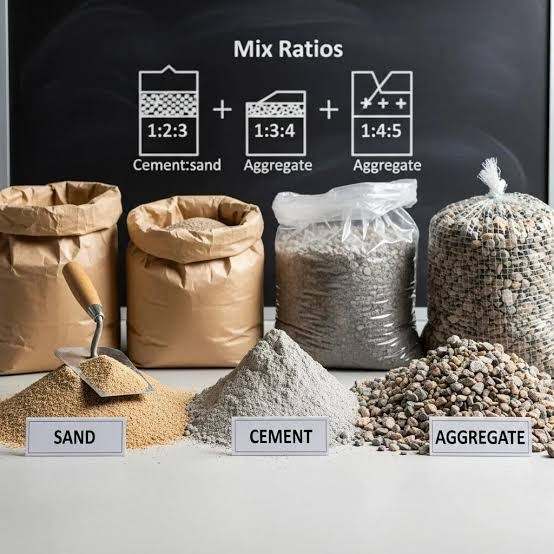
A concrete mix ratio describes the relative quantities of cement, fine aggregate (sand) and coarse aggregate (crushed stone or gravel) used to produce concrete.
The conventional notation is:
Cement : Sand : Coarse Aggregate
For example, a concrete mix ratio of 1:2:4 means:
- 1 part cement.
- 2 parts sand.
- 4 parts coarse aggregate.
If the same measuring method is used for all three materials, the proportions are based on equal units of measurement, commonly volume for traditional nominal site mixes.
A ratio of 1:2:4 does not mean one bag of cement, two bags of sand and four bags of aggregate. It means that the measured quantity of sand is twice the cement quantity and the measured quantity of coarse aggregate is four times the cement quantity.
The actual concrete mix must also account for water, aggregate moisture, grading, cement characteristics and the required performance.
2. Main Materials Used in Concrete Production
Before selecting a concrete mix ratio, it is important to understand the functions of the materials used.
Cement
Cement is the binding material in concrete. When mixed with water, it undergoes hydration and forms a hardened paste that binds sand and coarse aggregates together.
Common cement types available in Uganda include general-purpose Portland cement and blended cement products. The appropriate cement should be selected according to the project requirements and the manufacturer’s specifications.
Cement contributes to:
- Binding aggregate particles together.
- Developing concrete strength.
- Providing cohesion in fresh concrete.
- Supporting the durability of properly designed concrete.
The amount and type of cement used should be determined by the mix design rather than simply increasing cement to compensate for poor aggregates or uncontrolled water.
Sand (Fine Aggregate)
Sand is the fine aggregate in concrete. It fills spaces between larger coarse aggregate particles and contributes to the workability, packing and consistency of the mixture.
Common sources include:
- River sand.
- Pit sand.
- Manufactured sand.
- Suitable crushed stone sand.
Quality sand should have appropriate grading and acceptable levels of clay, silt, organic impurities and other harmful materials.
Coarse Aggregate
Coarse aggregate consists of larger particles, commonly obtained from crushed stone or suitable natural gravel.
It forms much of the concrete’s solid granular structure and contributes to strength, stiffness and dimensional stability.
Common commercial aggregate sizes include:
- 10 mm.
- 14 mm.
- 20 mm.
- Other specified graded sizes.
The correct aggregate size depends on the dimensions of the concrete element, reinforcement spacing, placement method and project specifications.
Water
Water is necessary for cement hydration and for achieving the required fresh concrete workability.
However, adding too much water can increase the water-cement ratio and reduce concrete strength and durability.
Use clean water suitable for concrete production and control the quantity according to the approved mix design.
3. Common Cement, Sand and Aggregate Ratios
Different concrete applications may require different mix proportions.
The following table provides examples of traditional nominal volume ratios used to explain common site concrete mixtures. They are not universal engineering specifications or guarantees of concrete strength.
| Concrete mix ratio | Cement | Sand | Coarse aggregate | Typical context |
|---|---|---|---|---|
| 1:1.5:3 | 1 part | 1.5 parts | 3 parts | Traditional richer nominal concrete mix |
| 1:2:4 | 1 part | 2 parts | 4 parts | General-purpose nominal concrete mix |
| 1:3:6 | 1 part | 3 parts | 6 parts | Selected lean or non-structural concrete applications |
| 1:4:8 | 1 part | 4 parts | 8 parts | Selected blinding and mass-filling applications |
Important: These ratios are traditional nominal proportions, not automatic substitutes for an engineered concrete mix. A 1:2:4 mixture does not automatically achieve a particular concrete grade. For reinforced concrete, structural members and other critical works, use a mix design approved by the responsible engineer and follow the specified strength and durability requirements.
4. Cement, Sand and Aggregate Ratios for Different Concrete Applications
The correct concrete mixture depends on the function of the structure, expected loading, environmental exposure and construction method.
4.1 Concrete for Foundation Blinding
Foundation blinding is a thin layer of lean concrete placed on prepared ground to provide a clean, level working surface beneath foundations.
It helps prevent direct contact between foundation concrete and soil and provides a suitable surface for setting out reinforcement and formwork.
A traditional lean concrete proportion such as 1:3:6 or 1:4:8 may be used in some non-structural blinding applications, where permitted by the project specification.
Important considerations:
- Prepare and compact the ground as specified.
- Remove loose soil and unsuitable material.
- Use clean sand and suitable coarse aggregate.
- Maintain the specified blinding thickness.
- Do not treat blinding concrete as a substitute for structural foundation concrete.
4.2 Concrete for Strip Foundations
Strip foundations distribute building loads along continuous foundation walls.
They are commonly used in suitable ground conditions for residential and other low-rise construction.
The concrete strength and mix design should be determined by the structural design, soil conditions and expected building loads.
A traditional nominal mix such as 1:2:4 may appear in general construction discussions, but it should not be adopted automatically for a structural strip foundation.
Important considerations:
- Follow the structural foundation drawings.
- Confirm the specified concrete strength.
- Use aggregates that meet the concrete specification.
- Ensure correct excavation and ground preparation.
- Compact concrete properly.
- Cure the concrete adequately.
4.3 Concrete for Pad Foundations
Pad foundations support concentrated loads from columns or other structural elements.
They are commonly used in buildings where the design requires isolated foundation bases.
Because pad foundations transfer structural loads into the ground, the concrete must meet the specified strength and durability requirements.
The mix should be determined through an approved design rather than selected solely from a traditional ratio table.
Important considerations:
- Follow the engineer’s reinforcement and foundation details.
- Use the specified aggregate size.
- Maintain the required concrete cover.
- Avoid adding uncontrolled water.
- Ensure proper placement and compaction.
4.4 Concrete for Columns
Columns are vertical structural elements that transfer building loads to the foundations.
They require concrete with suitable strength, workability and durability to surround reinforcement and fill the formwork properly.
A traditional richer nominal mix such as 1:1.5:3 is sometimes discussed for stronger concrete, but it should not be assumed to produce a specified structural grade.
Important considerations:
- Follow the approved concrete mix design.
- Select aggregate size according to reinforcement spacing and column dimensions.
- Ensure the mix can flow around reinforcement.
- Avoid segregation during placement.
- Compact concrete using an appropriate method.
- Maintain proper curing.
4.5 Concrete for Beams
Beams transfer loads from slabs and other structural elements to columns, walls or supports.
They may contain closely spaced reinforcement, making workability and aggregate size particularly important.
Concrete for beams should be designed to meet the specified strength, durability and placement requirements.
Important considerations:
- Use the specified concrete grade.
- Confirm the maximum aggregate size is suitable for reinforcement spacing.
- Maintain consistent batching.
- Avoid excessive water.
- Compact carefully to prevent honeycombing.
- Follow the approved curing procedure.
4.6 Concrete for Floor Slabs
Concrete slabs are used in residential, commercial and industrial buildings.
Ground-bearing slabs and suspended slabs have different structural requirements, so they should not automatically use the same concrete mix.
Traditional nominal proportions such as 1:2:4 are often discussed for general concrete work, but the actual slab mix should follow the design and specification.
Important considerations:
- Confirm slab thickness and reinforcement details.
- Prepare and compact the supporting base where required.
- Use the specified concrete strength.
- Maintain suitable workability.
- Place and compact the concrete properly.
- Finish and cure the slab correctly.
4.7 Concrete for Staircases
Concrete staircases must withstand repeated use and transfer loads safely to their supporting structure.
The concrete should meet the specified structural requirements and be workable enough to fill the staircase formwork and surround reinforcement.
Important considerations:
- Use the approved structural mix.
- Select aggregate size appropriate for the staircase dimensions.
- Ensure proper formwork support.
- Prevent segregation during placement.
- Compact thoroughly.
- Protect the concrete during curing.
4.8 Concrete for Driveways and Parking Areas
Driveways and parking areas are exposed to vehicle loads, weather and surface wear.
Their concrete requirements depend on vehicle type, traffic frequency, ground conditions, slab design and drainage.
A nominal ratio alone is not sufficient to determine a durable driveway mix.
Important considerations:
- Prepare a stable, properly compacted sub-base.
- Use concrete designed for the expected traffic.
- Provide appropriate slab thickness and joint details.
- Ensure effective drainage.
- Finish the surface appropriately.
- Cure the concrete to limit premature drying.
4.9 Concrete for Walkways and Footpaths
Concrete walkways and footpaths are generally designed for pedestrian traffic, although some may need to accommodate occasional maintenance vehicles.
The mix should meet the specified strength and durability requirements for the intended use.
Proper ground preparation, slab thickness, joints and drainage are also essential.
4.10 Concrete for Roads and Heavy-Duty Industrial Floors
Roads and industrial floors may be exposed to substantial traffic loads, impact, abrasion and environmental conditions.
These applications require carefully designed concrete and strict quality control.
Do not select a road or industrial floor mix simply by choosing a richer nominal ratio. The mix design should consider:
- Required strength and durability.
- Traffic and loading conditions.
- Aggregate quality.
- Abrasion resistance.
- Workability and placement.
- Jointing and curing requirements.
5. Understanding Concrete Mix Ratios: 1:2:4, 1:1.5:3 and 1:3:6
These three traditional ratios are frequently mentioned in construction discussions. Understanding what they represent helps builders avoid confusing material proportions with guaranteed concrete strength.
The 1:2:4 Concrete Mix
This means:
- 1 part cement.
- 2 parts sand.
- 4 parts coarse aggregate.
It is a commonly discussed nominal concrete mixture for general construction work.
Its actual performance depends on the materials, moisture content, grading, water quantity, batching, compaction and curing.
The 1:1.5:3 Concrete Mix
This means:
- 1 part cement.
- 1.5 parts sand.
- 3 parts coarse aggregate.
It contains a greater cement proportion relative to the aggregate quantities than a 1:2:4 mixture.
However, using more cement does not automatically guarantee a particular strength. The water-cement ratio, aggregate properties and concrete production process remain important.
The 1:3:6 Concrete Mix
This means:
- 1 part cement.
- 3 parts sand.
- 6 parts coarse aggregate.
It is a traditional leaner nominal mixture sometimes discussed for selected non-structural applications.
Its use should be limited to applications where the project specification permits it. It should not be substituted for designed structural concrete.
6. How to Calculate Cement, Sand and Aggregate Quantities
Calculating material quantities helps contractors prepare budgets, organise deliveries and minimise wastage.
The following example demonstrates the calculation process for a nominal 1:2:4 mix.
Example: Materials Required for 1 Cubic Metre of Concrete
Assume the target is approximately 1 cubic metre of finished concrete.
For an illustrative calculation, use a dry-volume factor of 1.54:
[
1.00 \times 1.54 = 1.54 \text{ m}^3
]
The factor is an estimating allowance for the difference between loose dry ingredients and the final compacted concrete volume. Actual yield depends on material properties, grading, batching and the mix design.
The total ratio is:
[
1+2+4=7
]
The material quantities are then estimated as follows.
Cement:
[
\frac{1}{7}\times1.54=0.22\text{ m}^3
]
Sand:
[
\frac{2}{7}\times1.54=0.44\text{ m}^3
]
Coarse aggregate:
[
\frac{4}{7}\times1.54=0.88\text{ m}^3
]
For illustration, if the assumed bulk density of cement is approximately 1,440 kg/m³:
[
0.22\times1,440\approx317\text{ kg}
]
If using 50 kg cement bags, this is approximately:
[
317\div50\approx6.3\text{ bags}
]
<text>Illustrative estimated quantities for approximately 1 m³ of concrete using a 1:2:4 nominal volume ratio:</text>
| Material | Approximate quantity |
|---|---|
| Cement | 317 kg (about 6.3 bags of 50 kg) |
| Sand | 0.44 m³ |
| Coarse aggregate | 0.88 m³ |
These figures are for preliminary estimation only. They are not a mix design, and actual quantities may differ. Cement bulk density is variable, and a proper concrete mix design should be based on measured material properties and trial batches.
Calculating Quantities for Other Concrete Ratios
The same general estimating method can be applied to other nominal ratios.
For example, for a 1:1.5:3 mix:
- Add the ratio components: 1 + 1.5 + 3 = 5.5.
- Divide the dry-volume estimate into the relevant proportions.
- Calculate cement, sand and coarse aggregate quantities separately.
- Check the estimated yield and adjust according to the mix design.
For major construction work, use a quantity surveyor’s material schedule and the approved mix design rather than relying on approximate nominal-ratio calculations.
7. Why the Water-Cement Ratio Matters
Although cement, sand and coarse aggregate are the main dry ingredients in traditional concrete mix ratios, water is equally important.
The water-cement ratio is the mass of mixing water divided by the mass of cement.
For example, if a concrete mix contains 50 kg of cement and 25 kg of effective mixing water:
[
\text{Water-cement ratio}=\frac{25}{50}=0.50
]
The water-cement ratio strongly influences concrete strength, permeability and durability.
Effects of Excessive Water
Adding too much water may:
- Reduce compressive strength.
- Increase concrete permeability.
- Increase bleeding and segregation.
- Increase drying shrinkage.
- Make the hardened concrete more vulnerable to deterioration.
Effects of Insufficient Water
Too little water may:
- Make concrete difficult to mix and place.
- Reduce workability.
- Make proper compaction difficult.
- Increase the risk of honeycombing and voids.
The objective is to use the water content required by the mix design while achieving the necessary workability.
Do not add water casually to make concrete easier to pour. Where workability needs adjustment, the responsible concrete specialist should determine the appropriate correction, including the use of a suitable admixture where specified.
8. Factors That Affect the Correct Concrete Mix Ratio
There is no single cement, sand and aggregate ratio suitable for every construction project.
Several factors determine the correct concrete proportions.
1. Required Concrete Strength
Structural components may require different concrete strengths depending on the building design and loading conditions.
The engineer specifies the required strength, and the mix designer determines suitable proportions to achieve it.
2. Type of Construction
Foundations, columns, beams, slabs, roads and drainage structures may have different concrete requirements.
The mix should reflect the function and design of the element.
3. Aggregate Size
Larger and smaller aggregate sizes affect surface area, workability, particle packing and placement.
The maximum aggregate size must be suitable for the dimensions of the concrete member and reinforcement spacing.
4. Sand Grading
Fine aggregate grading affects the water demand, cohesion and workability of concrete.
Poorly graded or excessively fine sand may require adjustments to the mixture.
5. Coarse Aggregate Quality
The strength, shape, grading, absorption and cleanliness of coarse aggregate influence concrete performance.
6. Water Content
The quantity of water must be controlled to achieve the required workability without increasing the water-cement ratio beyond the specified limit.
7. Environmental Exposure
Concrete exposed to moisture, chemicals, aggressive soils or other environmental conditions may require specific durability provisions.
8. Placement and Compaction Method
Concrete that must pass through congested reinforcement or be pumped may require different workability characteristics from concrete placed in less restricted conditions.
9. Cement Type
Different cement products may have different characteristics and performance requirements. Follow the manufacturer’s information and the project specification.
9. Common Mistakes When Mixing Cement, Sand and Aggregates
Incorrect concrete mixing practices can compromise the quality of a construction project even when good materials are available.
Avoid these common mistakes.
Using the Wrong Mix Ratio
Using one nominal ratio for every construction activity ignores differences in structural and durability requirements.
Follow the approved mix design and project specifications.
Adding Too Much Water
Excessive water may make concrete easier to handle temporarily but can weaken the hardened concrete and increase permeability.
Measure and control water carefully.
Using Dirty Sand
Sand containing excessive clay, silt, organic material or soil may affect concrete performance.
Inspect sand and arrange appropriate testing where necessary.
Using Poor-Quality Coarse Aggregates
Weak, weathered or contaminated stone may affect concrete strength and durability.
Use aggregate that meets the specified quality requirements.
Measuring Materials Inconsistently
Using different container sizes or estimating quantities by eye can result in inconsistent concrete batches.
Use calibrated measuring equipment and consistent batching procedures.
Failing to Mix Materials Properly
Incomplete mixing can produce inconsistent concrete with uneven distribution of cement paste and aggregates.
Follow the appropriate mixing procedure and ensure uniformity.
Poor Compaction
Insufficient compaction can leave air voids and honeycombing, especially around reinforcement and inside formwork.
Use suitable compaction equipment and methods.
Neglecting Curing
Fresh concrete needs appropriate protection and curing to support cement hydration.
Inadequate curing can increase cracking risk and reduce strength development.
10. Best Practices for Producing Quality Concrete
Achieving durable concrete requires proper material selection, accurate batching and good construction workmanship.
Follow these practices:
- Use cement that meets the project requirements.
- Select clean, properly graded sand.
- Use durable coarse aggregates of the specified size.
- Follow the approved concrete mix design.
- Measure materials consistently.
- Correct aggregate moisture content during batching.
- Control the water-cement ratio.
- Mix until the concrete is uniform.
- Place concrete without unnecessary delays.
- Compact adequately without causing segregation.
- Finish the surface using the specified method.
- Cure and protect the concrete appropriately.
- Conduct quality-control testing where required.
For structural construction, maintain records of batching, material sources, concrete testing and placement activities.
11. How to Test Concrete Quality
Concrete quality should be checked at different stages of production and construction.
Common tests include:
Slump Test
The slump test measures the consistency and workability of fresh concrete.
It helps determine whether the concrete has the specified workability for the intended placement method.
A slump result does not directly establish concrete strength.
Cube or Cylinder Compressive Strength Test
Concrete specimens are prepared and cured under controlled conditions before being tested in a compression-testing machine.
The results help determine whether the concrete meets the specified strength requirements at the designated testing age.
Aggregate Sieve Analysis
Sieve analysis checks the particle-size distribution of fine and coarse aggregates.
It helps establish whether the materials meet the specified grading requirements.
Water Absorption and Other Aggregate Tests
Additional aggregate tests may be required to assess density, absorption, abrasion resistance, particle shape and durability.
The testing programme should be established according to the project specification and the responsible engineer’s requirements.
12. Cement, Sand and Aggregate Ratios for Residential, Commercial and Industrial Projects
Different building projects have different concrete requirements.
Residential Buildings
Residential projects commonly use concrete for:
- Strip and pad foundations.
- Ground floor slabs.
- Columns and beams.
- Staircases.
- External walkways.
- Drainage channels.
Each structural component should follow the approved design and concrete specifications.
Commercial Buildings
Commercial developments may include offices, shopping complexes, hotels, schools and apartment buildings.
They may require concrete for:
- Reinforced concrete frames.
- Suspended slabs.
- Staircases.
- Parking areas.
- Retaining walls.
- Service areas.
The concrete requirements depend on structural design, occupancy, loading and exposure conditions.
Industrial Buildings
Factories, warehouses and workshops may require concrete for:
- Heavy-duty floor slabs.
- Equipment foundations.
- Loading bays.
- Industrial roads.
- Drainage systems.
- Structural frames.
Industrial concrete may need special attention to abrasion, impact, chemical exposure and heavy loading.
In all three categories, concrete proportions should be based on the design requirements rather than a generic ratio table.
13. Factors Affecting Cement, Sand and Aggregate Costs in Uganda
The cost of concrete production in Uganda depends on the prices and availability of the individual materials, transportation and construction arrangements.
Important cost factors include:
Cement prices: Cement brand, type, supplier, location and market conditions influence the purchase price.
Sand prices: Sand source, grading, cleanliness, washing and delivery distance affect its cost.
Aggregate prices: Crushed stone size, quarry location, processing and transportation influence the final price.
Transportation: The distance between suppliers and the construction site can significantly affect total material costs.
Quantity required: Larger projects may require planned bulk deliveries and coordinated procurement.
Wastage: Poor storage, inconsistent measurement and unnecessary material losses can increase construction costs.
Quality requirements: Testing, screening, washing and other quality-control processes may add to procurement costs.
When preparing a construction budget, compare the total delivered cost of materials that meet the same specifications. Choosing the cheapest materials without checking their quality may result in greater costs through repairs and rework.
14. How Daltrevco Can Support Your Construction Project
Producing quality concrete begins with proper planning, suitable building materials and careful construction management.
Whether you are constructing a residential house, commercial development, apartment block, warehouse or industrial facility, material selection and quality control are essential to achieving durable results.
Daltrevco provides construction-related solutions for property owners, developers and organisations in Uganda. Understanding the requirements of cement, sand, aggregates and other building materials helps support better construction planning and project execution.
Before starting your next construction project, ensure that the concrete requirements are properly established and that the materials selected meet the relevant specifications.
Visit Daltrevco to explore construction solutions and discuss your project requirements.
Frequently Asked Questions About Cement, Sand and Aggregate Ratios
1. What is the common cement, sand and aggregate ratio for concrete?
A commonly discussed traditional nominal mix is 1:2:4, meaning one part cement, two parts sand and four parts coarse aggregate. However, the correct mixture depends on the required concrete strength, materials and project specification.
2. What does a 1:2:4 concrete mix ratio mean?
It means one measured part cement, two measured parts sand and four measured parts coarse aggregate. The same measurement method should be used for all three materials.
3. What is the difference between a 1:2:4 and a 1:1.5:3 concrete mix?
A 1:1.5:3 mix contains a greater cement proportion relative to its aggregate quantities than a 1:2:4 mix. However, neither ratio guarantees a particular concrete strength without appropriate mix design and quality control.
4. What is the ratio for foundation concrete?
The correct foundation concrete mix depends on the foundation type, ground conditions, building loads and structural design. Follow the engineer’s specified concrete grade and approved mix design rather than selecting a ratio based on general advice.
5. What is the ratio for concrete columns and beams?
Columns and beams require concrete that meets the structural design requirements. Their proportions should be determined by an approved mix design, considering strength, reinforcement spacing, aggregate size and workability.
6. What is the ratio for concrete floor slabs?
The appropriate slab mix depends on whether the slab is ground-bearing or suspended, the design loading, reinforcement and exposure conditions. Follow the approved concrete specification.
7. How many bags of cement are needed for one cubic metre of concrete?
The quantity depends on the mix design, cement content, aggregate properties and required concrete performance. An illustrative 1:2:4 nominal volume calculation using a dry-volume factor of 1.54 and an assumed cement bulk density of 1,440 kg/m³ gives approximately 317 kg, or 6.3 bags of 50 kg cement. This is an estimate, not a universal material requirement.
8. Can I use river sand for concrete?
Yes, provided the river sand meets the required grading and quality specifications. It should be checked for excessive silt, clay, organic matter and other harmful impurities.
9. Can crushed stone dust replace sand in concrete?
Suitable manufactured fine aggregate may replace some or all natural sand when it meets the relevant grading and quality requirements and the mix is properly designed. Ordinary stone dust should not be substituted without testing.
10. Why should too much water not be added to concrete?
Excessive water increases the water-cement ratio, which can reduce concrete strength, increase permeability and contribute to shrinkage and durability problems.
11. What is the importance of curing concrete?
Curing helps maintain suitable moisture and temperature conditions for cement hydration and strength development. Proper curing supports durability and reduces the risk of premature drying and cracking.
12. Does a richer concrete mix always produce stronger concrete?
No. Increasing cement content alone does not guarantee better concrete. Water-cement ratio, aggregate quality, grading, compaction, curing and mix design all influence the final performance.
13. What is the difference between concrete and mortar mix ratios?
Concrete contains cement, sand, coarse aggregate and water. Mortar generally contains cement, sand and water without the coarse aggregate used in normal concrete. Their mix proportions and applications are therefore different.
14. How do I know whether my concrete mix is strong enough?
The concrete must meet the specified design strength. Appropriate quality-control measures include checking materials, controlling batching and water content, carrying out fresh concrete tests where required, and testing cured concrete specimens for compressive strength.
Conclusion
Cement, sand and aggregate ratios play an important role in determining the quality and performance of concrete used in construction.
Cement binds the materials together, fine aggregate fills spaces between larger particles, and coarse aggregate provides the main granular structure. The correct proportions help produce concrete with suitable workability, strength, durability and economy.
Although traditional ratios such as 1:2:4, 1:1.5:3 and 1:3:6 are useful for understanding common site mixing practices, they should not be treated as guaranteed concrete grades. Structural concrete for foundations, columns, beams, slabs and other load-bearing elements should always follow an approved mix design and project specification.
For construction projects in Uganda, selecting quality cement, clean sand and durable aggregates, controlling water, batching accurately, compacting properly and curing adequately are essential steps towards achieving reliable concrete.
Planning a construction project in Uganda? Contact Daltrevco through https://www.daltrevco.com/ to explore construction solutions and discuss your building requirements.