The water-cement ratio is one of the most important factors influencing the strength, durability and performance of concrete. Whether you are constructing a residential house, commercial building, warehouse, foundation, concrete floor or road pavement, using the correct amount of water during concrete mixing is essential for achieving reliable construction results.
In Uganda, concrete is widely used in building and infrastructure projects. However, one common construction mistake is adding too much water to concrete to make it easier to mix, transport and place. Although additional water can improve workability temporarily, it can also reduce concrete strength, increase porosity, cause shrinkage and affect long-term durability.
Understanding the water-cement ratio helps property owners, contractors, engineers and construction professionals make better decisions about concrete production and quality control.
This guide explains what the water-cement ratio means, how to calculate it, why it matters, how it affects concrete strength, and how to maintain the correct ratio during construction.
1. What Is the Water-Cement Ratio in Concrete?
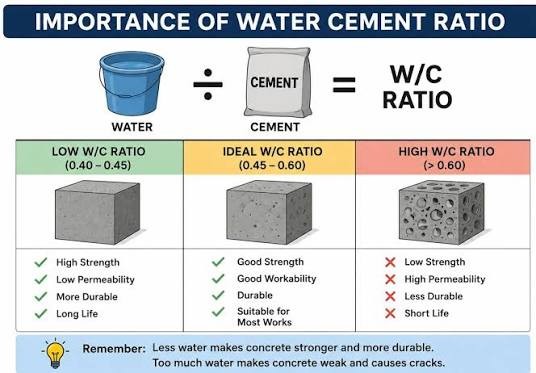
The water-cement ratio is the proportion of water to cement used in a concrete mixture. It is calculated by dividing the mass of water by the mass of cement.
Water-Cement Ratio = Mass of Water ÷ Mass of Cement
The ratio is normally expressed as a decimal rather than a percentage.
For example, if a concrete mixture contains:
- Cement: 50 kg
- Water: 25 kg
The calculation is:
25 ÷ 50 = 0.50
Therefore, the water-cement ratio is 0.50.
This means that the mixture contains 0.50 kg of water for every kilogram of cement.
The ratio is important because water is required for cement hydration, the chemical reaction that allows cement to develop strength. However, water added beyond what is needed for hydration and practical workability can leave additional pores in hardened concrete as it evaporates or moves through the concrete.
The objective is not simply to use as little water as possible. It is to use a properly designed amount of water that provides the required workability while meeting the specified strength and durability requirements.
2. Why Is the Water-Cement Ratio Important?
The water-cement ratio directly influences several properties of fresh and hardened concrete.
A. It Determines Concrete Strength
One of the most significant effects of the water-cement ratio is its influence on compressive strength.
When excess water is added to concrete, the additional water can create capillary pores in the hardened material. These pores reduce the density of the cement paste and can weaken the concrete.
A properly controlled water-cement ratio helps produce concrete that can achieve the strength specified in the structural design.
B. It Influences Concrete Durability
Concrete must withstand environmental exposure, moisture, temperature changes and other conditions throughout its service life.
A high water-cement ratio can increase the permeability of concrete, making it easier for water and harmful substances to penetrate. This may increase the risk of reinforcement corrosion and other forms of deterioration.
C. It Affects Workability
Workability describes how easily fresh concrete can be mixed, transported, placed, compacted and finished without segregation or excessive bleeding.
Adding water generally increases workability, but uncontrolled water addition can compromise strength and durability.
The correct approach is to achieve the required workability through an appropriate mix design, aggregate selection, admixtures where suitable, and proper placing methods.
D. It Helps Control Shrinkage and Cracking
Excess water can increase drying shrinkage. As concrete loses moisture, it may contract, creating tensile stresses that can result in cracking if the concrete is not properly designed, placed, cured and restrained.
Maintaining the specified water-cement ratio helps control one important source of shrinkage-related problems.
E. It Supports Quality Control
Consistent water measurement makes concrete production more predictable.
For contractors and construction teams, controlling the water-cement ratio helps reduce variations between batches and supports reliable quality-control procedures.
3. How to Calculate the Water-Cement Ratio
Calculating the water-cement ratio is straightforward when the quantities of water and cement are known.
The formula is:
Water-Cement Ratio = Water Mass (kg) ÷ Cement Mass (kg)
Both quantities must be expressed in the same mass units.
Example 1: Calculating the Ratio for One Cement Bag
Assume a concrete batch uses:
- Cement: 50 kg
- Water: 25 litres
For ordinary construction calculations, one litre of water has a mass of approximately one kilogram.
Therefore:
25 ÷ 50 = 0.50
The water-cement ratio is 0.50.
Example 2: Calculating a Higher Water-Cement Ratio
Assume a mixture contains:
- Cement: 50 kg
- Water: 30 litres
Calculation:
30 ÷ 50 = 0.60
The water-cement ratio is 0.60.
This mixture has a higher water-cement ratio than the previous example. If all other factors remain comparable, the higher ratio may result in lower concrete strength and greater permeability.
Example 3: Calculating the Water Required for a Specified Ratio
Suppose a concrete mix contains 100 kg of cement and the specified water-cement ratio is 0.45.
The formula is:
Water = Water-Cement Ratio × Cement Mass
Water = 0.45 × 100
Water = 45 kg
This is approximately 45 litres of water.
The actual quantity of water added at the mixer must also account for moisture already present in the aggregates and water absorbed by dry aggregates, as applicable.
4. What Is the Recommended Water-Cement Ratio for Concrete?
There is no single water-cement ratio that is suitable for every concrete application. The appropriate ratio depends on the required strength, exposure conditions, cement characteristics, aggregate properties, admixtures and construction specifications.
The following figures are illustrative examples of water-cement ratios that may be considered during preliminary discussions. They are not universal specifications or guaranteed strength classifications.
| Water-cement ratio | General interpretation |
|---|---|
| 0.35–0.40 | Relatively low ratio; requires careful mix design and workability control |
| 0.40–0.45 | May be appropriate for certain higher-performance mixes |
| 0.45–0.50 | Common range in some properly designed concrete mixes |
| 0.50–0.55 | May be suitable for some applications, subject to strength and exposure requirements |
| Above 0.55 | Requires particular attention because increased water content can compromise strength and durability |
These ranges should not be used to select a structural concrete mix without engineering assessment.
For structural elements such as foundations, columns, beams and suspended slabs, the water-cement ratio must comply with the approved concrete mix design and applicable project specifications.
5. Effects of a High Water-Cement Ratio on Concrete Strength
Using more water than required can negatively affect the performance of hardened concrete.
A. Reduced Compressive Strength
Excess water can increase the capillary pore structure in the cement paste. This reduces the effective density of the hardened material and can lower its compressive strength.
For example, two otherwise comparable concrete mixtures may develop different strengths because one contains more mixing water.
The actual difference depends on the cement, aggregates, curing conditions, compaction and other mix characteristics.
B. Increased Concrete Porosity
When excess mixing water leaves the concrete, it can create additional pore spaces.
Higher porosity can reduce resistance to water penetration and make concrete more vulnerable to certain environmental conditions.
C. Increased Permeability
Permeability refers to how easily liquids or gases move through concrete.
A high water-cement ratio can increase permeability, allowing moisture and aggressive substances to penetrate more easily.
This is particularly important for structures exposed to persistent moisture or aggressive environmental conditions.
D. Greater Risk of Reinforcement Corrosion
Reinforced concrete contains steel bars that provide tensile resistance.
If water, oxygen and harmful substances penetrate the concrete, reinforcement may become vulnerable to corrosion under suitable conditions.
Corrosion can cause steel expansion, cracking, delamination and loss of structural performance.
A suitable water-cement ratio, adequate concrete cover, proper compaction and good curing all contribute to reinforcement protection.
E. Increased Bleeding and Segregation
Excessive water can encourage bleeding, where water rises towards the concrete surface.
It can also contribute to segregation, where coarse aggregates separate from the cement paste and mortar.
These problems may result in weak surface layers, poor finish quality and inconsistent concrete strength.
6. What Happens When the Water-Cement Ratio Is Too Low?
Although excess water is harmful, using too little water can also create problems.
A very low water-cement ratio without suitable mix design and admixture control can make concrete difficult to mix, place and compact.
Possible problems include:
- Poor workability.
- Difficulty filling formwork.
- Inadequate compaction.
- Air pockets and honeycombing.
- Incomplete consolidation around reinforcement.
- Poor surface finish.
- Inconsistent concrete quality.
A low water-cement ratio does not automatically guarantee high-quality concrete.
Concrete must have enough workability to be properly placed and compacted. If a low-water mixture cannot be consolidated effectively, its actual strength and durability may be compromised.
For this reason, engineers and concrete technologists balance strength, durability and workability when developing concrete mix designs.
7. Factors That Influence the Water-Cement Ratio
Several factors determine the amount of water required in a concrete mixture.
A. Required Concrete Strength
Concrete used for structural elements may have different strength requirements from concrete used for non-structural applications.
The specified strength and other performance requirements influence the selection of the water-cement ratio during mix design.
B. Aggregate Size and Shape
The size, shape and surface texture of aggregates affect the water demand of concrete.
Angular and rough-textured aggregates may require different water quantities from rounded aggregates to achieve comparable workability.
C. Aggregate Moisture Content
Sand and coarse aggregates can contain moisture before mixing.
If this moisture is ignored, additional water may be added unnecessarily, increasing the actual water-cement ratio.
For accurate batching, aggregate moisture conditions should be assessed and the mixing water adjusted accordingly.
D. Cement Characteristics
Different cement types and properties can influence water demand, setting behaviour and concrete performance.
The cement selected should comply with the project’s material specifications and applicable requirements.
E. Chemical Admixtures
Water-reducing admixtures and superplasticisers can improve workability without requiring an equivalent increase in mixing water.
Their use must follow the manufacturer’s instructions and the approved mix design.
F. Weather Conditions
High temperatures, wind and low humidity can increase moisture loss from fresh concrete.
These conditions require appropriate planning, transportation, placement and curing measures. Adding uncontrolled water to compensate for evaporation is not a reliable solution.
8. How to Maintain the Correct Water-Cement Ratio During Concrete Mixing
Maintaining the specified water-cement ratio requires careful batching and consistent site practices.
1. Follow the Approved Mix Design
Before mixing concrete, confirm the required mix design and project specifications.
Do not rely on an assumed ratio for structural concrete.
2. Measure Water Accurately
Use calibrated measuring containers, water meters or suitable batching equipment.
Avoid estimating water quantities by eye or adding water randomly during mixing.
3. Check Aggregate Moisture
Sand and aggregates may contain surface moisture, particularly during rainy periods.
Measure or assess aggregate moisture and adjust the mixing water according to the mix design and batching procedure.
4. Avoid Adding Extra Water to Improve Workability
If concrete is too stiff, first investigate the cause.
Possible solutions include checking aggregate grading, reviewing the batching process and using an approved water-reducing admixture where appropriate.
Any adjustment must remain within the approved mix design.
5. Mix Concrete Properly
Use suitable mixing equipment and follow the specified mixing procedure to achieve uniform distribution of cement, water and aggregates.
6. Monitor Each Concrete Batch
Maintain consistent measurements for every batch.
For larger projects, record the quantities of cement, water, fine aggregates, coarse aggregates and admixtures used.
7. Ensure Proper Compaction and Curing
Correct batching alone does not guarantee good concrete.
Concrete must be properly placed, compacted and cured to support hydration and achieve the required performance.
9. Water-Cement Ratio and Concrete Curing
Curing is the process of maintaining suitable moisture and temperature conditions in concrete after placement so that cement hydration can continue.
Even concrete with a properly controlled water-cement ratio can perform poorly if it is not adequately cured.
Good curing helps:
- Support cement hydration.
- Improve strength development.
- Reduce premature moisture loss.
- Limit plastic and drying shrinkage-related cracking.
- Improve surface quality.
- Enhance durability.
Common curing methods include:
- Keeping concrete surfaces continuously moist.
- Covering concrete with wet hessian or other suitable materials.
- Using approved curing compounds.
- Applying suitable water-retaining coverings.
The curing method and duration should follow the concrete specification, environmental conditions and applicable standards.
In Uganda, hot weather, direct sunlight and wind can cause rapid moisture loss from exposed concrete. Construction teams should plan curing measures before concrete placement begins.
10. How Water-Cement Ratio Affects Different Building Applications
The importance of water-cement ratio applies to almost every concrete application, although the design requirements vary.
A. Foundations
Foundations transfer building loads to the supporting ground.
Concrete used in foundations must satisfy the specified strength and durability requirements. Excess water can reduce strength and increase permeability.
B. Columns and Beams
Columns and beams are structural components that carry and transfer building loads.
Their concrete must meet the approved structural design requirements. Proper workability is particularly important because reinforcement congestion and formwork geometry can make compaction difficult.
C. Concrete Floor Slabs
Floor slabs require suitable workability, finishing characteristics and durability.
Excess water can increase bleeding, shrinkage and surface defects.
D. Roads and Pavements
Concrete pavements are exposed to traffic loads and environmental conditions.
The water-cement ratio must be controlled as part of the overall mix design to achieve the required strength and durability.
E. Industrial Floors
Industrial floors may be exposed to heavy loads, abrasion and repeated operations.
Concrete quality depends on the specified mix, aggregate selection, finishing, joint design, curing and construction practices, not water-cement ratio alone.
11. Common Water-Cement Ratio Mistakes in Construction
Incorrect water management is a common source of concrete quality problems.
Avoid these mistakes:
Adding water without measuring it: Uncontrolled water addition changes the water-cement ratio and makes concrete quality inconsistent.
Ignoring moisture in sand: Wet sand contributes water to the mixture. Failing to account for it can increase the actual water content.
Using workability as the only quality indicator: Concrete that is easy to pour is not necessarily strong or durable.
Assuming less water always means stronger concrete: If concrete cannot be compacted properly, its performance may be reduced.
Adding water to concrete that has started setting: This can interfere with the intended concrete properties and should not be used as a method of restoring workability.
Neglecting curing: Poor curing can prevent concrete from developing its intended properties, even when the initial mix was properly proportioned.
Using the same ratio for every application: Different concrete elements and exposure conditions require different specifications.
12. How to Test and Monitor Concrete Quality
Water-cement ratio control should form part of a wider concrete quality-control programme.
Several tests and inspection procedures can help assess concrete performance.
Slump Test
The slump test assesses the consistency and workability of fresh concrete.
It helps identify variations between batches, but it does not directly measure compressive strength or establish the water-cement ratio.
Concrete Cube Test
Concrete cube testing is commonly used to assess compressive strength.
Samples are prepared and cured under controlled conditions before being tested at specified ages, often including 7 and 28 days, depending on the project requirements.
Aggregate Moisture Testing
Checking aggregate moisture helps determine how much water is already present in the materials before mixing.
This supports accurate water adjustment during batching.
Batching Records
Maintaining records of cement, water, aggregates and admixtures helps identify variations in concrete production and supports quality assurance.
Site Inspection
Inspect formwork, reinforcement, placing procedures, compaction and curing arrangements before and during concrete works.
A complete quality-control programme should follow the project specifications and relevant testing standards.
13. Water-Cement Ratio and Concrete Construction in Uganda
Concrete construction in Uganda must account for local material characteristics, weather conditions, transportation and site practices.
Cement, sand and crushed stone aggregates may come from different suppliers and sources. Their properties can vary, making proper material selection and quality checks important.
Construction teams should pay particular attention to:
- The grading and cleanliness of sand.
- The size, grading and quality of coarse aggregates.
- Moisture content in aggregates.
- Consistency of cement supply.
- Accurate water measurement.
- Concrete transportation and placing time.
- Site temperatures and weather conditions.
- Proper compaction and curing.
During rainy periods, sand and aggregates may contain additional moisture. This can affect the amount of water that should be added during batching.
For building projects in Kampala, Wakiso, Mukono, Entebbe and other parts of Uganda, contractors should ensure that concrete mix designs are suitable for the project’s structural and environmental requirements.
Choosing quality materials and maintaining good construction practices are essential for producing concrete that meets the required specifications.
14. Why Professional Concrete Planning and Quality Control Matter
The water-cement ratio is only one part of successful concrete production. Achieving reliable results also requires appropriate mix design, material testing, accurate batching, proper placement and effective curing.
Professional construction planning can help property owners and developers:
- Identify the appropriate concrete specifications.
- Estimate concrete quantities.
- Select suitable construction materials.
- Plan concrete production and delivery.
- Coordinate reinforcement and formwork activities.
- Monitor concrete placement and compaction.
- Maintain quality-control records.
- Reduce avoidable material wastage and construction defects.
Daltrevco supports construction-related solutions for residential, commercial and industrial building projects in Uganda.
Whether you are planning a new building or managing an ongoing development, proper material selection and construction quality control can help protect your investment.
Frequently Asked Questions About Water-Cement Ratio in Concrete
1. What is the water-cement ratio in concrete?
The water-cement ratio is the mass of mixing water divided by the mass of cement in a concrete mixture. It influences concrete strength, workability, permeability and durability.
2. What is the formula for calculating water-cement ratio?
The formula is:
Water-Cement Ratio = Mass of Water ÷ Mass of Cement
For example, 25 kg of water divided by 50 kg of cement gives a ratio of 0.50.
3. What is a good water-cement ratio for concrete?
There is no single ratio suitable for all concrete applications. The correct value depends on the specified strength, exposure conditions, materials, workability requirements and approved mix design.
4. Does adding more water make concrete stronger?
No. Adding excessive water generally increases porosity and can reduce compressive strength and durability, even though it may make fresh concrete easier to work with.
5. What happens if the water-cement ratio is too high?
A high water-cement ratio can lead to reduced compressive strength, increased permeability, greater shrinkage, bleeding, segregation and reduced durability.
6. What happens if the water-cement ratio is too low?
An excessively low ratio can make concrete difficult to mix, place and compact. Poor compaction may cause honeycombing, air pockets and reduced actual performance.
7. How much water is required for a 50 kg bag of cement?
The amount depends on the approved mix design and the moisture conditions of the aggregates. For illustration, a water-cement ratio of 0.50 corresponds to 25 kg, or approximately 25 litres, of water for 50 kg of cement. This is an example, not a universal mixing instruction.
8. Does water-cement ratio affect concrete durability?
Yes. A higher ratio can increase capillary porosity and permeability, making concrete more vulnerable to moisture penetration and certain forms of deterioration.
9. Does the water-cement ratio affect concrete curing?
The water-cement ratio influences the initial concrete mixture, while curing maintains suitable moisture and temperature conditions after placement. Both are important for strength development and durability.
10. Can I add water to concrete after mixing?
Additional water should not be added without checking the approved mix design and the concrete’s condition. Uncontrolled addition can increase the water-cement ratio and compromise the specified properties. Approved admixtures may be used where appropriate.
11. What is the difference between water-cement ratio and concrete mix ratio?
The water-cement ratio compares the mass of water with the mass of cement. A concrete mix ratio describes the proportions of cement, sand and coarse aggregate. They are related but measure different aspects of the concrete mixture.
12. How can contractors control the water-cement ratio on site?
Contractors can control it by measuring water accurately, checking aggregate moisture, following the approved mix design, using appropriate batching equipment and maintaining production records.
Conclusion: Why Water-Cement Ratio Matters in Concrete Construction
The water-cement ratio plays a major role in determining the strength, workability, permeability and durability of concrete. Using too much water can weaken the hardened concrete and increase the risk of cracking and deterioration. Using too little water without proper mix design can make concrete difficult to place and compact.
For successful construction, the objective should be to maintain the water-cement ratio specified in the approved mix design while ensuring proper batching, mixing, placement, compaction and curing.
For foundations, columns, beams, slabs, roads and other concrete structures, following professional engineering specifications is essential.
Planning a construction project in Uganda? Contact Daltrevco for professional construction support and solutions that help you make informed decisions about materials, project planning and building quality.