Every successful construction project depends on proper planning and effective time management. Whether you are building a residential house, apartment complex, commercial office, warehouse, factory or infrastructure facility, understanding how long each construction activity will take is essential for achieving an organised project.
Construction projects involve numerous activities that must be completed in the correct sequence. Site preparation, excavation, foundation construction, structural works, roofing, electrical installations, plumbing, finishing and external works all require time, labour, materials and equipment. If these activities are not properly scheduled, projects can experience unnecessary delays, increased costs, resource shortages and poor coordination.
This is why construction project scheduling is an essential part of construction project management.
A construction schedule provides a timeline showing when project activities should start, how long they are expected to take, which activities depend on others and when important milestones should be achieved. It helps property owners, developers, project managers, consultants and contractors coordinate construction work and monitor progress.
In Uganda, effective construction scheduling is particularly important because building projects may be affected by weather conditions, material availability, supplier lead times, site accessibility, contractor performance and approval processes. Developments in Kampala, Wakiso, Entebbe, Mukono and other growing areas require realistic schedules that reflect the actual project conditions.
This guide explains how construction project scheduling works, how to prepare a realistic building timeline, the factors that influence construction duration and the best practices for managing delays and keeping projects on track.
1. What Is Construction Project Scheduling?
Construction project scheduling is the process of organising construction activities into a logical sequence and assigning estimated start dates, durations and completion dates to each activity.
It provides a structured timeline that guides the implementation of a construction project from initial preparation to final handover.
A construction schedule helps the project team understand:
- What activities must be completed.
- When each activity should begin.
- How long each activity is expected to take.
- Which activities must be completed before others begin.
- Which activities can happen at the same time.
- What labour, materials and equipment are required.
- When contractors and subcontractors are needed.
- When important project milestones should be achieved.
- How actual progress compares with planned progress.
For example, a typical building project may require site preparation before foundation construction, structural works before certain roofing activities, and appropriate installation stages before final finishing.
However, some activities can overlap where technically and operationally appropriate. The project schedule should reflect the actual construction method, approved design information and available resources.
2. Why Is Construction Project Scheduling Important?
A well-prepared construction schedule helps the project team manage time, resources, costs and responsibilities more effectively.
2.1 Helps Establish Realistic Completion Dates
A construction schedule provides an organised estimate of how long the project is expected to take.
It allows property owners and developers to plan financing, procurement, occupancy and other activities around the anticipated completion period.
2.2 Improves Contractor Coordination
Different contractors may work on structural construction, roofing, electrical installations, plumbing, mechanical systems and finishing.
Scheduling helps coordinate their activities so that work is carried out in the correct sequence and unnecessary clashes are reduced.
2.3 Supports Construction Cost Management
Delays can increase costs through additional labour, equipment hire, site overheads, storage and extended project management requirements.
A realistic schedule helps the project team plan expenditure and identify activities that may create financial pressure if delayed.
2.4 Improves Resource Allocation
Construction requires materials, labour, machinery and equipment at different stages.
Scheduling helps ensure that resources are available when needed without unnecessary idle time or premature purchasing.
2.5 Helps Identify Potential Delays Early
Comparing actual progress against the schedule makes it easier to identify activities that are falling behind.
The project team can then investigate the causes and coordinate corrective action.
2.6 Supports Better Project Communication
A construction schedule gives the client, project manager, consultants, contractors and suppliers a shared reference for discussing project progress and upcoming activities.
2.7 Improves Accountability
When activities have clear timelines and assigned responsibilities, it becomes easier to identify who is responsible for completing particular work packages and tracking outstanding tasks.
3. Key Elements of a Construction Project Schedule
A useful construction schedule contains several important elements.
3.1 Project Activities
These are the individual tasks required to complete the project.
Examples include:
- Site clearing.
- Setting out.
- Excavation.
- Foundation construction.
- Concrete works.
- Wall construction.
- Roofing.
- Electrical installations.
- Plumbing.
- Plastering.
- Flooring.
- Painting.
- External works.
- Testing and handover.
3.2 Activity Durations
Each activity is assigned an estimated duration based on its size, complexity, construction method, available resources and site conditions.
Duration estimates should be realistic rather than based on arbitrary deadlines.
3.3 Start and Finish Dates
The schedule identifies the planned start and completion dates for individual activities and the overall project.
3.4 Dependencies
Dependencies explain how one activity relates to another.
For example, foundation construction generally depends on excavation, appropriate setting out, required inspections and the availability of relevant technical information.
3.5 Milestones
Milestones are important events or achievements used to measure project progress.
Examples include:
- Design approval.
- Site possession.
- Foundation completion.
- Structural frame completion.
- Roof completion.
- Building services installation.
- Practical completion.
- Final handover.
3.6 Resources
The schedule should identify the labour, equipment, materials and contractors required for each activity.
3.7 Progress Monitoring
The schedule should provide a basis for comparing planned progress with actual performance and identifying activities that require attention.
4. How to Prepare a Construction Project Schedule
Preparing a realistic construction schedule requires more than assigning dates to building activities. It involves understanding the project scope, construction methods, resource requirements, dependencies and possible risks.
The following steps provide a practical approach.
Step 1: Define the Project Scope
Before preparing the schedule, establish exactly what the construction project involves.
The project scope defines the work that must be completed and provides the basis for identifying activities and estimating their durations.
Consider:
- Building type and intended use.
- Total building size.
- Number of floors.
- Structural system.
- Site conditions.
- Architectural requirements.
- Electrical and mechanical installations.
- Plumbing and drainage requirements.
- External works.
- Required completion standards.
For example, a single-storey residential house will generally have a different construction programme from a multi-storey office building or industrial warehouse.
A clearly defined scope reduces the risk of overlooking important activities when preparing the schedule.
Step 2: Review Drawings and Technical Information
Construction scheduling should be based on sufficiently developed design information.
Review the available:
- Architectural drawings.
- Structural drawings.
- Foundation details.
- Electrical layouts.
- Plumbing and drainage drawings.
- Mechanical services drawings.
- Technical specifications.
- Bills of quantities, where applicable.
- Site investigation reports.
- Construction method information.
The project team should identify incomplete information, design conflicts and outstanding decisions that could affect construction sequencing.
For example, the installation of mechanical and electrical systems may need to be coordinated with structural and architectural works before ceilings, walls or other finishes are completed.
The project manager coordinates this information, while technical design decisions remain the responsibility of the appropriately appointed professionals.
Step 3: Break the Project into Manageable Activities
A large construction project is easier to schedule when it is divided into smaller activities and work packages.
This process is often supported by a Work Breakdown Structure (WBS).
For a typical building project, the main work packages may include:
| Work package | Typical activities |
|---|---|
| Pre-construction | Feasibility, design coordination and approvals |
| Site preparation | Clearing, setting out and earthworks |
| Substructure | Excavation, foundations and ground beams |
| Superstructure | Columns, beams, slabs and walls |
| Roofing | Roof structure and covering |
| Building enclosure | Doors, windows and external finishes |
| Building services | Electrical, plumbing and mechanical installations |
| Internal finishing | Plastering, ceilings, flooring and painting |
| External works | Drainage, paving, access roads and landscaping |
| Completion | Testing, defects and handover |
Each work package can then be divided into more detailed tasks.
For example, foundation construction may include excavation, inspection, reinforcement installation, formwork, concrete placement, curing and backfilling, as appropriate to the design and construction method.
Step 4: Estimate the Duration of Each Activity
After identifying project activities, estimate how long each one is expected to take.
Activity durations depend on several factors, including:
- Quantity of work.
- Building dimensions.
- Construction method.
- Labour availability.
- Equipment capacity.
- Material availability.
- Weather conditions.
- Site access.
- Inspection requirements.
- Contractor productivity.
- Work sequencing.
For example, the duration of excavation for a large commercial development may differ significantly from that of a small residential building.
Avoid using generic construction durations without assessing the actual project requirements.
Where possible, obtain estimates from the contractors and professionals responsible for the relevant activities.
Step 5: Identify Activity Dependencies
Not all construction activities can begin at the same time.
Some must be completed before others can proceed, while certain activities may overlap.
Dependencies should be clearly identified to prevent unrealistic scheduling.
Four common dependency relationships are:
Finish-to-Start (FS): The next activity starts after the previous activity finishes. For example, a particular foundation activity may need to finish before the next dependent structural activity begins.
Start-to-Start (SS): One activity can start after another activity has started, where the work methods allow it.
Finish-to-Finish (FF): Two related activities are planned to finish together or within an agreed relationship.
Start-to-Finish (SF): One activity cannot finish until another activity has started. This relationship is less common in ordinary building schedules.
The project manager should confirm that dependencies reflect the construction method, safety requirements, design details and inspection procedures.
Step 6: Establish the Critical Path
The Critical Path Method (CPM) is a scheduling technique used to identify the sequence of dependent activities that determines the shortest possible project duration based on the planned durations and relationships.
Activities on the critical path have no available scheduling flexibility without affecting the project completion date, unless the programme is changed.
For example, a sequence involving foundation works, structural construction, roofing and essential building enclosure may form part of a project’s critical path.
If a critical activity is delayed, the overall completion date may also be affected.
Understanding the critical path helps project managers prioritise activities that require close monitoring.
Step 7: Allocate Labour, Materials and Equipment
A construction schedule must be supported by adequate resources.
It is not enough to plan an activity for a particular date if the required workers, materials or equipment will not be available.
Resource planning should consider:
- Skilled and general labour.
- Site supervisors.
- Construction machinery.
- Concrete equipment.
- Scaffolding and formwork.
- Reinforcement steel.
- Cement and aggregates.
- Roofing materials.
- Electrical and plumbing materials.
- Specialist equipment.
- Delivery and storage arrangements.
For example, concrete works may require coordinated availability of reinforcement, formwork, concrete materials, labour, equipment and any specified inspections.
The schedule should be linked to the procurement plan so that materials arrive when they are needed.
Step 8: Establish Construction Milestones
Milestones help measure progress and communicate important achievements.
A project manager should identify milestones that reflect the major stages of the development.
Common construction milestones include:
- Completion of project planning.
- Design information ready for construction.
- Required approvals obtained.
- Site mobilisation completed.
- Foundation works completed.
- Structural works completed.
- Roofing completed.
- Building services installed.
- Finishing works completed.
- Testing and commissioning completed.
- Practical completion achieved.
- Final handover completed.
Milestones should have clear definitions so that all stakeholders understand what must be achieved before a milestone is considered complete.
Step 9: Include Time Allowances for Risks and Uncertainty
Construction activities do not always proceed exactly as planned.
Rainfall, material shortages, equipment breakdowns, design changes and unforeseen ground conditions can affect the programme.
A realistic schedule should account for relevant risks and include suitable time allowances where justified.
In Uganda, weather conditions may be particularly important for excavation, earthworks, concrete activities, site access and external works.
The appropriate allowance depends on the location, project season, construction method and risk assessment.
Time allowances should be based on identified uncertainty rather than arbitrary padding.
Step 10: Review and Approve the Construction Programme
Before the schedule is adopted, it should be reviewed with the relevant project participants.
This may include:
- The client.
- Construction project manager.
- Architect.
- Engineers.
- Quantity surveyor.
- Main contractor.
- Specialist subcontractors.
- Suppliers where relevant.
The review should confirm that:
- All required activities are included.
- Activity durations are reasonable.
- Dependencies are correctly identified.
- Resources are available.
- Procurement dates are realistic.
- Inspection requirements are considered.
- Milestones are clearly defined.
- Risks and time allowances are appropriate.
- The target completion date is achievable based on available information.
Once agreed through the relevant project arrangements, the schedule becomes the reference for monitoring construction progress.
5. Example of a Construction Project Timeline
A construction project timeline varies depending on building size, design complexity, site conditions, construction methods, approvals and available resources.
The following is an illustrative sequence for a building project. It is not a fixed duration estimate or a promise that every project will follow these exact stages.
| Stage | Main activities | Scheduling consideration |
|---|---|---|
| 1. Pre-construction | Feasibility, design, cost planning and approvals | Resolve critical information and approval requirements |
| 2. Site preparation | Clearing, setting out and earthworks | Consider access, ground conditions and weather |
| 3. Foundation works | Excavation, reinforcement and concrete works | Coordinate inspections and material supply |
| 4. Structural works | Columns, beams, slabs and walls | Coordinate labour, formwork and concrete operations |
| 5. Roofing and enclosure | Roof installation, windows and external doors | Plan long-lead materials and weather protection |
| 6. Building services | Electrical, plumbing and mechanical installations | Coordinate with walls, ceilings and structural elements |
| 7. Finishing works | Flooring, plastering, painting and fittings | Protect completed work and sequence trades carefully |
| 8. External works | Drainage, paving, roads and landscaping | Consider weather, access and site logistics |
| 9. Completion | Testing, defects and handover | Allow time for inspections and corrective work |
Some activities may overlap, depending on the construction method and site conditions. The project team should prepare a project-specific programme rather than assume that all projects take the same amount of time.
6. Common Construction Scheduling Methods and Tools
Different scheduling methods can be used depending on the size and complexity of the project.
6.1 Gantt Charts
A Gantt chart is one of the most common construction scheduling tools.
It displays project activities as horizontal bars along a timeline, making it easier to see:
- Planned start and finish dates.
- Activity durations.
- Overlapping activities.
- Milestones.
- Current progress.
- Delayed activities.
Gantt charts are particularly useful for residential, commercial and medium-sized construction projects where stakeholders need a clear visual programme.
6.2 Critical Path Method (CPM)
CPM identifies the sequence of activities that determines the project’s planned completion date.
It helps project managers understand which activities have little or no scheduling flexibility and should receive close attention.
6.3 Program Evaluation and Review Technique (PERT)
PERT is a scheduling approach that uses estimated activity durations under uncertainty.
It can be useful when the duration of some activities is difficult to predict precisely.
A common PERT estimate uses three duration estimates:
- Optimistic duration.
- Most likely duration.
- Pessimistic duration.
The expected duration can be calculated using:
[
\text{Expected Duration}=\frac{O+4M+P}{6}
]
Where:
- (O) = Optimistic duration.
- (M) = Most likely duration.
- (P) = Pessimistic duration.
For example, if an activity has an optimistic estimate of 4 days, a most likely estimate of 6 days and a pessimistic estimate of 10 days:
[
\frac{4+(4\times6)+10}{6}=6.33\text{ days}
]
This provides a weighted planning estimate, not a guaranteed completion duration.
6.4 Look-Ahead Schedules
Look-ahead schedules focus on activities planned over a shorter period, often the next few weeks.
They help contractors and project managers identify immediate resource requirements, outstanding information and possible constraints.
6.5 Construction Scheduling Software
Digital scheduling tools can help project teams develop, update and share construction programmes.
Examples include:
- Microsoft Project.
- Primavera P6.
- Excel-based construction schedules.
- Other project management and scheduling platforms.
The appropriate tool depends on the project’s size, reporting needs, team capabilities and scheduling complexity.
A simple spreadsheet may be adequate for a small project, while a complex commercial or infrastructure project may require more advanced scheduling and reporting tools.
7. Factors That Affect Construction Timelines in Uganda
Construction timelines in Uganda are influenced by several technical, financial, environmental and operational factors.
Understanding these factors helps project teams prepare more realistic programmes.
7.1 Project Size and Complexity
Larger buildings generally involve more activities, contractors, materials and technical coordination.
A multi-storey commercial building may require a more detailed schedule than a small residential house.
7.2 Site Conditions
The nature of the construction site can affect excavation, foundation works, drainage, access and equipment movement.
Rocky ground, unstable soils, steep terrain or waterlogged areas may require additional investigations and specialised construction methods.
7.3 Weather Conditions
Rainfall can affect earthworks, excavation, concrete activities, transportation and external works.
Project schedules should consider seasonal conditions and the specific sensitivity of planned activities to weather.
7.4 Material Availability
Delays in obtaining cement, steel, roofing products, tiles, electrical equipment or specialist materials can disrupt construction.
Early procurement planning helps identify materials that may require longer lead times.
7.5 Contractor Performance
The availability, experience, productivity and coordination of contractors can influence construction duration.
Poor workmanship may also create rework, which affects planned activities.
7.6 Design Changes
Changes made after construction begins can require revised drawings, additional materials, new approvals or changes to the construction method.
These changes may affect both the cost and completion date.
7.7 Approval Requirements
Projects may require planning, building, environmental, utility or other approvals depending on their location and nature.
The time required to obtain applicable approvals should be considered during pre-construction planning.
7.8 Financial Availability
Construction work may slow down if funding is unavailable when payments, procurement commitments or contractor obligations fall due.
Cash-flow planning is therefore an important part of schedule management.
7.9 Equipment and Labour Availability
A shortage of skilled workers, machinery or specialist equipment may affect planned construction activities.
The project manager should coordinate resource availability before activities are scheduled.
8. How to Monitor and Control Construction Schedules
Preparing a construction schedule is only the beginning. It must be monitored regularly to confirm whether work is progressing according to plan.
Schedule monitoring involves comparing actual performance against the approved programme and taking action when delays occur.
8.1 Conduct Regular Progress Meetings
Progress meetings provide an opportunity to review completed work, upcoming activities and outstanding issues.
Participants may include the client, project manager, contractor, consultants and relevant subcontractors.
8.2 Prepare Weekly or Monthly Progress Reports
Reports should show:
- Activities completed.
- Activities currently underway.
- Planned versus actual progress.
- Delayed activities.
- Reasons for delays.
- Procurement status.
- Labour and equipment issues.
- Decisions required.
- Corrective actions.
- Forecast completion dates.
8.3 Carry Out Site Monitoring
Site visits and progress inspections help verify reported progress and identify challenges that may not be obvious from written updates.
The frequency of monitoring should reflect the project’s complexity and the agreed appointment.
8.4 Update the Construction Schedule
The programme should be updated when actual progress differs from the original plan or when approved changes affect construction activities.
Updates should show what has happened, what remains outstanding and how the forecast completion date may be affected.
8.5 Track Critical Activities
Activities on the critical path should receive close attention because delays may affect the overall completion date.
Project managers should also monitor activities with limited float or significant procurement dependencies.
8.6 Follow Up on Corrective Actions
When delays are identified, the project team should agree on actions, assign responsibility and set realistic deadlines for resolving the underlying issues.
9. Common Causes of Construction Delays and How to Prevent Them
Construction delays can arise from different causes. Identifying them early helps the project team develop practical prevention and response measures.
| Common cause | Effect on project | Recommended management action |
|---|---|---|
| Poor initial planning | Missing activities and unrealistic timelines | Develop a detailed project programme |
| Delayed material delivery | Work interruptions | Prepare and monitor a procurement schedule |
| Incomplete drawings | Construction stoppages and rework | Coordinate technical information before affected work begins |
| Bad weather | Disruption to site activities | Consider seasonal conditions and suitable time allowances |
| Contractor underperformance | Missed milestones | Monitor performance and follow contractual procedures |
| Uncontrolled changes | Additional work and delays | Use formal change management |
| Equipment breakdown | Reduced productivity | Plan maintenance and equipment availability |
| Labour shortages | Slow activity completion | Coordinate workforce requirements in advance |
| Delayed payments | Procurement and contractor disruption | Plan project cash flow and payment approvals |
| Poor communication | Conflicting instructions and slow decisions | Establish reporting and communication procedures |
10. How to Recover a Delayed Construction Project
Even a carefully prepared construction programme can experience delays.
When a project falls behind schedule, the project team should first identify the cause and understand its effect on the remaining activities.
A practical recovery process involves the following steps.
Step 1: Identify the Delayed Activities
Compare the current programme with actual site progress to identify which activities have fallen behind.
Step 2: Establish the Cause
Determine whether the delay is caused by materials, labour, equipment, design information, weather, approvals, funding or contractor performance.
Step 3: Assess the Schedule Impact
Establish whether the delayed activity is on the critical path or has available scheduling flexibility.
Step 4: Review Recovery Options
Possible responses may include:
- Reallocating available labour.
- Improving coordination between contractors.
- Adjusting the sequence of activities.
- Expediting approved material procurement.
- Increasing equipment availability.
- Resolving outstanding technical information.
- Working additional shifts where lawful, safe and contractually appropriate.
- Overlapping activities where technically and safely possible.
Step 5: Assess Cost and Quality Implications
Schedule recovery measures can increase costs or create quality and safety risks if not managed properly.
Any proposed acceleration should be evaluated before implementation.
Step 6: Update the Programme
Once the appropriate actions have been agreed and authorised, update the construction schedule and communicate the revised expectations.
A recovery plan should address the cause of the delay rather than simply compressing dates without considering available resources and technical requirements.
11. Construction Project Scheduling for Different Types of Buildings
Different construction projects require different scheduling approaches.
11.1 Residential Buildings
Residential construction schedules should coordinate:
- Site preparation.
- Foundation construction.
- Structural works.
- Roofing.
- Doors and windows.
- Electrical and plumbing installations.
- Plastering and finishing.
- External works.
- Final inspections and handover.
For residential houses, client decisions about finishes, fittings and design changes should be made early where possible to avoid disrupting procurement and construction.
11.2 Commercial Buildings
Commercial projects often involve more complex building systems and several specialist contractors.
Scheduling should consider:
- Structural construction.
- Façade and glazing works.
- Electrical installations.
- Plumbing and drainage.
- Air conditioning and ventilation.
- Fire protection.
- Lifts where required.
- Security systems.
- Interior fit-out.
- Testing and commissioning.
Coordination between building services and architectural works is particularly important.
11.3 Industrial Buildings
Industrial facilities may require specialised construction and equipment installation.
The schedule should account for:
- Factory or warehouse structural works.
- Heavy-duty floors.
- Industrial electrical systems.
- Machinery foundations.
- Equipment procurement.
- Mechanical installations.
- Production utilities.
- Equipment installation and commissioning.
- Operational testing.
Some equipment may have long procurement and installation lead times, making early planning essential.
11.4 Infrastructure Projects
Infrastructure construction schedules may involve:
- Site surveys and investigations.
- Engineering design.
- Approvals and stakeholder coordination.
- Earthworks.
- Drainage.
- Road construction.
- Bridges and culverts.
- Utility installations.
- Testing and completion.
Weather, access, traffic management, land requirements and environmental considerations can have a significant influence on infrastructure programmes.
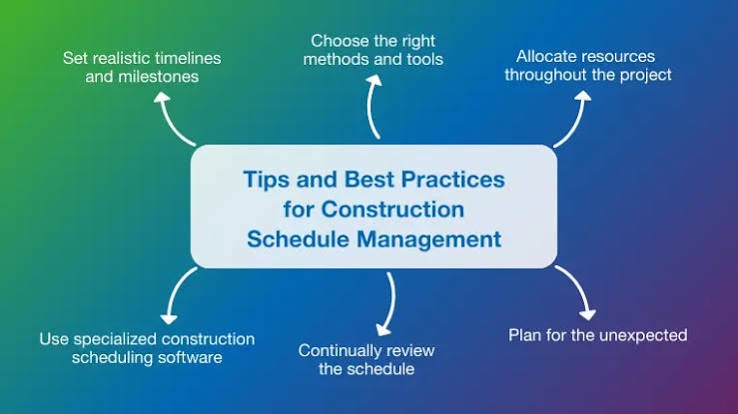
12. Best Practices for Effective Construction Schedule Management
To improve the accuracy and usefulness of construction schedules, project teams should follow these practices.
12.1 Involve the Relevant Professionals Early
Contractors, consultants and specialists should contribute to schedule development where their input is required.
This helps ensure that durations, construction methods and dependencies are realistic.
12.2 Use Accurate Project Information
Schedules should be based on the latest available drawings, specifications, quantities, site information and procurement requirements.
12.3 Coordinate the Programme With the Budget
The construction schedule and project budget should be reviewed together.
The timing of expenditure, procurement commitments, labour costs and contractor payments should reflect the planned sequence of work.
12.4 Plan Procurement in Advance
Identify long-lead materials and specialist equipment early to avoid unnecessary disruptions.
12.5 Monitor Progress Consistently
Regular reporting, site monitoring and programme reviews help identify issues before they become more difficult to resolve.
12.6 Maintain Clear Communication
All project participants should understand their responsibilities, upcoming activities, required decisions and reporting arrangements.
12.7 Document Changes
Revised drawings, instructions, variations and schedule updates should be recorded and communicated through agreed procedures.
12.8 Allow for Realistic Uncertainty
Do not prepare a programme that assumes perfect weather, uninterrupted supply, immediate approvals and unlimited labour availability.
A realistic schedule recognises project-specific risks.
13. How Much Does Construction Project Scheduling Cost in Uganda?
The cost of preparing and managing a construction schedule in Uganda depends on the size, complexity and requirements of the project.
Some construction projects require only a basic activity schedule, while others need detailed programmes, resource loading, procurement coordination, critical path analysis and regular progress updates.
Factors that may influence the cost include:
- Project size and estimated value.
- Number of construction activities.
- Number of contractors and subcontractors.
- Availability of design and cost information.
- Scheduling software and reporting requirements.
- Project duration.
- Site location and accessibility.
- Frequency of progress monitoring.
- Level of detail required.
- Whether scheduling is part of a wider project management appointment.
A small residential project may need a relatively simple programme. A large commercial building, industrial facility or infrastructure project may require more detailed scheduling and ongoing programme management.
Before appointing a provider, request a written proposal defining the scheduling deliverables, update frequency, reporting arrangements, exclusions and professional fees.
There is no single scheduling fee that applies to every construction project.
14. The Role of Construction Project Management in Scheduling Building Timelines
Construction scheduling is closely connected to overall project management.
A schedule cannot operate effectively without proper coordination of project scope, costs, procurement, resources, risks and communication.
A construction project manager helps coordinate these areas so that the construction programme remains aligned with the wider project objectives.
Depending on the agreed appointment, responsibilities may include:
- Coordinating schedule preparation.
- Reviewing activity durations.
- Monitoring construction progress.
- Coordinating contractors and subcontractors.
- Tracking procurement requirements.
- Identifying schedule risks.
- Monitoring critical activities.
- Preparing progress reports.
- Coordinating responses to delays.
- Reviewing approved changes.
- Updating project completion forecasts.
Effective project management helps ensure that scheduling is not treated as an isolated exercise but as part of the overall construction delivery process.
15. How Daltrevco Can Support Your Construction Project Requirements
Effective construction scheduling begins with understanding the project scope, available resources, site conditions and expected outcomes.
Whether you are planning a residential development, commercial building, warehouse, factory or infrastructure project, a realistic programme is important for coordinating activities and managing construction timelines.
Daltrevco provides a point of contact for discussing construction and project-related requirements. Property owners, developers, investors and organisations can contact Daltrevco to discuss their proposed developments and identify the type of construction support or professional input their projects may require.
Before proceeding, clarify the required services, project deliverables, responsibilities, professional qualifications, reporting arrangements and applicable fees.
If you are planning a construction project in Kampala, Wakiso, Entebbe, Mukono or elsewhere in Uganda, contact Daltrevco to discuss your project requirements and the appropriate next steps.
A well-planned construction schedule provides a practical foundation for coordinating work, monitoring progress and managing building timelines.
16. Frequently Asked Questions About Construction Project Scheduling
1. What is construction project scheduling?
Construction project scheduling is the process of organising construction activities into a logical sequence and assigning estimated durations, start dates, finish dates and milestones to each activity.
2. Why is construction project scheduling important?
It helps coordinate contractors, manage resources, monitor progress, identify delays, control project costs and establish realistic completion expectations.
3. How do you prepare a construction project schedule?
Start by defining the project scope, reviewing drawings, breaking the work into activities, estimating durations, identifying dependencies, allocating resources, establishing milestones and reviewing the programme with relevant stakeholders.
4. What is a construction timeline?
A construction timeline is a visual or documented representation of the expected duration and sequence of activities required to complete a construction project.
5. What is a Gantt chart in construction?
A Gantt chart is a scheduling tool that displays project activities as bars along a timeline. It shows planned durations, start and finish dates, overlapping activities and milestones.
6. What is the Critical Path Method in construction?
The Critical Path Method is a scheduling technique used to identify the sequence of dependent activities that determines the shortest possible project duration based on the planned programme.
7. What factors affect construction timelines in Uganda?
Factors include project size, design complexity, site conditions, weather, material availability, contractor performance, labour, equipment, funding and applicable approval requirements.
8. How can construction delays be prevented?
Delays can be reduced through realistic planning, early procurement, design coordination, clear communication, resource allocation, regular progress monitoring and effective risk management.
9. What is a construction project milestone?
A milestone is an important event or achievement in the project schedule, such as foundation completion, structural completion, roof completion or final handover.
10. What is the difference between a construction schedule and a project management plan?
A construction schedule focuses on activity sequencing, durations and milestones. A project management plan covers the wider approach to delivering the project, including scope, cost, schedule, procurement, quality, risk and communication.
11. Who prepares a construction project schedule?
It is commonly prepared or coordinated by a construction project manager or planning professional with input from contractors, consultants and other relevant project participants.
12. How often should a construction schedule be updated?
The schedule should be reviewed regularly, with update frequency depending on project complexity and reporting requirements. It should also be revised when approved changes or significant delays affect the programme.
13. Can construction activities happen at the same time?
Yes. Some activities can overlap where the construction method, site conditions, design and safety requirements allow. The schedule must identify appropriate dependencies and work interfaces.
14. What causes construction schedules to fail?
Common causes include unrealistic activity durations, incomplete drawings, poor procurement planning, insufficient resources, design changes, contractor underperformance and inadequate progress monitoring.
15. What is a look-ahead construction schedule?
A look-ahead schedule focuses on activities planned over a shorter period, helping the project team identify immediate resource needs, outstanding information and possible constraints.
16. How does weather affect construction scheduling?
Rainfall can affect excavation, earthworks, concrete activities, transportation and external works. Project schedules should account for weather-related risks based on the site and construction method.
17. What is schedule recovery in construction?
Schedule recovery is the process of identifying why a project is delayed and developing appropriate measures to improve progress and reduce the effect on the completion date.
18. What software is used for construction project scheduling?
Common tools include Microsoft Project, Primavera P6, Excel-based schedules and other project management platforms. The appropriate tool depends on project size and complexity.
19. How does procurement affect construction timelines?
Late delivery of materials and equipment can interrupt planned activities. Procurement should therefore be coordinated with the construction programme and long-lead items identified early.
20. What is float in a construction schedule?
Float is the amount of time an activity can be delayed without affecting a specified schedule milestone or project completion date, depending on the type of float being measured.
21. How do you monitor construction progress?
Progress can be monitored through site visits, contractor reports, progress meetings, schedule updates, milestone reviews and comparisons between planned and actual work.
22. Can a construction project manager guarantee completion on time?
No. A project manager can prepare realistic schedules, coordinate resources and monitor delays, but unforeseen site conditions, weather, supply problems and other factors may affect completion.
23. How does construction scheduling help control costs?
Scheduling helps coordinate labour, materials, equipment and contractor activities. Better coordination can reduce idle time, avoid unnecessary extensions and support expenditure planning.
24. Does a residential house need a construction schedule?
Yes. Even a relatively small residential project benefits from a schedule showing construction stages, material requirements, contractor activities and expected milestones.
25. What is the final stage of a construction schedule?
The final stage usually includes completion inspections, testing, commissioning where applicable, defect correction, documentation and formal handover to the client.
Conclusion
Construction project scheduling is essential for planning and managing building timelines effectively. It provides a clear sequence of activities, establishes realistic durations, coordinates resources and helps project teams monitor progress from the beginning of construction to final handover.
For construction projects in Uganda, realistic scheduling is particularly important because weather conditions, material supply, site characteristics, contractor performance and approval requirements can influence project duration.
Whether you are constructing a residential house, commercial building, warehouse, factory or infrastructure facility, an effective construction schedule helps establish clear expectations and provides a practical framework for managing time.
The most effective schedules are based on accurate project information, realistic activity durations, clear responsibilities and regular monitoring.
Contact Daltrevco to discuss your construction project requirements and explore the appropriate support for planning and coordinating your development.