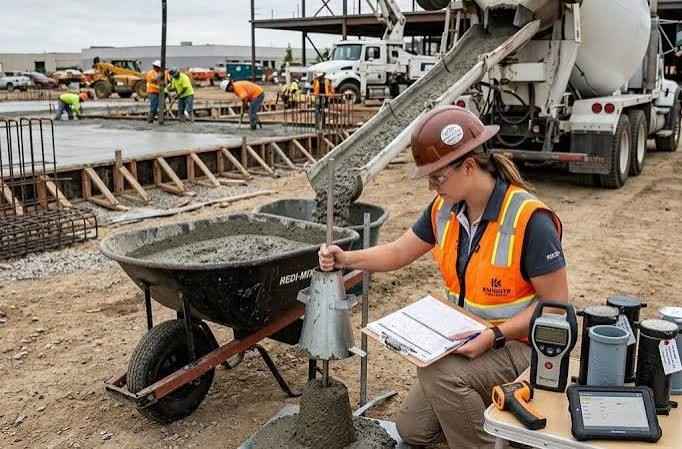
Concrete quality control is one of the most important aspects of building construction because the strength, stability and durability of a building depend heavily on the quality of its concrete structures.
Foundations, columns, beams, suspended slabs, staircases and retaining walls all require concrete that meets specified engineering and construction standards. If concrete is poorly mixed, incorrectly placed, inadequately compacted or improperly cured, the resulting structure may develop cracks, honeycombing, reduced strength, water penetration and premature deterioration.
For property owners and developers in Uganda, these problems can lead to expensive repairs, construction delays, safety concerns and reduced property value.
However, achieving good concrete quality involves much more than purchasing cement and mixing it with sand, aggregates and water. It requires a controlled process covering material selection, mix design, batching, transportation, placement, compaction, curing, testing and documentation.
Concrete quality control during building construction ensures that every stage of concrete production and installation meets the requirements established by the structural design, project specifications and applicable standards.
At Daltrevco, we recognise that reliable construction requires careful technical supervision, proper inspections and consistent quality monitoring. This guide explains how concrete quality control works, the inspections and tests required, common mistakes to avoid and how professional construction supervision helps protect building projects.
1. What Is Concrete Quality Control in Construction?
Concrete quality control is the systematic inspection, testing and monitoring of concrete materials, production methods and construction activities to verify that concrete meets the specified requirements.
It begins before concrete is mixed and continues throughout placement, curing and strength verification.
The purpose is to ensure that concrete achieves the required:
- Compressive strength.
- Workability and consistency.
- Durability under expected exposure conditions.
- Density and proper compaction.
- Dimensional accuracy and surface quality.
- Protection of embedded reinforcement.
- Compliance with approved construction specifications.
Concrete quality control applies to both small residential projects and large commercial, industrial and institutional developments.
For example, concrete used in a house foundation must meet the requirements established for that foundation. Concrete used in a suspended slab must satisfy the relevant structural, durability and placement requirements for that slab.
The concrete grade, mix proportions, testing frequency and acceptance criteria should be determined by the project specifications and responsible design professionals.
2. Why Is Concrete Quality Control Important?
Poor concrete quality can affect a building long after construction has been completed. In some cases, defects become visible during construction. In others, they develop gradually through moisture penetration, reinforcement corrosion or excessive structural movement.
Proper quality control helps prevent these problems.
2.1 Ensures Structural Strength
Concrete is used in structural elements that carry and transfer building loads.
If concrete fails to achieve its specified strength, the performance of foundations, columns, beams and slabs may be compromised.
Quality control helps verify that the concrete used on site is consistent with the approved structural requirements.
2.2 Improves Building Durability
Durable concrete should resist the environmental conditions anticipated during its service life.
Poorly compacted concrete, inadequate curing, excessive permeability and insufficient reinforcement cover can make structural elements more vulnerable to moisture and deterioration.
Quality monitoring helps reduce these risks.
2.3 Prevents Expensive Construction Defects
Defective concrete can require investigation, specialist assessment, repairs or even replacement of affected elements.
Inspecting materials, reinforcement, formwork and concrete placement before work proceeds helps identify problems when corrective action is more manageable.
2.4 Reduces Construction Delays
Unacceptable concrete test results, defective formwork or poor placement can interrupt construction activities.
A properly organised quality-control process helps identify issues early and reduces avoidable rework.
2.5 Protects Reinforcement From Corrosion
Reinforced concrete depends on the interaction between concrete and steel reinforcement.
Adequate concrete cover and properly compacted concrete help protect reinforcement from environmental exposure.
Where concrete is porous, cracked or poorly constructed, moisture and harmful substances may reach the steel and contribute to corrosion.
2.6 Provides Evidence of Construction Quality
Inspection reports, concrete delivery records, test results and curing records provide evidence of the quality-control activities undertaken.
These documents help property owners, contractors, consultants and engineers evaluate whether the required procedures were followed.
3. Important Factors That Determine Concrete Quality
Before examining the construction procedures, it is important to understand the materials and technical factors that influence concrete performance.
3.1 Cement Quality
Cement binds the other concrete ingredients together through hydration.
The cement used must be suitable for the project and comply with the relevant specifications.
Site inspections should establish:
- Whether the correct cement type has been delivered.
- Whether packaging and identification are intact.
- Whether bags show signs of moisture damage.
- Whether cement is stored in a dry, protected location.
- Whether damaged or contaminated cement has been excluded.
Cement should be handled and stored according to manufacturer recommendations and project requirements.
3.2 Sand Quality
Sand contributes to concrete’s particle structure, workability and strength development.
Sand containing excessive clay, organic matter or other harmful impurities can affect concrete performance.
Quality checks should consider:
- Cleanliness.
- Particle-size distribution.
- Suitability for the specified mix.
- Moisture content.
- Consistency between deliveries.
Where required, sand should be tested before being approved for concrete production.
3.3 Coarse Aggregate Quality
Coarse aggregates form an important part of the concrete structure.
Their size, grading, strength, shape and cleanliness influence the properties of fresh and hardened concrete.
Supervisors should check that aggregates:
- Meet the specified grading requirements.
- Are free from harmful contamination.
- Are stored separately where necessary.
- Have consistent quality.
- Are suitable for the reinforcement spacing and member dimensions.
Large aggregates may be unsuitable in heavily reinforced sections if they prevent concrete from flowing and compacting properly.
3.4 Water Quality
Water is essential for cement hydration and workability.
However, contaminated water can affect concrete performance.
Water should meet applicable requirements for concrete production. The suitability of a source should be established rather than assuming that any available water is acceptable.
3.5 Admixtures
Admixtures may be used to modify concrete properties, including workability, setting time and water demand.
Examples include water-reducing admixtures, plasticisers, superplasticisers and other specified products.
They should only be used in accordance with the approved mix design and manufacturer’s instructions.
Unauthorised changes to admixture quantities can affect concrete performance.
3.6 Water-Cement Ratio
The water-cement ratio is the mass of mixing water divided by the mass of cement in the mix.
It is a major factor influencing concrete strength and permeability.
Adding too much water may make concrete easier to pour, but it can increase porosity and reduce the strength and durability of hardened concrete.
The water content must therefore be controlled in accordance with the approved mix design, including adjustments for aggregate moisture where required.
4. Concrete Quality Control Procedures Before Pouring
Some of the most important concrete quality checks must happen before concrete is placed.
Once concrete has hardened, correcting concealed problems can be difficult and expensive.
4.1 Review the Approved Structural Drawings
The construction team should understand the structural requirements before beginning concrete works.
The supervisor should review relevant information, including:
- Concrete strength or grade.
- Dimensions of structural members.
- Reinforcement sizes and arrangements.
- Required concrete cover.
- Construction joint details.
- Concrete placement requirements.
- Any special durability requirements.
Any discrepancy between drawings, specifications and site conditions should be referred to the appropriate design professional before work proceeds.
4.2 Inspect Excavations and Foundation Preparation
Before foundation concrete is poured, the excavation and bearing surface should be inspected.
Important checks include:
- Foundation dimensions and levels.
- Excavation depth.
- Ground conditions.
- Removal of unsuitable material.
- Stability of excavation sides.
- Groundwater or water accumulation.
- Approved foundation preparation details.
If the exposed soil differs significantly from the expected conditions, the matter should be referred to the responsible geotechnical or structural professional.
Concrete should not be poured onto an unsuitable or unapproved foundation surface.
4.3 Inspect Reinforcement Installation
Reinforcement must be correctly installed to achieve the intended structural performance.
Before pouring, the supervisor should check:
- Correct bar diameters.
- Correct number of reinforcement bars.
- Bar spacing.
- Position and orientation.
- Lap lengths and anchorage.
- Links, stirrups and ties.
- Concrete cover.
- Spacers and reinforcement supports.
- Cleanliness and condition of the steel.
- Compliance with approved structural drawings.
Particular attention should be given to congested reinforcement areas, beam-column connections and slab support zones.
Reinforcement should not be accepted simply because it appears sufficient. It must match the approved structural details.
4.4 Inspect Formwork and Temporary Supports
Formwork determines the shape and dimensions of fresh concrete.
Defective formwork can cause leakage, bulging, incorrect dimensions and surface defects. Inadequate temporary supports can create serious safety risks during concrete placement.
The inspection should cover:
- Dimensions and alignment.
- Verticality and levels.
- Stability of supports and bracing.
- Tightness of joints.
- Cleanliness.
- Correct release-agent application.
- Access for concrete placement.
- Adequacy of the formwork system for anticipated loads.
Formwork and temporary works should be checked by competent personnel before pouring begins.
4.5 Confirm Concrete Mix Approval
Before concrete production, the responsible technical team should confirm the specified mix and its suitability for the intended structural element.
The mix requirements may include:
- Specified compressive strength.
- Cement type.
- Aggregate grading and maximum size.
- Water-cement ratio or specified water-content controls.
- Workability requirements.
- Admixtures.
- Exposure and durability requirements.
Concrete should not be mixed using arbitrary proportions when the project requires an approved mix design.
5. Concrete Quality Control During Mixing and Batching
Correct material measurement and mixing are essential for consistent concrete production.
5.1 Accurate Batching of Materials
Batching involves measuring the quantities of cement, water, sand, aggregates and admixtures required for the concrete mix.
Inaccurate batching can produce inconsistent concrete.
Supervisors should verify:
- Correct material quantities.
- Suitable measuring equipment.
- Consistent batching procedures.
- Aggregate moisture adjustments where necessary.
- Accurate water measurement.
- Correct admixture dosage.
For larger projects, weigh batching is generally preferable where the equipment and project arrangements allow it. Where volume batching is permitted, it must be controlled and follow the project specification.
5.2 Proper Concrete Mixing
Concrete ingredients must be mixed sufficiently to achieve a uniform mixture.
The mixing procedure should follow the approved production method and equipment recommendations.
Checks include:
- Correct material introduction.
- Suitable mixing equipment.
- Appropriate mixing duration.
- Uniform distribution of ingredients.
- No unauthorised addition of water.
- Consistent appearance and workability.
Concrete should not be accepted solely because it looks wet or workable. Its condition must be assessed against the specified requirements.
5.3 Avoiding Uncontrolled Water Addition
One common site mistake is adding water to concrete whenever workers find it difficult to pour.
This can change the water-cement ratio and affect the final strength.
If workability requires adjustment, it should be handled through an approved procedure by the responsible technical personnel.
Water should not be added casually to a concrete mixer, truck or discharged concrete without authorisation.
6. Concrete Quality Control During Transportation and Delivery
Concrete quality can deteriorate if transportation and delivery are poorly managed.
For ready-mixed concrete, delivery documentation should be checked before discharge.
The supervisor should verify:
- Concrete grade or specified strength class.
- Mix identification.
- Delivery time and relevant production information.
- Quantity delivered.
- Specified workability.
- Approved admixture details where applicable.
- Any special placement requirements.
- Whether the concrete has been handled within the permitted time limits.
Concrete should be delivered and placed according to the applicable specification and approved procedures.
Unusual delays, excessive loss of workability or suspected unauthorised water addition should be reported and assessed before the concrete is used.
7. Concrete Quality Tests During Building Construction
Testing provides measurable information about concrete properties. It complements visual inspection and should form part of the project’s quality-control plan.
Different tests are used at different stages.
7.1 Slump Test for Fresh Concrete
<image-placeholder></image-placeholder>
The slump test assesses the consistency and workability of fresh concrete.
It helps determine whether concrete has a suitable consistency for placement and compaction under the specified conditions.
The test generally involves:
- Preparing the standard slump cone and a suitable base.
- Filling the cone using the prescribed procedure.
- Compacting each layer as required by the testing standard.
- Lifting the cone vertically.
- Measuring the difference between the original cone height and the slumped concrete.
The result is recorded and compared with the permitted range for the concrete mix.
Why the test matters: A significant change in slump may indicate a variation in water content, material moisture, batching or concrete consistency.
However, slump is not a direct measurement of compressive strength. A concrete mix can have an acceptable slump and still fail to achieve the required strength.
7.2 Concrete Cube or Cylinder Compressive Strength Test
<image-placeholder></image-placeholder>
Compressive strength testing is used to assess the ability of hardened concrete to resist crushing forces.
The general process involves:
- Collecting a representative fresh concrete sample.
- Preparing the required test moulds.
- Filling and compacting the specimens.
- Labelling each specimen with identification details.
- Curing the specimens under specified conditions.
- Transporting them to a suitable laboratory.
- Testing them at the required age.
- Recording and evaluating the results.
Concrete cubes are commonly used in many construction testing arrangements, while cylinders are used in other standards and testing systems.
The specimen type, sampling frequency, curing method and acceptance criteria should follow the applicable project requirements and testing standard.
7.3 Seven-Day Concrete Strength Testing
Seven-day testing is commonly used to monitor early strength development.
It can help the technical team identify unusual strength-development patterns before the conventional 28-day testing age.
However, a seven-day result should not automatically be treated as final acceptance of the concrete.
7.4 Twenty-Eight-Day Concrete Strength Testing
Twenty-eight-day compressive strength testing is widely used as a reference for evaluating specified concrete strength.
The result should be assessed using the applicable standard and project acceptance criteria.
It is important to evaluate the required test results as a set rather than making decisions based on one isolated specimen.
7.5 Aggregate Testing
Where required, aggregates may be tested to assess their grading, cleanliness and other relevant properties.
The results help establish whether the materials are suitable for the approved concrete mix.
7.6 Water Testing
Water testing may be required to establish whether a source is suitable for concrete production.
This is particularly important when water comes from an unfamiliar or potentially contaminated source.
7.7 Additional Concrete Tests
Depending on the project, other tests may be necessary, including:
- Rebound hammer testing.
- Ultrasonic pulse velocity testing.
- Core sampling and testing.
- Concrete permeability-related tests.
- Tests for special durability requirements.
These tests have different purposes and limitations. They should be selected and interpreted by competent professionals.
For example, a rebound hammer provides an indication of surface hardness and should not be treated as a definitive replacement for compressive strength testing.
8. Concrete Quality Control During Placement and Compaction
Even correctly mixed concrete can become defective if it is poorly placed or compacted.
8.1 Correct Concrete Placement
Concrete should be deposited as close as practical to its final position.
This reduces unnecessary movement and the risk of segregation.
Supervisors should monitor:
- Placement sequence.
- Discharge height.
- Concrete flow around reinforcement.
- Continuity of pouring.
- Concrete layer thickness where applicable.
- Movement of reinforcement.
- Stability of formwork.
- Prevention of contamination.
The placement procedure should suit the member dimensions, reinforcement arrangement and concrete characteristics.
8.2 Proper Vibration and Compaction
<image-placeholder></image-placeholder>
Compaction removes trapped air and helps concrete fill the formwork and surround reinforcement.
Mechanical vibrators are commonly used for reinforced concrete.
The supervisor should confirm that:
- Suitable equipment is available.
- Vibrators are functioning correctly.
- Concrete is compacted systematically.
- Reinforcement is not displaced.
- Formwork remains stable.
- Areas around congested reinforcement are properly filled.
- Excessive vibration is avoided.
Insufficient compaction may cause honeycombing and voids, while inappropriate vibration can contribute to segregation.
8.3 Managing Construction Joints
Construction joints are formed where concrete placement is interrupted or where the structural design specifies a joint.
Their location and treatment should follow the approved structural details and construction procedures.
Unplanned interruptions should be reported so that the responsible engineer can determine how the work should proceed.
Poorly managed joints can create weak interfaces and water penetration paths.
9. Concrete Curing and Why It Must Not Be Neglected
Curing is the process of maintaining suitable moisture and temperature conditions so that cement hydration can continue and concrete can develop its intended properties.
It is one of the most important yet frequently neglected aspects of concrete quality control.
Common Concrete Curing Methods
Water curing: Applying water regularly to maintain suitable moisture conditions.
Wet coverings: Using appropriate wet materials to reduce moisture loss.
Plastic sheeting: Covering concrete to reduce evaporation.
Curing compounds: Applying approved products designed to reduce moisture loss.
The method should be selected according to the project specification, concrete type and site conditions.
How Long Should Concrete Be Cured?
There is no single curing period suitable for every concrete mix and construction condition.
The required duration depends on factors such as:
- Cement type.
- Concrete mix design.
- Environmental conditions.
- Member dimensions.
- Exposure conditions.
- Specified strength-development requirements.
- Project specifications.
Seven days is a commonly used minimum curing period in many ordinary construction situations, but some projects require longer curing.
The responsible technical team should establish the appropriate curing requirements.
Concrete Curing Checks for Supervisors
Supervisors should confirm that:
- Curing starts at the appropriate time.
- Fresh concrete is protected from rapid moisture loss.
- The selected curing method is suitable.
- Water curing is maintained where specified.
- Curing compounds are correctly applied.
- Concrete is protected from damage and premature loading.
- Curing activities are documented.
In Uganda, high temperatures, sunlight and wind can increase moisture loss, making proper curing particularly important.
10. Common Concrete Defects and Their Causes
Concrete defects may affect appearance, strength, durability and structural performance.
The following problems should be monitored throughout construction.
10.1 Honeycombing
Honeycombing appears as voids or exposed aggregate on the concrete surface or within the concrete.
Common causes:
- Insufficient compaction.
- Poor workability.
- Congested reinforcement.
- Leaking formwork.
- Incorrect placement methods.
Prevention: Check formwork, use suitable concrete workability, ensure proper access for placement and supervise compaction.
10.2 Concrete Segregation
Segregation occurs when concrete ingredients separate instead of remaining uniformly distributed.
Common causes:
- Excessive water.
- Poor mix proportions.
- Excessive discharge height.
- Improper handling.
- Inappropriate vibration.
Prevention: Control the mix, avoid uncontrolled water addition and use suitable placement and compaction methods.
10.3 Plastic Shrinkage Cracking
These cracks develop when fresh concrete loses moisture faster than it can be replaced.
Common causes:
- High temperatures.
- Strong winds.
- Low humidity.
- Direct sunlight.
- Delayed curing.
Prevention: Protect fresh concrete, plan placement appropriately and begin curing at the required time.
10.4 Drying Shrinkage Cracking
Drying shrinkage occurs as hardened concrete loses moisture and contracts.
Common causes:
- Excessive water in the mix.
- Inadequate curing.
- Incorrect joint arrangements.
- Restraint to movement.
- Unsuitable concrete proportions.
Prevention: Follow the approved mix design, provide specified joints and implement appropriate curing.
10.5 Cold Joints
Cold joints may form when fresh concrete is placed against concrete that has already begun to set without appropriate joint preparation or an approved construction joint detail.
Common causes:
- Long interruptions during pouring.
- Delayed concrete deliveries.
- Equipment breakdown.
- Poor construction coordination.
Prevention: Plan concrete pours, coordinate deliveries and follow approved procedures for construction joints.
10.6 Surface Scaling
Scaling occurs when the concrete surface flakes or breaks away.
Common causes:
- Poor finishing practices.
- Inadequate curing.
- Unsuitable concrete.
- Environmental exposure.
- Premature surface damage.
Prevention: Use suitable materials, follow the specified finishing process and protect concrete during early curing.
10.7 Reinforcement Corrosion
Reinforcement corrosion occurs when steel inside concrete deteriorates due to environmental exposure.
Common contributing factors:
- Inadequate concrete cover.
- Poor compaction.
- High permeability.
- Cracking.
- Moisture penetration.
- Aggressive exposure conditions.
Prevention: Ensure the specified concrete cover, proper compaction, suitable durability provisions and effective drainage and waterproofing.
10.8 Low Compressive Strength
Low concrete strength occurs when test results do not satisfy the specified acceptance requirements.
Common causes:
- Incorrect mix proportions.
- Excessive water.
- Poor-quality materials.
- Inaccurate batching.
- Inadequate mixing.
- Poor compaction.
- Insufficient curing.
- Sampling or testing errors.
Prevention: Control all production and construction stages and use proper sampling, testing and record-keeping procedures.
11. What Happens When Concrete Fails a Quality Test?
A concrete test result that falls outside the specified acceptance criteria must be investigated.
It should not be ignored, concealed or automatically dismissed as a laboratory error.
The following steps provide a responsible approach.
Step 1: Verify the test records.
Check sample identification, collection details, specimen preparation, curing, transportation, testing age and laboratory records.
Step 2: Review the concrete production records.
Examine delivery notes, mix identification, batching records, slump results and any changes made during production.
Step 3: Establish where the concrete was placed.
Identify the exact foundation, column, beam, slab or other structural element associated with the test sample.
Step 4: Inform the responsible professionals.
The contractor, site engineer, quality-control team and relevant design consultant should be informed.
Step 5: Determine whether further investigation is required.
The structural engineer may recommend additional testing, such as appropriately planned non-destructive testing or core testing, depending on the circumstances.
Step 6: Assess the structural implications.
The responsible structural engineer should evaluate whether the affected element meets the required performance and safety criteria.
Step 7: Approve corrective action.
Possible actions may include acceptance based on further assessment, strengthening, specialist repair or replacement. The appropriate action depends on the actual condition and engineering assessment.
Step 8: Document the outcome.
The investigation, decisions and corrective work should be recorded and verified.
A failed test result does not automatically mean that an entire structure is unsafe. Equally, a satisfactory-looking concrete surface does not prove that the concrete has achieved its specified strength.
Professional assessment is essential.
12. Concrete Quality Control Checklist at Every Construction Stage
The following checklist provides a practical overview of important concrete quality checks.
| Stage | Inspection and quality-control requirements |
|---|---|
| Before construction | Approved structural drawings, concrete specifications and quality-control plan |
| Material delivery | Cement, sand, aggregates, water and admixture suitability |
| Material storage | Dry cement storage and protection of aggregates from contamination |
| Mix preparation | Approved mix design and correct proportions |
| Batching | Accurate material measurement and water control |
| Mixing | Uniformity and correct mixing procedure |
| Fresh concrete | Slump testing and delivery checks where specified |
| Excavation | Foundation dimensions, levels and ground conditions |
| Reinforcement | Bar size, spacing, anchorage and concrete cover |
| Formwork | Dimensions, alignment, stability and cleanliness |
| Concrete placement | Correct sequence, delivery and handling |
| Compaction | Appropriate vibration and removal of trapped air |
| Finishing | Correct levels, dimensions and surface finish |
| Curing | Suitable method, protection and curing duration |
| Strength testing | Proper sampling, identification and laboratory testing |
| Final inspection | Defect assessment, records and approval of outstanding work |
This checklist should be expanded into project-specific inspection and test plans where necessary.
13. Concrete Quality Control for Different Structural Elements
Concrete requirements are not identical for every building component. The checks must reflect the purpose, design and construction conditions of each element.
13.1 Foundations
Foundation concrete transfers building loads to the ground.
Quality control should cover excavation, bearing conditions, reinforcement, concrete cover, formwork where required, mix approval, placement, compaction and curing.
13.2 Columns
Columns transfer loads through the building.
Important checks include reinforcement arrangement, links, concrete cover, formwork alignment, concrete placement, compaction and curing.
13.3 Beams
Beams carry loads from slabs and other structural members.
The supervisor should inspect reinforcement details, anchorage, formwork, propping, concrete placement and curing.
13.4 Suspended Slabs
Suspended slabs require particular attention to reinforcement, slab thickness, formwork, temporary supports and service openings.
Concrete should be placed and finished according to the approved structural details.
Removal of temporary supports must follow the approved procedure and relevant engineering requirements.
13.5 Staircases
Staircases require accurate dimensions, reinforcement positioning and suitable concrete finishing.
Inspection should cover step dimensions, landings, reinforcement, formwork, concrete placement and curing.
13.6 Retaining Walls
Retaining walls must resist the forces acting on the retained soil and any additional loads considered in the design.
Concrete quality control should include reinforcement, formwork, concrete cover, placement, compaction, curing and specified drainage and waterproofing details.
14. Common Concrete Quality Control Mistakes to Avoid
Some construction mistakes occur repeatedly because quality-control procedures are ignored or rushed.
Property owners, contractors and supervisors should avoid the following:
- Using unapproved concrete mix proportions: Concrete should follow the specified mix requirements.
- Adding excessive water: Uncontrolled water addition can affect concrete strength and durability.
- Pouring before reinforcement inspection: Reinforcement must be checked before it is concealed.
- Ignoring formwork stability: Weak formwork can fail during concrete placement.
- Skipping slump tests where required: Fresh concrete consistency should be checked according to the testing plan.
- Failing to compact concrete properly: Inadequate vibration can cause honeycombing and voids.
- Neglecting curing: Concrete needs suitable curing conditions to develop its intended properties.
- Failing to take test samples: Required strength verification should not be overlooked.
- Ignoring failed test results: Non-conforming results require proper investigation and assessment.
- Poor record-keeping: Missing inspection and test records make quality verification difficult.
- Allowing premature loading: Structural elements should not be loaded before the required strength and support conditions have been established.
- Concealing defects without approval: Repairs should follow an appropriate technical assessment and approved method.
15. The Role of Professional Construction Supervision in Concrete Quality Control
A concrete quality-control system is only effective when its requirements are properly implemented on site.
Professional construction supervision helps ensure that contractors follow approved procedures and that important inspections are completed before work proceeds.
Reviewing Drawings and Specifications
Supervisors help verify that concrete works follow the approved structural drawings and specifications.
They identify discrepancies and refer technical matters to the responsible professionals.
Inspecting Materials and Workmanship
Supervisors check the condition of materials and monitor the way concrete is produced, transported, placed, compacted and cured.
Inspecting Reinforcement and Formwork
Before pouring, supervisors verify that reinforcement and formwork meet the required details and are ready for concrete placement.
Monitoring Testing Activities
Supervisors help coordinate required slump tests, sampling and compressive strength testing.
They also ensure that results are recorded and brought to the attention of the relevant technical professionals.
Identifying Non-Conforming Work
When concrete work does not meet the specified requirements, supervisors document the problem and follow up on corrective action.
Structural concerns are referred to the appropriate engineer.
Maintaining Quality Records
Inspection reports, delivery notes, test results and corrective-action records help maintain accountability throughout construction.
Coordinating Construction Activities
Supervisors coordinate contractors, suppliers and technical teams to minimise delays and prevent mistakes that may compromise concrete quality.
16. Challenges Affecting Concrete Quality on Construction Sites in Uganda
Concrete quality control is especially important where construction projects face inconsistent material supplies, varying site conditions and limited quality-monitoring resources.
Variations in Sand and Aggregate Quality
Materials from different sources may have different grading, moisture content and cleanliness.
Testing and approval help ensure that materials are suitable for the specified mix.
Inconsistent Water Measurement
Uncontrolled water addition can alter the mix and reduce concrete performance.
Proper batching and supervision help maintain the required water content.
Inadequate Testing Facilities or Planning
Some projects fail to arrange timely sampling and laboratory testing.
A concrete inspection and testing plan should be established before major structural works begin, using competent testing facilities.
Weather and Rapid Moisture Loss
High temperatures, sunlight and wind can increase evaporation from fresh concrete.
Appropriate placement planning, protection and curing are necessary to reduce moisture-related problems.
Poor Workmanship
Inadequate reinforcement fixing, poor formwork, insufficient compaction and incorrect finishing can compromise the concrete.
Regular inspections help detect these problems before they become permanent.
Pressure to Complete Work Quickly
Rushed construction can lead to skipped inspections, incorrect batching and inadequate curing.
Construction schedules should allow enough time for quality checks and required testing.
17. How to Choose a Construction Supervision Company for Concrete Quality Control in Uganda
Selecting a suitable construction supervision partner is important for developers who want proper monitoring of structural works.
Before appointing a company, consider the following:
Relevant construction experience: Look for experience in projects similar to yours, including residential, commercial and industrial developments.
Qualified technical personnel: Confirm that the team has appropriate qualifications and competence for its assigned responsibilities.
Understanding of concrete procedures: The team should understand mix requirements, reinforcement inspections, formwork, concrete placement, curing and testing.
Clear inspection procedures: Ask how inspections will be scheduled and what checks will be completed before concrete pouring.
Testing coordination: Confirm how the company will coordinate required concrete tests and review results.
Reporting and documentation: Ensure that inspection findings, defects and corrective actions will be recorded.
Communication and accountability: The company should provide clear updates and promptly communicate important construction quality concerns.
Defined professional responsibilities: Establish the scope of supervision, reporting arrangements and authority for dealing with non-conforming work.
18. Professional Construction Supervision and Quality Monitoring by Daltrevco
At Daltrevco, we understand that the quality of concrete works has a direct influence on building performance, durability and construction costs.
Whether you are developing a residential house, apartment complex, commercial building, warehouse, factory or institutional facility, proper construction supervision helps maintain quality throughout the project.
Daltrevco provides construction consultancy and supervision support to help property owners, developers and organisations monitor construction activities and maintain project requirements.
Our services may include:
- Construction project supervision.
- Concrete works inspection and quality monitoring.
- Reinforcement and formwork inspections.
- Material and workmanship checks.
- Construction progress monitoring.
- Monitoring work against approved drawings and specifications.
- Contractor and subcontractor coordination.
- Identification and reporting of construction defects.
- Coordination of required quality inspections and testing.
- Construction project management and consultancy.
Our approach focuses on identifying construction problems early, improving site coordination and helping clients maintain better oversight of their building projects.
Planning to construct a building in Uganda? Contact Daltrevco to discuss professional construction supervision and quality-monitoring services for your project.
Frequently Asked Questions About Concrete Quality Control
1. What is concrete quality control during building construction?
Concrete quality control is the process of inspecting materials, checking mix proportions, monitoring concrete production and placement, supervising curing and testing hardened concrete to ensure compliance with project specifications.
2. What are the most important concrete quality-control tests?
Common tests include the slump test for fresh concrete workability and compressive strength tests using concrete cubes or cylinders. Other tests may be required depending on the mix, materials and project requirements.
3. What is the purpose of a concrete slump test?
A slump test measures the consistency and workability of fresh concrete. It helps determine whether the concrete has suitable workability for its intended placement and compaction conditions.
It does not directly measure compressive strength.
4. Why is concrete cube testing important?
Concrete cube testing helps determine the compressive strength of hardened concrete. The results are compared against the specified strength and applicable acceptance criteria to evaluate whether the concrete meets project requirements.
5. Why is 28-day concrete testing commonly used?
Twenty-eight-day testing is a widely used reference for evaluating concrete compressive strength. It allows time for significant strength development, although concrete continues to gain strength beyond this age under suitable conditions.
6. What causes low concrete strength?
Low concrete strength can result from excessive water, incorrect mix proportions, unsuitable materials, poor batching, inadequate mixing, insufficient compaction, poor curing or problems with sampling and testing.
7. How long should concrete be cured?
Curing duration depends on the cement type, concrete mix, environmental conditions and project specifications. Seven days is commonly used as a minimum in many ordinary applications, but longer periods may be required.
8. What causes honeycombing in concrete?
Honeycombing is commonly caused by inadequate compaction, poor workability, congested reinforcement, leaking formwork or incorrect concrete placement.
9. Who is responsible for concrete quality control?
Concrete quality control involves the contractor, site engineer, quality-control personnel, construction supervisor, testing laboratory and relevant design professionals. Their exact responsibilities depend on the project arrangements and professional appointments.
10. Can concrete look good but still be weak?
Yes. A smooth concrete surface does not prove that the concrete has achieved its specified compressive strength. Proper sampling, testing and review of construction records are necessary to assess quality.
11. What should happen if concrete fails a strength test?
The test records and production details should be reviewed, the affected structural element identified and the responsible structural engineer informed. Further investigation or testing may be necessary before an appropriate decision is made.
12. Why is professional supervision important for concrete works?
Professional supervision helps ensure that materials, reinforcement, formwork, concrete placement, compaction, curing and testing follow approved project requirements. It also helps identify defects and document corrective actions.
Conclusion: Achieve Stronger and More Durable Buildings Through Concrete Quality Control
Concrete quality control is essential for achieving safe, strong and durable buildings. Every stage matters, from selecting suitable materials and controlling mix proportions to inspecting reinforcement, supervising placement, ensuring proper compaction and maintaining adequate curing.
Failure to control these activities can result in weak concrete, honeycombing, cracking, reinforcement corrosion and costly structural repairs.
For property owners and developers in Uganda, quality control should be treated as an essential part of construction management rather than an activity carried out only when problems appear.
Professional construction supervision provides the inspections, testing coordination, technical monitoring and documentation needed to maintain construction standards.
Choose Daltrevco for construction consultancy, professional site supervision and quality monitoring. Contact our team to discuss how we can help protect your construction investment and support the delivery of a quality building project.