Concrete blocks are among the most widely used building materials in Uganda. They are used in residential houses, commercial buildings, warehouses, boundary walls, schools, factories and other construction projects. However, not all concrete blocks offer the same level of strength, durability or quality.
Poor-quality concrete blocks can develop cracks, break during transportation, absorb excessive moisture or fail to perform as expected after installation. Using them in construction can lead to structural problems, unnecessary repair expenses, material wastage and project delays.
This makes concrete block quality testing an important step when purchasing building materials. Builders, contractors, engineers, property developers and homeowners should understand how to inspect concrete blocks, assess their physical characteristics and verify whether they meet the requirements of their intended application.
Whether you are constructing a residential house in Kampala, developing rental apartments in Wakiso or undertaking a commercial construction project elsewhere in Uganda, selecting quality concrete blocks can significantly influence the performance and lifespan of your building.
This guide explains how to test concrete block quality, identify strong and durable blocks, understand laboratory testing methods, recognise common defects and choose reliable concrete blocks for your construction project.
1. What Is Concrete Block Quality Testing?
Concrete block quality testing is the process of examining and evaluating concrete masonry units to determine whether they meet specified requirements for strength, dimensions, durability and overall performance.
The process involves visual inspections, physical measurements and, where necessary, laboratory testing.
The purpose is to establish whether concrete blocks are suitable for their intended use, such as:
- Load-bearing walls.
- Non-load-bearing partition walls.
- External building walls.
- Internal walls.
- Boundary walls and perimeter structures.
- Commercial and industrial buildings.
- Other masonry applications specified by the project design.
Quality testing helps identify blocks that may be unsuitable for construction before they are purchased in large quantities or incorporated into a building.
Importantly, a block that looks strong is not automatically structurally suitable. Its performance must be assessed against the required specifications and intended application.
2. Why Is Concrete Block Quality Testing Important?
Concrete blocks contribute to the strength, stability, durability and general performance of masonry construction. Poor-quality materials can affect the entire building project.
Testing helps construction professionals make informed decisions before using concrete blocks.
Prevents the Use of Weak Building Materials
Blocks with inadequate compressive strength may crack, crush or fail when subjected to loads beyond their capacity.
Testing helps establish whether the blocks meet the strength requirements specified by the structural design and applicable standards.
Improves Building Durability
Good-quality concrete blocks should be manufactured, compacted and cured properly.
Testing helps identify products with characteristics that could contribute to premature deterioration, including excessive water absorption, poor compaction and manufacturing defects.
Reduces Construction Costs
Using unsuitable blocks can increase expenses through breakages, replacements, additional mortar, plastering and remedial work.
Quality checks help reduce these avoidable costs.
Improves Construction Safety
The suitability of masonry materials is important for the safety of occupants, workers and surrounding property.
Testing helps identify materials that should not be used in applications where their performance is inadequate.
Supports Compliance With Project Specifications
Construction projects may specify particular block dimensions, strength classifications and other performance requirements.
Testing provides evidence that the supplied materials meet the requirements established by the project designer and applicable standards.
Reduces Material Wastage
Blocks that break easily during handling and installation can increase wastage.
Inspecting quality before delivery or installation helps contractors avoid purchasing materials that are likely to perform poorly.
3. Important Properties of High-Quality Concrete Blocks
Before testing concrete blocks, it is important to understand the characteristics that determine their quality.
| Quality property | What to look for | Why it matters |
|---|---|---|
| Compressive strength | Meets the specified strength requirement | Helps the block resist applied loads |
| Dimensions | Consistent length, width and height | Supports accurate masonry construction |
| Shape | Uniform and properly formed | Improves alignment and joint consistency |
| Density | Appropriate for the specified block type | Can indicate consistency, but does not prove strength |
| Water absorption | Within the applicable specification | Helps assess moisture-related performance |
| Surface condition | No serious cracks or major defects | Reduces installation and durability problems |
| Curing quality | Properly cured during manufacturing | Supports strength development and durability |
| Workmanship | Consistent production and compaction | Reduces variations between blocks |
These properties should be considered together. No single characteristic can establish the overall quality of a concrete block.
4. How to Identify Strong Concrete Blocks Through Visual Inspection
Visual inspection is one of the easiest ways to identify obvious manufacturing defects before purchasing concrete blocks.
Although it cannot replace laboratory testing, it helps builders and property owners reject visibly defective materials.
Check for Cracks
Examine the block surfaces, corners, edges and internal webs for visible cracks.
Small surface imperfections may not always indicate structural weakness, but significant cracks, broken sections and visible fractures should be investigated.
Pay particular attention to cracks that extend through the block or affect its structural sections.
Examine the Edges and Corners
Good-quality blocks should generally have well-formed edges and corners appropriate to their manufacturing method.
Look for:
- Broken corners.
- Chipped edges.
- Missing sections.
- Uneven surfaces.
- Poorly formed openings.
- Excessive surface damage.
Blocks with extensive damage may be difficult to lay properly and can increase material wastage.
Check Surface Uniformity
The surfaces should be reasonably consistent with the intended finish and manufacturing process.
Watch out for:
- Large cavities.
- Loose particles.
- Excessive exposed aggregate.
- Uneven compaction.
- Poorly formed surfaces.
- Areas that crumble easily.
A rough appearance does not automatically mean a block is defective. The important consideration is whether its manufacturing quality and performance satisfy the required specification.
Look for Consistent Colour and Appearance
Blocks from the same production batch should generally have a reasonably consistent appearance.
Major variations may indicate differences in raw materials, mixing, moisture content, compaction or curing.
However, colour alone cannot establish compressive strength or durability.
Inspect Hollow Sections and Internal Webs
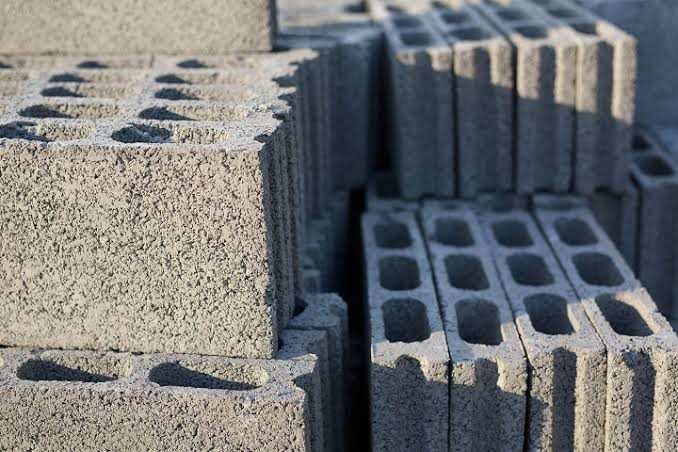
For hollow concrete blocks, examine the openings, face shells and internal webs.
Check that the sections are properly formed and do not have significant cracks, missing material or irregular shapes that could affect handling and performance.
The required dimensions and geometry should match the applicable product specification.
5. Concrete Block Compressive Strength Test
The concrete block compressive strength test is one of the most important laboratory methods used to assess the load-resisting capacity of concrete masonry units.
Compressive strength refers to the ability of a material to resist a compressive force before failure.
It is particularly important when selecting blocks for applications where masonry must support structural loads.
How Is the Compressive Strength Test Conducted?
A typical laboratory procedure involves the following steps:
- Select representative samples: Blocks are selected from the production batch or delivery lot according to the applicable sampling procedure.
- Record sample details: The laboratory records relevant information such as block type, dimensions, manufacturer or source, and batch identification where available.
- Prepare the specimens: The blocks are conditioned and prepared according to the relevant testing method.
- Measure the specimens: Dimensions and the required loading area are established.
- Position the block: The specimen is placed correctly in a calibrated compression testing machine.
- Apply compressive load: The machine applies an increasing compressive force according to the prescribed testing procedure.
- Record the failure load: The maximum load sustained before failure is recorded.
- Calculate the strength: The result is calculated using the appropriate loading area and reporting method.
- Compare the result with specifications: The laboratory results are assessed against the applicable product standard and project requirements.
The testing method must be appropriate for the particular type of masonry unit. Different standards may prescribe different specimen preparation, loading areas, conditioning procedures and reporting requirements.
How Is Compressive Strength Calculated?
The basic relationship is:
Compressive Strength = Maximum Applied Load ÷ Relevant Loaded Area
For example, assume a hypothetical specimen fails under a maximum load of 180,000 newtons and has a relevant loaded area of 15,000 square millimetres.
Compressive strength:
180,000 ÷ 15,000 = 12 N/mm²
Since 1 N/mm² is equivalent to 1 MPa, the calculated result is 12 MPa.
This is an illustrative calculation, not a recommended acceptance value for every concrete block. The correct loading area, test procedure and strength classification must follow the applicable standard.
Why Is This Test Important?
Compressive strength testing helps determine whether blocks are suitable for their intended masonry application.
It is particularly useful when:
- Purchasing blocks for large construction projects.
- Assessing materials intended for load-bearing walls.
- Comparing products from different manufacturers.
- Investigating suspected manufacturing defects.
- Verifying compliance with project specifications.
- Evaluating the consistency of production batches.
A block should never be accepted for structural use simply because it feels heavy or appears solid.
6. Concrete Block Water Absorption Test
Water absorption is another important consideration when evaluating concrete block quality.
Concrete blocks can absorb moisture through their pores. Excessive absorption may contribute to moisture-related problems, particularly when blocks are exposed to rain, ground moisture or unsuitable finishing conditions.
How Is the Water Absorption Test Conducted?
A typical laboratory procedure involves:
- Selecting representative concrete block specimens.
- Drying the specimens according to the applicable testing procedure.
- Recording their dry mass.
- Immersing the specimens in water for the prescribed period and under specified conditions.
- Removing the specimens and preparing them for weighing as required by the test method.
- Recording the saturated mass.
- Calculating the percentage of water absorbed.
The basic calculation is:
Water Absorption (%) = [(Saturated Mass − Dry Mass) ÷ Dry Mass] × 100
For example:
- Dry mass: 12 kg.
- Saturated mass: 13.2 kg.
- Difference: 1.2 kg.
Water absorption:
(1.2 ÷ 12) × 100 = 10%
This is a hypothetical example. Whether the result is acceptable depends on the relevant block classification and applicable product specification.
Why Does Water Absorption Matter?
The test helps assess how much moisture a block takes up under defined laboratory conditions.
It can help identify:
- Blocks with potentially excessive porosity.
- Inconsistent manufacturing quality.
- Products that may require further investigation.
- Materials that may be unsuitable for particular exposure conditions.
Water absorption should be interpreted alongside compressive strength, density, dimensional accuracy and other relevant performance requirements.
7. Concrete Block Dimension and Tolerance Test
Dimensional accuracy is essential for achieving properly aligned masonry walls.
Blocks with inconsistent dimensions can cause uneven courses, irregular mortar joints and additional plastering requirements.
What Should Be Measured?
The main dimensions include:
- Length.
- Width.
- Height.
- Face shell thickness, where applicable.
- Web thickness, where applicable.
- Internal opening dimensions for hollow blocks.
How Is the Test Conducted?
A suitable measuring instrument, such as a calibrated steel rule, calliper or other specified measuring device, is used to measure representative blocks.
The measurements are recorded and compared with the manufacturer’s declared dimensions and the applicable product specification.
Why Are Accurate Dimensions Important?
Correct dimensions help contractors achieve:
- Straight and uniform walls.
- Consistent mortar joints.
- Better alignment of masonry courses.
- Reduced cutting and adjustment.
- More accurate material quantity estimates.
- Improved finishing quality.
When purchasing concrete blocks in bulk, contractors should check whether the dimensions remain consistent across the supplied batch.
8. Concrete Block Density Test
Density is another property that may be assessed during concrete block quality testing.
It refers to the mass of a material relative to its volume.
The basic calculation is:
Density = Mass ÷ Volume
Density can help distinguish between different block categories and assess consistency within a production batch.
However, higher density does not automatically mean higher compressive strength.
The performance of a concrete block also depends on the quality of its raw materials, water-to-cement ratio, compaction, curing, geometry and manufacturing process.
Density should therefore be interpreted together with other test results rather than used as the only indicator of quality.
9. Concrete Block Soundness and Handling Checks
During preliminary inspection, contractors may examine how blocks behave during ordinary handling.
For example, blocks should not crumble excessively or lose significant material during careful lifting and placement.
Some buyers also use tapping or striking a block lightly to listen for differences in sound.
However, these informal checks are not reliable methods of measuring compressive strength. The sound produced can vary with block geometry, moisture content, density and internal structure.
Similarly, dropping a block or striking it forcefully is not a recognised substitute for laboratory testing.
Use these observations only to identify obvious defects, not to certify structural suitability.
10. How Does the Manufacturing Process Affect Concrete Block Quality?
Concrete block quality begins during manufacturing.
Even when manufacturers use similar raw materials, differences in batching, mixing, compaction and curing can produce blocks with different performance characteristics.
Selection of Raw Materials
Concrete blocks are commonly produced using cement, aggregates and water.
The quality, cleanliness, grading and suitability of these materials influence the properties of the finished product.
Unsuitable aggregates or contaminated materials may negatively affect the final block.
Accurate Batching
The materials should be measured according to a controlled mix design.
Inconsistent proportions can result in variations in strength, density and workability.
Proper Mixing
Cement, aggregates and water should be mixed uniformly.
Poor mixing can create inconsistent material distribution and affect the quality of the finished blocks.
Effective Compaction
Compaction helps remove excessive air voids and consolidate the concrete mixture within the mould.
Poor compaction can result in weak sections, surface defects and inconsistent block density.
Correct Moulding
The mould should produce blocks with the required dimensions, shape and geometry.
Damaged or poorly maintained moulds can lead to dimensional variations and manufacturing defects.
Proper Curing
Curing is essential for concrete strength development.
Newly manufactured blocks require suitable moisture and temperature conditions for the prescribed curing period.
Inadequate curing can result in lower strength, increased susceptibility to cracking and inconsistent performance.
Proper Storage and Transportation
Blocks should be handled and stored carefully after production.
Poor stacking, rough transportation and premature handling can cause cracks, chipped edges and breakages.
11. Common Signs of Poor-Quality Concrete Blocks
Builders should be cautious when they encounter blocks with the following characteristics:
| Warning sign | Possible concern | Recommended action |
|---|---|---|
| Significant cracks | Possible manufacturing or handling damage | Inspect and investigate before acceptance |
| Crumbling surfaces | Poor cohesion or manufacturing defects | Request further quality assessment |
| Broken corners | Damage or poor handling | Assess the extent of damage |
| Inconsistent dimensions | Poor moulding or production control | Measure representative samples |
| Large surface cavities | Possible compaction or moulding problems | Inspect and consider laboratory testing |
| Excessive variation within a batch | Inconsistent manufacturing | Request batch testing and documentation |
| Poorly formed hollow sections | Incorrect geometry or manufacturing defects | Compare with product requirements |
| Unusually high moisture uptake | Potential porosity concern | Arrange an appropriate absorption test |
These signs do not independently establish the cause of a defect. They indicate when additional inspection or testing may be necessary.
12. Which Concrete Blocks Should Be Tested?
Different concrete block types may require different quality checks depending on their intended use.
Solid Concrete Blocks
<image_placeholder>
Solid concrete blocks are commonly used in masonry applications where the design requires solid units.
Their suitability depends on the specified strength, dimensions and other relevant characteristics.
Important checks include:
- Compressive strength.
- Dimensional accuracy.
- Surface condition.
- Density where required.
- Water absorption where specified.
Hollow Concrete Blocks
Hollow blocks contain openings that reduce their overall mass and can provide space for certain construction details.
Important checks include:
- Face shell thickness.
- Web thickness.
- Opening dimensions.
- Compressive strength.
- Dimensional consistency.
- Cracks and manufacturing defects.
The presence of hollow sections does not automatically make a block unsuitable for load-bearing construction. Suitability depends on its classification, tested performance and structural design.
Interlocking Concrete Blocks
Interlocking blocks are designed with shapes that allow adjacent units to fit together in a particular arrangement.
Quality checks should include:
- Dimensional consistency.
- Interlocking profile accuracy.
- Compressive strength where required.
- Surface condition.
- Manufacturing uniformity.
Decorative Concrete Blocks
Decorative blocks are used for architectural features, screens, ventilation and partitions.
Depending on their intended application, checks may include:
- Pattern consistency.
- Dimensional accuracy.
- Surface finish.
- Resistance to handling damage.
- Strength appropriate to the intended use.
Decorative appearance should never be treated as proof of structural capacity.
13. What Standards Should Concrete Blocks Meet in Uganda?
Concrete blocks used in Uganda should meet the applicable product standards, building requirements and project specifications.
The exact requirements may depend on:
- Whether the blocks are solid or hollow.
- Their intended structural or non-structural application.
- Their declared strength classification.
- Their dimensions and geometry.
- Their exposure conditions.
- The applicable masonry design requirements.
Builders and developers should confirm the current applicable Uganda Standards through the Uganda National Bureau of Standards (UNBS) and consult the relevant project specifications.
Where a project requires structural masonry, the structural engineer should establish the required block properties and acceptance criteria.
Do not assume that every concrete block must meet the same compressive strength or water absorption limit. Requirements differ according to the product type and intended application.
14. How to Test Concrete Blocks Before Buying in Uganda
Purchasing concrete blocks without checking their quality can expose a construction project to unnecessary risks.
The following practical process can help builders and property owners make better purchasing decisions.
Step 1: Identify the Intended Application
Determine whether the blocks will be used for load-bearing walls, partition walls, boundary walls or another application.
The intended use determines the required block type and performance characteristics.
Step 2: Request Product Information
Ask the supplier or manufacturer for relevant details, including:
- Block type.
- Nominal dimensions.
- Declared strength classification.
- Intended application.
- Manufacturing information.
- Available test reports.
- Applicable product standard.
Step 3: Inspect Physical Appearance
Examine the blocks for cracks, broken corners, excessive cavities and inconsistent workmanship.
Inspect more than one block to avoid judging an entire batch from a single sample.
Step 4: Measure Dimensions
Use appropriate measuring tools to check whether the blocks meet their declared dimensions and project requirements.
Step 5: Request Laboratory Test Results
For significant construction projects, request relevant laboratory results, especially compressive strength and other tests required by the specification.
Check whether the test report identifies the product, batch or sample and the testing method used.
Step 6: Arrange Independent Testing Where Necessary
If the project is large, the material is intended for structural applications or there are concerns about quality, arrange testing through a competent laboratory.
Sampling should follow the relevant standard or approved project inspection procedure.
Step 7: Confirm Batch Consistency
Check whether the blocks supplied in the actual delivery match the approved sample and declared product details.
Do not assume that a test report for one batch automatically proves the quality of every later delivery.
Step 8: Inspect During Delivery
Examine the delivered blocks for transportation damage, excessive breakage and visible changes in quality.
Document defects and communicate concerns before the materials are incorporated into the building.
15. Common Mistakes to Avoid When Testing Concrete Blocks
Even experienced buyers can make mistakes when evaluating concrete blocks.
Avoid the following:
1. Judging quality by appearance alone
A block can look attractive and still fail to meet its required strength classification.
2. Assuming heavier blocks are always stronger
Weight is influenced by block size, aggregate type, moisture content and density. It is not a direct measure of compressive strength.
3. Using the drop test as proof of strength
A block surviving a fall does not establish compliance with a strength specification.
4. Ignoring water absorption
Moisture-related performance is important, particularly for external walls and other exposed applications.
5. Failing to check dimensions
Inconsistent dimensions can affect wall alignment, mortar consumption and finishing.
6. Accepting a test report without checking its details
The report should identify the tested product, relevant sample information, method and results.
7. Assuming one sample represents every delivery
Production quality may vary between batches. Sampling should be appropriate to the size and risk of the supply.
8. Using unsuitable blocks for structural applications
Blocks must be selected according to the structural design and required performance specifications.
16. How to Maintain Concrete Block Quality During Storage and Construction
Even good-quality blocks can become damaged if they are poorly stored or handled.
The following practices help preserve their condition.
- Store blocks on firm, reasonably level ground.
- Avoid placing them directly in areas where they may become contaminated with soil or debris.
- Stack blocks safely to reduce the risk of collapse.
- Protect materials from unnecessary impact and rough handling.
- Avoid excessive stacking heights that could cause instability or damage.
- Separate visibly damaged blocks from acceptable materials.
- Follow the manufacturer’s recommendations for handling and use.
- Use suitable mortar and construction methods specified for the masonry system.
- Protect completed masonry where required during construction.
Proper handling helps reduce wastage and preserves the quality of materials between delivery and installation.
17. How Concrete Block Quality Affects Construction Costs
The initial purchase price of concrete blocks is only one part of their total cost.
Poor-quality blocks can create additional expenses during transportation, construction and maintenance.
Consider the following cost factors:
| Cost factor | How poor-quality blocks may affect it |
|---|---|
| Transportation | Fragile blocks may break during loading and delivery |
| Material wastage | Damaged blocks may need replacement |
| Labour | Irregular dimensions can slow masonry work |
| Mortar consumption | Inconsistent sizes may create uneven joints |
| Plastering | Poor surfaces may require additional preparation |
| Repairs | Defective masonry may require remedial work |
| Project delays | Replacing rejected materials can interrupt construction |
| Long-term maintenance | Unsuitable materials may contribute to premature deterioration |
For this reason, comparing suppliers only by unit price can be misleading.
A slightly lower purchase price may not represent good value if the blocks require frequent replacement or create additional construction problems.
18. Concrete Block Quality Testing Checklist for Builders and Developers
Before accepting concrete blocks for a project, use the following checklist.
- Confirm the intended application and required block classification.
- Verify the declared dimensions.
- Inspect representative blocks for cracks and defects.
- Examine edges, corners and hollow sections.
- Check consistency across the supplied batch.
- Request available product information and test reports.
- Verify compressive strength where required.
- Check water absorption where specified.
- Confirm applicable standards and project requirements.
- Arrange independent laboratory testing where necessary.
- Inspect blocks during delivery.
- Record and separate rejected or damaged materials.
- Store accepted blocks safely before installation.
Following this process helps reduce the risk of using unsuitable materials and supports better construction quality management.
19. Frequently Asked Questions About Concrete Block Quality Testing
How can I identify strong concrete blocks?
Start by checking for visible cracks, broken corners, poor compaction, irregular dimensions and other manufacturing defects. However, laboratory compressive strength testing is the appropriate method for verifying strength against a specified requirement.
What is the most important test for concrete blocks?
Compressive strength testing is particularly important because it evaluates the block’s resistance to compressive loads. Other tests, including water absorption and dimensional measurements, are also important depending on the intended application and applicable specification.
Can I test concrete block strength at home?
You can conduct preliminary visual inspections and dimensional checks at home or on a construction site. However, these checks cannot reliably establish compressive strength. A suitable laboratory compression test is required for dependable strength assessment.
Does a heavier concrete block mean better quality?
No. A heavier block is not necessarily stronger or more durable. Strength depends on several factors, including raw materials, mix proportions, compaction, curing and manufacturing quality.
Why do concrete blocks break easily?
Possible causes include inadequate mix proportions, poor compaction, insufficient curing, unsuitable raw materials, manufacturing defects and damage during transportation or handling.
How long should concrete blocks cure before use?
There is no single curing period that applies to every block, mix and manufacturing process. Manufacturers should follow the appropriate production and curing requirements, and blocks should be used in accordance with the applicable product specification and project instructions.
What is the difference between concrete block strength and durability?
Strength describes the ability of a block to resist applied loads, while durability concerns its ability to maintain satisfactory performance over time under expected environmental and service conditions.
A block may have acceptable compressive strength but still require further assessment of moisture-related performance and other durability characteristics.
Should hollow concrete blocks be tested?
Yes. Hollow concrete blocks should be assessed against the requirements applicable to their intended use. Testing may include compressive strength, dimensional accuracy, face shell and web dimensions, and other specified properties.
Are all concrete blocks suitable for load-bearing walls?
No. Blocks must have the required strength classification and other properties specified by the structural design. A qualified structural professional should determine their suitability for load-bearing applications.
Where can I get concrete blocks tested in Uganda?
You should seek a competent materials testing laboratory that can conduct the relevant tests using appropriate methods. Confirm that the laboratory can test the particular type of concrete masonry unit and report results against the applicable specification.
20. Choose Quality Construction Materials for Your Project with Daltrev Co. Ltd.
Selecting suitable concrete blocks is an important part of achieving a durable, safe and well-planned building project.
Whether you are constructing a residential house, commercial property, industrial facility or other development in Uganda, material selection should be guided by project specifications, quality inspection and appropriate testing.
At Daltrev Co. Ltd., we recognise the importance of proper construction planning, suitable building materials and professional attention to project requirements.
We encourage builders, developers and property owners to evaluate construction materials carefully rather than making purchasing decisions based on price or appearance alone.
For support with construction-related requirements, material planning and project enquiries, visit:
- Daltrev Construction Materials
- Daltrev Construction Works
- Daltrev Construction Consultancy
- Contact Daltrev Co. Ltd.
Make quality a priority from the beginning of your construction project. Choose concrete blocks that meet the required specifications, verify their performance and build with confidence.
Conclusion
Concrete block quality testing is essential for identifying strong, durable and suitable building materials. Visual inspection, dimensional measurements, compressive strength testing, water absorption assessment and density evaluation all contribute to a better understanding of block quality.
However, no single inspection method can establish every aspect of performance. Builders and property developers should evaluate concrete blocks against their intended application, relevant standards and project specifications.
By inspecting materials before purchase, requesting appropriate test reports, arranging laboratory testing when necessary and maintaining proper storage practices, construction professionals can reduce material wastage, improve workmanship and support the long-term performance of their buildings.
For anyone undertaking construction in Uganda, investing in concrete block quality assessment is a practical step towards better building outcomes.