Choosing the right office partitioning system is an important part of creating a functional, attractive and productive working environment. Modern offices require well-designed spaces that provide privacy, maximise available floor space, improve organisation and maintain a professional appearance. However, with several partitioning materials available, choosing the right option can be challenging.
Three of the most popular options for modern office interiors are glass partitions, aluminium partitions and gypsum board partitions. Each offers different advantages in terms of appearance, privacy, durability, maintenance, installation and cost.
Whether you are setting up a new office, renovating an existing commercial building or reorganising your workplace, understanding the differences between these partitioning systems will help you make the right investment.
At Daltrevco, we provide construction and interior solutions that help businesses create practical and modern working environments. This guide explains how to choose between glass, aluminium and gypsum office partitions in Uganda, including their benefits, limitations, applications and important selection considerations.
Understanding the Different Types of Office Partitions
Before selecting an office partitioning system, it is important to understand how each material works and where it is most suitable.
1. Glass Office Partitions
<image-placeholder></image-placeholder>
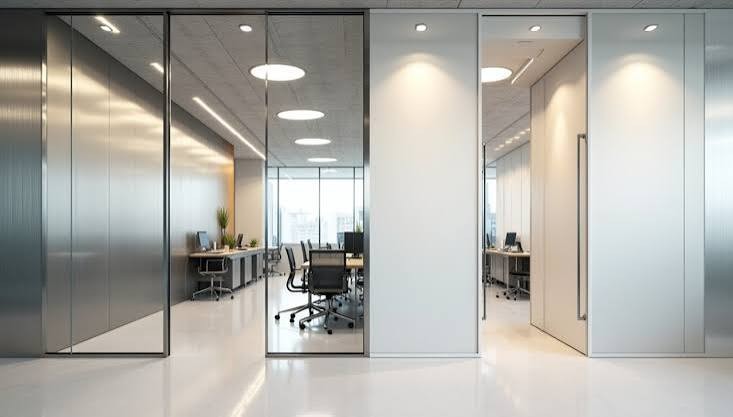
Glass office partitions use transparent, frosted, tinted or decorative glass panels to divide interior spaces while maintaining visual openness.
They are commonly installed in modern corporate offices, reception areas, conference rooms, boardrooms and executive offices.
Glass partitions are popular because they allow natural light to move between different office sections, making workplaces appear brighter, more spacious and contemporary.
Common glass partition options include:
- Frameless glass partitions.
- Aluminium-framed glass partitions.
- Frosted glass office partitions.
- Double-glazed glass partitions.
- Sliding glass office partitions.
- Tinted and decorative glass partitions.
Glass is an excellent option for businesses that want to maintain an open office appearance while creating separate functional spaces.
2. Aluminium Office Partitions
<image-placeholder></image-placeholder>
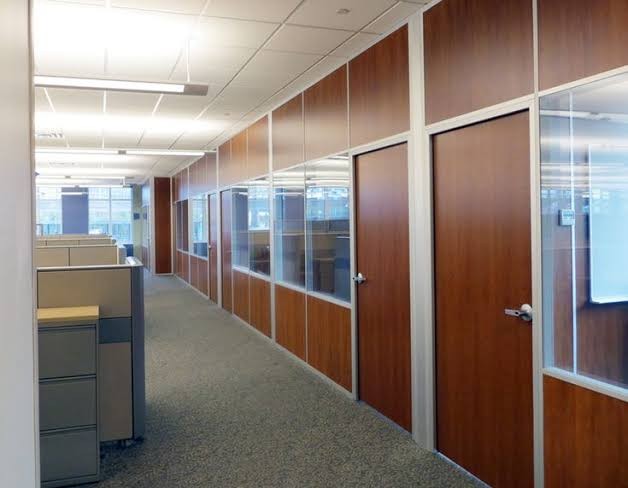
Aluminium office partitions use aluminium framing systems, which may incorporate glass panels, solid infill panels or a combination of materials.
Aluminium is lightweight, corrosion-resistant when properly finished, durable and suitable for different commercial interior designs.
These partitions are commonly used in corporate offices, banks, hospitals, educational institutions, commercial buildings and reception areas.
Popular aluminium partition designs include:
- Aluminium-framed glass partitions.
- Full-height aluminium office partitions.
- Aluminium partitions with solid panels.
- Aluminium and glass combination partitions.
- Sliding aluminium partitions.
- Custom-designed aluminium partition systems.
Aluminium partitions are particularly suitable for businesses looking for a durable framing system that combines functionality with a modern appearance.
3. Gypsum Board Office Partitions
Gypsum board office partitions are constructed using gypsum panels fixed onto a supporting framework, usually made from galvanised steel or timber.
They provide solid internal walls that can be painted and finished to match the office interior design.
Gypsum partitions are suitable for offices requiring greater visual privacy, enclosed rooms and clearly separated departments.
Common applications include:
- Private executive offices.
- Meeting rooms.
- Human resource departments.
- Accounting offices.
- Consultation rooms.
- Storage areas.
- Internal departmental divisions.
Gypsum board partitions are especially useful where businesses want enclosed office spaces with smooth, professional finishes.
Glass vs Aluminium vs Gypsum Office Partitions: Key Differences
The three partitioning systems offer different features depending on the intended application.
| Feature | Glass Partitions | Aluminium Partitions | Gypsum Partitions |
|---|---|---|---|
| Appearance | Modern and elegant | Modern and versatile | Smooth and contemporary |
| Natural light | Excellent | Depends on panel selection | Limited |
| Visual privacy | Low unless treated | Depends on infill material | High |
| Sound insulation | Depends on glass system | Depends on construction | Good with suitable acoustic systems |
| Durability | Good with suitable safety glass | Good with quality framing | Good when properly installed and protected |
| Maintenance | Requires regular glass cleaning | Generally easy | Occasional repairs and repainting |
| Design flexibility | High | High | High |
| Installation | Requires specialist fitting | Requires accurate fabrication and fitting | Relatively quick |
| Best application | Boardrooms and modern offices | Flexible commercial divisions | Private enclosed rooms |
The best option depends on your office layout, privacy requirements, budget and preferred interior design.
1. Consider the Level of Privacy Required
Privacy is one of the most important factors when choosing office partitions.
Different departments and working areas require different levels of separation.
Glass partitions
Clear glass partitions provide visual openness but limited visual privacy. However, frosted, tinted, patterned or electronically switchable privacy glass can provide greater privacy while maintaining a modern appearance.
They are suitable for reception areas, collaborative spaces and meeting rooms where visibility is important.
Aluminium partitions
Aluminium partitions can provide different privacy levels depending on the materials used within the frames. Solid panels offer more visual privacy, while glass infill panels maintain openness.
They are suitable for offices requiring a balance between separation and visibility.
Gypsum partitions
Gypsum partitions provide solid visual separation and are suitable for enclosed offices, confidential meeting rooms and administrative departments.
They can also incorporate acoustic insulation for improved sound privacy.
Recommendation: Choose gypsum board for enclosed private offices, frosted glass for stylish meeting rooms and aluminium systems with appropriate solid or glass panels for flexible departmental separation.
2. Evaluate Natural Lighting and Office Brightness
Natural lighting contributes to a comfortable and welcoming working environment.
A poorly designed office layout may create dark interior spaces, particularly when rooms are separated using solid walls.
Glass partitions allow natural light to pass between office areas, reducing the need for artificial lighting during daylight hours.
Aluminium-framed glass partitions also support good light distribution while providing structural framing and design flexibility.
Gypsum partitions, on the other hand, create solid divisions that block direct light between rooms unless combined with windows or glass sections.
Recommendation: If your office has limited natural lighting, consider clear glass partitions or aluminium-framed glass systems. They help maintain a brighter and more open atmosphere.
3. Compare the Cost of Installation
The cost of office partitioning in Uganda depends on the materials, dimensions, design, installation requirements and finishing specifications.
Each partitioning system has different cost considerations.
Glass partitions: Costs are influenced by glass thickness, safety glass specifications, framing, fittings, doors and decorative finishes.
Aluminium partitions: Pricing depends on aluminium profile quality, frame design, panel materials, hardware, fabrication and installation.
Gypsum partitions: Costs depend on board type, number of board layers, framework, insulation, joint treatment and finishing.
When comparing quotations, consider the complete installed system rather than the price of individual materials.
For an accurate quotation, request a site assessment and detailed breakdown of the materials and installation work.
4. Consider Sound Insulation and Noise Control
Noise can reduce concentration and affect productivity, especially in busy offices where employees handle different tasks.
The ability of a partition to control sound depends on its construction and installation.
Glass partitions: Single-glazed systems provide some sound separation, but acoustic-rated laminated or double-glazed systems can offer improved performance when properly installed and sealed.
Aluminium partitions: Their acoustic performance depends on the infill materials, glazing specification, seals and overall partition construction.
Gypsum partitions: Gypsum systems can achieve good sound insulation when designed with suitable insulation materials, multiple board layers and properly sealed joints.
Recommendation: For confidential offices and meeting rooms, consider tested acoustic partition systems rather than choosing a material based on appearance alone.
5. Assess Durability and Maintenance Requirements
A good office partition should maintain its appearance and functionality over time.
Each partitioning material has different maintenance requirements.
Glass partitions
Glass is durable when suitable safety glass is specified and installed correctly. Regular cleaning is necessary to remove fingerprints, dust and stains. Hardware and seals should also be inspected periodically.
Aluminium partitions
Aluminium is valued for its lightweight construction and resistance to corrosion. Quality finishes and properly installed fittings help maintain its appearance and performance.
Gypsum partitions
Gypsum partitions are durable in normal indoor conditions but may be damaged by impacts or persistent moisture. Scratches, small holes and damaged sections can usually be repaired and repainted.
Recommendation: Choose the partition system according to the expected level of daily use, maintenance capacity and environmental conditions.
6. Match the Partition to Your Office Design
Your office partitioning system should complement the building’s architectural style and company identity.
Different materials create different interior appearances.
Glass partitions create a sophisticated, open and contemporary appearance.
Aluminium partitions provide clean lines and can be customised using different frame finishes and panel combinations.
Gypsum partitions offer smooth surfaces that can be painted in corporate colours and decorated to match the overall interior design.
Businesses can also combine these materials to create more attractive and functional spaces.
For example, a modern office may feature glass partitions for meeting rooms, aluminium-framed divisions for departmental areas and gypsum walls for private offices.
7. Consider Installation Time and Office Disruption
Installation time is an important consideration, particularly for businesses that need to continue operating during renovations.
Gypsum board partitions are generally quicker to install than traditional masonry walls, although joint treatment and finishing require additional time.
Glass partitions require accurate measurements, specialist glass handling and careful installation.
Aluminium partitions may require fabrication before installation, depending on the design and complexity of the system.
The total project duration depends on the size of the office, site preparation, material availability and design requirements.
Professional planning helps reduce unnecessary delays and disruption to business operations.
8. Consider Safety and Fire Performance
Office partitions should meet the safety requirements of the building and the intended use of the space.
For glass partitions, appropriately specified safety glass, such as toughened or laminated glass, should be selected according to the application.
Aluminium framing should be properly fabricated and installed to support the selected panels.
For gypsum partitions, fire-resistant board systems are available for applications requiring improved fire performance. However, the required fire rating must be established for the complete tested partition assembly.
Businesses should work with qualified professionals to ensure that partitioning systems meet applicable building and fire safety requirements.
9. Think About Future Office Expansion and Flexibility
Businesses grow, departments change and office space requirements evolve.
Choosing a partitioning system that supports future modifications can help reduce renovation costs.
Glass and aluminium partitions can be suitable for offices that require adaptable layouts, depending on whether the system is designed for disassembly and reconfiguration.
Gypsum partitions can also be modified, although removal or relocation generally involves additional finishing and repair work.
If your business expects frequent office reorganisations, discuss modular or demountable partitioning options with your contractor.
Best Applications for Glass, Aluminium and Gypsum Office Partitions
Understanding where each partitioning system works best makes it easier to select the right option.
Where to Use Glass Office Partitions
Glass partitions are particularly suitable for:
- Corporate boardrooms.
- Conference and meeting rooms.
- Reception areas.
- Executive offices.
- Collaborative workspaces.
- Modern commercial offices.
They are ideal where natural light, transparency and a modern appearance are priorities.
Where to Use Aluminium Office Partitions
Aluminium partitions are suitable for:
- Corporate office divisions.
- Commercial reception areas.
- Hospital administrative offices.
- Educational institutions.
- Banks and financial institutions.
- Commercial buildings.
- Offices requiring customised framing systems.
They provide flexibility in design and can accommodate different panel materials.
Where to Use Gypsum Board Office Partitions
Gypsum partitions are commonly used for:
- Private executive offices.
- Human resource departments.
- Accounting offices.
- Confidential meeting rooms.
- Consultation rooms.
- Storage spaces.
- Internal office divisions.
They are suitable where visual privacy and solid internal walls are required.
Can You Combine Glass, Aluminium and Gypsum Office Partitions?
Yes. Combining different partitioning materials is one of the most effective ways to achieve a functional and attractive office interior.
Rather than using one material throughout the entire building, businesses can select different partitioning systems for different rooms.
For example:
Reception area: Aluminium-framed glass partitions can create a welcoming and professional first impression.
Boardroom: Frosted or clear glass partitions can provide a modern meeting environment with suitable privacy treatments.
Executive offices: Gypsum partitions can create enclosed private spaces.
Departmental workspaces: Aluminium-framed glass or solid-panel partitions can help organise employees while maintaining a consistent interior appearance.
Consultation rooms: Gypsum or appropriately specified acoustic glass systems can provide the required privacy.
Combining materials allows businesses to balance appearance, functionality, privacy and cost.
Common Mistakes to Avoid When Choosing Office Partitions
Before selecting an office partitioning system, avoid these common mistakes:
- Choosing based on price alone: Cheap materials or poor installation can result in additional maintenance and replacement costs.
- Ignoring sound insulation: A visually attractive partition may not provide sufficient acoustic privacy for meetings and confidential discussions.
- Overlooking natural lighting: Installing too many solid partitions can make an office feel dark and enclosed.
- Using unsuitable materials: Standard gypsum boards, for example, are not appropriate for areas exposed to persistent moisture.
- Ignoring future office needs: A partitioning design should consider potential business growth and workspace changes.
- Failing to plan electrical installations: Sockets, switches, lighting and network connections should be considered before partitions are installed.
- Hiring inexperienced installers: Poor measurements, weak framing and badly finished joints can affect the quality and durability of the entire installation.
How to Choose the Right Office Partitioning Contractor in Uganda
Selecting the right contractor is just as important as choosing the partitioning material.
A professional contractor should understand the technical requirements of glass, aluminium and gypsum partitioning systems.
Before hiring an office partitioning company, consider:
- Experience in office partitioning and interior design.
- Knowledge of different partitioning materials.
- Quality of previous installation projects.
- Ability to provide customised designs.
- Quality of materials and fittings.
- Clear project quotations.
- Installation standards and finishing quality.
- Ability to meet project timelines.
It is also advisable to request a site inspection before installation so that measurements, layout requirements and material specifications can be assessed accurately.
Why Choose Daltrevco for Office Partitioning Solutions in Uganda?
Choosing the right office partitioning solution requires a good understanding of building interiors, available materials and the functional requirements of each workspace.
Daltrevco provides construction and interior solutions for clients seeking practical, attractive and professionally planned spaces in Uganda.
Whether you are interested in glass office partitions, aluminium partition systems or gypsum board partitions, selecting the right design and installation approach is essential to achieving a successful result.
Daltrevco focuses on solutions that help businesses:
- Improve office space utilisation.
- Create organised working environments.
- Achieve modern and professional interiors.
- Select suitable partitioning materials.
- Develop functional layouts for different departments.
- Improve the appearance and usability of commercial spaces.
Whether you are planning a new office, renovating an existing building or expanding your business premises, Daltrevco can help you explore suitable construction and interior solutions.
Visit https://www.daltrevco.com/ to learn more about our services.
Frequently Asked Questions About Office Partitioning
1. Which is better for office partitioning: glass, aluminium or gypsum?
There is no single best material for every office. Glass is ideal for natural lighting and modern designs, aluminium offers flexible framing and panel options, while gypsum is suitable for enclosed spaces requiring visual privacy.
2. Are glass office partitions better than gypsum partitions?
Glass partitions are better where visibility, natural light and an open appearance are priorities. Gypsum partitions are more suitable for private rooms and enclosed office spaces. The choice depends on the purpose of the room.
3. Are aluminium office partitions durable?
Yes. Aluminium partitions are durable when manufactured using quality profiles and installed correctly. Aluminium is lightweight and naturally corrosion-resistant, making it suitable for many commercial interior applications.
4. Which office partition provides the best sound insulation?
A properly designed gypsum partition with acoustic insulation and multiple board layers can provide good sound insulation. However, specialist acoustic glass and other tested partition systems can also achieve strong acoustic performance.
5. Are gypsum partitions cheaper than glass partitions?
Gypsum partitions can be more affordable for many solid internal wall applications. However, the actual cost depends on board specifications, framing, insulation, glass requirements, finishing and installation.
6. Can aluminium and glass partitions be used together?
Yes. Aluminium frames are commonly used to support glass panels. This combination creates modern office partitions that provide structural framing, natural light and different design possibilities.
7. Which partition is best for a small office?
Glass and aluminium-framed glass partitions are often suitable for small offices because they maintain visual openness and allow light to spread throughout the workspace. Gypsum can be used where private enclosed rooms are necessary.
8. Can office partitions be customised?
Yes. Glass, aluminium and gypsum partitions can all be customised to suit different office layouts, dimensions, colours, finishes and functional requirements.
9. How much does office partitioning cost in Uganda?
The cost depends on the partition material, total area, design, glass thickness, aluminium profile specifications, gypsum board type, insulation and installation requirements. A site assessment is the best way to obtain an accurate quotation.
10. Can different partitioning materials be used in one office?
Yes. Combining glass, aluminium and gypsum is a practical way to meet different office requirements. For example, glass can be used in boardrooms, aluminium partitions in departmental areas and gypsum partitions in private offices.
Conclusion
Choosing between glass, aluminium and gypsum office partitions depends on your business requirements, office layout, privacy needs, budget and preferred interior design.
Glass partitions are ideal for creating bright, modern and visually open workplaces. Aluminium partitions provide durable framing systems with flexible design options, while gypsum board partitions are suitable for enclosed rooms requiring greater visual privacy and smooth interior finishes.
For many modern offices in Uganda, combining these materials provides the best balance of functionality, appearance and efficient space utilisation.
Before beginning your office partitioning project, assess your requirements carefully and work with an experienced contractor who can recommend suitable materials and professional installation solutions.
Looking for professional office partitioning solutions in Uganda? Contact Daltrevco today to discuss your project and create an office environment that combines modern design, functionality and quality workmanship.
Visit https://www.daltrevco.com/ to get started.