
Solar energy is becoming an increasingly practical solution for homes, offices, commercial buildings, factories, farms and other properties in Uganda. With the right solar power system, property owners can generate electricity from sunlight, reduce dependence on the national grid, manage electricity expenses and maintain a reliable power supply during outages.
However, successful solar panel installation involves more than simply mounting panels on a roof. A properly designed system must have the correct solar panel capacity, suitable inverter, appropriate battery storage where required, safe electrical connections and a mounting structure capable of withstanding local weather conditions.
Understanding the solar panel installation process, essential components and technical requirements helps property owners make informed decisions and avoid costly installation mistakes.
This guide explains how solar panel installation works in Uganda, the equipment required, the steps involved, important safety considerations and how to choose the right solar installation company.
What Is Solar Panel Installation?
Solar panel installation is the process of designing, mounting and connecting photovoltaic (PV) panels and associated electrical equipment to generate usable electricity from sunlight.
Solar panels contain photovoltaic cells that convert sunlight into direct current (DC) electricity. An inverter converts this electricity into alternating current (AC), which is used by most household and commercial electrical appliances.
Depending on the system design, the generated electricity can be:
- Used immediately to power electrical appliances.
- Stored in batteries for use at night or during power interruptions.
- Supplied to the national electricity grid where an approved grid-connected arrangement is available.
- Used in combination with grid electricity or another backup power source.
A professionally installed solar power system should be designed around the property’s electricity consumption, available installation space, operating requirements and future energy needs.
Types of Solar Panel Systems Available in Uganda
Before beginning installation, it is important to select a solar system that suits the property. The three main types are off-grid, grid-tied and hybrid solar systems.
1. Off-Grid Solar Systems
An off-grid solar system operates independently of the national electricity grid. It generates electricity through solar panels and stores excess energy in batteries for later use.
Off-grid systems are particularly useful for:
- Homes in areas without reliable grid access.
- Rural properties and farms.
- Remote accommodation facilities.
- Agricultural operations.
- Buildings requiring independent electricity supplies.
The battery bank is an important part of an off-grid system because it provides electricity when sunlight is unavailable.
2. Grid-Tied Solar Systems
A grid-tied solar system is connected to the national electricity grid. Solar panels generate electricity during daylight hours, reducing the amount of electricity the property needs to obtain from the grid.
Depending on the approved system arrangement, excess electricity may be exported to the grid under applicable utility requirements.
Grid-tied systems commonly suit offices, shops, commercial buildings and properties with reliable grid access.
An important consideration is that conventional grid-tied inverters normally shut down during a grid outage for safety. They do not automatically provide backup electricity unless the system has been specifically designed with suitable backup equipment and an appropriate electrical arrangement.
3. Hybrid Solar Systems
A hybrid solar system combines solar panels, battery storage and grid electricity. It can use solar energy during the day, store surplus electricity in batteries and draw electricity from the grid when necessary.
Hybrid systems are suitable for:
- Residential buildings.
- Offices and commercial premises.
- Hotels and lodges.
- Clinics and healthcare facilities.
- Schools and educational institutions.
- Businesses that require dependable backup electricity.
The main advantage of a hybrid system is its flexibility. The system can be designed to prioritise solar generation, battery storage or grid electricity according to the property’s needs.
Main Components Required for Solar Panel Installation
A complete solar installation consists of several components that work together to generate, convert, distribute and, where applicable, store electricity.
Choosing compatible, appropriately rated equipment is essential for system efficiency, safety and long-term performance.
1. Solar Panels
Solar panels are the primary components responsible for converting sunlight into electricity.
They are made up of photovoltaic cells that produce DC electricity when exposed to sunlight.
When selecting solar panels, consider:
- Total rated power output in watts.
- Panel efficiency.
- Physical dimensions and available roof space.
- Performance under local environmental conditions.
- Manufacturer warranty and product documentation.
- Compatibility with the selected inverter.
The total number of panels required depends on the property’s electricity consumption, available sunlight, system design and the output rating of each panel.
2. Solar Inverter
The solar inverter converts the DC electricity produced by the panels into AC electricity used by most electrical appliances.
It also manages important functions depending on the inverter type and system design.
Common inverter types include:
- String inverters.
- Hybrid inverters.
- Off-grid inverters.
- Microinverters.
The inverter must be correctly sized for the system’s expected power demand. Its continuous output capacity, surge capability, battery compatibility, input voltage range and monitoring features should all be considered.
An undersized inverter may struggle to support the required appliances, while an unsuitable or unnecessarily oversized unit can increase installation costs.
3. Solar Batteries
Solar batteries store electricity generated during the day for use when solar production is insufficient, especially at night or during cloudy conditions.
They are particularly important in off-grid and hybrid solar installations.
Common battery technologies include lithium-ion batteries and lead-acid batteries.
When selecting battery storage, consider:
- Total energy storage capacity in kilowatt-hours (kWh).
- Usable battery capacity.
- Maximum charging and discharging rates.
- Expected backup duration.
- Battery management system compatibility.
- Operating temperature and ventilation requirements.
- Manufacturer warranty and expected service life.
Battery capacity should be based on the appliances that must remain operational and the number of hours they need to run.
4. Solar Charge Controller
A solar charge controller regulates electricity flowing from solar panels to batteries.
It helps prevent inappropriate charging and protects batteries from operating outside their permitted charging limits.
The two common technologies are:
- PWM (Pulse Width Modulation): A simpler charging technology commonly used in smaller systems.
- MPPT (Maximum Power Point Tracking): Adjusts the electrical operating point of the solar panels to improve energy harvesting under varying conditions.
Some modern hybrid and off-grid inverters include built-in MPPT charge controllers, meaning a separate controller may not be necessary.
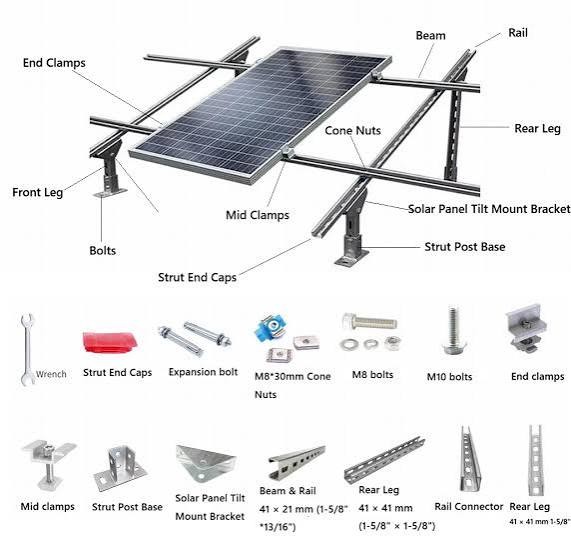
5. Mounting Structures and Rails
Mounting structures secure solar panels to rooftops, ground-mounted frames or other suitable supporting surfaces.
They must be strong enough to support the panels and withstand wind, rain and other environmental conditions.
The mounting system should:
- Be compatible with the selected panels.
- Be suitable for the roof material or ground installation.
- Provide secure mechanical fixing.
- Resist corrosion.
- Maintain appropriate panel spacing and ventilation.
- Avoid damaging the roof or creating water leakage points.
6. Solar Cables and Connectors
Solar cables and connectors transfer electricity between the panels, inverter, batteries and other system components.
They must be correctly rated for the expected voltage, current, installation environment and cable route.
Using unsuitable cables or poorly installed connectors can result in overheating, voltage losses, electrical faults and fire risks.
7. Protection and Isolation Equipment
Solar systems require appropriate electrical protection to reduce the risk of equipment damage, electric shock and fire.
Depending on the system design, protection equipment may include:
- DC isolators.
- AC circuit breakers.
- DC fuses.
- Surge protection devices.
- Residual-current protection where required.
- Earthing and bonding arrangements.
- Appropriate lightning protection measures.
Protection equipment must be correctly selected and installed in accordance with the system design and applicable electrical requirements.
8. Monitoring and Control Equipment
Monitoring equipment allows property owners and technicians to check solar system performance.
Depending on the inverter and system configuration, monitoring features may display:
- Daily solar energy production.
- Battery charging and discharge levels.
- Electricity consumption.
- Grid electricity usage.
- System faults and alerts.
- Historical energy performance.
Monitoring helps identify performance problems and supports effective maintenance.
Solar Panel Installation Requirements in Uganda
Before installing solar panels, property owners should assess the building, electrical system, energy demand and installation environment.
The following requirements help ensure a safe, reliable and properly functioning installation.
1. Conduct an Energy Assessment
The first requirement is understanding how much electricity the property consumes.
A professional installer should assess the electricity usage of appliances and equipment such as:
- Lighting systems.
- Refrigerators and freezers.
- Televisions and entertainment equipment.
- Computers and office equipment.
- Water pumps.
- Air conditioning systems.
- Industrial machinery.
- Security systems.
- Communication equipment.
The assessment should identify the appliances that will run on solar power, their power ratings and how long they operate each day.
For properties with an existing electricity connection, previous electricity bills and available meter data can help establish consumption patterns.
2. Determine the Required Solar System Capacity
Solar system capacity should match the property’s energy requirements.
The installer must estimate daily electricity consumption, available sunlight, system losses, battery requirements and expected operating conditions.
For example, a property with high daytime electricity consumption may require a different system design from a home that needs most of its electricity during the evening.
The design should also consider future expansion where additional appliances, equipment or building facilities may be introduced.
3. Assess the Roof or Installation Site
The installation location affects how much sunlight the panels receive and how safely they can be mounted.
A site assessment should consider:
- Available roof space.
- Roof condition and structural strength.
- Nearby buildings and trees that may cause shading.
- Roof orientation and slope.
- Wind exposure.
- Drainage and water protection.
- Accessibility for installation and maintenance.
Where the roof is unsuitable, a professionally designed ground-mounted solar installation may be an alternative.
4. Evaluate Sunlight Exposure and Shading
Solar panels require adequate sunlight to generate electricity effectively.
Shading from trees, neighbouring buildings, water tanks, chimneys and other structures can reduce energy production.
The installer should assess shading throughout the day and consider how it changes with the seasons.
Where shading cannot be avoided, the system may require a suitable panel layout, optimised electrical configuration or equipment designed to reduce the impact of shading.
5. Check Electrical Infrastructure
The property’s existing electrical installation must be assessed before solar equipment is connected.
The installer should check:
- Distribution boards.
- Existing wiring and cable capacity.
- Circuit protection.
- Earthing arrangements.
- Main electrical supply.
- Load distribution.
- Compatibility with the proposed inverter.
- Requirements for backup circuits.
Electrical modifications may be necessary to accommodate the new solar installation safely.
6. Confirm Applicable Approvals and Utility Requirements
Some solar installations may require additional approvals, inspections or coordination with the relevant electricity utility, particularly where the system will operate in parallel with the national grid or export electricity.
Property owners should confirm the applicable requirements before installation begins.
The installer should also ensure that the electrical design, equipment and installation comply with relevant Ugandan requirements and applicable technical standards.
Solar Panel Installation Process: Step-by-Step Guide
Professional solar panel installation follows a planned process to ensure that the system is correctly designed, securely mounted, properly connected and tested before use.
Step 1: Initial Consultation and Site Assessment
The process begins with a discussion about the property’s electricity requirements.
The solar installation company gathers information about energy consumption, available installation space, backup expectations and the owner’s budget.
A physical site assessment then evaluates roof suitability, sunlight exposure, shading, electrical infrastructure and equipment locations.
This information provides the foundation for the system design.
Step 2: Solar System Design and Planning
After the assessment, the installer prepares a solar system design based on the property’s energy requirements.
The design determines:
- Required solar panel capacity.
- Number and arrangement of panels.
- Inverter type and rating.
- Battery storage capacity, where required.
- Solar charge controller specifications.
- Cable sizes and electrical protection.
- Mounting structure requirements.
- Equipment locations and installation layout.
A detailed design helps ensure that all components work together correctly.
Step 3: Selecting Solar Equipment
The next stage involves selecting suitable equipment.
Solar panels, inverters, batteries, cables, mounting structures and protection devices should be compatible and appropriately rated.
Property owners should request clear equipment specifications, manufacturer details, warranty information and a written installation quotation.
The cheapest equipment is not necessarily the most economical option over the system’s operating life.
Step 4: Preparing the Installation Site
Before mounting the panels, technicians prepare the roof or ground installation area.
Preparation may involve:
- Cleaning and inspecting the roof.
- Checking the structural condition.
- Identifying suitable mounting points.
- Planning cable routes.
- Preparing inverter and battery locations.
- Arranging necessary electrical isolation and safety measures.
Any structural or roof defects should be addressed before installation proceeds.
Step 5: Installing the Mounting Structures
Technicians install the rails, brackets and supporting structures that hold the solar panels in position.
Mounting points must be secure and suitable for the building structure.
The installation should protect the roof from water penetration and allow the panels to remain firmly supported under expected environmental conditions.
Step 6: Mounting the Solar Panels
Once the supporting structures are ready, technicians position and secure the solar panels.
Panel spacing, orientation and arrangement should follow the system design and manufacturer instructions.
Panels should be positioned to minimise shading and allow sufficient ventilation behind them.
Care should also be taken to avoid damaging the panel frames, glass surfaces or electrical connectors during handling.
Step 7: Installing the Inverter and Batteries
The inverter and batteries are installed in appropriate locations according to manufacturer requirements.
The inverter should be protected from excessive heat, moisture and unauthorised access.
Battery installations must follow the manufacturer’s requirements for mounting, ventilation, temperature, clearances and electrical protection.
The installer should also ensure that the equipment remains accessible for inspection and maintenance.
Step 8: Connecting Solar Cables and Electrical Protection
Technicians connect the solar panels to the inverter and integrate the battery system where applicable.
All wiring should be correctly sized, routed, supported, labelled and protected.
DC and AC circuits must have appropriate isolation and protective devices.
Earthing and bonding should be completed according to the electrical design and applicable requirements.
Only qualified personnel should carry out electrical connections and testing.
Step 9: System Configuration and Testing
After installation, the system is configured according to the selected equipment and operating requirements.
Testing should verify that:
- Solar panels are connected correctly.
- Polarity and electrical connections are correct.
- Inverter settings are appropriate.
- Batteries communicate and charge correctly where applicable.
- Protective devices operate as intended.
- Earthing and safety arrangements are satisfactory.
- The system produces electricity as expected.
- Monitoring equipment functions correctly.
For grid-connected systems, applicable utility requirements and commissioning procedures must also be followed.
Step 10: Commissioning and Handover
The final stage is commissioning and handing over the completed solar installation.
The property owner should receive relevant equipment manuals, warranty documentation, system specifications and maintenance guidance.
The installer should explain how to monitor the system, interpret common warning indicators and respond to faults.
A properly documented handover makes it easier to maintain the system and obtain technical support in the future.
Factors That Affect Solar Panel Installation Costs in Uganda
Solar panel installation costs vary depending on the size, complexity and technical requirements of the project.
There is no single price that applies to every property because a small residential installation and a large commercial solar system require different equipment and installation work.
Important cost factors include:
1. Solar Panel Capacity
Larger solar installations generally require more panels, mounting materials, cables and installation labour.
The required capacity depends on electricity consumption and expected solar generation.
2. Inverter Type and Capacity
The inverter’s rating, technology, features and compatibility with the system affect the total cost.
Hybrid and specialised commercial inverters may have different costs from basic grid-tied or off-grid units.
3. Battery Storage Requirements
Battery storage can significantly affect the project budget.
The required capacity depends on how much electricity must be stored and how long the property needs backup power.
Properties requiring longer backup periods generally need greater usable battery capacity.
4. Installation Location and Roof Condition
Roof height, accessibility, structural condition and mounting complexity can affect labour and material costs.
Ground-mounted installations may also require additional foundations, supporting structures and site preparation.
5. Electrical Protection and Wiring
Proper cables, isolators, circuit breakers, surge protection and earthing equipment are necessary for a safe installation.
These components should be included in the project budget rather than treated as optional extras.
6. Project Size and Complexity
Commercial and industrial installations may require detailed engineering, larger inverters, multiple distribution circuits, specialised mounting arrangements and additional commissioning work.
The final quotation should clearly explain the equipment, installation work and any additional requirements.
Common Solar Panel Installation Mistakes to Avoid
Poor planning and improper installation can reduce system performance, increase maintenance costs and create safety risks.
Property owners should avoid the following mistakes:
Installing an Undersized Solar System
A system that cannot meet the property’s energy demand may result in frequent battery depletion, continued dependence on grid electricity or unreliable power supply.
Always carry out an energy assessment before selecting equipment.
Choosing an Inverter Without Checking Compatibility
The inverter must be compatible with the solar panel configuration, battery technology and electrical requirements.
Incorrect matching can lead to poor performance or equipment faults.
Ignoring Battery Capacity
A solar system may generate sufficient electricity during the day but still fail to provide the expected night-time backup if the battery is too small.
Battery capacity should be calculated according to actual backup requirements.
Installing Panels in Shaded Areas
Shading can reduce solar generation and affect system performance.
A proper site assessment should identify potential shading problems before the panel layout is finalised.
Using Poor-Quality Mounting Materials
Weak or unsuitable mounting structures can cause panels to become loose or damaged.
Use durable, compatible mounting equipment designed for the installation environment.
Neglecting Electrical Protection
Inadequate isolation, incorrect cable sizing, poor earthing and unsuitable protective devices can create serious hazards.
All electrical work should be completed and tested by appropriately qualified personnel.
Choosing an Installer Based Only on Price
A low quotation may exclude essential components, proper protection, commissioning or after-installation support.
Compare quotations based on equipment quality, system design, workmanship, warranties and the full scope of work.
Benefits of Professional Solar Panel Installation
Working with an experienced solar installation company offers several important benefits.
Correct system sizing: Professional assessment helps ensure that the solar system is designed around actual electricity consumption.
Improved safety: Proper wiring, isolation, earthing and protective equipment reduce electrical risks.
Better system performance: Correct panel positioning, equipment compatibility and configuration help maximise the useful electricity generated.
Reliable backup power: Suitable battery and inverter selection helps meet the property’s backup requirements.
Reduced installation errors: Professional planning and testing help identify problems before the system is put into regular operation.
Long-term maintenance support: A reputable installer can provide guidance, troubleshooting and maintenance services after commissioning.
Solar Panel Installation for Different Types of Properties
Solar power systems can be designed for different building types and electricity requirements.
Residential Solar Panel Installation
Home solar installations can support lighting, refrigeration, entertainment equipment, security systems and other household appliances.
The system may be grid-tied, off-grid or hybrid depending on the property’s electricity supply and backup requirements.
Commercial Solar Panel Installation
Offices, shops, hotels, restaurants and other commercial properties can use solar power to support lighting, computers, refrigeration, air conditioning and other business equipment.
System design should account for operating hours, daytime electricity demand and critical business operations.
Industrial Solar Panel Installation
Factories, workshops and industrial facilities may require larger solar installations to support machinery, lighting, pumps and other equipment.
Industrial projects need careful load assessment, electrical engineering and consideration of equipment starting currents and operating patterns.
Agricultural Solar Panel Installation
Solar power can support irrigation pumps, farm buildings, water supply systems, refrigeration and other agricultural operations.
For properties in remote locations, off-grid solar installations can provide electricity without relying entirely on grid connections.
Solar Panel Maintenance After Installation
Regular maintenance helps maintain solar system performance and identify developing faults.
Important maintenance activities include:
- Inspecting panels for dirt, dust, leaves and physical damage.
- Cleaning panels using suitable methods recommended by the manufacturer.
- Checking mounting structures and fasteners.
- Inspecting cables and electrical connections for visible deterioration.
- Checking inverter displays and system alerts.
- Monitoring battery performance and charging behaviour.
- Inspecting protective equipment and earthing arrangements.
- Reviewing energy production for unusual performance changes.
Maintenance frequency depends on the installation environment, equipment instructions and operating conditions.
Electrical inspections and repairs should be handled by qualified technicians. Property owners should not attempt to work on live solar circuits or open electrical equipment.
How to Choose the Best Solar Panel Installation Company in Uganda
Choosing the right solar installation company is essential for obtaining a safe, reliable and properly designed system.
Before hiring an installer, consider the following:
- Technical experience: Choose a company with experience designing and installing solar systems for properties similar to yours.
- Site assessment: The company should assess your property and electricity consumption before recommending a system.
- Equipment quality: Ask for the specifications, manufacturer details and warranties of the proposed panels, inverter and batteries.
- System design: Request a clear explanation of the proposed system capacity and how it will meet your energy requirements.
- Electrical safety: Confirm that the installation includes suitable cables, isolation, protection and earthing.
- Written quotation: The quotation should identify equipment, labour, installation materials and any exclusions.
- After-installation support: Choose an installer who can provide maintenance guidance and technical assistance.
- Documentation: Request installation records, equipment manuals, warranty information and commissioning results.
A professional installer should be able to explain why particular components have been selected and how the complete system will operate.
Frequently Asked Questions About Solar Panel Installation
1. How long does solar panel installation take?
Installation time depends on system size, site conditions, roof accessibility and electrical complexity. A straightforward residential installation may take a shorter period, while larger commercial and industrial projects can require several days or longer, including preparation and commissioning.
2. How many solar panels do I need for my home?
The number depends on your daily electricity consumption, panel output, available sunlight, system losses and available installation space. A professional energy assessment is the best way to determine the correct number.
3. Can solar panels power an entire house?
Yes. A properly designed solar system can power an entire household, provided its generation capacity, inverter rating and battery storage where required are sufficient for the property’s electricity demand.
4. Do solar panels work during cloudy weather?
Solar panels can still generate electricity during cloudy conditions, but their output is generally lower than under strong direct sunlight. System design should account for variations in solar production.
5. Do I need batteries for solar panel installation?
Not always. Grid-tied systems can operate without batteries where backup storage is not required. Off-grid systems need energy storage, while hybrid systems commonly use batteries to provide backup and improve energy flexibility.
6. Can solar panels be installed on any roof?
Not every roof is suitable without modification. The roof must have sufficient space, adequate structural strength and a suitable installation arrangement. A site assessment helps determine whether rooftop or ground-mounted installation is more appropriate.
7. How long do solar panels last?
Solar panels are designed for long-term operation, and many manufacturers provide performance warranties extending for decades. Actual service life and energy output depend on product quality, environmental conditions, installation and maintenance.
8. Can solar power reduce electricity bills in Uganda?
Yes. Solar power can reduce the amount of electricity purchased from the grid by supplying part of the property’s energy demand. The actual savings depend on system capacity, electricity consumption patterns, equipment costs and the applicable electricity arrangement.
9. Is solar panel installation suitable for commercial buildings?
Yes. Solar systems can be designed for offices, hotels, schools, shops, warehouses, factories and other commercial properties. A detailed energy assessment is important to determine the appropriate system size and configuration.
10. What should be included in a solar installation quotation?
A detailed quotation should identify solar panel specifications, inverter capacity, battery capacity where applicable, mounting structures, cables, protection equipment, labour, commissioning, warranties and any additional electrical or structural work.
Get Professional Solar Panel Installation Services in Uganda
Installing a solar power system is an important investment that requires proper planning, quality equipment and professional electrical workmanship. Whether you are installing solar panels for a home, office, commercial building, factory or agricultural property, the system should be designed around your actual electricity requirements.
Daltrevco provides building and electrical solutions tailored to the needs of residential, commercial and industrial properties. When planning a solar installation, work with a professional team that understands the importance of system design, equipment compatibility, electrical safety and reliable installation.
Contact Daltrevco to discuss your solar panel installation requirements and explore a suitable solar power solution for your property in Uganda.
Choose a properly designed solar installation for dependable energy generation, improved electricity management and long-term value.

