
Choosing between a hybrid solar system and an off-grid solar system is an important decision when planning to install solar power for your home, business, farm or commercial property in Uganda.
Both systems provide access to solar-generated electricity and can reduce dependence on conventional electricity supplies. However, they operate differently, have different equipment requirements and are designed for different energy needs.
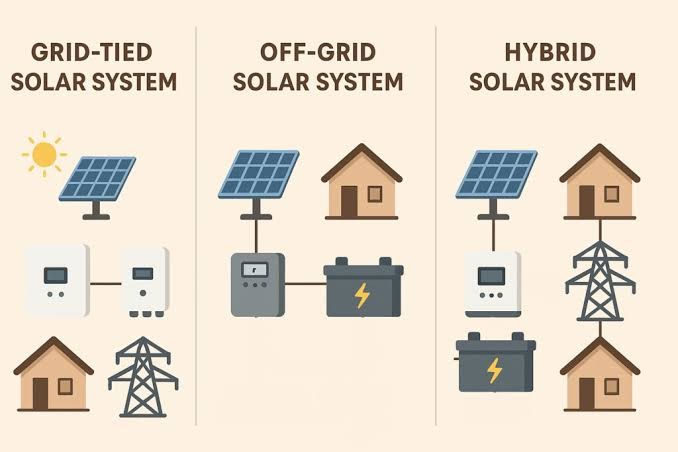
A hybrid solar system combines solar panels, battery storage and grid electricity, allowing users to switch between available energy sources according to system settings and electricity demand. An off-grid solar system operates independently of the national electricity grid and relies on solar panels, battery storage and, where necessary, an alternative backup generator.
Understanding the differences is essential before investing in solar power. The wrong system choice can lead to insufficient backup electricity, unnecessary equipment costs, poor energy management and limitations when expanding the installation.
This guide compares hybrid solar systems and off-grid solar systems in Uganda, explains how each works, examines their benefits and limitations, and provides practical advice on choosing the right solution for residential, commercial, agricultural and industrial applications.
What Is a Hybrid Solar System?
A hybrid solar system is a solar power installation that combines solar panels, battery storage and grid electricity through a compatible hybrid inverter.
The system generates electricity from sunlight and uses it to power connected appliances. Excess solar electricity can charge the batteries, while grid electricity can supplement the supply when solar generation and stored energy are insufficient.
Depending on the inverter and system configuration, a hybrid solar installation can also provide backup electricity during grid interruptions.
Hybrid solar systems are particularly useful for properties that have access to the national electricity grid but want to reduce dependence on it and maintain selected electrical services during power outages.
How Does a Hybrid Solar System Work?
A hybrid solar system manages electricity from three main sources:
- Solar panels: Generate electricity during daylight hours.
- Battery storage: Stores surplus solar energy for later use.
- Grid electricity: Supplements solar generation and battery storage when required.
During the day, solar panels generate electricity that can power appliances directly. Excess electricity may be used to charge the batteries.
At night or during periods of insufficient sunlight, the system can use stored battery energy. If the battery charge becomes low or electricity demand exceeds the available solar and battery supply, the inverter can draw power from the grid, depending on its settings.
When grid electricity fails, a properly designed hybrid system can continue supplying designated backup circuits using solar generation and stored battery energy.
However, not every hybrid inverter provides the same backup functionality. The inverter must have an appropriate backup output, and the battery capacity and electrical installation must be correctly designed.
What Is an Off-Grid Solar System?
An off-grid solar system is an independent electricity generation and storage system that operates without relying on the national electricity grid.
It uses solar panels to generate electricity and batteries to store energy for use when sunlight is unavailable or insufficient.
Off-grid solar systems are suitable for properties in remote areas, rural communities, farms and other locations where grid electricity is unavailable, unreliable or difficult to access.
Some off-grid systems also include a backup generator to provide additional electricity during extended periods of poor solar generation or unusually high energy demand.
How Does an Off-Grid Solar System Work?
An off-grid solar installation operates through a combination of solar generation, battery charging and electricity conversion.
The process generally involves:
- Solar panels capture sunlight and generate DC electricity.
- A solar charge controller or integrated inverter charger regulates battery charging.
- Batteries store electricity for later use.
- An off-grid inverter converts DC electricity into AC electricity.
- Connected appliances receive electricity from the inverter.
- Stored battery energy supplies electricity when solar generation is insufficient.
Because an off-grid system does not have the national electricity grid as a backup source, the solar panels, inverter and battery bank must be carefully sized to meet the property’s electricity requirements.
A generator may be included as an additional backup source where required.
Hybrid Solar Systems vs Off-Grid Solar Systems: Key Differences
Although both systems use solar panels and battery storage, they differ in how they obtain, store and supply electricity.
| Feature | Hybrid solar system | Off-grid solar system |
|---|---|---|
| Grid connection | Connected to the grid where supported | Operates independently of the grid |
| Solar panels | Required | Required |
| Battery storage | Commonly included | Essential |
| Grid electricity | Can supplement solar and battery power | Not available as a normal supply source |
| Backup during outages | Available with suitable backup configuration | Independent of grid outages |
| Generator integration | Possible on compatible systems | Possible and useful for additional backup |
| Energy independence | Partial, depending on system size | High, subject to solar and storage capacity |
| System complexity | Depends on grid, battery and backup integration | Depends on load, storage and generation requirements |
| Suitable applications | Grid-connected homes and businesses | Remote homes, farms and properties without grid access |
The main difference is that a hybrid system can use grid electricity alongside solar and batteries, while an off-grid system must meet its electricity requirements independently of the grid.
Main Components of Hybrid Solar Systems
A hybrid solar installation contains several components that work together to generate, store and manage electricity.
1. Solar Panels
Solar panels convert sunlight into DC electricity.
Their capacity should be determined by the property’s daily electricity consumption, available roof space, sunlight exposure and battery charging requirements.
2. Hybrid Solar Inverter
The hybrid inverter manages electricity from solar panels, batteries and the grid.
It converts DC electricity into AC electricity and controls how energy is distributed within the system.
Its capacity must match the expected electrical demand and the requirements of the connected equipment.
3. Battery Storage
Batteries store surplus electricity generated by solar panels for use when solar production is insufficient.
Battery capacity determines how much stored energy is available for backup operation.
Lithium iron phosphate and lead-acid batteries are among the technologies used in solar storage installations.
4. Electrical Protection Equipment
Protection equipment helps safeguard the solar installation against electrical faults and unsafe operating conditions.
It may include DC isolators, AC circuit breakers, fuses, surge protection devices, appropriate earthing and other protective components.
5. Monitoring and Energy Management Equipment
Modern hybrid systems may include monitoring applications and control systems that display solar generation, battery charge levels, grid consumption and energy usage.
These features help users understand how electricity is being generated and consumed.
Main Components of Off-Grid Solar Systems
Off-grid solar installations use similar equipment but require enough generation and storage capacity to operate independently of the national electricity grid.
1. Solar Panels
Solar panels provide the electricity needed to power appliances and recharge the battery bank.
The total panel capacity should account for daily energy consumption, battery charging requirements and periods of reduced solar generation.
2. Off-Grid Solar Inverter
The off-grid inverter converts DC electricity from the solar panels or batteries into AC electricity for connected appliances.
It must have sufficient continuous output and surge capacity to operate the expected electrical loads.
3. Battery Bank
The battery bank stores electricity for use during evenings, at night and during periods of low solar production.
Because an off-grid installation has no grid supply to rely on, battery capacity is particularly important.
4. Solar Charge Controller
The charge controller regulates electricity flowing from the solar panels to the batteries.
Many modern off-grid inverters have built-in MPPT charge controllers, eliminating the need for a separate unit in those configurations.
5. Backup Generator
Some off-grid installations include a generator to provide additional electricity when solar production is insufficient or battery levels become too low.
A generator is particularly useful for properties with high electricity demand or extended periods of poor solar conditions.
6. Electrical Protection and Distribution Equipment
Appropriate circuit breakers, isolators, cables, earthing and surge protection equipment are necessary to support safe operation.
The distribution arrangement should also allow electrical loads to be managed appropriately.
Advantages of Hybrid Solar Systems
Hybrid solar systems offer several benefits, particularly for properties that already have access to grid electricity.
1. Multiple Sources of Electricity
A hybrid system combines solar generation, battery storage and grid electricity.
This flexibility allows property owners to use solar energy when available and rely on the grid when additional electricity is required.
2. Backup Power During Grid Interruptions
A properly designed hybrid solar installation can continue supplying selected appliances during a power outage.
This is particularly useful for homes, offices, hotels, shops and businesses that require electricity for essential operations.
3. Reduced Dependence on Grid Electricity
Solar panels can supply a significant portion of a property’s daytime electricity demand.
Surplus electricity can be stored in batteries and used later, reducing the amount of electricity purchased from the grid.
4. Better Energy Management
Hybrid inverters allow users to manage how electricity is obtained and distributed.
Depending on the equipment, the system can prioritise solar power, charge batteries, reserve battery capacity for backup and use grid electricity when necessary.
5. Flexible System Expansion
Some hybrid systems allow additional solar panels or battery storage to be added, subject to inverter specifications and system design limits.
This can be useful when a property increases its electricity consumption.
6. Suitable for Urban and Commercial Properties
Hybrid systems are suitable for many grid-connected properties in Kampala, Wakiso, Entebbe and other urban and commercial areas.
They can support homes, offices, hotels, schools, shops and other facilities that want solar energy alongside grid electricity.
Disadvantages of Hybrid Solar Systems
Despite their advantages, hybrid systems also have limitations.
1. Higher Initial Investment Than Basic Grid-Tied Systems
A hybrid installation generally requires battery storage and a compatible inverter, increasing the initial cost compared with a battery-free grid-tied system.
2. Continued Dependence on Grid Electricity
If the solar panels and batteries cannot meet the property’s electricity demand, the system may still need grid electricity.
3. Battery Replacement Costs
Batteries have a limited operating life and may eventually need replacement.
The timing depends on battery technology, operating conditions, charging practices and manufacturer specifications.
4. Equipment Compatibility Requirements
The inverter, batteries and solar panels must be correctly matched.
Incompatible equipment can result in charging problems, communication faults and poor system performance.
Advantages of Off-Grid Solar Systems
Off-grid solar systems offer important benefits for properties that need independent electricity generation.
1. Independence from the National Electricity Grid
An off-grid installation can supply electricity without a connection to the national grid.
This makes it useful for remote homes, farms, rural facilities and other locations where grid access is unavailable or impractical.
2. Reliable Electricity for Remote Properties
A properly designed off-grid system can supply electricity for lighting, refrigeration, communication, water pumping and other essential applications.
This can improve access to electricity in areas with limited infrastructure.
3. Protection from Grid Outages
Because the system does not depend on grid electricity, interruptions in the national supply do not directly affect its operation.
The system must, however, have sufficient solar generation and battery capacity to meet demand.
4. Reduced Dependence on Fuel-Powered Generators
Solar energy can reduce the need to operate generators for routine electricity supply.
Where a generator is included, it can be reserved for extended periods of low solar generation or unusually high demand.
5. Suitable for Agricultural Applications
Off-grid solar systems can support farms, irrigation systems, water pumps, storage facilities, security equipment and other agricultural operations.
They are particularly valuable in locations far from existing electricity infrastructure.
6. Greater Control Over Electricity Generation
Property owners can manage their own electricity generation and storage according to the installed system’s capacity.
This can be useful where grid access is unreliable or unavailable.
Disadvantages of Off-Grid Solar Systems
Off-grid solar systems provide energy independence but require careful planning and sufficient equipment capacity.
1. Higher Battery Storage Requirements
An off-grid system must store enough electricity to supply appliances when solar generation is unavailable.
This may require a larger battery bank than a grid-connected hybrid system with similar daytime energy consumption.
2. Greater Dependence on Solar Generation
The system relies heavily on solar panels and stored energy.
Extended periods of poor sunlight can affect electricity availability if the installation is not adequately sized.
3. Risk of Battery Depletion
If electricity consumption exceeds the available generation and storage capacity, batteries can become depleted.
This may interrupt electricity supply or activate a backup generator where one is installed.
4. Careful Energy Management Is Required
Off-grid users may need to manage electricity consumption, particularly during periods of reduced solar generation.
High-power appliances should be considered carefully during system design.
5. Initial Installation Costs Can Be High
An off-grid system may require substantial solar generation capacity, battery storage and a suitable inverter.
The total investment depends on the amount of electricity the property needs and the desired level of backup.
Hybrid vs Off-Grid Solar Systems: Which Is More Affordable?
The total cost of a solar installation depends on system capacity, battery requirements, inverter type, equipment quality and installation complexity.
Neither hybrid nor off-grid systems are automatically cheaper in every situation.
A hybrid system may be more economical for a grid-connected property that uses solar power during the day and needs limited battery backup.
An off-grid system may be more practical for a remote property where connecting to the national electricity grid would involve significant infrastructure costs.
The following factors influence the overall installation budget.
1. Solar Panel Capacity
The larger the electricity demand, the more solar generation capacity may be required.
The number and output rating of the panels affect the total equipment cost.
2. Battery Storage Capacity
Battery storage is an important cost consideration.
Off-grid installations may require greater storage capacity because there is no grid supply available to supplement electricity demand.
However, the actual requirement depends on the property’s consumption and backup expectations.
3. Inverter Type and Capacity
Hybrid and off-grid inverters have different functions and specifications.
The required inverter capacity depends on the connected loads, starting currents, battery configuration and system design.
4. Installation Location
Roof condition, accessibility, cable distances, mounting structures and site preparation can affect installation costs.
Remote locations may also involve additional transport and labour expenses.
5. Backup Requirements
Properties requiring longer backup periods generally need more battery storage.
High-demand applications may also require larger inverters or generator integration.
6. Maintenance and Replacement Costs
A proper cost comparison should include battery replacement, inverter maintenance, inspections and any generator servicing over the system’s operating life.
Property owners should request a detailed quotation rather than relying on a general price estimate.
Hybrid Solar Systems vs Off-Grid Solar Systems for Homes
The best system for a home depends on electricity access, household consumption and backup requirements.
When Should Homeowners Choose a Hybrid Solar System?
A hybrid system may be the better choice when:
- The home is connected to the national electricity grid.
- The homeowner wants to reduce grid electricity consumption.
- Backup power is needed during outages.
- The property uses significant electricity during the day.
- The homeowner wants battery storage for evening use.
- There is a desire to retain grid electricity as an additional supply source.
Hybrid systems are particularly suitable for urban homes with existing grid connections.
When Should Homeowners Choose an Off-Grid Solar System?
An off-grid system may be more appropriate when:
- The home is located in an area without grid electricity.
- Connecting to the grid is impractical or expensive.
- The homeowner wants an independent electricity supply.
- The property has a suitable location for solar panels.
- Energy consumption can be matched to available solar generation and storage.
Rural homes, remote residences and properties outside established electricity networks may benefit from off-grid installations.
Hybrid Solar Systems vs Off-Grid Solar Systems for Businesses
Businesses have different electricity requirements depending on their operations, operating hours and equipment.
Hybrid Solar Systems for Businesses
Hybrid systems are suitable for grid-connected businesses that want to reduce electricity expenses and maintain essential operations during grid interruptions.
They can support:
- Offices.
- Hotels and lodges.
- Restaurants.
- Retail shops.
- Supermarkets.
- Schools.
- Clinics.
- Commercial buildings.
A hybrid system can be designed to supply selected critical circuits during outages while allowing less essential loads to remain disconnected.
Off-Grid Solar Systems for Businesses
Off-grid systems are useful for businesses operating in remote locations without dependable grid electricity.
They may support:
- Remote accommodation facilities.
- Agricultural businesses.
- Rural workshops.
- Farms.
- Remote storage facilities.
- Communication installations.
- Other independent commercial operations.
For industrial and commercial properties, detailed energy assessments are essential before selecting either system.
Important Factors to Consider Before Installing a Hybrid or Off-Grid Solar System in Uganda
Before investing in solar power, property owners should assess the following requirements.
1. Electricity Consumption
Review the property’s electricity bills, appliance ratings and daily operating patterns.
Identify the equipment that must operate on solar power and determine the total energy requirement in kilowatt-hours.
2. Required Backup Duration
Determine how long the system should supply electricity when grid power or solar generation is unavailable.
This helps establish the required battery storage capacity.
3. Solar Panel Installation Space
Assess the roof or ground installation area to determine whether sufficient space is available for the proposed solar panels.
The assessment should consider structural strength, shading, orientation and accessibility.
4. Inverter Capacity
The inverter must support the expected simultaneous electricity demand and the starting requirements of connected appliances.
Commercial and industrial equipment may require additional engineering assessment.
5. Battery Technology
Compare battery technologies according to usable capacity, cycle life, charging requirements, warranty and maintenance needs.
6. Grid Availability
A hybrid system is generally intended for properties with access to grid electricity.
Where grid electricity is unavailable, an off-grid system may be more appropriate.
7. Future Electricity Requirements
Consider whether the property may add new appliances, machinery, rooms or facilities in the future.
Planning for expansion can reduce the need for major system replacement.
8. Installation Safety
The system should include suitable electrical cables, isolation devices, circuit protection, earthing and surge protection.
Battery installations must also follow manufacturer requirements for temperature, ventilation, clearances and protection.
9. Applicable Technical Requirements
Grid-connected solar installations should meet applicable electrical requirements and relevant utility connection procedures.
The installer should confirm any necessary approvals before connecting the system to the national electricity grid.
Common Mistakes to Avoid When Choosing Between Hybrid and Off-Grid Solar Systems
Choosing the wrong solar configuration can increase installation costs and affect electricity reliability.
Avoid these common mistakes:
- Choosing a system without assessing electricity consumption: Solar capacity should be based on actual energy requirements.
- Undersizing the battery bank: Insufficient storage can result in unexpected power interruptions.
- Ignoring inverter capacity: The inverter must support the connected appliances and their starting currents.
- Selecting off-grid equipment when grid backup is desired: Off-grid systems do not automatically use national grid electricity.
- Assuming every hybrid inverter provides backup: Confirm the inverter’s backup output and operating configuration.
- Ignoring future expansion: Consider possible increases in household or business electricity consumption.
- Using incompatible equipment: Solar panels, inverters and batteries must meet the relevant technical specifications.
- Choosing an installer based only on price: Proper design, electrical protection and commissioning are essential.
- Ignoring maintenance: Solar systems need periodic inspection and performance monitoring.
- Failing to consider poor weather conditions: System design should account for variations in solar generation and the required energy reserve.
How to Choose the Best Solar Installation Company in Uganda
The quality of the solar installation is just as important as the equipment selected.
Before hiring a contractor, consider the following:
Technical Experience
Choose a company with experience in designing and installing solar systems for properties similar to yours.
Professional Site Assessment
The installer should inspect the property, assess electricity consumption and evaluate the proposed solar panel installation area.
Appropriate System Design
Request a clear design showing the proposed panel capacity, inverter specifications, battery capacity and electrical protection arrangements.
Quality Equipment
Check the specifications, manufacturer details and warranty information for all major components.
Transparent Quotation
The quotation should identify the equipment, labour, installation materials, commissioning and any additional electrical work.
Safety and Compliance
Confirm that the installation will follow applicable electrical requirements and manufacturer instructions.
After-Installation Support
Choose an installer that can provide maintenance guidance, technical assistance and warranty support.
A reliable solar installation company should explain the advantages and limitations of each proposed system rather than recommending equipment without understanding the property’s needs.
Hybrid Solar Systems vs Off-Grid Solar Systems: Final Verdict
So, which is better: a hybrid solar system or an off-grid solar system?
The answer depends on the property’s electricity access, energy consumption, backup requirements and budget.
A hybrid solar system is generally the better option for a grid-connected property that wants to reduce dependence on conventional electricity, store solar energy and maintain backup power during outages.
An off-grid solar system is generally the better option for a property without practical access to the national electricity grid or one that requires an independent electricity supply.
Neither system is universally superior. The right choice is the one that meets the property’s energy requirements reliably and economically.
A professional site assessment and system design will help determine the most suitable configuration.
Frequently Asked Questions About Hybrid and Off-Grid Solar Systems
1. What is the main difference between hybrid and off-grid solar systems?
A hybrid solar system combines solar panels, batteries and grid electricity. An off-grid solar system operates independently of the national electricity grid and relies on solar generation and stored energy, with a generator sometimes included as additional backup.
2. Which is better for a home in Uganda: hybrid or off-grid solar?
A hybrid system is often suitable for a home connected to the national grid that needs backup electricity. An off-grid system is more suitable for a home without a practical grid connection.
3. Does a hybrid solar system work during power outages?
Yes, if the inverter has suitable backup functionality and the system includes adequate battery storage. Some hybrid inverters have dedicated backup outputs that can continue supplying selected circuits during grid interruptions.
4. Can an off-grid solar system work without batteries?
Most conventional off-grid systems require batteries to provide electricity when solar generation is unavailable or insufficient. Battery-free solar systems may be designed for specific daytime applications, but they cannot provide conventional stored-energy backup at night.
5. Is an off-grid solar system more expensive than a hybrid system?
Not necessarily. An off-grid system may require larger battery storage and solar generation capacity, but the total cost depends on the property’s electricity requirements and the equipment selected. A hybrid system may also be expensive when substantial backup capacity is required.
6. Can I convert my existing off-grid solar system into a hybrid system?
Possibly. The existing inverter, batteries, solar panels and electrical installation must be assessed to determine whether they are compatible with a hybrid configuration. Some systems may require a new inverter or additional electrical protection.
7. Can a hybrid solar system reduce electricity bills?
Yes. Solar panels can supply electricity directly, while batteries can store excess generation for later use. This can reduce the amount of grid electricity purchased, depending on energy consumption patterns and system size.
8. Do off-grid solar systems require a generator?
Not always. A properly designed off-grid solar system can operate using solar panels and batteries alone. However, a generator can provide additional backup during extended periods of low solar generation or unusually high electricity demand.
9. Can hybrid solar systems power an entire house?
Yes, if the solar panels, inverter and battery storage are correctly sized for the home’s electricity consumption and backup requirements. Some systems may prioritise essential circuits rather than supplying every appliance during a grid outage.
10. Which solar system is better for a farm?
An off-grid system may be suitable for farms without grid electricity, while a hybrid system may be more practical for farms with an existing grid connection. The choice depends on water pumping, irrigation, refrigeration, lighting and other energy requirements.
11. Can a hybrid solar system operate without batteries?
Some hybrid inverters can operate without batteries, depending on the model and configuration. However, battery-free operation may limit backup functionality and the ability to store surplus solar energy.
12. How long do hybrid and off-grid solar batteries last?
Battery life depends on battery technology, operating conditions, charging and discharging practices and manufacturer specifications. Lithium iron phosphate and lead-acid batteries have different performance characteristics and replacement requirements.
Get Professional Solar System Installation Services in Uganda
Choosing between a hybrid solar system and an off-grid solar system requires careful consideration of electricity consumption, grid availability, battery storage, inverter capacity and long-term energy requirements.
Whether you need solar power for a home, office, hotel, farm, commercial building or industrial facility, a properly designed system can help improve electricity reliability and energy management.
Daltrevco provides building and electrical solutions for residential, commercial and industrial properties. When planning your solar installation, consider professional assessment, suitable equipment selection, quality electrical protection and proper commissioning.
Contact Daltrevco to discuss your solar installation requirements and explore a suitable hybrid or off-grid solar solution for your property in Uganda.
Make an informed investment in solar energy with a system designed around your property’s actual electricity needs.

