
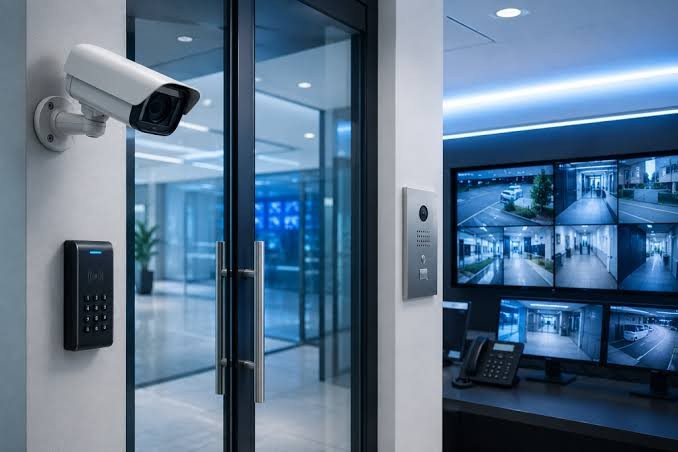
Multi-storey buildings require carefully planned security systems to protect occupants, employees, visitors, equipment and property. Unlike smaller buildings with only a few access points, commercial towers, office blocks, apartment buildings, hotels and mixed-use developments have multiple floors, entrances, staircases, lifts, parking facilities and restricted areas that require effective monitoring and access management.
As commercial and residential developments continue to expand in Uganda, building owners and property managers increasingly need security solutions that can manage movement across entire buildings. CCTV surveillance and electronic access control play an important role in achieving this objective.
CCTV and access control installation for multi-storey buildings involves designing and installing surveillance cameras, electronic door readers, access controllers, recording equipment and monitoring systems to provide coordinated security across different floors and departments.
A well-designed installation helps monitor entrances, corridors, parking areas and other important locations while ensuring that only authorised individuals can access designated areas.
For property developers, facility managers and commercial building owners, combining CCTV cameras with access control provides a more organised approach to managing building security.
Daltrevco recognises the importance of selecting suitable security solutions for modern commercial and residential properties. This guide explains how CCTV and access control systems work together, where they should be installed, how to plan security across multiple floors and what to consider when installing these systems in Uganda.
1. Why Multi-Storey Buildings Need CCTV and Access Control Systems
Multi-storey buildings have security requirements that are different from those of smaller properties.
A single building may accommodate several businesses, hundreds of employees, residents, visitors, contractors and service providers. Different floors may also contain departments with different access requirements.
Without suitable security arrangements, it can be difficult to monitor movement, manage visitors and protect restricted areas.
Improved surveillance across multiple floors
CCTV cameras allow authorised personnel to monitor important areas throughout the building.
Depending on the design, cameras can cover entrances, reception areas, corridors, lift lobbies, staircases, parking facilities and selected restricted areas.
Controlled access to restricted areas
Not every occupant or visitor should have unrestricted access to every floor or room.
Access control systems help restrict entry into server rooms, management offices, electrical rooms, records departments, equipment rooms and other sensitive areas.
Better visitor management
Multi-storey buildings receive visitors who may need access to specific offices, businesses or departments.
Access control and visitor management systems can help ensure that visitors follow appropriate entry procedures and access only authorised areas.
Improved incident investigation
CCTV footage and access records can help authorised personnel investigate reported incidents, review access events and establish relevant timelines.
Centralised security management
A properly designed system can allow authorised security personnel to monitor cameras and manage access across different floors from a central location.
Better protection of shared facilities
Parking areas, reception spaces, lifts, staircases and shared entrances may be used by many occupants. CCTV and access control help building managers monitor these areas and regulate entry where necessary.
2. Understanding CCTV Systems for Multi-Storey Buildings
CCTV surveillance systems use cameras and recording equipment to monitor selected areas of a property.
For multi-storey buildings, the system must be designed around the building’s structure, number of floors, security risks, camera coverage requirements and available network infrastructure.
Modern installations may use IP network cameras or analogue high-definition cameras, depending on the project’s requirements.
Types of CCTV cameras suitable for multi-storey buildings
1. Dome CCTV cameras
Dome cameras are commonly used in indoor areas such as reception spaces, corridors, lift lobbies and office entrances.
Their compact design makes them suitable for many commercial environments.
2. Bullet CCTV cameras
Bullet cameras are often used for outdoor surveillance, building entrances, parking facilities and perimeter monitoring.
They can be selected in suitable weather-resistant configurations.
3. Turret CCTV cameras
Turret cameras can provide indoor and outdoor surveillance and may be suitable for corridors, entrances and selected building exteriors.
4. PTZ CCTV cameras
Pan-tilt-zoom cameras allow authorised operators to adjust viewing direction and zoom where supported.
They may be useful for large outdoor spaces, entrances and parking areas. However, a PTZ camera should not automatically replace fixed cameras required for continuous coverage of critical locations.
5. IP CCTV cameras
IP cameras transmit digital video over a network and can support centralised recording, remote access and compatible video analytics.
They are commonly considered for new multi-storey CCTV installations where suitable network infrastructure is available.
Important CCTV features for multi-storey buildings
When selecting cameras, consider:
- Image resolution.
- Lens and viewing angle.
- Low-light performance.
- Infrared night vision.
- Wide dynamic range for challenging lighting.
- Weather and dust protection.
- Video compression.
- Recording compatibility.
- Network connectivity.
- Power requirements.
- Video analytics where appropriate.
Camera selection should be based on the purpose of each location. A camera intended to monitor general movement may have different requirements from one intended to capture identifiable details at a controlled entrance.
3. Important CCTV Camera Installation Areas in Multi-Storey Buildings
Camera placement is one of the most important stages of a CCTV installation project.
A poorly positioned camera may leave blind spots or capture footage without sufficient detail.
A building-wide surveillance plan should identify important security areas on every floor.
A. Main entrances and exits
Main entrances are important CCTV installation locations because they experience frequent movement by employees, visitors, residents and contractors.
Cameras should be positioned to capture useful views of entry and exit activities.
B. Reception areas
Reception spaces are often the first point of contact for visitors.
CCTV cameras can help authorised personnel monitor the reception area and review reported incidents.
C. Corridors and walkways
Corridors connect different departments, offices and facilities.
Appropriately positioned cameras can provide visibility across important walkways while minimising unnecessary duplication.
D. Lift lobbies
Lift lobbies are important shared areas where occupants and visitors move between floors.
CCTV cameras can help monitor activity around lift entrances.
E. Staircases and emergency access routes
Selected stairwell entrances and access points may require surveillance, depending on the building’s design and security risks.
Security equipment must not obstruct emergency routes or compromise evacuation arrangements.
F. Parking facilities
Basement and outdoor parking areas may require cameras to monitor vehicle movement, pedestrian access and important entry points.
Low-light performance and suitable camera placement are particularly important.
G. Loading and delivery areas
Commercial buildings often receive supplies, equipment and deliveries.
CCTV can help monitor loading bays, service entrances and goods movement areas.
H. Restricted operational areas
Server rooms, electrical rooms, management offices and equipment storage areas may require additional surveillance.
Cameras should be positioned appropriately without interfering with sensitive activities or privacy requirements.
4. Access Control Systems for Multi-Storey Buildings
Access control systems regulate who can enter a building, floor, room or restricted department.
In multi-storey properties, they help building managers establish different access permissions for occupants, employees, visitors and service providers.
Common access control technologies
RFID card access control
Users present an authorised card or credential to a reader to gain access.
RFID systems are commonly used in office buildings, commercial properties and residential developments.
Fingerprint access control
Fingerprint readers verify a user’s fingerprint against enrolled biometric information.
They can be suitable for selected restricted areas where biometric authentication is appropriate.
Facial recognition access control
Facial recognition systems use biometric technology to compare a person’s face with enrolled identity records.
Their suitability depends on accuracy requirements, environmental conditions, privacy considerations and the system’s configuration.
Keypad access control
Keypad systems require users to enter an authorised PIN code.
They can be used for selected doors and restricted areas, although shared codes require careful management.
Mobile access control
Some modern systems allow authorised users to use compatible mobile credentials through supported applications or communication technologies.
Electronic door locks
Electronic locks can be integrated with suitable access controllers to manage door locking and authorised entry.
The correct locking arrangement must preserve emergency egress and comply with applicable fire and building safety requirements.
5. Floor-by-Floor Access Control Planning
One of the main advantages of access control in multi-storey buildings is the ability to assign different access permissions to different floors and departments.
For example, an office tower may contain several companies, each occupying a different floor. Building management may need to control access to shared entrances while individual tenants manage access to their own offices.
A suitable access control design should consider the following areas.
Main building entrance
The main entrance may use a reception desk, visitor management process, access readers or other suitable entry arrangements.
Individual office floors
Access readers can regulate entry into selected floors or tenant areas.
Management offices
Restricted areas can be protected using authorised credentials.
Server and IT rooms
These rooms may require stronger access restrictions because they contain sensitive business infrastructure.
Electrical and mechanical rooms
Access should be limited to authorised technical and maintenance personnel.
Storage rooms
Electronic access control can help regulate entry into areas containing valuable equipment or inventory.
Parking and service entrances
Vehicle barriers, access readers and suitable surveillance can help manage movement into basement parking facilities and service entrances.
Example of floor-by-floor security planning
| Building area | Recommended access control arrangement | CCTV coverage |
|---|---|---|
| Main entrance | Controlled entry and visitor management | Entrance and reception cameras |
| Ground floor reception | Visitor registration and authorised entry | Reception and lobby cameras |
| Office floors | Floor-specific access permissions where required | Lift lobby and common corridor cameras |
| Management offices | Restricted electronic access | Suitable entrance surveillance |
| Server room | Restricted credentials and access logging | Camera at the entrance, where appropriate |
| Parking basement | Vehicle access control and pedestrian entry control | Parking and access-point cameras |
| Plant rooms | Authorised technical staff access | Suitable entrance monitoring |
| Rooftop or service areas | Restricted access | Appropriate access-point surveillance |
The final arrangement should reflect the actual building design and the responsibilities of the property manager and individual tenants.
6. Integrating CCTV Cameras with Access Control Systems
CCTV and access control systems provide complementary security functions.
CCTV monitors and records selected activities, while access control regulates entry into designated areas.
When compatible systems are integrated, access events can be associated with video footage to support security monitoring and investigation.
How CCTV and access control integration works
Consider a person attempting to enter a restricted office floor.
- The person presents an access card to the reader.
- The access controller checks whether the credential is authorised.
- The system grants or denies access according to its configuration.
- The access event is recorded.
- A compatible video management system may display the nearby camera feed.
- Authorised personnel can review the event if necessary.
Benefits of integration
- Better visibility of access events.
- Easier investigation of reported incidents.
- Improved monitoring of restricted areas.
- Centralised management of compatible devices.
- More organised security reporting.
- Better coordination between security personnel.
Not all CCTV cameras and access control systems automatically communicate. The selected hardware, software, communication interfaces and configuration must support the required integration.
7. CCTV and Access Control for Lift Systems
Lifts are important parts of multi-storey building infrastructure because they transport occupants and visitors between floors.
In buildings with restricted departments or multiple tenants, lift access management can form part of the overall security design.
Lift access control systems
Depending on the lift controller and access control equipment, a building may use credentials to authorise access to selected floors.
For example:
- Employees may access their designated office floors.
- Visitors may receive temporary authorisation for a particular floor.
- Maintenance personnel may receive access to selected service areas.
- Residents may access authorised residential floors.
CCTV monitoring around lifts
Cameras can be installed in lift lobbies to monitor activity around lift entrances.
Where cameras are installed inside lift cars, equipment selection and installation should account for lift manufacturer requirements, vibration, power, cabling and applicable safety considerations.
Lift access integration should be planned with the lift contractor or building systems specialist to avoid interfering with lift safety functions.
Important considerations
- Compatibility with lift control equipment.
- Emergency access arrangements.
- Fire evacuation procedures.
- Temporary visitor credentials.
- Access permissions for maintenance teams.
- System operation during power interruptions.
- Safe operation of the lift under all required conditions.
Access control should never interfere with emergency evacuation or required lift safety functions.
8. Network Infrastructure for Multi-Storey CCTV Systems
Modern IP CCTV installations depend on reliable network infrastructure.
In a multi-storey building, cameras may be installed across several floors and connected to network switches, recording equipment and monitoring stations.
The network should be designed to support the required video traffic and future expansion.
Important network components
Structured cabling
Ethernet cabling provides connections between IP cameras, network switches and other devices.
Network switches
Switches connect network devices and help distribute traffic across the building.
Power over Ethernet switches
PoE switches can supply electrical power and network connectivity to compatible cameras through a single Ethernet cable.
Fibre-optic backbone
Fibre links may be useful for connecting equipment rooms across multiple floors or long distances where network design requires higher capacity or greater reach.
Network video recorders
NVRs receive and record compatible IP camera streams.
Video management software
Video management software can provide a central interface for viewing, managing and reviewing footage from multiple cameras.
Network planning considerations
A suitable design should account for:
- Number of cameras.
- Video resolution and frame rates.
- Network bandwidth.
- Switch capacity.
- PoE power budgets.
- Cable distances.
- Fibre connections where required.
- Recording storage.
- Network segmentation.
- Cybersecurity controls.
- Future expansion.
The network should also distinguish security traffic from general office traffic where appropriate, using properly configured network segmentation and access restrictions.
9. CCTV Recording and Storage for Multi-Storey Buildings
A multi-storey building may require a large number of cameras, making recording capacity an important part of the installation.
The storage requirement depends on several factors.
Number of cameras
More cameras generally require greater storage capacity.
Video resolution
Higher-resolution footage generally requires more storage when other recording settings are comparable.
Frame rate
Higher frame rates can increase storage requirements.
Compression technology
Video compression can reduce the amount of storage required, depending on image quality and recording settings.
Recording schedule
Continuous recording generally requires more storage than event-based recording, although the actual difference depends on activity and configuration.
Retention requirements
The building owner should establish how long footage needs to be retained, taking account of operational needs and applicable data protection requirements.
Centralised versus distributed recording
A building may use centralised recording in a suitable equipment room or distributed recording arrangements across different floors.
The correct option depends on the network design, equipment capacity, resilience requirements and management arrangements.
10. Centralised Security Monitoring for Multi-Storey Buildings
Centralised monitoring allows authorised security personnel to manage surveillance and security events from a designated location.
For a building with multiple floors, a central monitoring arrangement can improve visibility across important areas.
A security control room may include:
- CCTV display screens.
- Video management software.
- NVRs or recording servers.
- Access control management software.
- Alarm monitoring interfaces.
- Network equipment.
- Communication systems.
- Suitable backup power.
Benefits of centralised monitoring
- Monitoring of selected cameras across multiple floors.
- Easier review of recorded footage.
- Centralised management of compatible access systems.
- Better coordination of security personnel.
- Improved visibility of important security events.
- More organised incident reporting.
For buildings with several tenants, monitoring access should be carefully managed to ensure that authorised personnel only view the cameras and records they are permitted to access.
11. CCTV and Access Control Installation for Different Types of Multi-Storey Buildings
Different building types require different security arrangements.
A. Commercial office buildings
Office towers may accommodate multiple companies, management departments, meeting rooms and IT facilities.
Recommended systems include:
- CCTV cameras at entrances and shared areas.
- Electronic access control for selected floors.
- Visitor management systems.
- Server room access control.
- Lift access integration where required.
- Centralised monitoring.
B. Residential apartment buildings
Apartment buildings require security for residents, visitors, property managers and service personnel.
Recommended systems may include:
- Entrance CCTV.
- Reception and lobby surveillance.
- Electronic pedestrian access.
- Video intercom systems.
- Parking access control.
- CCTV monitoring of shared facilities.
- Restricted access to plant and service rooms.
Cameras should be positioned to respect residents’ privacy, particularly around individual apartment interiors and private living spaces.
C. Hotels
Hotels require security that protects guests and employees without compromising hospitality.
Suitable systems may include:
- CCTV in appropriate public areas.
- Electronic guest room locks.
- Staff access control.
- Visitor and contractor management.
- Parking access control.
- Restricted service area access.
- Centralised monitoring.
D. Hospitals and healthcare buildings
Hospitals require carefully planned security because they accommodate patients, medical personnel, visitors and emergency services.
Suitable systems may include:
- CCTV in appropriate public areas.
- Access control for pharmacies and medical stores.
- Restricted access to records and IT departments.
- Visitor management.
- Controlled staff entrances.
- Centralised security monitoring.
Emergency movement, patient privacy and clinical operations must be prioritised during system design.
E. Shopping complexes
Shopping complexes have public walkways, retail units, parking facilities, service entrances and management offices.
Suitable systems may include:
- CCTV surveillance across common areas.
- Access control for management offices.
- Vehicle access control.
- Intruder alarms for selected premises.
- Restricted service area access.
- Centralised monitoring.
12. Power Backup and Reliability Considerations
Security equipment needs reliable power to operate.
In multi-storey buildings, a power interruption can affect cameras, recording equipment, network switches, access controllers and alarms.
A suitable backup power arrangement should be planned according to the equipment load and the required operating duration.
Important backup power considerations
- CCTV camera power requirements.
- PoE switch power consumption.
- NVR and recording server loads.
- Access control panel requirements.
- Electronic lock requirements.
- Alarm control panel batteries.
- Network equipment.
- Monitoring station equipment.
UPS systems and other suitable backup arrangements can support continued operation during certain power interruptions.
However, the actual backup duration depends on battery capacity, equipment load, battery condition and system configuration.
Emergency egress must remain safe even when normal power is unavailable. Electronic locking systems should be selected and configured according to door function, fire safety requirements and applicable building regulations.
13. Cybersecurity for Multi-Storey CCTV and Access Control Systems
Modern CCTV cameras and access controllers often connect to IP networks.
Without suitable cybersecurity measures, these systems may be exposed to unauthorised access, compromised credentials and other network threats.
Building owners and IT administrators should consider the following measures.
Strong passwords
Change default passwords and use unique credentials for administrator accounts.
Restricted user permissions
Give employees and security personnel only the access required for their responsibilities.
Regular firmware updates
Keep supported cameras, NVRs, access controllers and management software updated according to a controlled maintenance process.
Secure remote access
Use supported secure access methods, such as properly configured VPN access or secure vendor-supported services.
Avoid exposing camera and recorder administration interfaces directly to the public internet without appropriate security controls.
Network segmentation
Separate security devices from general office systems where appropriate. Use suitable firewall rules and access restrictions rather than relying on network separation alone.
Secure recording storage
Protect CCTV footage and access records against unauthorised access, copying, alteration and disclosure.
Regular account reviews
Review administrator accounts and remove credentials that are no longer required.
14. Privacy and Data Protection Considerations
CCTV and access control systems can collect information about employees, visitors, tenants and building occupants.
CCTV footage, visitor registers, access logs and biometric information may constitute personal data.
In Uganda, businesses should consider the Data Protection and Privacy Act, 2019, and applicable regulations when planning surveillance and access control.
Important considerations include:
- Establishing a legitimate and clearly defined purpose for surveillance.
- Placing cameras in appropriate locations.
- Avoiding unnecessary monitoring of private spaces.
- Providing appropriate notices where required.
- Restricting access to recordings.
- Establishing suitable retention periods.
- Protecting stored footage and access records.
- Handling biometric information with particular care.
- Reviewing how information is shared with third parties.
Security system design should balance property protection with the privacy rights of people who use the building.
15. Common CCTV and Access Control Installation Mistakes
Poor installation can reduce the effectiveness of building security systems.
Property developers and facility managers should avoid the following mistakes.
1. Installing cameras without a floor-by-floor plan
A multi-storey building needs a coordinated surveillance layout. Installing cameras without considering floor plans may leave important entrances, corridors or shared spaces uncovered.
2. Choosing unsuitable cameras
Camera specifications should match the environment and the purpose of surveillance.
3. Ignoring lift and stairwell access
Lift lobbies, stairwell entrances and other vertical movement areas should be assessed as part of the security design.
4. Failing to separate access permissions
Employees, tenants, residents, contractors and visitors may need different access rights.
5. Ignoring network capacity
An inadequate network can affect camera streams, recording performance and communication between security devices.
6. Underestimating recording storage
Storage should be calculated using camera quantities, resolution, frame rates, compression, recording schedules and retention requirements.
7. Neglecting backup power
Security equipment may stop functioning during power interruptions if suitable backup arrangements are not provided.
8. Installing incompatible equipment
Not all CCTV cameras, access readers, door controllers and management platforms support the same integration functions.
9. Ignoring emergency exit requirements
Access-controlled doors must be designed so that occupants can evacuate safely in an emergency.
10. Failing to plan maintenance
Cameras, door readers, locks, network switches, batteries and recording devices require regular inspection and servicing.
16. How Much Does CCTV and Access Control Installation Cost for Multi-Storey Buildings in Uganda?
The cost of installing CCTV and access control systems in a multi-storey building depends on the size of the property, number of floors, number of devices and complexity of the installation.
A small office block will have different requirements from a large commercial tower, hotel or apartment development.
Main factors affecting installation costs
Building size and number of floors: Larger buildings may require more cameras, access readers, network switches and cabling.
Number of CCTV cameras: Camera quantities and specifications affect equipment and installation requirements.
Number of access-controlled doors: Each controlled door may require readers, locks, controllers, cabling and configuration.
Lift access integration: Integration with lift systems may require additional equipment and coordination with the lift contractor.
Network infrastructure: IP-based installations may need structured cabling, fibre links, network cabinets and PoE switches.
Recording and storage requirements: The required retention period and video quality affect recording capacity.
System integration: Connecting CCTV, access control, alarms and visitor management may require compatible software and additional configuration.
Building design: Cable routes, ceiling construction, equipment rooms and installation access can affect labour requirements.
Backup power: UPS systems and other backup equipment may be required to support continued operation.
Maintenance arrangements: Future servicing, repairs, software updates and replacement components should be considered in the project budget.
Why a site assessment is important
A site assessment helps determine the number of cameras, access-controlled doors, network devices and other components needed for the building.
It also helps identify existing infrastructure that may be reused and areas that require additional installation work.
Property developers and building managers should request a solution based on the actual building layout and security requirements rather than relying on a generic estimate.
Contact Daltrevco to discuss suitable CCTV and access control options for your multi-storey property.
17. Choosing the Right CCTV and Access Control Installation Company in Uganda
Selecting a suitable installation provider is important because multi-storey building security requires coordinated planning across different floors and departments.
Before engaging a provider, consider the following factors.
Experience with commercial building requirements
The provider should understand the security requirements of office towers, apartment buildings, hotels and other multi-storey properties.
Ability to conduct site assessments
A proper assessment should review the building layout, access points, security risks, cabling routes and infrastructure.
Knowledge of CCTV technologies
The provider should understand IP cameras, recording systems, storage requirements, low-light surveillance and camera placement.
Access control expertise
The provider should be able to explain suitable credential technologies, electronic locking arrangements, door controllers and access permissions.
Equipment compatibility
Where integration is required, confirm that the proposed equipment supports the intended communication and management functions.
Installation quality
Cabling, device mounting, equipment protection and software configuration all affect long-term performance.
Testing and commissioning
The completed system should be tested before handover to verify camera coverage, recording, access permissions, door operation and supported integrations.
Maintenance and technical support
Ask about inspection schedules, troubleshooting, replacement parts and ongoing maintenance arrangements.
18. Why Professional CCTV and Access Control Installation Matters
Installing CCTV cameras and access control devices in a multi-storey building requires more than mounting equipment on walls and connecting cables.
The system should be planned around the building’s architecture, occupant movement, restricted areas, network capacity and security requirements.
Proper planning helps ensure that:
- Cameras provide useful coverage across important floors.
- Access permissions match occupant responsibilities.
- Lift and entrance security are coordinated.
- Recording equipment has suitable storage capacity.
- Network infrastructure supports the connected devices.
- Backup power is appropriately planned.
- Emergency exits remain safe.
- Security information is protected.
- Systems can be maintained and expanded where necessary.
For property developers and facility managers, professional system planning helps create a more organised and manageable security environment.
19. CCTV and Access Control Installation Solutions from Daltrevco
Daltrevco recognises the importance of reliable security infrastructure in modern commercial and residential buildings.
Multi-storey properties require carefully planned CCTV surveillance and access control systems to manage movement, monitor important areas and protect restricted facilities.
A suitable security arrangement should consider the building’s number of floors, entrances, shared spaces, tenant requirements, parking facilities and operational activities.
Whether you are planning security for an office tower, apartment development, hotel, hospital or shopping complex, proper system assessment and equipment selection are important steps towards effective building security.
Contact Daltrevco to discuss suitable CCTV and access control installation solutions for your multi-storey building in Uganda.
Frequently Asked Questions About CCTV and Access Control Installation for Multi-Storey Buildings
1. What is CCTV and access control installation?
CCTV and access control installation involves setting up surveillance cameras, recording equipment, electronic readers, door controllers and related security infrastructure to monitor a property and regulate authorised entry.
2. Why do multi-storey buildings need CCTV systems?
CCTV systems help monitor entrances, corridors, lift lobbies, parking areas and other important locations across different floors.
3. What is the best CCTV system for a multi-storey building?
IP CCTV systems are often considered for multi-storey projects because they can support network-based recording and centralised management. The most suitable system depends on building size, network infrastructure, camera requirements and budget.
4. How many CCTV cameras does a multi-storey building need?
The required number depends on the building’s floor plans, entrances, corridors, parking areas, security risks and required camera coverage. A site assessment is necessary to determine the appropriate quantity.
5. What access control system is best for office buildings?
RFID cards, biometric readers, keypad systems and mobile credentials can all be suitable. The best option depends on user numbers, security requirements, door types and operational needs.
6. Can access control systems restrict entry to specific floors?
Yes. Compatible access control systems can assign users permissions for selected floors, doors or departments.
7. Can CCTV cameras be integrated with access control systems?
Yes. Compatible systems can associate access events with nearby CCTV footage, helping authorised personnel investigate security incidents.
8. Can lift access be controlled using access cards?
Yes. Suitable lift access systems can restrict floor selection based on authorised credentials, provided the access control equipment is compatible with the lift control system.
9. Where should CCTV cameras be installed in a multi-storey building?
Common locations include entrances, reception areas, corridors, lift lobbies, parking facilities, loading bays and selected restricted-area entrances. Camera placement should also consider privacy.
10. Can CCTV cameras be installed in lifts?
Yes, where suitable equipment and installation arrangements are supported by the lift design and manufacturer requirements. Cameras should be installed without interfering with lift safety systems.
11. What is centralised CCTV monitoring?
Centralised CCTV monitoring allows authorised personnel to view and manage cameras from different floors through a central monitoring location.
12. Do multi-storey buildings need network video recorders?
IP CCTV installations commonly use NVRs or compatible recording servers to store and manage video from network cameras. The recording arrangement depends on the system design.
13. Can CCTV and access control systems operate during power outages?
Some systems can continue operating using suitable backup power. The duration depends on equipment load, battery capacity, condition and configuration.
14. What is the difference between RFID and biometric access control?
RFID access control uses cards or other compatible credentials, while biometric access control uses physical or behavioural characteristics such as fingerprints or facial recognition. Both have different security, privacy and management considerations.
15. How long should CCTV footage be stored in a commercial building?
The appropriate retention period depends on operational requirements, storage capacity, security policies and applicable data protection obligations.
16. Can an existing multi-storey building upgrade its CCTV system?
Yes. Existing buildings can upgrade cameras, recording equipment, network infrastructure and access control devices. A site assessment helps determine which components can be retained.
17. How much does CCTV installation cost in Uganda?
The cost depends on camera quantities, specifications, building size, cable routes, recording storage, network equipment and installation complexity.
18. How much does access control installation cost for a multi-storey building?
Costs depend on the number of controlled doors, access readers, electronic locks, controllers, credential technology and integration requirements.
19. How often should CCTV and access control systems be maintained?
Maintenance frequency depends on equipment specifications, manufacturer guidance and operating conditions. Regular inspections should cover cameras, recording equipment, readers, locks, controllers, network devices and backup power.
20. How do I choose a CCTV and access control installation company in Uganda?
Choose a provider that can assess the building, plan floor-by-floor security, recommend suitable equipment, verify compatibility, complete installation and testing, and discuss ongoing maintenance.
Conclusion
CCTV and access control installation for multi-storey buildings requires careful planning to ensure that security is coordinated across different floors, entrances, departments and shared facilities.
By combining strategically positioned CCTV cameras with electronic access control, lift access management, suitable network infrastructure and centralised monitoring, building owners can improve surveillance and regulate movement throughout their properties.
The most effective installation is one that reflects the building’s architecture, security risks, occupant requirements and operational needs while maintaining privacy and emergency safety.
For property developers, commercial building owners and facility managers in Uganda, investing in a properly planned security system is an important part of managing a modern multi-storey property.
Contact Daltrevco to discuss CCTV and access control installation for your office tower, apartment building, hotel, hospital or shopping complex.

