Concrete products play an important role in modern construction because they provide strength, durability, stability and versatility across different types of building projects. From residential houses and apartment developments to commercial buildings, factories, warehouses and infrastructure facilities, concrete products are used in foundations, walls, floors, drainage systems, access roads and other essential building components.
In Uganda, the growing demand for residential developments, commercial facilities and industrial infrastructure makes the selection of suitable construction materials increasingly important. Property developers, contractors, architects and engineers must understand the different concrete products available, their applications and the quality requirements that influence their performance.
Choosing the wrong concrete product can result in structural problems, unnecessary maintenance, material wastage and increased construction costs. On the other hand, selecting appropriate products that meet the project’s engineering specifications helps improve construction efficiency and long-term building performance.
This guide explores the major concrete products for residential, commercial and industrial construction, their uses, benefits, selection considerations and the factors that influence their cost in Uganda.
1. What Are Concrete Products?
Concrete products are construction components manufactured using cement, aggregates, water and, where necessary, approved admixtures or reinforcement materials.
They can be produced at a manufacturing facility as precast components or formed directly at the construction site through cast-in-place concrete work.
Concrete products are available in different shapes, sizes, strengths and finishes to serve specific construction requirements.
Common examples include:
- Concrete blocks.
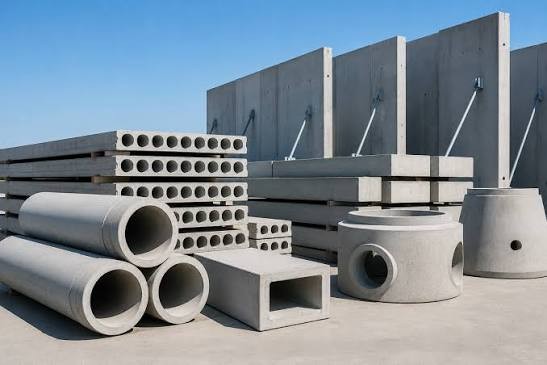
- Precast concrete slabs.
- Concrete beams and columns.
- Concrete pipes and culverts.
- Concrete paving blocks.
- Concrete kerbstones.
- Concrete lintels.
- Concrete drainage channels.
- Concrete manhole covers and chambers.
- Concrete fence posts.
- Concrete stairs and wall panels.
- Concrete flooring and paving components.
The appropriate product depends on the building design, structural requirements, environmental conditions and intended application.
2. Concrete Products Used in Residential Construction
Residential construction requires materials that provide structural stability, durability, functionality and an appropriate appearance. Concrete products are used in different stages of house construction, from foundations and walling to floors, external paving and drainage.
The following are some of the most common concrete products used in residential developments in Uganda.
2.1 Concrete Blocks
Concrete blocks are widely used in residential wall construction. They are available in solid and hollow configurations, with different dimensions and strength classifications.
They can be used for:
- External house walls.
- Internal partition walls.
- Boundary walls.
- Garages and storage buildings.
- Selected load-bearing masonry applications.
Concrete blocks offer consistent shapes and can support efficient wall construction when manufactured to the required specifications.
However, not every concrete block is suitable for load-bearing applications. Developers should confirm the required strength and block classification with the structural engineer before purchasing.
2.2 Precast Concrete Slabs
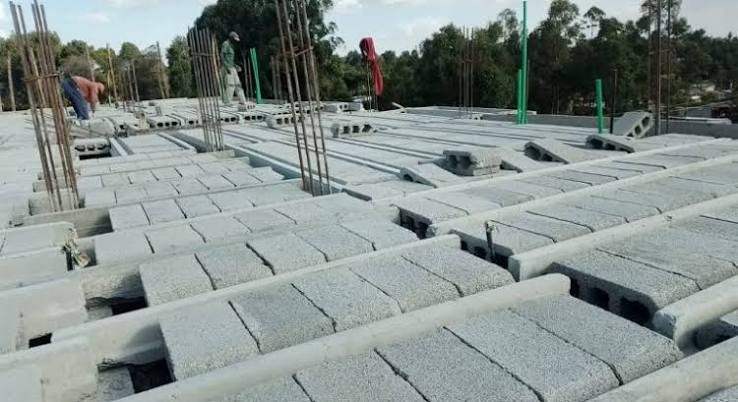
Precast concrete slabs are manufactured before being transported to the construction site for installation.
Depending on their design, they may be used in floor systems, roofing applications, balconies and other structural components.
Their use can help reduce some on-site formwork activities and improve construction coordination. However, slab dimensions, reinforcement, lifting arrangements, bearing details and installation procedures must be established by the project design team.
2.3 Concrete Lintels
Concrete lintels are structural components installed above door and window openings to support loads from the masonry or other building elements above them.
They may be precast or cast in place, depending on the design.
Important considerations include:
- Opening width.
- Applied loads.
- Reinforcement details.
- Bearing length.
- Concrete strength.
- Installation procedure.
Using an undersized or poorly reinforced lintel can create cracking and structural problems around openings.
2.4 Concrete Paving Blocks
Concrete paving blocks are used for outdoor surfaces around residential properties.
Typical applications include:
- Driveways.
- Walkways.
- Courtyards.
- Parking spaces.
- Garden paths.
- Outdoor entertainment areas.
Paving blocks are available in different shapes, colours, thicknesses and surface finishes.
Their performance depends not only on the blocks themselves but also on proper ground preparation, sub-base construction, bedding material, joint filling and drainage.
2.5 Concrete Fence Posts
Concrete fence posts provide support for selected fencing systems around residential properties, farms and other developments.
They can be used with chain-link fencing, wire fencing and other suitable boundary systems.
The post dimensions, reinforcement, concrete quality, spacing and foundation details should be appropriate for the fence height, ground conditions and expected loading.
2.6 Concrete Drainage Products
Residential developments require suitable drainage systems to manage rainwater and reduce water accumulation around buildings.
Concrete drainage products include:
- Precast drainage channels.
- Concrete culverts.
- Manhole components.
- Inspection chambers.
- Drainage covers.
These products help direct water away from buildings, driveways and access areas when properly designed and installed.
3. Concrete Products Used in Commercial Construction
Commercial construction projects include office buildings, shopping centres, hotels, supermarkets, schools, hospitals, retail developments and other business facilities.
Such buildings may experience higher occupancy levels, greater floor loading, more demanding operational requirements and increased traffic compared with many residential properties.
Concrete products used in commercial construction must therefore be selected according to the project’s structural design, intended use and performance requirements.
3.1 Precast Concrete Beams and Columns
Precast concrete beams and columns are structural components manufactured away from the construction site and installed as part of a building’s structural system.
They can be used in selected commercial buildings where the structural design supports precast construction.
Potential benefits include controlled factory production, reduced on-site casting activities and improved construction coordination.
Their dimensions, reinforcement, connections, lifting points and installation sequence must be designed and approved by qualified structural professionals.
3.2 Concrete Floor Slabs
Concrete floor slabs are important components in commercial buildings because they support occupants, furniture, equipment and other imposed loads.
They are used in:
- Office buildings.
- Shopping centres.
- Hotels.
- Hospitals.
- Educational facilities.
- Commercial warehouses.
Floor slabs may be cast in place or constructed using suitable precast systems.
The required thickness, reinforcement, concrete grade, joints and surface finish depend on structural calculations and the intended use of the floor.
3.3 Concrete Kerbstones
Concrete kerbstones are used to define the edges of roads, parking areas, walkways and landscaped spaces.
In commercial developments, they help separate pedestrian and vehicle areas, protect paved surfaces and improve site organisation.
Common applications include:
- Shopping centre parking areas.
- Office complex driveways.
- Hotel access roads.
- Commercial walkways.
- Landscaping and paved courtyards.
Correct installation requires proper alignment, bedding, support and consideration of surface drainage.
3.4 Precast Concrete Stairs
Precast concrete stairs are manufactured before being transported and installed at the construction site.
They can be used in commercial developments where the building layout and construction method allow precast installation.
Their advantages may include reduced on-site formwork and faster installation once the supporting structure is ready.
The stair dimensions, reinforcement, support details, lifting arrangements and connections must be properly designed.
3.5 Concrete Manhole Covers and Chambers
Concrete manhole chambers and covers form part of drainage and underground utility systems.
They are commonly used in commercial developments to provide access to inspection points and underground drainage infrastructure.
The cover classification must be suitable for its location. A cover installed in a vehicle-accessible area must meet the applicable loading requirements.
4. Concrete Products Used in Industrial Construction
Industrial construction involves factories, manufacturing plants, warehouses, workshops, processing facilities, distribution centres and other specialised buildings.
These projects often require construction materials capable of supporting heavy equipment, operational traffic, storage loads and demanding working environments.
Concrete products must therefore be selected with careful consideration of structural loads, durability, ground conditions, chemical exposure and operational requirements.
4.1 Industrial Concrete Floor Slabs
Industrial floors are among the most important concrete components in factories and warehouses.
They may support:
- Heavy machinery.
- Forklifts and material-handling equipment.
- Storage racks.
- Production lines.
- Industrial vehicles.
- High-volume operational traffic.
Industrial floor design should consider the expected loading, subgrade condition, slab thickness, concrete properties, reinforcement, joints, surface finish and curing.
Where specialised performance is required, the project may also specify surface hardeners, protective coatings or other approved treatments.
4.2 Precast Concrete Wall Panels
Precast concrete wall panels are manufactured off-site and installed to form external or internal walls.
They can be used in selected industrial facilities, warehouses and commercial buildings.
Potential benefits include:
- Controlled production conditions.
- Reduced on-site wall construction activities.
- Consistent panel dimensions.
- Faster enclosure of suitable building sections.
- Integration with planned structural systems.
Panel design must account for reinforcement, lifting, transportation, wind loads, connections, fire requirements and installation safety.
4.3 Concrete Culverts
Concrete culverts are used to convey water beneath roads, access routes, driveways and other infrastructure.
They are important in industrial developments where surface water must be managed around access roads, loading areas and large paved surfaces.
Culverts may be manufactured in different shapes and sizes depending on the drainage design.
Their selection should consider:
- Expected water flow.
- Structural loading.
- Installation depth.
- Soil and ground conditions.
- Hydraulic capacity.
- Jointing and connection requirements.
4.4 Concrete Pipes
Concrete pipes are used in selected stormwater drainage, sewerage and other underground infrastructure systems.
They provide a durable option for projects requiring underground water conveyance.
The correct pipe class and dimensions depend on hydraulic requirements, installation depth, soil conditions and external loading.
Proper bedding, jointing, installation and backfilling are essential for long-term performance.
4.5 Concrete Equipment Foundations
Industrial facilities often require concrete foundations and plinths for machinery, production equipment, storage systems and other installations.
These components must be designed according to the equipment manufacturer’s requirements and the structural engineer’s calculations.
Depending on the equipment, the design may need to consider static loads, dynamic forces, vibration, anchorage and settlement.
4.6 Heavy-Duty Concrete Paving Products
Industrial sites may require concrete paving products or engineered concrete pavement systems for loading bays, service yards, vehicle routes and outdoor storage areas.
The design should account for vehicle type, axle loads, traffic frequency, ground conditions, drainage and the required surface performance.
5. Precast Concrete Products Versus Cast-in-Place Concrete
Concrete products can be manufactured away from the construction site or formed directly at the project location.
Understanding the difference helps developers select an appropriate construction method.
Precast Concrete Products
Precast concrete products are manufactured in moulds under controlled production conditions, cured and transported to the construction site for installation.
Examples include:
- Precast slabs.
- Concrete blocks.
- Precast beams.
- Precast columns.
- Wall panels.
- Culverts.
- Concrete pipes.
- Kerbstones.
Advantages of precast concrete include:
- Potentially better control over production conditions.
- Repeated production of standardised components.
- Reduced on-site formwork for suitable applications.
- Faster installation where components are available and site preparation is complete.
- Better coordination of certain construction activities.
However, precast construction requires proper transportation, lifting equipment, access planning, connection design and installation supervision.
Cast-in-Place Concrete
Cast-in-place concrete is mixed or delivered and placed directly into prepared formwork at the construction site.
It is commonly used for:
- Foundations.
- Columns.
- Beams.
- Floor slabs.
- Retaining structures.
- Concrete walls.
- Specialised structural components.
Advantages include:
- Flexibility for different shapes and dimensions.
- Reduced need to transport large precast components.
- Suitability for structures with complex site-specific geometries.
- Ability to form continuous structural elements where designed.
The appropriate method depends on the building design, project programme, site access, available equipment and cost considerations.
6. Important Quality Standards for Concrete Products in Uganda
Quality is one of the most important considerations when selecting concrete products for any construction project.
Poor-quality products may lead to cracking, premature deterioration, structural deficiencies, water penetration and expensive repairs.
Manufacturers, suppliers, contractors and property developers should ensure that concrete products comply with the applicable Uganda Standards (US) and any relevant project specifications or recognised standards referenced in the design.
The current standard, edition and conformity requirements should be confirmed with the Uganda National Bureau of Standards (UNBS).
Important quality considerations include:
6.1 Compressive Strength
Compressive strength measures the ability of concrete to resist crushing under an applied load.
It is important for concrete blocks, slabs, beams, columns, culverts and other products that must withstand specified loads.
The required strength depends on the product type and intended application. It should be established by the project specification and verified through suitable testing.
6.2 Dimensional Accuracy
Concrete products should have dimensions that meet the required specifications.
Incorrect dimensions can create problems during installation, increase material wastage and affect the alignment of building components.
Manufacturers should use properly maintained moulds and carry out routine dimensional inspections.
6.3 Water Absorption and Moisture Performance
Water absorption is important for many concrete products, particularly masonry units and products exposed to moisture.
Excessive absorption may affect durability, finishes and moisture performance.
The acceptable limits and testing methods depend on the applicable product standard.
6.4 Reinforcement Quality
Reinforced concrete products require appropriate reinforcement materials, placement, cover and detailing.
This is particularly important for beams, slabs, columns, precast panels, pipes and other structural components.
Reinforcement should follow the approved structural drawings and relevant design requirements.
6.5 Durability
Concrete products should be suitable for the environmental conditions in which they will be used.
The mix design, materials, compaction, curing and protective measures all influence durability.
Special consideration may be necessary where products are exposed to aggressive soils, chemicals, persistent moisture or other demanding conditions.
6.6 Workmanship and Surface Finish
Concrete products should be inspected for defects such as:
- Major cracks.
- Broken corners and edges.
- Excessive surface voids.
- Poorly formed surfaces.
- Distorted dimensions.
- Exposed reinforcement where it is not permitted.
- Inconsistent finishes.
Acceptance should be based on the relevant specification and intended use rather than appearance alone.
7. How to Choose the Right Concrete Products for Your Construction Project
Choosing concrete products requires more than comparing prices. The products must meet the technical requirements of the building and be suitable for the conditions under which they will be used.
Consider these important factors before purchasing.
1. Identify the Project Type
Determine whether the products are intended for residential, commercial or industrial construction.
A residential partition wall, commercial floor slab and industrial machinery foundation have different performance requirements.
2. Understand the Engineering Specifications
Consult the approved architectural and structural drawings, specifications and bills of quantities.
These documents identify the required dimensions, grades, reinforcement details and other product requirements.
3. Check Product Quality
Inspect concrete products for visible defects and dimensional consistency.
Where structural performance is important, request appropriate test reports from a competent laboratory.
4. Consider the Installation Requirements
Some concrete products require specialised lifting equipment, supporting structures, prepared foundations or skilled installation teams.
These requirements should be considered before ordering.
5. Evaluate Durability
Consider exposure to water, weather, chemicals, traffic, heavy loads and other operating conditions.
The selected products should be suitable for their intended environment.
6. Compare Suppliers
Assess suppliers based on product specifications, consistency, production capacity, availability, delivery arrangements and quality documentation.
7. Consider the Total Project Cost
The cheapest product may not provide the best overall value.
Compare material prices alongside transportation, handling, installation, maintenance and potential replacement costs.
8. Factors Affecting the Cost of Concrete Products in Uganda
Concrete product prices vary depending on the product type, dimensions, strength requirements, raw materials, manufacturing method and delivery location.
The following factors commonly influence prices.
Raw material costs: Cement, aggregates, reinforcement steel, water and approved additives contribute to production costs.
Product dimensions: Larger or thicker concrete products generally require more materials and may need additional handling equipment.
Strength requirements: Products designed to meet higher performance requirements may require different mix designs, reinforcement or additional quality-control measures.
Manufacturing method: Precast production, specialised moulds, machinery and factory operations can affect the final price.
Order quantity: Large orders may influence production and transportation costs, depending on supplier capacity and availability.
Transportation distance: Concrete products can be heavy and bulky. Delivery costs may vary significantly depending on the distance between the manufacturer and construction site.
Installation requirements: Some products require cranes, lifting equipment, specialised labour or additional site preparation.
Testing and compliance: Quality testing, certification and inspection requirements may contribute to the overall cost.
For accurate budgeting, developers should request quotations based on the exact product specifications, required quantities and delivery location.
9. Common Mistakes to Avoid When Purchasing Concrete Products
Selecting unsuitable concrete products can create unnecessary construction costs and affect building performance.
Avoid the following mistakes:
- Buying products based on price alone: Low prices do not guarantee suitable quality or performance.
- Ignoring engineering specifications: Products must meet the requirements stated in approved drawings and project documents.
- Failing to request test reports: Where strength and durability are critical, appropriate test documentation should be requested.
- Selecting the wrong product type: Concrete blocks, slabs, pipes and other products have different applications.
- Ignoring transportation and handling: Poor handling can damage products before they reach the construction site.
- Overlooking installation requirements: Precast components may require specialised equipment and technical supervision.
- Ordering without accurate measurements: Incorrect quantities can result in shortages, delays or excess materials.
- Neglecting storage conditions: Improper storage may damage products or affect their condition before installation.
Proper planning and technical assessment help prevent these problems.
10. Why Concrete Products Are Important for Modern Construction in Uganda
Concrete products continue to play an important role in the development of residential, commercial, industrial and infrastructure projects.
Their importance comes from several characteristics.
Strength and load resistance: Properly designed and manufactured concrete products can support the structural and operational requirements of different buildings.
Durability: Suitable concrete products can provide long service life when correctly designed, manufactured, installed and maintained.
Versatility: Concrete can be manufactured into different shapes, sizes and finishes to meet diverse construction requirements.
Availability of different product types: Builders can select blocks, slabs, pipes, paving units, culverts and other components for specific applications.
Construction efficiency: Standardised precast products can improve coordination and reduce some on-site construction activities.
Low maintenance potential: Properly specified concrete products can offer reliable performance without frequent replacement, although maintenance requirements depend on exposure and use.
These advantages make concrete an important material in Uganda’s continuing construction and infrastructure development.
11. How Daltrev Co. Ltd Supports Construction Projects in Uganda
Selecting the right concrete products is an important part of delivering a successful construction project. Developers, contractors and property owners need materials that match their project specifications, quantities, budget and construction programme.
Daltrev Co. Ltd supports construction projects through construction materials enquiries and sourcing based on project requirements, specifications, quantities and availability.
The company also provides construction and civil engineering works, construction consultancy and related project support services.
Whether you are developing a residential property, commercial facility, industrial building or infrastructure project, proper material selection and construction planning can help improve project coordination and delivery.
Explore our construction materials services, learn more about our construction and civil engineering works, or discover our construction consultancy services.
For construction materials enquiries or assistance with your next development, contact Daltrev Co. Ltd.
12. Frequently Asked Questions About Concrete Products for Construction
What are the main concrete products used in residential construction?
Common products include concrete blocks, precast slabs, lintels, paving blocks, fence posts, drainage channels and manhole components. Their suitability depends on the building design and intended application.
Which concrete products are used in commercial buildings?
Commercial developments commonly use concrete floor slabs, blocks, beams, columns, precast stairs, kerbstones, manhole chambers and drainage components.
What concrete products are used in industrial construction?
Industrial projects may require heavy-duty floor slabs, equipment foundations, precast wall panels, concrete pipes, culverts, drainage channels and specialised paving systems.
What is the difference between precast and cast-in-place concrete?
Precast concrete is manufactured in moulds before being transported to the construction site for installation. Cast-in-place concrete is poured into prepared formwork directly at the project location.
Are precast concrete products suitable for large construction projects?
Yes. Precast concrete products can be suitable for residential, commercial and industrial projects when they are properly designed, manufactured, transported and installed.
How do I identify quality concrete products in Uganda?
Check product dimensions, appearance, specifications and consistency. Request relevant test reports where necessary and confirm compliance with the applicable standards and project requirements.
What determines the price of concrete products in Uganda?
Prices depend on the type of product, dimensions, strength requirements, raw materials, reinforcement, manufacturing method, order quantities, transportation and installation requirements.
Why is concrete quality important in building construction?
Concrete quality affects strength, durability, structural performance and resistance to environmental conditions. Proper material selection, production control, testing and installation help achieve the required performance.
Where can I get construction materials for my building project in Uganda?
You can contact construction materials providers and suppliers to discuss your project specifications, quantities, availability and delivery requirements. Always verify that the products meet your project’s technical requirements before purchasing.