Concrete kerbs are essential components of road construction, urban infrastructure and external paving projects. They provide clear boundaries between carriageways, footpaths, parking areas, landscaped spaces and drainage channels. Besides improving the appearance of roads, kerbs help control surface water, protect pavement edges and support safer movement for pedestrians and vehicles.
When planning a road construction project, one important decision is whether to use precast concrete kerbs or cast-in-situ concrete kerbs. Both options can provide durable and effective results when correctly designed, manufactured or constructed. However, they differ in production methods, installation procedures, quality control, labour requirements, construction speed and suitability for different site conditions.
For contractors, property developers, engineers and project managers in Uganda, understanding these differences is important when selecting the most appropriate kerb system.
This guide explains precast concrete kerbs vs cast-in-situ kerbs, their advantages, disadvantages, applications, installation processes and cost considerations. It also provides practical guidance on choosing the right option for roads, highways, residential developments, commercial properties and industrial sites.
1. What Are Concrete Kerbs?
Concrete kerbs are raised or flush-edged concrete elements installed along roads, pavements, parking areas and other paved surfaces. They create physical boundaries between different sections of a developed area.
Kerbs are commonly used to separate vehicle lanes from pedestrian walkways, define road edges, support drainage arrangements and prevent pavement materials from spreading beyond their intended boundaries.
In road construction, concrete kerbs contribute to the overall performance and organisation of the pavement system.
Common functions of concrete kerbs
- Road edge protection: Help define carriageway boundaries and protect pavement edges.
- Drainage management: Direct surface runoff towards designated drainage channels and inlets.
- Pedestrian safety: Separate footpaths from vehicle movement where appropriate.
- Traffic organisation: Define medians, islands, junctions and traffic channelisation areas.
- Pavement containment: Help retain paving blocks and other surface materials.
- Landscaping: Separate lawns, gardens, planted areas and paved spaces.
- Visual improvement: Give roads, parking areas and landscaped developments a neat, organised appearance.
The required kerb design depends on the road layout, expected traffic, drainage arrangements, pedestrian requirements and engineering specifications.
2. What Are Precast Concrete Kerbs?
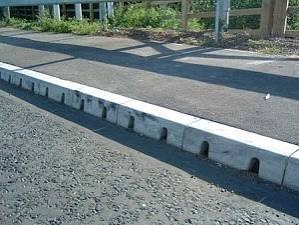
Precast concrete kerbs are manufactured in a controlled production environment before being transported to the construction site for installation.
The concrete is mixed, placed into specially designed moulds, compacted and cured. Once the units have achieved the required handling and installation strength, they are transported to the project location.
Precast kerbs are generally manufactured in standard shapes and dimensions, although specialised profiles can be produced to meet specific project requirements.
How precast concrete kerbs are manufactured
The manufacturing process normally involves the following stages:
- Material selection: Cement, aggregates, water and any approved admixtures are selected according to the required concrete properties.
- Batching: Materials are measured in controlled proportions to achieve the specified concrete mix.
- Mixing: The materials are mixed to produce a consistent concrete mixture.
- Mould preparation: Suitable moulds are cleaned, prepared and checked for the required dimensions.
- Concrete placement: Concrete is placed into the moulds.
- Compaction: Mechanical vibration or another approved method is used to reduce air voids and improve compaction.
- Demoulding: Kerb units are removed from the moulds at the appropriate stage.
- Curing: The units are cured under suitable conditions to support strength development.
- Quality inspection: Finished kerbs are checked for dimensions, visible defects and compliance with project requirements.
- Storage and transportation: Approved units are carefully stored and delivered to the construction site.
The controlled manufacturing process makes it possible to produce multiple kerbs with consistent profiles and dimensions.
3. What Are Cast-in-Situ Concrete Kerbs?
Cast-in-situ concrete kerbs are constructed directly at their final position on the project site.
Instead of manufacturing individual units elsewhere, concrete is placed into temporary or reusable formwork installed along the required kerb alignment. The concrete is then compacted, finished and cured in position.
This method is useful where kerbs need to follow particular site conditions, curved alignments or specialised road profiles.
How cast-in-situ kerbs are constructed
The construction process generally includes:
- Setting out: Surveyors or construction teams mark the required kerb alignment, levels and dimensions.
- Excavation and preparation: The area is excavated or prepared to accommodate the kerb and its supporting foundation.
- Foundation preparation: The underlying surface is levelled and compacted according to the design.
- Formwork installation: Formwork is positioned along the required alignment and securely supported.
- Concrete mixing and delivery: Concrete is prepared or delivered in accordance with the project specification.
- Concrete placement: Concrete is placed into the prepared formwork.
- Compaction: Appropriate compaction methods are used to minimise voids and honeycombing.
- Finishing: The exposed surfaces are finished to achieve the required profile and appearance.
- Curing: The concrete is protected and cured to support strength development.
- Formwork removal and inspection: Formwork is removed at the appropriate time, and the completed kerb is inspected.
Because the kerb is constructed in its final position, the method can reduce the need to transport and handle individual concrete units.
4. Precast Concrete Kerbs vs Cast-in-Situ Kerbs: Key Differences
Both methods can produce effective kerbs, but their construction processes and practical performance differ.
The following table highlights the main differences.
| Comparison factor | Precast concrete kerbs | Cast-in-situ concrete kerbs |
|---|---|---|
| Production location | Manufactured away from the installation position | Constructed directly at the project site |
| Construction method | Individual units are installed along the alignment | Concrete is placed into formwork at the final position |
| Quality control | Can benefit from controlled production conditions | Depends heavily on site supervision and workmanship |
| Dimensions | Consistent dimensions can be achieved through reusable moulds | Dimensions depend on formwork accuracy and site workmanship |
| Installation speed | Can be quick where units are available and the site is prepared | Requires formwork, placement, finishing and curing |
| Transportation | Requires delivery of manufactured units | Can reduce transportation of finished kerb units |
| Labour requirements | Requires handling, positioning and jointing | Requires formwork, concrete placement and finishing teams |
| Curved sections | Requires suitable curved units or careful joint arrangements | Can accommodate many curves through appropriately shaped formwork |
| Site access | Requires access for transporting and unloading units | May be suitable where delivery of bulky units is difficult |
| Jointing | Usually includes joints between individual units | Can be constructed continuously, with specified joints where required |
| Repairs | Individual damaged units may be replaced | Local repairs may be possible, depending on damage and design |
| Material wastage | Controlled production can help manage material use | On-site batching and formwork practices influence wastage |
| Initial cost factors | Manufacturing, storage, transport and installation | Formwork, site labour, concrete supply and placement |
Neither system is automatically superior in every situation. The best option depends on project size, design requirements, construction conditions, available resources and the expected performance of the completed road.
5. Advantages of Precast Concrete Kerbs
Precast concrete kerbs are widely used in roadworks, commercial developments, residential estates and parking facilities because they offer several practical advantages.
5.1 Consistent dimensions and appearance
Precast kerbs are manufactured using prepared moulds. This helps achieve consistent dimensions, profiles and finishes across large quantities of units.
Consistency is particularly important on roads and paved developments where uniform kerb alignment improves both appearance and construction quality.
5.2 Better control over manufacturing conditions
Precast production can take place in a dedicated environment where batching, mixing, compaction and curing are managed systematically.
This can improve consistency and reduce some of the quality variations associated with uncontrolled site production.
However, a factory-produced kerb is not automatically high-quality. Proper materials, mix design, compaction, curing and inspection remain essential.
5.3 Faster installation on prepared sites
Where precast units have already been manufactured and delivered, installation can proceed without waiting for every kerb section to be cast and cured on site.
This can help construction teams complete kerb installation efficiently, particularly on large developments with repetitive road layouts.
5.4 Suitable for large-scale projects
Precast kerbs are useful where substantial quantities of similar units are required.
Examples include:
- Urban road construction.
- Highway improvement works.
- Residential estates.
- Commercial developments.
- Industrial parks.
- Shopping centres.
- Institutional compounds.
- Large parking facilities.
5.5 Easier replacement of individual units
Where a precast kerb is damaged, an individual unit may be removed and replaced without reconstructing an entire continuous section.
The replacement process still requires careful attention to the bedding, foundation, jointing and surrounding pavement.
5.6 Reduced dependence on continuous site formwork
Because precast units are manufactured before installation, contractors do not need to construct continuous formwork along every section of the kerb alignment.
This can reduce some site preparation and formwork activities.
5.7 Potentially better programme coordination
Precast kerb production can take place while other site activities are progressing.
For example, kerbs can be manufactured while drainage works, excavation or pavement preparation are underway. This may help coordinate construction activities and reduce delays when deliveries are properly planned.
6. Disadvantages of Precast Concrete Kerbs
Despite their advantages, precast concrete kerbs also have limitations that should be considered before selecting them.
6.1 Transportation costs
Precast kerbs must be transported from the manufacturing location to the construction site.
Their weight and volume can increase delivery costs, particularly where projects are located far from the production facility or require difficult access routes.
6.2 Handling and storage requirements
Concrete kerbs can crack, chip or break if they are dropped, dragged or stored incorrectly.
Proper loading, unloading, stacking and handling procedures are necessary to minimise damage.
6.3 Joint requirements
Precast kerbs are installed as individual units, meaning joints occur between adjacent sections.
These joints must be properly detailed and constructed to achieve the required alignment, appearance and performance.
Poor jointing can create uneven surfaces, allow unwanted water movement or contribute to local movement.
6.4 Limitations on unusual shapes
Standard precast units may not suit every curve, junction, drainage transition or specialised road layout.
Custom moulds or specially shaped units may be required, increasing production planning and potentially the cost.
6.5 Dependence on supply availability
Construction programmes may be affected if the required kerb profiles, dimensions or quantities are not available when needed.
Contractors should confirm production capacity, quality requirements and delivery schedules before relying on precast units.
7. Advantages of Cast-in-Situ Concrete Kerbs
Cast-in-situ kerbs offer flexibility because the concrete is formed directly along the required alignment.
7.1 Flexibility in road alignment
Cast-in-situ kerbs can be formed to follow straight sections, curves, bends and other design features.
This is useful where the road layout includes complex geometry or where standard precast units would require numerous special pieces.
7.2 Reduced transportation of finished kerb units
Since the kerbs are constructed at the site, contractors do not need to transport large quantities of finished individual units.
This may be beneficial for projects located far from precast suppliers or where access for heavy deliveries is difficult.
However, the concrete materials, equipment and formwork must still be transported to the site.
7.3 Continuous construction
Cast-in-situ kerbs can be constructed in continuous sections, subject to the required construction and movement joints.
This can provide a uniform appearance and reduce the number of individual unit joints.
7.4 Adaptability to site conditions
The formwork can be adjusted to suit different kerb heights, widths, profiles and transitions.
This flexibility is useful where the project involves non-standard kerb arrangements or connections to existing infrastructure.
7.5 Potential suitability for smaller or specialised sections
For small sections, isolated locations or unusual transitions, constructing kerbs directly on site may be practical where manufacturing and delivering special precast units would be inefficient.
8. Disadvantages of Cast-in-Situ Concrete Kerbs
Cast-in-situ kerbs require careful construction management because their quality depends significantly on site conditions and workmanship.
8.1 Greater dependence on site workmanship
The final quality is influenced by formwork accuracy, concrete consistency, compaction, finishing and curing.
Poor workmanship can result in uneven surfaces, inconsistent dimensions, honeycombing and weak sections.
8.2 Formwork requirements
Formwork must be accurately installed and adequately supported to maintain the required kerb profile.
Poorly secured formwork can move during concrete placement, resulting in irregular dimensions and alignment.
8.3 Weather-related challenges
Rain, excessive heat and other environmental conditions can affect concrete placement, finishing and curing.
In Uganda, construction teams should plan concrete works with consideration for rainfall, site drainage and appropriate concrete protection.
8.4 Longer construction operations
Cast-in-situ kerbs require several activities to be completed at the project location, including formwork preparation, concrete placement, finishing and curing.
These activities can affect the construction programme, particularly where large quantities are required.
8.5 Difficulty maintaining uniformity over long distances
Producing consistent kerb dimensions and finishes along extensive road sections requires careful setting out, formwork control and continuous quality supervision.
8.6 Potential for higher wastage
Poorly planned concrete quantities, inaccurate batching, spillage and inefficient formwork operations can increase material wastage.
Effective site management is necessary to control these costs.
9. Cost Comparison: Which Kerb System Is More Affordable?
One of the most important considerations when choosing between precast concrete kerbs and cast-in-situ kerbs is the overall project cost.
It is not sufficient to compare the purchase price of a precast unit with the cost of concrete used for a cast-in-situ section. A fair comparison should consider all activities required to deliver an installed kerb that meets the project specification.
Factors affecting the cost of precast concrete kerbs
The cost of precast kerbs may depend on:
- Kerb dimensions and cross-sectional profile.
- Concrete mix requirements and specified strength.
- Type and quality of cement and aggregates.
- Manufacturing equipment and production methods.
- Mould requirements and production quantities.
- Colour, texture or specialised finishes.
- Quality inspection and testing.
- Storage and handling.
- Transportation distance.
- Loading and unloading arrangements.
- Installation labour and equipment.
- Bedding, foundation and jointing materials.
Large orders of standard units may benefit from production efficiencies, although the actual savings depend on supplier capacity and delivery arrangements.
Factors affecting the cost of cast-in-situ concrete kerbs
The cost of cast-in-situ kerbs may depend on:
- Concrete material quantities and specifications.
- Cement, sand and aggregate prices.
- Formwork materials and labour.
- Formwork installation and removal.
- Concrete mixing or delivery arrangements.
- Labour for placement, compaction and finishing.
- Site accessibility.
- Concrete curing and protection.
- Equipment and tools.
- Construction joints and detailing.
- Inspection and quality control.
- Material wastage and rework.
Which option is cheaper?
There is no universal answer.
Precast concrete kerbs may be more economical for large projects requiring standardised units, particularly where reliable supply and transportation are available.
Cast-in-situ kerbs may be more economical for small, irregular or specialised sections where manufacturing, transporting and handling precast units would add unnecessary costs.
The best approach is to compare the complete installed cost of both alternatives using the same dimensions, concrete performance requirements, foundation details and project quantities.
10. Installation Process: Precast vs Cast-in-Situ Concrete Kerbs
The installation process is another important difference between the two systems.
A. Installing precast concrete kerbs
The typical installation procedure includes:
Step 1: Setting out the kerb alignment
The required kerb line, levels, curves and positions are marked according to the approved road design.
Step 2: Excavating and preparing the foundation
The area is excavated to the specified dimensions. The underlying material is checked, levelled and compacted as required.
Step 3: Preparing the bedding or support
A suitable bedding layer or concrete foundation is prepared according to the design details.
Step 4: Positioning the kerbs
Precast units are carefully lifted and positioned along the marked alignment.
Step 5: Adjusting levels and alignment
Each unit is checked for the required line, level, height and relationship with adjacent units.
Step 6: Constructing joints
Joints are completed according to the project specification to maintain the required alignment and performance.
Step 7: Providing lateral support
Where specified, concrete backing or other suitable restraint is installed to support the kerbs against movement.
Step 8: Completing adjoining pavement works
Road surfaces, footpaths, paving blocks and drainage components are installed or completed around the kerbs.
Step 9: Inspection
The finished work is checked for alignment, levels, stability, joint quality and compliance with the design.
B. Constructing cast-in-situ concrete kerbs
The typical procedure includes:
Step 1: Surveying and setting out
The kerb alignment, levels and dimensions are marked on the ground.
Step 2: Preparing the foundation
The construction area is excavated and prepared to provide suitable support.
Step 3: Installing formwork
Formwork is installed along the required alignment and secured to prevent movement during concrete placement.
Step 4: Checking dimensions
The formwork is inspected to confirm the required width, height, profile and alignment.
Step 5: Placing concrete
Concrete is placed into the formwork using the specified mix and placement procedure.
Step 6: Compacting the concrete
Appropriate compaction is carried out to reduce air voids and minimise honeycombing.
Step 7: Finishing the kerb
The exposed surfaces are finished to the required shape, level and appearance.
Step 8: Curing
The concrete is protected and cured in accordance with the project requirements.
Step 9: Removing formwork
Formwork is removed when the concrete has achieved sufficient strength to maintain its shape.
Step 10: Inspecting the completed work
The kerbs are checked for cracks, honeycombing, dimensional accuracy, alignment and surface quality.
11. Which Kerb Type Is Better for Different Road Construction Projects?
The most suitable kerb system depends on the type, size and complexity of the project.
| Project type | Often suitable option | Important considerations |
|---|---|---|
| Urban road construction | Precast or cast-in-situ | Standardisation, drainage, alignment and traffic requirements |
| Highway projects | Precast or cast-in-situ | Engineering design, traffic loading and construction programme |
| Residential estates | Precast or cast-in-situ | Road layout, appearance and availability |
| Commercial developments | Precast or cast-in-situ | Parking arrangements, pedestrian movement and landscaping |
| Industrial facilities | Project-specific selection | Heavy vehicle movement, pavement design and edge restraint |
| Large parking areas | Precast or cast-in-situ | Repetitive layouts, drainage and installation efficiency |
| Curved road sections | Often cast-in-situ or specialised precast | Curve radius, profile and availability of suitable units |
| Small repair works | Depends on the repair | Existing kerb type, extent of damage and site conditions |
| Special drainage transitions | Project-specific selection | Hydraulic design and connection details |
These are general selection guidelines rather than fixed rules. The final choice should be approved by the responsible engineer and based on the project drawings and specifications.
12. Quality Requirements for Precast and Cast-in-Situ Concrete Kerbs
Regardless of the construction method, kerbs must satisfy the relevant design, material and workmanship requirements.
A poorly manufactured precast kerb or badly constructed cast-in-situ kerb can create maintenance problems and reduce the service life of the surrounding pavement.
Important quality considerations
1. Concrete strength
The concrete must meet the strength requirements specified for the project. The required strength should be established through the approved design and applicable product specifications.
2. Dimensional accuracy
Kerbs must have the specified height, width, length and profile to achieve proper installation and alignment.
3. Surface finish
Finished surfaces should be reasonably uniform and free from unacceptable defects such as extensive honeycombing, major cracks and exposed aggregate caused by poor workmanship.
4. Compaction
Concrete should be adequately compacted to minimise air voids and improve the quality of the finished product.
5. Curing
Appropriate curing is necessary to support concrete strength development and reduce the risk of premature drying and cracking.
6. Foundation support
Kerbs require suitable and stable support. Weak or poorly prepared foundations can contribute to settlement, tilting and movement.
7. Alignment and levels
The kerb line, height and gradient must follow the approved design. Poor alignment can affect road appearance, drainage and adjoining pavement construction.
8. Joint quality
For precast kerbs, joints should be constructed according to the specified details. Cast-in-situ sections should include the required construction or movement joints.
9. Durability
Concrete materials, mix design, workmanship and exposure conditions should be considered to achieve the required service performance.
Standards and testing in Uganda
Contractors and developers should confirm the current applicable Uganda Standards through the Uganda National Bureau of Standards (UNBS), together with the relevant road authority requirements, contract specifications and approved engineering drawings.
Where required, quality assurance may include concrete sampling, compressive strength testing, dimensional checks and inspection of finished kerb installations.
Acceptance criteria should be based on the applicable standard and project specification rather than assumed universal values.
13. Common Problems Associated with Concrete Kerbs
Both precast and cast-in-situ kerbs can experience defects if the materials, design, installation or supervision are inadequate.
| Common problem | Possible cause | Recommended prevention |
|---|---|---|
| Cracking | Poor concrete quality, inadequate support or movement | Use suitable concrete and provide proper foundation support |
| Kerb displacement | Weak bedding or insufficient restraint | Prepare a stable foundation and provide specified backing |
| Uneven alignment | Poor setting out or installation | Use accurate surveying and level checks |
| Honeycombing | Inadequate concrete compaction | Apply appropriate compaction procedures |
| Surface deterioration | Poor materials, curing or exposure-related issues | Use suitable materials and follow curing requirements |
| Joint failure | Incorrect joint construction or movement | Follow approved joint details |
| Water accumulation | Incorrect levels or inadequate drainage design | Coordinate kerb gradients with drainage arrangements |
| Damaged kerb edges | Poor handling or construction practices | Use suitable handling and protection methods |
Identifying these problems early can reduce repair costs and prevent defects from affecting adjoining pavement and drainage works.
14. How to Choose Between Precast and Cast-in-Situ Concrete Kerbs
Before selecting a kerb system, project owners and contractors should assess the following factors.
1. Project size and quantity
Large projects requiring many standard kerb units may benefit from precast production.
Smaller projects or isolated sections may be better suited to cast-in-situ construction, depending on local material and labour costs.
2. Design requirements
Review the required kerb profile, dimensions, height, curves, junctions and transitions.
If the design includes unusual shapes, determine whether suitable precast units are available or whether cast-in-situ construction would provide greater flexibility.
3. Project location
Consider the distance between the project site and potential precast manufacturing facilities.
Transportation costs, road access, unloading arrangements and delivery schedules can influence the final decision.
4. Construction programme
Determine how quickly the kerbs are required and whether manufacturing can take place alongside other site activities.
Precast units may support faster installation once delivered, while cast-in-situ works require on-site preparation, placement and curing.
5. Quality control capacity
Assess whether the project team can maintain the required quality standards.
Precast manufacturing may offer more controlled production conditions, while cast-in-situ work requires effective site supervision and workmanship control.
6. Availability of skilled labour and equipment
Precast installation requires suitable lifting, handling and positioning arrangements where necessary.
Cast-in-situ construction requires competent formwork, concrete placement, compaction and finishing teams.
7. Total installed cost
Compare the complete cost of each alternative rather than looking only at the material or unit price.
Include foundations, transportation, labour, equipment, joints, waste, quality inspections and potential repairs.
8. Long-term maintenance
Consider the expected traffic, environmental exposure, drainage performance and accessibility for future repairs.
The selected system should support the intended service conditions of the road or paved area.
15. Can Precast and Cast-in-Situ Kerbs Be Used on the Same Project?
Yes. A road construction project can use both precast and cast-in-situ kerbs where the design and engineering details permit.
For example, a residential estate may use standard precast kerbs along straight road sections while cast-in-situ concrete is used for specialised transitions or sections with unusual geometry.
Similarly, a commercial development may use precast units around parking areas and cast-in-situ kerbs where custom profiles are required.
However, combining the two methods requires proper coordination. Differences in dimensions, levels, concrete properties, joints and foundation details must be addressed in the design and construction specifications.
The use of different kerb systems should not create weak connections, uneven surfaces or drainage problems.
16. The Importance of Professional Planning and Supervision in Kerb Construction
Concrete kerbs may appear to be simple construction elements, but their performance depends on several interconnected activities.
Poorly planned kerb installation can affect pavement edges, drainage, pedestrian facilities and the overall appearance of a completed development.
Professional planning and construction supervision help ensure that the selected kerb system is appropriate for the project.
Important supervision activities include:
- Reviewing the kerb design and construction specifications.
- Confirming dimensions, profiles and concrete requirements.
- Checking material quality before construction.
- Inspecting the foundation and bedding preparation.
- Verifying alignment, levels and gradients.
- Monitoring concrete placement and compaction.
- Checking curing and protection procedures.
- Inspecting joints and connections.
- Coordinating kerb installation with drainage and pavement works.
- Recording inspections and correcting defects.
For road construction and property development projects in Uganda, these activities help improve workmanship, manage construction risks and support long-term infrastructure performance.
17. Frequently Asked Questions About Precast and Cast-in-Situ Concrete Kerbs
1. What is the main difference between precast and cast-in-situ concrete kerbs?
Precast concrete kerbs are manufactured before being transported to the construction site for installation. Cast-in-situ kerbs are formed and constructed directly at their final position using formwork.
2. Are precast concrete kerbs stronger than cast-in-situ kerbs?
Not necessarily. Both methods can produce strong and durable kerbs when the correct concrete specifications, materials, compaction, curing and workmanship are followed. Actual performance depends on the quality of the concrete and the supporting construction.
3. Which kerb system is faster to install?
Precast kerbs can often be installed quickly once the units are available and the foundation is prepared. Cast-in-situ kerbs require formwork, concrete placement, finishing and curing, which can extend the construction process.
However, manufacturing and delivery schedules must also be considered when assessing the overall programme.
4. Which is cheaper: precast or cast-in-situ concrete kerbs?
The cheaper option depends on project size, location, design, labour, materials, transportation and installation requirements. Precast kerbs may be economical for large quantities of standard units, while cast-in-situ kerbs may be practical for smaller or specialised sections.
5. Are precast kerbs suitable for highways?
Yes, precast kerbs can be used on highway projects where their dimensions, concrete properties, installation details and performance satisfy the approved engineering design and applicable specifications.
6. Can cast-in-situ kerbs be used for curved roads?
Yes. Cast-in-situ kerbs can be formed to follow curved road alignments using appropriately shaped formwork and accurate setting out.
7. Do precast concrete kerbs require a foundation?
Yes. Precast kerbs generally require suitable bedding or foundation support and, where specified, lateral restraint. The exact arrangement depends on the design and site conditions.
8. How long do concrete kerbs last?
Their service life depends on concrete quality, design, foundation stability, installation, traffic exposure, drainage and maintenance. Properly designed and constructed kerbs can provide long-term service.
9. Can damaged precast concrete kerbs be replaced?
Yes. Individual damaged units can often be removed and replaced, provided the underlying foundation and adjoining sections are properly inspected and repaired where necessary.
10. What should contractors inspect before accepting concrete kerbs?
Contractors should check dimensions, profile, surface condition, cracks, visible defects, concrete quality documentation, alignment requirements and compliance with the approved project specifications.
18. Conclusion: Which Is Better, Precast or Cast-in-Situ Concrete Kerbs?
Both precast concrete kerbs and cast-in-situ concrete kerbs are effective options for road construction when properly designed and installed.
Precast kerbs are particularly useful for projects requiring standardised dimensions, controlled manufacturing, large quantities and efficient installation. Cast-in-situ kerbs offer flexibility for curved alignments, unusual profiles, specialised transitions and locations where transporting finished units may be impractical.
The better option is the one that meets the engineering requirements while providing the most practical balance of quality, construction time, total installed cost and long-term performance.
For contractors, developers and property owners in Uganda, careful material selection, accurate setting out, proper foundation preparation, effective quality control and professional supervision are essential for successful kerb construction.
Planning a road construction or infrastructure project in Uganda?
Daltrev Co. Ltd. supports construction-related project requirements through its construction and consultancy services. Whether you are planning roadworks, drainage improvements, commercial developments or other infrastructure projects, proper planning and material selection are important for achieving durable results.
Visit Daltrev Co. Ltd. to explore its construction-related services or contact the team to discuss your project requirements.