Concrete is one of the most widely used construction materials in Uganda. It is essential for building foundations, columns, beams, floor slabs, roads, bridges, retaining walls and other structural elements. Although cement is often considered the main ingredient in concrete, aggregates make up a significant proportion of the concrete mixture and play an equally important role in determining its quality, strength, durability and performance.
Two major categories of aggregates used in concrete production are coarse aggregates and fine aggregates. Both are essential, but they perform different functions within the concrete mixture. Coarse aggregates provide the main granular skeleton, while fine aggregates fill spaces between larger particles, improve particle packing and contribute to the workability of fresh concrete.
Understanding coarse vs fine aggregates is important when selecting construction materials, preparing concrete mixes and managing the quality of building projects. Using unsuitable aggregate sizes, poorly graded materials or contaminated aggregates can result in weak concrete, poor workability, segregation, excessive water demand and premature structural deterioration.
For construction projects in Uganda, choosing the right combination of coarse and fine aggregates helps contractors produce concrete that meets the required engineering specifications.
This guide explores the differences between coarse and fine aggregates, their types, properties, roles in concrete production, quality requirements and factors to consider when selecting aggregates for residential, commercial and industrial construction.
What Are Aggregates in Concrete Production?
Aggregates are granular construction materials mixed with cement and water to produce concrete. They may be obtained from natural deposits or manufactured by crushing suitable rock.
Aggregates commonly include natural sand, crushed stone, gravel and manufactured sand.
They generally account for approximately 60–75% of the volume of normal concrete, although the exact proportion depends on the mix design and concrete type.
Aggregates perform several important functions:
- Provide bulk and form the main solid structure of concrete.
- Contribute to the strength and stiffness of hardened concrete.
- Reduce the quantity of cement paste required.
- Influence the workability of fresh concrete.
- Affect shrinkage and dimensional stability.
- Contribute to the durability of concrete.
- Influence the density and overall performance of the finished structure.
Aggregates are commonly classified into two main groups according to particle size:
- Fine aggregates.
- Coarse aggregates.
Both must have suitable properties and grading to produce quality concrete.
What Are Fine Aggregates?
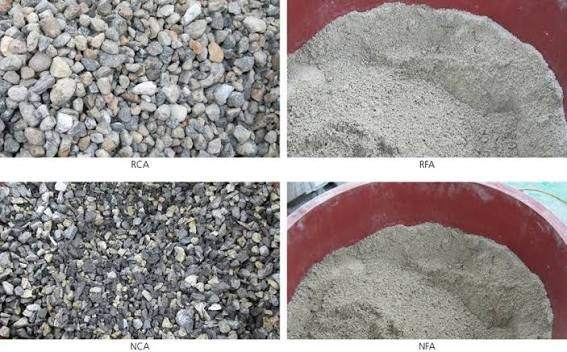
Fine aggregates are smaller granular materials used in concrete production. They occupy spaces between larger coarse aggregate particles and contribute to the overall packing, workability and consistency of the concrete mixture.
Natural sand and suitable manufactured sand are common examples of fine aggregates.
In commonly used concrete specifications, fine aggregate is material that passes a 4.75 mm sieve, although the complete grading requirements depend on the applicable standard and project specification.
Common Types of Fine Aggregates
Fine aggregates may be obtained from different natural and manufactured sources.
1. River Sand
River sand is naturally deposited by flowing water. Its particle shape and grading depend on the source and natural sediment conditions.
It is commonly used in concrete and mortar when it meets the required quality and grading specifications.
2. Pit Sand
Pit sand is extracted from natural deposits beneath the ground. Its properties vary according to the geological formation and extraction location.
It may be used in concrete production when it is appropriately graded and free from excessive clay, soil and other harmful impurities.
3. Manufactured Sand
Manufactured sand is produced by crushing suitable rock into fine particles.
It can be used as an alternative to natural sand or blended with natural sand in concrete production when its grading, particle shape and fines content meet the required specifications.
4. Crushed Stone Sand
Crushed stone sand is a fine aggregate obtained from processed crushed rock. Its suitability depends on the source material, production process and grading.
It is used in concrete and other construction applications where its properties meet the relevant requirements.
Important Properties of Fine Aggregates
Quality fine aggregates should have the following characteristics:
- Suitable particle-size distribution.
- Acceptable levels of clay, silt and other fine materials.
- Minimal harmful organic impurities.
- Suitable particle shape and texture.
- Appropriate moisture characteristics.
- Consistent grading between deliveries.
- Compatibility with the concrete mix design.
The quality of fine aggregate influences the amount of water and cement paste needed to produce workable concrete.
What Are Coarse Aggregates?
Coarse aggregates are larger granular materials used in concrete production. They form the main load-bearing granular skeleton within the concrete mixture and contribute significantly to its strength, stiffness and dimensional stability.
Common coarse aggregates include crushed stone and suitable natural gravel.
Under commonly used aggregate classifications, coarse aggregate consists of particles retained on the 4.75 mm sieve, although the exact grading limits are determined by the applicable specification.
Common Types of Coarse Aggregates
1. Crushed Stone Aggregates
Crushed stone aggregates are produced by mechanically breaking suitable rocks into smaller particles.
Common source rocks include granite, basalt, limestone and other durable rock types.
They are widely used in reinforced concrete, foundations, columns, beams, slabs, roads and precast concrete products.
2. Natural Gravel
Natural gravel is obtained from deposits formed through geological processes. Its particles are generally rounded or sub-rounded.
Suitable gravel can be used in concrete production when it meets the required grading, strength, cleanliness and durability specifications.
3. Single-Sized Coarse Aggregates
These aggregates consist of particles within a relatively narrow size range.
They are used in concrete production and selected drainage or civil engineering applications, depending on the specified grading.
4. Graded Coarse Aggregates
Graded coarse aggregates contain particles distributed across a specified range of sizes.
Appropriate grading helps improve particle packing and reduce excessive void spaces in concrete.
Common Coarse Aggregate Sizes
Coarse aggregates are available in different nominal sizes depending on the supplier and application.
| Nominal aggregate size | Typical applications |
|---|---|
| 5–10 mm | Selected concrete and precast applications |
| 10–14 mm | Concrete production and selected precast products |
| 14–20 mm | General reinforced and unreinforced concrete, where specified |
| 20–40 mm | Selected mass concrete and other applications where permitted |
| Larger stone | Specialised civil engineering and drainage applications |
These are indicative commercial size descriptions, not universal grading specifications. Always confirm the actual sieve grading and project requirements.
Important Properties of Coarse Aggregates
Quality coarse aggregates should have:
- Adequate strength and durability.
- Appropriate particle-size distribution.
- Acceptable particle shape.
- Low levels of harmful impurities.
- Suitable resistance to abrasion and crushing.
- Acceptable water absorption.
- Consistent quality.
- Compatibility with the concrete mix design.
Coarse aggregate quality is particularly important in structural concrete because unsuitable particles may compromise the performance of the finished structure.
Coarse vs Fine Aggregates: Key Differences
Although coarse and fine aggregates work together in concrete production, they have different particle sizes, functions and characteristics.
The following table highlights their main differences.
| Feature | Fine aggregates | Coarse aggregates |
|---|---|---|
| Particle size classification | Generally passes a 4.75 mm sieve | Generally retained on a 4.75 mm sieve |
| Common materials | Natural sand and manufactured sand | Crushed stone and natural gravel |
| Main function | Fill spaces between larger particles and contribute to workability | Form the main granular skeleton of concrete |
| Surface area | Generally higher for a given mass | Generally lower for a given mass |
| Influence on water demand | Fine grading and particle shape can significantly affect water demand | Shape, texture and absorption influence water demand and workability |
| Typical source | Sand deposits and crushed rock processing | Quarries and suitable gravel deposits |
| Common applications | Concrete, mortar and plastering | Concrete, foundations, slabs and structural elements |
| Quality considerations | Grading, silt, clay and organic impurities | Strength, grading, shape, abrasion and durability |
The two types of aggregates are not interchangeable without considering the concrete mix design. Both are required in appropriate proportions to achieve the desired concrete properties.
Roles of Fine Aggregates in Concrete Production
Fine aggregates perform several important functions in concrete.
1. Filling Voids Between Coarse Aggregates
One of the main functions of fine aggregates is to occupy spaces between larger coarse aggregate particles.
This improves the packing arrangement of the aggregate mixture and helps reduce the amount of empty space that must be filled by cement paste.
Proper particle grading contributes to a denser concrete mixture.
2. Improving Concrete Workability
Fine aggregates influence the consistency and handling characteristics of fresh concrete.
A suitable grading helps produce concrete that can be mixed, transported, placed and compacted effectively.
However, excessive fine particles or unsuitable sand grading may increase water demand and make concrete difficult to handle.
3. Supporting a Uniform Concrete Mix
Fine aggregates help distribute cement paste throughout the aggregate mixture.
This contributes to a more cohesive concrete mixture and can reduce segregation when the mix is correctly proportioned.
4. Influencing Surface Finish
Fine aggregates contribute to the texture and appearance of concrete surfaces.
Their grading and particle characteristics influence the finish achievable during concrete placement and finishing.
This is important in concrete floors, precast components and other visible concrete surfaces.
5. Contributing to Concrete Density
Appropriately graded fine aggregates help fill spaces between larger particles.
This can improve the packing density of the aggregate system and contribute to the production of dense concrete.
6. Helping Control Cement Paste Requirements
Good aggregate grading can reduce unnecessary void spaces and support efficient use of cement paste.
However, the final cement content must be established through the concrete mix design and project requirements.
Roles of Coarse Aggregates in Concrete Production
Coarse aggregates also perform several essential functions.
1. Providing the Main Aggregate Skeleton
Coarse aggregates form a substantial part of the solid structure of concrete.
They create a framework within which cement paste and fine aggregates are distributed.
2. Contributing to Concrete Strength
The strength and quality of coarse aggregates influence the performance of hardened concrete.
Strong, durable particles help concrete withstand applied loads, provided the mix is properly designed and produced.
3. Improving Dimensional Stability
Coarse aggregates help restrain deformation within concrete.
Suitable aggregates can reduce the tendency of concrete to undergo excessive shrinkage compared with mixtures containing a higher proportion of cement paste.
4. Reducing Cement Paste Requirements
A well-proportioned coarse aggregate skeleton helps limit the amount of cement paste needed to fill spaces and coat particles.
This can support economical concrete production while maintaining the required performance.
5. Influencing Concrete Stiffness
The stiffness and elastic properties of coarse aggregates contribute to the overall deformation characteristics of hardened concrete.
This is important in structural members such as columns, beams, slabs and foundations.
6. Supporting Long-Term Durability
Durable coarse aggregates help concrete resist deterioration under the conditions for which it is designed.
Aggregate soundness, abrasion resistance, water absorption and chemical compatibility should be considered during material selection.
How Coarse and Fine Aggregates Work Together in Concrete
Concrete performance depends on the combined behaviour of cement paste, fine aggregates and coarse aggregates.
Coarse aggregates provide the larger particle framework, while fine aggregates fill spaces between those particles. Cement paste coats and binds the aggregate particles together.
When the aggregate grading is appropriate, the mixture can achieve effective particle packing with manageable cement paste requirements.
The relationship between the two aggregate categories influences several important concrete properties.
1. Aggregate Packing
The combination of coarse and fine particles helps fill spaces within the concrete mixture.
A suitable particle-size distribution reduces excessive voids and supports a dense aggregate arrangement.
2. Workability
The proportions, grading, particle shape and surface texture of both aggregate categories affect how easily fresh concrete can be mixed and placed.
An unsuitable balance may result in concrete that is too harsh, sticky or prone to segregation.
3. Concrete Strength
Both aggregate categories contribute to the performance of hardened concrete.
Coarse aggregate strength, fine aggregate quality, cement paste quality, water-cement ratio, compaction and curing all influence the final compressive strength.
4. Durability
Appropriate aggregate selection helps concrete resist environmental exposure, wear and other deterioration mechanisms.
The aggregate must be compatible with the exposure conditions and project specification.
5. Economy of Concrete Production
Suitable aggregate proportions can help optimise cement paste requirements and reduce unnecessary material consumption.
The aim is not simply to use the lowest possible cement content, but to produce concrete that meets the specified strength, workability and durability requirements economically.
Importance of Aggregate Grading in Concrete Production
Aggregate grading refers to the distribution of different particle sizes within an aggregate sample.
It is usually determined through sieve analysis.
Both coarse and fine aggregates require appropriate grading to achieve the desired concrete properties.
Why Fine Aggregate Grading Matters
Fine aggregate grading affects:
- Concrete workability.
- Water demand.
- Cement paste requirements.
- Cohesion.
- Surface finish.
- Risk of segregation.
Sand that is excessively fine may increase water demand, while sand that is too coarse or poorly graded may produce a harsh mixture.
Why Coarse Aggregate Grading Matters
Coarse aggregate grading affects:
- Particle packing.
- Concrete workability.
- Segregation risk.
- Aggregate interlock.
- Placement and compaction.
- Cement paste requirements.
The correct grading depends on the concrete design and the dimensions of the structural member.
Combined Aggregate Grading
In concrete mix design, fine and coarse aggregates should be considered together.
The objective is to achieve a suitable combined grading that supports workability, density, strength and durability.
Simply increasing the quantity of either aggregate category does not guarantee better concrete.
How Aggregate Size Affects Concrete Performance
Aggregate size is an important factor in concrete production.
The maximum nominal aggregate size must be appropriate for the structural element, reinforcement spacing and placement method.
Smaller Coarse Aggregates
Smaller coarse aggregate sizes may be suitable for structural members with closely spaced reinforcement or relatively restricted sections.
However, smaller particles generally create a greater total surface area for a given aggregate volume, which may influence paste and water requirements.
Larger Coarse Aggregates
Larger aggregates can reduce the total surface area of aggregate particles for a given volume.
They may be suitable for larger concrete sections where the placement and reinforcement conditions allow them.
However, aggregate that is too large can obstruct concrete flow, interfere with reinforcement spacing and make compaction difficult.
Choosing the Appropriate Size
The appropriate maximum aggregate size should be determined by the engineer or mix designer based on:
- Minimum dimensions of the concrete member.
- Clear spacing between reinforcement bars.
- Cover requirements.
- Placement and compaction method.
- Concrete workability requirements.
- Applicable construction specifications.
Quality Requirements for Coarse and Fine Aggregates
The quality of aggregates should be checked before they are approved for concrete production.
Poor-quality materials may lead to concrete defects and reduce the reliability of the finished structure.
Fine Aggregate Quality Checks
Inspect fine aggregates for:
- Excessive silt and clay.
- Organic impurities.
- Unsuitable particle-size distribution.
- Soil contamination.
- Excessive or uncontrolled stone dust.
- Variations in moisture and grading.
Sieve analysis and appropriate impurity tests should be performed when required.
Coarse Aggregate Quality Checks
Inspect coarse aggregates for:
- Weak or weathered particles.
- Excessive flaky or elongated particles.
- Clay and soil contamination.
- Unsuitable particle grading.
- Excessive dust.
- Poor abrasion resistance.
- High water absorption where relevant.
Laboratory testing should be carried out according to the project specification.
Common Aggregate Tests
| Test | Aggregate category | Purpose |
|---|---|---|
| Sieve analysis | Fine and coarse | Determines particle-size distribution |
| Silt and fine material assessment | Fine and coarse | Checks the amount of fine material |
| Organic impurity test | Fine | Identifies potentially harmful organic contamination |
| Specific gravity | Fine and coarse | Determines relative density |
| Water absorption | Fine and coarse | Measures water absorbed by aggregate |
| Los Angeles abrasion test | Mainly coarse | Assesses resistance to abrasion and impact |
| Flakiness and elongation tests | Coarse | Assess particle shape |
| Aggregate crushing value | Coarse | Evaluates resistance to crushing |
The required tests and acceptance limits depend on the applicable standards and the concrete specification.
What Happens When Poor-Quality Aggregates Are Used?
Using unsuitable fine or coarse aggregates can affect both fresh and hardened concrete.
Common problems include:
1. Reduced Concrete Strength
Weak aggregate particles, excessive impurities or poor mix proportions may compromise concrete performance.
2. Poor Workability
Incorrect aggregate grading and particle shape can make concrete difficult to mix, place and compact.
3. Segregation
An unsuitable balance of aggregate sizes and paste content may cause coarse particles to separate from the cement mortar.
4. Excessive Water Demand
Very fine sand, excessive fines or unfavourable particle shapes may increase water requirements.
Adding uncontrolled water can increase the water-cement ratio and reduce concrete strength and durability.
5. Surface Defects
Poor aggregate grading and inadequate compaction may contribute to honeycombing, voids and uneven concrete surfaces.
6. Increased Shrinkage
An unsuitable aggregate-paste balance may increase the tendency of concrete to shrink and crack.
7. Durability Problems
Unsound or chemically unsuitable aggregates may contribute to deterioration under particular environmental conditions.
Selecting suitable aggregates, following the approved mix design and maintaining proper construction practices helps minimise these risks.
How to Choose the Right Coarse and Fine Aggregates for Your Project
Choosing aggregates should be based on the structural requirements and intended application rather than price or appearance alone.
Consider the following factors when purchasing aggregates in Uganda.
1. Identify the Concrete Application
Determine whether the concrete is intended for:
- Building foundations.
- Columns and beams.
- Suspended slabs.
- Ground floors.
- Roads and pavements.
- Retaining walls.
- Precast concrete products.
- Industrial floors.
Different applications may require different aggregate properties and grading.
2. Confirm the Required Aggregate Sizes
Use the sizes specified in the approved concrete mix design.
Do not select coarse aggregate based only on the supplier’s commercial description.
3. Check the Quality of Fine Aggregates
Fine aggregates should have suitable grading and acceptable levels of impurities.
Avoid sand containing excessive clay, silt, organic matter or uncontrolled fines.
4. Inspect Coarse Aggregate Quality
Check the coarse aggregates for particle shape, cleanliness, strength and durability.
Avoid material containing excessive weak or weathered particles.
5. Request Relevant Test Results
For structural and large-scale construction projects, request test results or arrange independent testing.
This helps confirm whether the material meets the project requirements.
6. Consider Moisture Content
Aggregate moisture affects the quantity of water required during concrete batching.
Fine aggregates may contain varying amounts of surface moisture, while coarse aggregates may absorb or carry water depending on their condition.
Moisture corrections should be made during batching to maintain the intended water-cement ratio.
7. Choose a Reliable Supplier
Work with suppliers who can provide consistent aggregate quality, accurate grading information and reliable deliveries.
8. Compare Total Delivered Cost
Consider the material price, transport distance, loading, offloading and delivery reliability.
Always compare quotations for materials that meet the same quality and grading requirements.
Factors Affecting the Cost of Coarse and Fine Aggregates in Uganda
Aggregate prices in Uganda vary according to material type, source, location, quality and transportation arrangements.
Important cost factors include:
1. Source location: Aggregates obtained from different quarries or natural deposits may have different production and supply costs.
2. Aggregate size: Different particle sizes may require different crushing, screening and processing arrangements.
3. Material quality: Washed, screened or specially graded aggregates may have additional processing costs.
4. Transportation: Distance from the quarry or supplier to the construction site affects the final delivered cost.
5. Order quantity: The volume required may influence truck availability, loading arrangements and delivery costs.
6. Market demand: Construction activity and local supply conditions may affect availability and pricing.
7. Delivery arrangements: Confirm whether the quotation includes loading, transport and offloading.
For projects in Kampala, Wakiso, Mukono and other parts of Uganda, compare the total delivered price rather than relying only on the quoted price per unit of material.
Applications of Coarse and Fine Aggregates in Different Construction Projects
Both aggregate categories are used across a wide range of construction developments.
Residential Construction
In residential buildings, aggregates are used in:
- Foundation concrete.
- Ground floor slabs.
- Columns and beams.
- Staircases.
- Concrete walkways.
- External paving.
- Drainage structures.
Commercial Construction
Commercial buildings require aggregates for:
- Reinforced concrete frames.
- Suspended slabs.
- Parking areas.
- Concrete floors.
- Staircases.
- Retaining walls.
- External paved areas.
Industrial Construction
Industrial facilities may require specially designed concrete for heavy-duty applications.
Aggregates are used in:
- Warehouse floors.
- Factory slabs.
- Loading bays.
- Industrial roads.
- Equipment foundations.
- Drainage structures.
The aggregate selection should consider loading conditions, abrasion requirements and environmental exposure.
Infrastructure Construction
Roads, bridges, culverts and other infrastructure projects use both fine and coarse aggregates in concrete and pavement construction.
Material selection must comply with the relevant engineering specifications.
Best Practices for Handling and Storing Aggregates
Even good-quality aggregates can become unsuitable if they are contaminated or poorly managed on site.
Follow these practices:
- Store coarse and fine aggregates separately.
- Prepare clean and well-drained storage areas.
- Prevent contamination by soil, rubbish and organic materials.
- Avoid mixing different aggregate sizes.
- Manage runoff around stockpiles.
- Inspect aggregates before batching.
- Monitor moisture content.
- Use consistent materials throughout concrete production.
- Maintain proper batching and quality-control records.
For large construction projects, establish clear procedures for material acceptance and stockpile management.
Frequently Asked Questions About Coarse vs Fine Aggregates
1. What is the main difference between coarse and fine aggregates?
Fine aggregates generally pass through a 4.75 mm sieve and include natural sand and manufactured sand. Coarse aggregates are generally retained on that sieve and include crushed stone and gravel. Fine aggregates fill spaces between larger particles, while coarse aggregates form the main granular skeleton of concrete.
2. Which aggregate is more important in concrete production?
Both are essential. Coarse aggregates provide the main granular framework, while fine aggregates improve particle packing and contribute to workability. Concrete performance depends on their combined grading and proportions, together with cement paste quality and construction practices.
3. What is the common size of coarse aggregate used in concrete?
Common commercial nominal sizes include 10 mm, 14 mm and 20 mm. The correct size depends on the structural member, reinforcement spacing, concrete mix design and placement method.
4. Can fine aggregates be used without coarse aggregates?
Fine aggregate can be used in specialised cement-based materials such as mortar, but normal structural concrete generally contains both fine and coarse aggregates. The mixture must be designed for its intended application.
5. Can coarse aggregates be used without fine aggregates?
Some specialised concrete and drainage applications use open-graded coarse aggregate systems. However, conventional concrete production generally requires fine aggregate as part of the mix.
6. How do fine aggregates affect concrete strength?
Fine aggregates influence particle packing, workability, water demand and cement paste requirements. Their quality and grading can therefore affect concrete strength and durability.
7. How do coarse aggregates affect concrete strength?
Coarse aggregate strength, durability, particle shape and grading influence the performance of hardened concrete. The final strength also depends on cement quality, water-cement ratio, mix design, compaction and curing.
8. What happens if too much fine aggregate is used in concrete?
Excessive fine aggregate may increase surface area and water demand, potentially making the mix less workable or more difficult to compact. Its effects depend on the combined grading and mix design.
9. Is crushed stone a coarse aggregate?
Yes. Crushed stone is commonly used as coarse aggregate when its particle sizes and properties meet the relevant concrete specifications. Fine particles produced from crushing may also be processed for use as fine aggregate.
10. What is the difference between fine aggregate and sand?
Sand is a common material used as fine aggregate. However, fine aggregate is a broader technical category that may include natural sand and suitable manufactured fine materials.
11. How do you test aggregates before using them in concrete?
Common tests include sieve analysis, specific gravity, water absorption, impurity assessments and, for coarse aggregates, abrasion, crushing and particle-shape tests. The appropriate testing programme depends on the project specification.
12. Why should aggregates be stored separately?
Separate storage prevents contamination and unwanted mixing between aggregate sizes. It also helps maintain consistent grading during concrete batching.
Conclusion
Understanding coarse vs fine aggregates is essential for producing quality concrete in residential, commercial, industrial and infrastructure construction.
Fine aggregates fill spaces between larger particles, contribute to concrete workability and support effective particle packing. Coarse aggregates form the main granular skeleton, contribute to strength and stiffness, and help control deformation in hardened concrete.
Although they perform different functions, both must work together in suitable proportions to produce concrete that meets the required strength, durability and workability specifications.
For construction projects in Uganda, contractors and developers should pay attention to aggregate grading, particle size, cleanliness, strength, moisture content and consistency. They should also follow approved mix designs, conduct appropriate material testing and maintain proper storage and batching procedures.
Choosing the right combination of coarse and fine aggregates is an important step towards producing durable concrete, controlling construction costs and achieving reliable building performance.
Planning a residential, commercial or industrial construction project in Uganda? Visit Daltrevco to explore construction solutions and discuss your project requirements.