
Electrical safety is one of the most important considerations in residential, commercial and industrial building installations. Every property that uses electricity requires reliable protective devices to prevent electrical faults from damaging equipment, disrupting operations or creating dangerous conditions. Among the most important components of an electrical installation are circuit breakers.
Electrical circuit breakers are automatic protective devices designed to interrupt electrical current when abnormal conditions, such as overloads and short circuits, occur. They help protect electrical wiring, appliances, machinery and other connected equipment against excessive current that could cause overheating, equipment damage or electrical fires.
Whether you are constructing a residential house, developing an office building, installing an industrial facility or upgrading an existing electrical system, choosing the correct circuit breakers is essential for reliable electrical protection.
In Uganda, where residential properties, commercial buildings, factories and industrial facilities depend on electricity for daily operations, properly designed circuit protection helps improve electrical safety and system reliability.
At Daltrevco, we understand the importance of professionally designed electrical installations and dependable building utility systems. This guide explains how electrical circuit breakers work, the different types available, their functions, important selection considerations, installation requirements and maintenance practices.
What Is an Electrical Circuit Breaker?
An electrical circuit breaker is an automatically operated switching device that protects an electrical circuit by interrupting the flow of current when a fault or abnormal electrical condition occurs.
Unlike a traditional fuse, which must be replaced after operating, many circuit breakers can be reset after the fault has been identified and corrected.
Circuit breakers are installed in electrical distribution boards, consumer units, switchboards and industrial electrical panels to protect individual circuits or larger sections of an electrical installation.
Their primary purpose is to prevent excessive current from flowing through electrical conductors and connected equipment for longer than the circuit can safely withstand.
Circuit breakers are commonly used to protect:
- Residential lighting and socket circuits.
- Air conditioning and refrigeration systems.
- Water heaters and electric cookers.
- Commercial office electrical installations.
- Industrial machinery and production equipment.
- Pumps, motors and compressors.
- Distribution boards and electrical feeders.
- Electrical control panels.
- Commercial lighting systems.
Selecting the right circuit breaker requires understanding the electrical load, cable capacity, fault conditions and specific protection requirements of the installation.
How Does an Electrical Circuit Breaker Work?
Circuit breakers operate by automatically opening an electrical circuit when the current exceeds a predetermined limit or when another specified fault condition is detected.
Most commonly used low-voltage circuit breakers use thermal, magnetic or electronic tripping mechanisms.
1. Normal Electrical Operation
Under normal conditions, electrical current flows through the circuit breaker to supply connected appliances, equipment and electrical systems.
The breaker remains closed, allowing electricity to reach the connected load.
2. Detection of an Electrical Fault
When an abnormal electrical condition occurs, the circuit breaker detects the fault through its internal protection mechanism.
For example, an overload occurs when a circuit carries more current than it is designed to handle. A short circuit occurs when an unintended low-impedance connection causes a very high current to flow.
3. Automatic Tripping
When the fault reaches the breaker’s operating threshold, the internal mechanism activates and separates the electrical contacts.
This interrupts the current flowing through the circuit and helps prevent damage to the installation.
4. Isolation of the Faulty Circuit
After tripping, the circuit breaker isolates the affected circuit while other independently protected circuits may continue operating.
This helps limit the impact of electrical faults within a building.
5. Resetting the Circuit Breaker
Once the cause of the fault has been identified and corrected, the breaker may be reset according to the manufacturer’s instructions.
A breaker that repeatedly trips should never be forced to remain switched on. Repeated tripping indicates that the electrical installation requires investigation.
Main Functions of Electrical Circuit Breakers
Circuit breakers perform several important functions in electrical installations.
1. Protection Against Electrical Overloads
An electrical overload occurs when a circuit carries more current than its designed capacity.
This may happen when too many appliances are connected to one circuit or when equipment draws excessive current during operation.
Overloads can cause electrical cables to overheat, damage insulation and increase the risk of fire.
Circuit breakers with appropriate overload protection automatically disconnect the affected circuit when the current exceeds the permitted operating conditions.
2. Protection Against Short Circuits
A short circuit occurs when electrical conductors come into unintended contact, creating a low-impedance path that allows excessive current to flow.
Short circuits can produce very high fault currents and cause severe electrical damage.
Circuit breakers are designed to interrupt these currents within their specified operating and breaking capabilities.
3. Protection of Electrical Wiring
Electrical cables have current-carrying capacities that depend on their size, insulation, installation method, ambient temperature and grouping conditions.
A properly selected circuit breaker helps ensure that the circuit is protected against excessive current that could damage the cable.
The breaker rating must be coordinated with the cable’s permitted current-carrying capacity.
4. Isolation of Electrical Circuits
Circuit breakers can be used to isolate electrical circuits during maintenance, inspection and repair, provided the device is suitable for isolation and the correct safety procedures are followed.
This helps electricians work on specific parts of an installation without unnecessarily disconnecting the entire building.
5. Protection of Electrical Equipment
Appropriate circuit protection helps reduce the risk of damage to electrical equipment caused by excessive current and short circuits.
Different equipment may require additional specialised protection, such as motor overload relays, earth leakage protection and temperature monitoring.
A circuit breaker should therefore be selected according to the protection requirements of the complete electrical system.
6. Improved Electrical System Reliability
By isolating faulty circuits, circuit breakers help prevent localised electrical problems from affecting an entire building.
This is particularly important in commercial and industrial facilities where electrical interruptions can affect business operations and production activities.
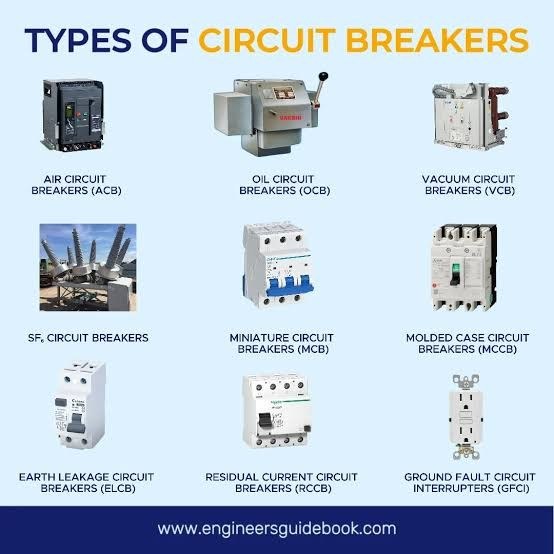
Types of Electrical Circuit Breakers
Different circuit breakers are designed for different electrical applications, current ratings, voltage levels and fault conditions.
The following are some of the most commonly used circuit breakers in residential, commercial and industrial electrical installations.
1. Miniature Circuit Breaker (MCB)
A Miniature Circuit Breaker (MCB) is a commonly used low-voltage protective device designed to protect electrical circuits against overloads and short circuits.
MCBs are widely installed in residential buildings, offices, shops and other properties with relatively low-current electrical circuits.
They are commonly used for:
- Lighting circuits.
- General socket outlets.
- Small electrical appliances.
- Residential distribution boards.
- Office electrical circuits.
- Selected small equipment circuits.
MCBs are available in different current ratings and tripping characteristics.
Common MCB tripping curves include:
Type B: Generally trips instantaneously at approximately 3–5 times its rated current. It is commonly used for circuits with relatively low starting currents, such as many domestic lighting and socket applications.
Type C: Generally trips instantaneously at approximately 5–10 times its rated current. It is commonly used where moderate inrush currents occur, including some commercial equipment and small motors.
Type D: Generally trips instantaneously at approximately 10–20 times its rated current. It is intended for applications with high inrush currents, subject to proper fault-current and installation assessments.
The appropriate MCB type depends on the characteristics of the connected equipment and the electrical installation.
2. Moulded Case Circuit Breaker (MCCB)
A Moulded Case Circuit Breaker (MCCB) is a larger circuit breaker designed to protect higher-current electrical circuits.
MCCBs are commonly used in commercial buildings, factories, industrial facilities and large electrical distribution systems.
They generally offer higher current ratings and breaking capacities than standard MCBs.
Depending on the model, MCCBs may provide adjustable thermal and magnetic protection or electronic trip settings.
Common applications include:
- Main electrical distribution systems.
- Industrial machinery.
- Commercial electrical panels.
- Large air conditioning systems.
- Industrial motor feeders.
- Distribution feeders.
- Manufacturing facilities.
- Large commercial buildings.
MCCBs are particularly useful where the electrical installation requires higher current ratings, adjustable protection settings or greater fault-interruption capacity.
3. Air Circuit Breaker (ACB)
An Air Circuit Breaker (ACB) is a circuit breaker that uses air as the medium for extinguishing the electrical arc produced when its contacts separate.
ACBs are commonly used in low-voltage main distribution systems that require high current ratings and advanced protection features.
They are often installed in large commercial and industrial electrical switchboards.
Typical applications include:
- Main low-voltage distribution boards.
- Industrial power distribution systems.
- Large manufacturing facilities.
- Commercial complexes.
- Power distribution panels.
- Large electrical installations.
Depending on the design, ACBs may provide adjustable protection functions, including overload, short-circuit and earth-fault protection.
They are particularly useful in installations requiring high-capacity electrical distribution and coordinated protection.
4. Residual Current Circuit Breaker (RCCB)
A Residual Current Circuit Breaker (RCCB) is a protective device designed to detect an imbalance between the current flowing through live conductors and the current returning through the neutral conductor.
This imbalance may indicate current leakage to earth.
When the detected residual current reaches the device’s operating threshold, the RCCB disconnects the circuit.
RCCBs are important for reducing the risk of electric shock and protecting against certain electrical leakage-related fire hazards.
Common applications include:
- Residential socket circuits.
- Bathrooms and other areas requiring additional shock protection.
- Commercial buildings.
- Outdoor electrical installations.
- Selected appliance circuits.
An RCCB does not normally provide overload or short-circuit protection. It must therefore be used with an appropriately rated overcurrent protective device, such as an MCB or MCCB, unless the selected device combines these functions.
5. Residual Current Circuit Breaker with Overcurrent Protection (RCBO)
An RCBO combines residual current protection and overcurrent protection in one device.
It provides protection against:
- Electrical overloads.
- Short circuits.
- Residual current faults.
RCBOs are particularly useful where individual circuits require combined protection without installing separate RCCBs and MCBs.
They are commonly used in modern residential distribution boards, commercial buildings and selected industrial applications.
One advantage of RCBOs is that a fault on one protected circuit can be isolated without necessarily disconnecting other circuits through a shared residual-current device.
6. Vacuum Circuit Breaker (VCB)
A Vacuum Circuit Breaker (VCB) uses a vacuum interrupter to extinguish the electrical arc when the breaker opens.
VCBs are commonly used in medium-voltage electrical distribution systems.
They are suitable for installations requiring reliable switching and protection of medium-voltage equipment.
Typical applications include:
- Industrial substations.
- Medium-voltage distribution systems.
- Large factories.
- Commercial power distribution installations.
- Transformer feeder protection.
- Electrical utility systems.
VCBs are generally selected for medium-voltage applications rather than ordinary residential distribution boards.
7. SF6 Circuit Breaker
An SF6 circuit breaker uses sulphur hexafluoride gas as an insulating and arc-extinguishing medium.
These breakers have historically been used in medium-voltage and high-voltage electrical installations because of their effective insulation and arc-interruption characteristics.
Applications include:
- High-voltage substations.
- Electrical transmission systems.
- Power distribution infrastructure.
- Selected industrial substations.
However, SF6 is a highly potent greenhouse gas. Environmental regulations and the transition towards alternative technologies are increasingly important considerations when specifying, maintaining or replacing SF6 equipment.
Difference Between MCB, MCCB, RCCB and RCBO
Although these devices are all used in electrical protection systems, they perform different functions.
| Device | Main protection function | Common application |
|---|---|---|
| MCB | Overload and short circuit | Homes and offices |
| MCCB | Overload and short circuit | Commercial and industrial systems |
| RCCB | Residual current and earth leakage | Shock protection |
| RCBO | Residual current, overload and short circuit | Individual protected circuits |
| ACB | High-capacity low-voltage circuit protection | Main distribution systems |
| VCB | Medium-voltage switching and protection | Industrial substations |
Choosing between these devices requires understanding the electrical fault conditions and the protection required for each circuit.
How to Choose the Right Electrical Circuit Breaker
Selecting the right circuit breaker is essential for ensuring that an electrical installation is adequately protected.
An incorrectly selected breaker may fail to provide the required protection or cause unnecessary interruptions during normal equipment operation.
The following factors should be considered when selecting circuit breakers.
1. Determine the Electrical Load
The first step is calculating the expected electrical load connected to the circuit.
This involves identifying the appliances, machinery and equipment that will operate on the circuit.
The expected current demand helps determine the appropriate breaker rating.
For single-phase electrical loads, a simplified current calculation is:
Current (A) = Power (W) ÷ Voltage (V)
For three-phase systems supplying balanced loads, a simplified calculation is:
Current (A) = Power (W) ÷ (√3 × Voltage (V) × Power Factor)
For three-phase motors, efficiency must also be considered when calculating current from mechanical output power.
A qualified electrical professional should verify the actual design current using the equipment specifications and installation conditions.
2. Select the Correct Current Rating
The circuit breaker’s rated current must be suitable for the design current and the cable’s current-carrying capacity.
Under commonly applied IEC installation principles, the relationship is:
Ib ≤ In ≤ Iz
Where:
- Ib = Design current of the circuit.
- In = Rated current of the protective device.
- Iz = Permitted current-carrying capacity of the cable.
The applicable overload protection conditions must also be satisfied.
Choosing a breaker with an excessively high rating can leave the cable inadequately protected, while a rating that is too low may cause unnecessary tripping.
3. Consider the Breaking Capacity
Breaking capacity is the maximum prospective fault current that a circuit breaker can safely interrupt under its specified conditions.
The selected breaker must have an adequate breaking capacity for the prospective short-circuit current at its installation point.
For example, a breaker with a breaking capacity of 6 kA is not automatically suitable for an installation where the prospective fault current exceeds that value.
This is an important consideration in commercial and industrial buildings, where available fault currents may be significantly higher than those in smaller installations.
4. Choose the Appropriate Tripping Curve
MCB tripping characteristics determine how the device responds to short-duration high currents.
- Type B: Suitable for many circuits with relatively low inrush currents.
- Type C: Suitable for selected circuits with moderate starting currents.
- Type D: Suitable for selected circuits with high starting or inrush currents.
The correct selection depends on the connected equipment, starting characteristics and required disconnection times.
A higher tripping curve should never be selected simply to stop a breaker from tripping repeatedly without investigating the cause.
5. Consider the Number of Poles
Circuit breakers are available in different pole configurations depending on the electrical system.
Common options include:
- Single-pole breakers.
- Double-pole breakers.
- Three-pole breakers.
- Four-pole breakers.
Single-pole devices are commonly used for selected single-phase circuits, while double-pole devices may be used where both live and neutral conductors require switching.
Three-pole breakers are commonly used in three-phase systems, while four-pole devices can switch three phases and neutral.
The appropriate arrangement depends on the supply system, earthing arrangement, isolation requirements and applicable electrical standards.
6. Consider the Operating Voltage
Circuit breakers must be rated for the voltage and frequency of the electrical system in which they will operate.
The voltage rating should be compatible with the installation and the manufacturer’s specifications.
7. Check the Installation Environment
The installation environment can influence the performance and suitability of circuit breakers.
Important considerations include:
- Ambient temperature.
- Dust and moisture exposure.
- Ventilation.
- Enclosure protection rating.
- Corrosive conditions.
- Altitude where relevant.
- Available installation space.
Industrial environments may require specialised enclosures and circuit breakers designed for more demanding operating conditions.
8. Consider Equipment Starting Currents
Some electrical equipment draws significantly higher current during startup than during normal operation.
Examples include:
- Electric motors.
- Air conditioning compressors.
- Water pumps.
- Refrigeration equipment.
- Industrial machinery.
Circuit breaker selection must account for these starting characteristics while maintaining appropriate protection against actual faults.
9. Ensure Coordination With Other Protective Devices
Circuit breakers should be coordinated with other electrical protection devices to achieve appropriate fault isolation and minimise unnecessary interruptions.
This may involve coordination between main breakers, sub-main breakers, final circuit MCBs, RCCBs, RCBOs and motor protection devices.
A properly designed system helps ensure that the protective device closest to a fault operates where selectivity can be achieved.
Circuit Breaker Selection for Different Buildings
Different buildings have different electrical requirements. The appropriate circuit breaker selection depends on the building’s load demand, electrical design and operational needs.
Circuit Breakers for Residential Buildings
Residential properties require circuit breakers to protect lighting, sockets, cooking equipment, water heaters, air conditioning and other electrical appliances.
A typical residential distribution board may contain:
- MCBs for lighting circuits.
- MCBs for socket circuits.
- Dedicated protection for electric cookers.
- Dedicated protection for water heaters.
- RCBOs for selected circuits.
- Main incoming circuit protection.
- Appropriate residual current protection.
The exact configuration depends on the electrical installation design and applicable regulations.
Circuit Breakers for Commercial Buildings
Commercial properties generally have more extensive electrical installations than ordinary homes.
Offices, hotels, shopping centres, hospitals, banks and educational institutions may require different levels of circuit protection.
Typical applications include:
- Main distribution circuit breakers.
- Sub-distribution MCCBs.
- MCBs for lighting and socket circuits.
- RCBOs for selected equipment circuits.
- Protection for air conditioning systems.
- Protection for lifts and escalators.
- Protection for commercial kitchen equipment.
- Dedicated equipment protection.
Commercial circuit breaker selection should consider operating hours, load diversity, electrical continuity and future expansion.
Circuit Breakers for Industrial Facilities
Industrial electrical systems often operate large motors, pumps, compressors, manufacturing equipment and automated production systems.
These installations may require MCCBs, ACBs, VCBs and specialised motor protection equipment.
Important industrial applications include:
- Main incoming supply protection.
- Motor control centres.
- Transformer feeder protection.
- Industrial distribution boards.
- Production machinery.
- Pumping systems.
- Large ventilation and cooling systems.
- Automated production lines.
Industrial installations require careful fault-current calculations, protection coordination and consideration of motor starting conditions.
Circuit Breaker Installation Process
Correct installation is essential for ensuring that circuit breakers operate safely and reliably.
Circuit breaker installation should be carried out by competent electrical professionals using suitable tools, approved equipment and appropriate safety procedures.
Step 1: Assess the Existing Electrical Installation
The first step is inspecting the electrical distribution system to understand its configuration and protection requirements.
The assessment should identify:
- Incoming electrical supply.
- Existing distribution boards.
- Connected electrical loads.
- Cable sizes and installation methods.
- Existing protective devices.
- Earthing arrangements.
- Available fault-current information.
- Potential electrical safety concerns.
Step 2: Calculate the Required Circuit Protection
The electrical professional determines the design current, cable capacity, prospective short-circuit current and required disconnection characteristics.
This information is used to select suitable circuit breaker ratings and types.
Step 3: Select Compatible Circuit Breakers
The selected devices should be compatible with the distribution board, electrical supply, connected loads and required protection functions.
It is also important to consider manufacturer specifications, breaking capacity and coordination with upstream and downstream devices.
Step 4: Install the Circuit Breakers
The electrical installation is safely isolated before work begins.
The circuit breakers are installed in suitable distribution boards or switchgear using the manufacturer’s approved mounting and connection arrangements.
Proper conductor preparation, terminal connections, phase identification and required tightening torques are essential.
Step 5: Test the Electrical Installation
After installation, appropriate inspections and electrical tests should be completed.
These may include:
- Continuity of protective conductors.
- Insulation resistance.
- Polarity verification.
- Earth fault loop impedance.
- Prospective short-circuit current.
- Residual current device testing where applicable.
- Functional verification of protective devices.
Testing should confirm that the installation meets the applicable electrical requirements.
Step 6: Label and Document the Distribution Board
All protected circuits should be clearly identified.
Accurate circuit schedules and documentation help property owners and maintenance personnel identify circuits during future inspections, repairs and upgrades.
Common Circuit Breaker Problems and Their Solutions
Circuit breakers are designed to protect electrical installations, but they may experience operating problems due to faults, incorrect selection, ageing or installation defects.
Understanding common problems helps property owners know when to seek professional electrical assistance.
1. Circuit Breaker Keeps Tripping
Repeated tripping may indicate an overloaded circuit, short circuit, earth fault, defective appliance or an incorrectly selected protective device.
Solution: Have a qualified electrician identify and correct the underlying fault. Do not repeatedly reset the breaker without investigating the problem.
2. Circuit Breaker Feels Hot
Excessive heating may result from overloaded circuits, loose connections, unsuitable equipment ratings or poor ventilation.
Solution: Arrange an inspection of the breaker, terminals, connected conductors and electrical load.
3. Circuit Breaker Fails to Reset
A breaker that refuses to reset may still be detecting an electrical fault or may have developed an internal mechanical or electrical defect.
Solution: The connected circuit should be inspected and the defective breaker replaced where necessary.
4. Circuit Breaker Trips Without an Obvious Cause
Nuisance tripping may occur due to equipment starting currents, incorrect breaker characteristics, deteriorated insulation or residual current leakage.
Solution: Conduct appropriate electrical testing to identify the source of the problem before changing the breaker rating or type.
5. Circuit Breaker Does Not Trip During a Fault
A circuit breaker that fails to interrupt a fault presents a serious electrical safety risk.
Solution: The installation should be isolated and urgently inspected by a competent electrical professional. The breaker and associated protection system must be tested and defective components replaced.
How to Maintain Electrical Circuit Breakers
Regular inspection and maintenance help ensure that circuit breakers remain reliable throughout their service life.
The following practices are important for residential, commercial and industrial installations.
1. Conduct Periodic Electrical Inspections
Inspect distribution boards and protective devices for visible damage, discolouration, corrosion, contamination and other signs of deterioration.
2. Check for Overheating
Unusual heat, burning smells or discoloured terminals may indicate loose connections, excessive loading or defective equipment. These conditions require immediate professional attention.
3. Test Protective Devices
Appropriate testing should be carried out according to the manufacturer’s instructions and applicable electrical maintenance requirements.
4. Keep Distribution Boards Clean and Secure
Electrical panels should be kept free from dust, moisture and unauthorised access. Enclosures should remain properly closed and protected.
5. Replace Damaged Circuit Breakers
Cracked, burnt, mechanically damaged or defective circuit breakers should be replaced with suitable compatible devices.
6. Maintain Updated Circuit Schedules
Accurate circuit labelling makes fault identification, isolation and future electrical maintenance easier.
7. Avoid Overloading Electrical Circuits
Electrical loads should remain within the designed capacity of the circuits and associated protective devices.
Maintenance and testing should be performed by qualified personnel. Circuit breakers should never be opened, bypassed or modified by unqualified individuals.
What Is the Difference Between a Circuit Breaker and a Fuse?
Circuit breakers and fuses both protect electrical circuits against excessive current, but they operate differently.
A fuse contains a metal element that melts when excessive current flows through it for a sufficient period. Once the fuse operates, it must be replaced with an appropriate new fuse.
A circuit breaker uses a mechanical switching mechanism that automatically opens the circuit during a fault. Many circuit breakers can be reset after the fault has been corrected.
The main differences include:
| Feature | Circuit breaker | Fuse |
|---|---|---|
| Operation | Mechanical tripping mechanism | Melting fuse element |
| Reuse | Generally resettable | Must be replaced after operation |
| Fault interruption | Depends on rated breaking capacity | Depends on rated breaking capacity |
| Maintenance | Inspection and testing | Inspection and replacement |
| Applications | Residential, commercial and industrial | Residential, commercial and industrial |
Both devices have important applications in electrical protection systems. The correct choice depends on the installation design and protection requirements.
How Much Does Circuit Breaker Installation Cost in Uganda?
The cost of electrical circuit breaker installation in Uganda varies depending on the type of breaker, electrical load, installation complexity and condition of the existing electrical system.
There is no universal installation price because a small residential distribution board requires different equipment and labour from a large commercial switchboard or industrial electrical panel.
The following factors influence the overall cost.
1. Type of Circuit Breaker
MCBs, MCCBs, RCCBs, RCBOs, ACBs and VCBs have different technical specifications, applications and purchase prices.
Industrial-grade breakers generally have different cost requirements from standard residential MCBs.
2. Current Rating and Breaking Capacity
Circuit breakers with higher current ratings or greater fault-interruption capabilities may cost more than lower-rated alternatives.
The selected rating must be based on the electrical design rather than price alone.
3. Number of Circuits
A building with many lighting, socket, air conditioning and equipment circuits may require more protective devices.
The number of breakers directly influences material requirements.
4. Electrical Distribution Board Requirements
Some installations may require a new distribution board, replacement of existing panels or modifications to accommodate additional protective devices.
These requirements influence the total project cost.
5. Condition of Existing Electrical Wiring
Older installations may require additional work to correct defective wiring, improve earthing or replace unsuitable electrical components before new circuit breakers can be installed.
6. Installation Labour and Testing
Professional installation, inspection and testing contribute to the overall project cost.
For an accurate quotation, property owners should arrange an electrical assessment to determine the appropriate circuit protection requirements.
Common Mistakes to Avoid When Selecting Circuit Breakers
Incorrect circuit breaker selection can compromise the safety and reliability of an electrical installation.
Property owners, developers and contractors should avoid the following mistakes:
Choosing a breaker with an excessively high current rating: This may leave electrical cables inadequately protected against overloads.
Ignoring breaking capacity: A breaker must be capable of safely interrupting the prospective fault current at its installation point.
Selecting the wrong tripping curve: Incorrect characteristics may cause nuisance tripping or inadequate protection under certain fault conditions.
Ignoring cable size: The circuit breaker must be coordinated with the current-carrying capacity of the associated conductors.
Confusing RCCBs with RCBOs: An ordinary RCCB does not normally provide overload and short-circuit protection.
Using incompatible replacement breakers: Circuit breakers must be compatible with the distribution board and approved equipment configuration.
Ignoring electrical testing: Correct installation must be verified through appropriate inspection and testing.
Overlooking future electrical loads: New equipment and building expansion should be considered during electrical system design.
Electrical Circuit Breakers and Building Electrical Safety Standards
Electrical circuit breaker selection and installation should follow recognised engineering standards and applicable national electrical requirements.
Relevant international standards include:
- IEC 60898-1: Requirements for circuit breakers for overcurrent protection in household and similar installations.
- IEC 60947-2: Requirements for low-voltage circuit breakers used in industrial and related applications.
- IEC 61008-1: Requirements for residual current operated circuit breakers without integral overcurrent protection.
- IEC 61009-1: Requirements for residual current operated circuit breakers with integral overcurrent protection.
- IEC 60364 series: Requirements for the design, installation and verification of low-voltage electrical installations.
The applicable standard depends on the device, installation type and intended application.
Using correctly rated equipment, following manufacturer specifications and ensuring professional installation are essential for achieving reliable circuit protection.
Why Choose Daltrevco for Electrical Installation Solutions in Uganda?
Choosing the right electrical installation company is important when planning a new building, upgrading an existing property or improving electrical safety.
Daltrevco understands the importance of reliable electrical installations as part of modern residential, commercial and industrial construction projects.
Whether you are constructing a house, developing commercial premises, installing an office electrical system or upgrading an industrial facility, proper circuit protection should be an essential part of the electrical design.
When planning electrical installation works, important considerations include:
- Electrical load assessment and distribution planning.
- Selection of appropriate circuit breakers.
- Installation of residential and commercial distribution boards.
- Protection of lighting and socket circuits.
- Coordination of electrical protective devices.
- Electrical earthing and grounding arrangements.
- Inspection and testing of electrical installations.
- Electrical system upgrades and maintenance.
Daltrevco provides building and construction-related solutions for property owners, developers and businesses in Uganda.
For dependable electrical installation and building utility solutions, contact Daltrevco to discuss the requirements of your next project.
Frequently Asked Questions About Electrical Circuit Breakers
1. What is the main function of an electrical circuit breaker?
The main function of an electrical circuit breaker is to automatically interrupt electrical current when an overload, short circuit or other specified fault occurs. This helps protect electrical wiring, connected equipment and electrical installations against damage.
2. What are the main types of circuit breakers?
Common types include Miniature Circuit Breakers (MCBs), Moulded Case Circuit Breakers (MCCBs), Air Circuit Breakers (ACBs), Residual Current Circuit Breakers (RCCBs), RCBOs, Vacuum Circuit Breakers (VCBs) and SF6 circuit breakers.
3. What is the difference between an MCB and an MCCB?
An MCB is generally used for lower-current circuits in residential and smaller commercial installations. An MCCB is designed for higher-current applications and is commonly used in larger commercial and industrial electrical distribution systems.
4. What is the difference between an RCCB and an RCBO?
An RCCB detects residual current leakage but does not normally provide overload and short-circuit protection. An RCBO combines residual current protection with overload and short-circuit protection in one device.
5. Which circuit breaker is suitable for a house in Uganda?
Residential buildings commonly use MCBs, RCCBs and RCBOs, depending on the electrical design. The correct devices and ratings must be determined by assessing the electrical loads, cable sizes, supply arrangement and applicable safety requirements.
6. Why does my circuit breaker keep tripping?
A circuit breaker may repeatedly trip because of an overloaded circuit, short circuit, defective appliance, damaged wiring, earth leakage or unsuitable protective device selection. A qualified electrician should identify the cause before the breaker is reset or replaced.
7. Can I replace a circuit breaker with one that has a higher rating?
A circuit breaker should never be upgraded to a higher current rating without first assessing the cable capacity, electrical load and fault protection requirements. An incorrectly rated breaker can leave electrical wiring inadequately protected.
8. How long do electrical circuit breakers last?
The service life of a circuit breaker depends on its quality, operating conditions, fault interruptions, mechanical operations and maintenance. Regular inspection and manufacturer-recommended testing help identify devices that require replacement.
9. Do circuit breakers protect against electric shock?
Ordinary MCBs and MCCBs primarily provide overcurrent protection and do not provide comprehensive protection against electric shock. RCCBs and RCBOs provide residual current protection that helps reduce certain electric shock risks when correctly selected and installed.
10. How much does it cost to install circuit breakers in Uganda?
The installation cost depends on the breaker type, current rating, breaking capacity, number of circuits, distribution board condition and labour requirements. An electrical assessment is necessary to establish the correct equipment and project cost.
Conclusion: Choose the Right Electrical Circuit Breakers for Reliable Protection
Electrical circuit breakers are essential components of safe and dependable electrical installations. They protect wiring and connected equipment against overloads and short circuits while helping isolate electrical faults before they cause more extensive damage.
From residential MCBs and RCBOs to commercial MCCBs and industrial ACBs and VCBs, every circuit breaker has a specific application and protection capability.
However, effective electrical protection depends on more than purchasing a circuit breaker with the correct-looking rating. Proper selection requires accurate load calculations, cable coordination, adequate breaking capacity, suitable tripping characteristics and compliance with recognised electrical installation standards.
Whether you are constructing a new house, developing a commercial building, upgrading an office or operating an industrial facility, investing in correctly designed circuit protection is essential for protecting your electrical installation.
Contact Daltrevco for professional building electrical installation and utility solutions in Uganda. Ensure your electrical systems are properly designed, protected and maintained for dependable performance, improved safety and long-term reliability.

