Successful construction projects require more than architectural drawings, building materials and skilled workers. They need proper planning, effective coordination, financial control, quality monitoring and consistent supervision throughout the construction process. Without organised management, even a well-designed building project can experience unnecessary delays, unexpected expenses, poor workmanship and communication problems.
This is where a construction project manager plays an important role.
A construction project manager is responsible for coordinating the different activities, professionals, contractors, resources and decisions required to deliver a construction project. From the initial planning stages to construction completion and handover, the project manager helps ensure that work follows the agreed scope, budget, programme and quality expectations.
In Uganda, construction project management is particularly important for residential developments, commercial buildings, offices, warehouses, factories, institutional facilities and infrastructure projects. Projects in Kampala, Wakiso, Entebbe, Mukono and other growing urban areas may involve multiple contractors, professional consultants, suppliers and regulatory requirements that must be coordinated carefully.
Understanding the responsibilities of a construction project manager helps property owners, developers, investors and organisations make informed decisions when planning construction projects.
This guide explains the key responsibilities of a construction project manager, the skills required, how project management works at different construction stages and why professional project coordination matters.
1. What Is a Construction Project Manager?
A construction project manager is a professional responsible for planning, coordinating, monitoring and controlling the activities involved in delivering a construction project.
The project manager acts as a central coordination point between the client, consultants, contractors, suppliers and other project stakeholders. Their primary objective is to help the project achieve its agreed requirements while managing time, cost, quality, resources and risks.
Depending on the project and contractual appointment, a construction project manager may be involved in:
- Defining project objectives and requirements.
- Preparing construction plans and programmes.
- Coordinating architects, engineers and other consultants.
- Developing and monitoring project budgets.
- Supporting contractor procurement and selection.
- Coordinating construction activities.
- Monitoring project progress.
- Managing project risks and changes.
- Supporting quality management.
- Preparing progress reports.
- Coordinating testing, completion and handover.
The exact responsibilities depend on the project’s size, complexity, contract arrangements and the authority given to the project manager.
A project manager does not automatically replace an architect, structural engineer, quantity surveyor, contractor or statutory authority. Each professional has distinct responsibilities, and regulated technical work must be undertaken by appropriately qualified and registered professionals where required.
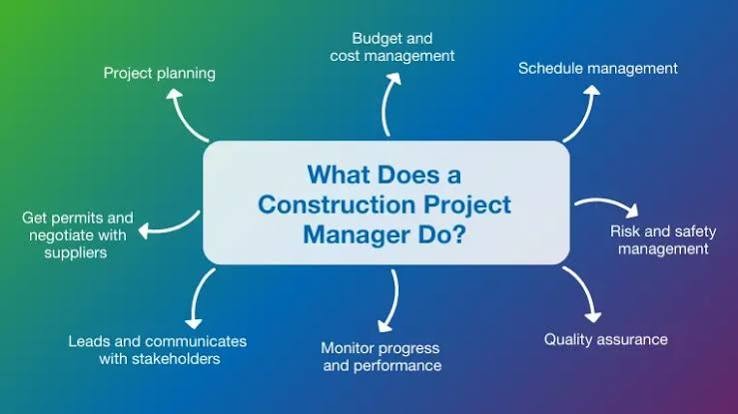
2. Key Responsibilities of a Construction Project Manager
Construction project management involves several interconnected responsibilities. Each one contributes to the successful coordination and delivery of a building or infrastructure project.
2.1 Defining Project Objectives and Requirements
One of the first responsibilities of a construction project manager is understanding what the client wants to achieve.
Before construction begins, the project manager works with the client and relevant professionals to establish the project’s purpose, scope, expected outcomes and priorities.
This may involve identifying:
- The intended use of the building or facility.
- The required size, layout and functionality.
- The expected construction budget.
- The preferred completion period.
- The required construction standards.
- The client’s operational requirements.
- Important design and performance expectations.
- Any specific project constraints.
For example, a developer planning an office building in Kampala may require adequate parking, meeting rooms, reception areas, reliable utilities, accessibility and provision for future expansion.
A project manager helps ensure these requirements are properly communicated to the design and construction teams.
Clearly defined objectives reduce misunderstandings and help prevent unnecessary changes during construction.
2.2 Construction Project Planning
Project planning is one of the most important responsibilities of a construction project manager.
A construction project involves many activities that must happen in a logical sequence. Poor planning can result in resource shortages, overlapping activities, idle workers and avoidable delays.
The project manager helps develop a coordinated plan that explains how the project will be delivered.
Construction planning may include:
- Defining project activities.
- Establishing construction phases.
- Identifying required resources.
- Setting project milestones.
- Coordinating design and procurement schedules.
- Identifying activity dependencies.
- Establishing reporting procedures.
- Planning site operations.
- Identifying potential risks.
- Agreeing on project communication arrangements.
For example, foundation construction must generally follow the necessary site investigations, design development, approvals and setting-out activities. Structural works must also be coordinated with the required materials, labour and technical inspections.
A realistic project plan helps stakeholders understand what must happen, when it should happen and who is responsible.
2.3 Preparing and Managing Construction Budgets
Construction costs must be properly estimated, allocated and monitored throughout a project.
A construction project manager works with the client and relevant cost professionals to establish an appropriate project budget and monitor expenditure against it.
Budget management may involve:
- Reviewing initial project cost estimates.
- Identifying major cost components.
- Coordinating budget preparation.
- Monitoring construction expenditure.
- Reviewing procurement costs.
- Tracking approved variations.
- Identifying potential cost overruns.
- Reporting financial progress.
- Supporting cost-control decisions.
Typical construction cost components include:
| Cost component | Examples |
|---|---|
| Preliminary costs | Site establishment, temporary facilities and mobilisation |
| Professional fees | Architectural, engineering and other consultancy fees |
| Materials | Cement, reinforcement, roofing, finishes and fittings |
| Labour | Skilled workers, technicians and general labour |
| Equipment | Machinery, tools and equipment hire |
| Contractor costs | Construction activities and contractual obligations |
| Utilities | Electrical, plumbing, drainage and mechanical installations |
| External works | Access roads, paving, drainage and landscaping |
| Contingencies | Allowances for identified uncertainties and unforeseen work |
The project manager helps identify budget pressures early so that the client can make informed decisions.
Detailed cost estimating, bills of quantities, valuations and other quantity surveying functions should be handled by appropriately competent professionals, such as a quantity surveyor, where required.
2.4 Developing and Monitoring Construction Schedules
Construction projects operate according to schedules that outline when activities should start and finish.
A construction project manager helps prepare, coordinate and monitor the construction programme to keep activities aligned with the agreed completion objectives.
Scheduling responsibilities may include:
- Preparing the overall project programme.
- Identifying key construction milestones.
- Coordinating contractors and subcontractors.
- Monitoring planned versus actual progress.
- Identifying delayed activities.
- Reviewing activity dependencies.
- Coordinating material deliveries.
- Updating construction schedules.
- Recommending corrective measures.
For example, delays in delivering reinforcement steel may affect structural works. If structural activities fall behind schedule, roofing, electrical installations and finishing activities may also be affected.
A project manager monitors these relationships and coordinates responses to minimise disruption.
Scheduling does not eliminate every possible delay. Weather, design changes, material shortages, approval processes and unforeseen site conditions can affect construction timelines.
2.5 Coordinating Architects, Engineers and Other Consultants
Construction projects often involve several professionals whose work must be properly coordinated.
These may include:
- Architects.
- Structural engineers.
- Civil engineers.
- Electrical engineers.
- Mechanical engineers.
- Quantity surveyors.
- Land surveyors.
- Environmental specialists.
- Health and safety professionals.
- Specialist building services consultants.
The project manager helps coordinate communication and information exchange between these professionals.
For example, architectural drawings must be coordinated with structural and building services requirements. Electrical installations, plumbing routes, ventilation systems and structural elements must work together without unnecessary conflicts.
The project manager may organise coordination meetings, monitor outstanding design information, track drawing revisions and ensure that relevant project participants receive updated information.
Good coordination helps reduce conflicting instructions, design omissions, construction rework and avoidable delays.
However, technical design decisions remain the responsibility of the appropriately appointed professionals.
2.6 Managing Contractors and Subcontractors
Contractor coordination is another major responsibility of a construction project manager.
A construction project may involve a main contractor and several specialist subcontractors responsible for different work packages.
These may include:
- Foundation and structural works.
- Masonry and plastering.
- Roofing.
- Electrical installations.
- Plumbing and drainage.
- Air conditioning and ventilation.
- Aluminium and glazing.
- Flooring and finishing.
- External works.
The project manager helps coordinate these parties to ensure that their activities follow the agreed construction programme and project requirements.
Responsibilities may include:
- Coordinating contractor mobilisation.
- Clarifying work schedules and interfaces.
- Monitoring contractor performance.
- Organising progress meetings.
- Tracking outstanding activities.
- Coordinating access to work areas.
- Reviewing reported challenges.
- Communicating approved project changes.
- Escalating contractual or performance concerns.
Contractual authority must be clearly defined. A project manager should not issue instructions, approve additional payments or change contractual requirements unless authorised under the relevant appointment and construction contract.
2.7 Managing Construction Procurement
Procurement involves obtaining the materials, equipment, labour and services required to complete a construction project.
Poor procurement planning can lead to shortages, expensive emergency purchases, delayed activities and unnecessary storage costs.
A construction project manager helps coordinate procurement activities with the client, quantity surveyor, contractor and suppliers.
This responsibility may include:
- Identifying procurement requirements.
- Coordinating procurement schedules.
- Tracking long-lead materials.
- Monitoring supplier delivery dates.
- Coordinating contractor and supplier information.
- Supporting tendering arrangements.
- Tracking purchase and delivery status.
- Identifying procurement risks.
- Monitoring materials required for upcoming activities.
For a commercial building, materials such as structural steel, roofing systems, lifts, generators, electrical equipment and specialised mechanical installations may require early procurement planning.
The project manager helps ensure that procurement is aligned with the construction programme.
2.8 Monitoring Construction Quality
Quality management helps ensure that completed construction work meets the approved drawings, specifications, applicable standards and contractual requirements.
A construction project manager coordinates quality monitoring activities throughout the project.
This may involve:
- Confirming that quality requirements are documented.
- Coordinating inspections.
- Monitoring reported workmanship concerns.
- Tracking non-conformances.
- Following up on corrective actions.
- Coordinating testing where required.
- Monitoring material approval procedures.
- Reviewing quality documentation.
- Tracking outstanding defects.
For example, concrete works may require checks relating to formwork, reinforcement placement, concrete quality and specified testing procedures.
Similarly, roofing, waterproofing, plumbing, electrical installations and finishing works should be assessed against their relevant specifications and inspection requirements.
The project manager coordinates the quality process, while technical inspections, testing and professional certifications must be undertaken by appropriately qualified and authorised persons.
2.9 Monitoring Construction Site Activities
Construction site monitoring allows the project manager to understand what is happening on the ground and identify issues before they become major problems.
Depending on the appointment, site monitoring may include:
- Reviewing daily or weekly progress reports.
- Conducting or coordinating site visits.
- Monitoring completed work against the programme.
- Reviewing labour and equipment availability.
- Identifying work delays.
- Tracking material deliveries.
- Following up on site instructions.
- Monitoring outstanding technical information.
- Recording project issues.
- Coordinating corrective actions.
Site monitoring is particularly important for projects with multiple contractors, complex construction activities or significant financial commitments.
Regular monitoring helps the client receive accurate information about project progress and emerging challenges.
It should not be confused with continuous contractor supervision or statutory inspection unless those responsibilities are specifically included in the relevant professional appointment.
2.10 Identifying and Managing Construction Risks
Every construction project faces risks that may affect its cost, schedule, quality, safety or successful completion.
A construction project manager helps identify these risks, assess their potential impact and coordinate suitable responses.
Common construction risks in Uganda include:
- Unforeseen ground conditions.
- Heavy rainfall and poor drainage.
- Delayed material deliveries.
- Fluctuating material costs.
- Contractor underperformance.
- Labour shortages.
- Design changes.
- Incomplete project information.
- Utility connection challenges.
- Delayed approvals.
- Health and safety incidents.
- Poor coordination between contractors.
Risk management involves identifying potential problems early rather than waiting until they disrupt the project.
For example, a project located on land with difficult access may experience material delivery challenges. The project team can consider access arrangements, delivery schedules and temporary site improvements before construction activities are affected.
A project manager may maintain a risk register showing each risk, its potential impact, proposed response, responsible person and current status.
2.11 Managing Project Communication
Construction projects involve multiple stakeholders who need accurate and timely information.
Poor communication can result in conflicting instructions, misunderstandings, delayed decisions and disputes.
The project manager establishes communication procedures to ensure that relevant information reaches the right people.
Responsibilities may include:
- Organising project meetings.
- Preparing meeting agendas.
- Recording meeting minutes.
- Distributing project updates.
- Tracking outstanding decisions.
- Coordinating technical queries.
- Communicating approved changes.
- Preparing progress reports.
- Escalating unresolved issues.
For example, if a client requests a change to the layout of a commercial building, the project manager helps coordinate the relevant discussions with the architect, engineers, cost professionals and contractor.
The change should be properly assessed and documented before it is implemented.
2.12 Managing Construction Changes and Variations
Changes may occur during construction because of revised client requirements, design coordination issues, unforeseen site conditions or other project developments.
However, uncontrolled changes can significantly affect construction costs and completion dates.
A construction project manager helps coordinate the process of assessing and documenting proposed changes.
This may involve:
- Recording the proposed change.
- Establishing why the change is necessary.
- Consulting relevant design professionals.
- Assessing technical implications.
- Obtaining cost advice.
- Evaluating programme implications.
- Obtaining the required client or contractual approval.
- Communicating authorised instructions.
- Updating project records and schedules.
For example, changing the location of a staircase after structural works have started may affect structural design, materials, labour, cost and construction time.
Proper change management helps prevent unauthorised work and disagreements over payment.
2.13 Monitoring Health and Safety Coordination
Construction sites contain potential hazards involving machinery, working at height, electricity, excavations, moving vehicles, lifting operations and construction materials.
A construction project manager helps ensure that health and safety matters receive appropriate attention within project coordination and reporting arrangements.
Depending on the project structure and appointment, responsibilities may include:
- Coordinating communication about site safety requirements.
- Monitoring whether safety matters are being reported.
- Following up on identified safety concerns.
- Coordinating relevant project participants.
- Tracking corrective actions.
- Supporting the implementation of agreed safety procedures.
- Escalating serious concerns through the appropriate channels.
Contractors and other duty holders retain their own legal and contractual health and safety responsibilities. The project manager does not automatically assume every safety duty simply by coordinating the project.
2.14 Preparing Construction Progress Reports
Clients and developers need reliable information about the status of their investments.
A construction project manager prepares or coordinates regular progress reports that explain the project’s current position.
A progress report may include:
- Work completed during the reporting period.
- Activities currently in progress.
- Progress against the construction programme.
- Budget and cost status.
- Procurement and material delivery updates.
- Contractor performance observations.
- Quality issues and corrective actions.
- Health and safety matters.
- Identified risks and challenges.
- Decisions required from the client.
- Activities planned for the next reporting period.
For example, a monthly report for a warehouse development may explain the status of foundation works, structural framing, roofing procurement, electrical installations and external drainage.
Accurate reporting helps clients make timely decisions and maintain better oversight of their projects.
2.15 Managing Project Documentation and Records
Construction projects generate important documents that must be organised and maintained.
These records provide evidence of decisions, instructions, approvals, progress, payments, changes and completed work.
A construction project manager helps coordinate project documentation, which may include:
- Approved drawings.
- Technical specifications.
- Construction schedules.
- Meeting minutes.
- Progress reports.
- Procurement records.
- Site instructions.
- Variation records.
- Inspection reports.
- Test certificates.
- Contract correspondence.
- Completion documentation.
Proper record management helps reduce misunderstandings and supports accountability throughout the project.
It is also important during disputes, audits, handover and future maintenance.
2.16 Coordinating Testing, Commissioning and Handover
Construction management does not end when the contractor finishes the main building works.
The completed facility may need inspections, testing, commissioning, documentation and formal handover before it is ready for occupation or operation.
A construction project manager helps coordinate these activities.
They may include:
- Preparing a completion checklist.
- Coordinating outstanding inspections.
- Tracking defects and incomplete work.
- Following up on corrective actions.
- Coordinating mechanical and electrical testing.
- Monitoring commissioning activities.
- Collecting operation and maintenance manuals.
- Coordinating as-built documentation.
- Tracking warranties and equipment information.
- Organising client handover meetings.
For example, a commercial building may require testing of electrical systems, water supply, drainage, fire protection, lifts, ventilation and other installed equipment.
The relevant specialists must carry out technical testing and certification within their competence and authority.
A properly coordinated handover gives the client the documentation and information needed to operate and maintain the facility.
3. Responsibilities of a Construction Project Manager at Different Project Stages
The responsibilities of a construction project manager change as the project progresses.
| Project stage | Main project manager responsibilities |
|---|---|
| Project initiation | Understand client requirements and define objectives |
| Feasibility and assessment | Coordinate site investigations and feasibility information |
| Design development | Coordinate consultants and design information |
| Budget preparation | Monitor cost planning and budget development |
| Procurement | Coordinate tendering and procurement schedules |
| Contractor mobilisation | Coordinate project commencement and site readiness |
| Construction | Monitor progress, coordination, risks and quality processes |
| Project closeout | Coordinate inspections, defects and completion documentation |
| Handover | Coordinate commissioning, records and client handover |
Early involvement is particularly valuable because decisions made during planning and design can influence construction costs, buildability, procurement and project duration.
4. Construction Project Manager Responsibilities for Different Types of Projects
The nature of project management depends on the type, size and complexity of the development.
4.1 Residential Construction Projects
For residential developments, the project manager may coordinate:
- Client requirements and project objectives.
- Design and consultant coordination.
- Construction budgets.
- Contractor selection.
- Construction schedules.
- Material procurement.
- Site progress monitoring.
- Quality issues.
- Defect correction.
- Final handover.
This is relevant to individual houses, apartments, housing estates and residential developments.
4.2 Commercial Construction Projects
Commercial developments often involve more complex building systems and operational requirements.
Project management responsibilities may include coordinating:
- Office building construction.
- Shopping centres.
- Hotels.
- Retail facilities.
- Restaurants.
- Business premises.
- Multi-storey developments.
- Parking facilities.
- Mechanical and electrical installations.
The project manager helps ensure that architectural, structural, building services and operational requirements are properly coordinated.
4.3 Industrial Construction Projects
Industrial projects may involve specialised equipment, production processes, heavy-duty installations and complex utility requirements.
Project management may include coordinating:
- Factories.
- Warehouses.
- Workshops.
- Processing facilities.
- Industrial storage buildings.
- Logistics facilities.
- Manufacturing plants.
Industrial construction requires careful attention to operational requirements, equipment interfaces, access, safety and commissioning.
4.4 Infrastructure Construction Projects
Infrastructure developments may involve several technical disciplines, contractors and external stakeholders.
Depending on the project, the project manager may coordinate:
- Road construction.
- Drainage systems.
- Water supply infrastructure.
- Wastewater facilities.
- Bridges and culverts.
- Utility infrastructure.
- Site development works.
These projects may require additional environmental, social, engineering, procurement and stakeholder coordination arrangements.
5. Essential Skills of an Effective Construction Project Manager
Successful construction project management requires a combination of technical understanding, leadership, organisation and communication.
The following skills are particularly important.
5.1 Project Planning and Organisation
A project manager must be able to organise activities, allocate responsibilities, establish priorities and coordinate resources.
5.2 Financial and Cost Management
Understanding construction budgets, expenditure monitoring, procurement costs and financial reporting helps project managers identify cost pressures.
5.3 Communication Skills
Project managers must communicate effectively with clients, consultants, contractors, suppliers and other stakeholders.
5.4 Leadership and Coordination
Construction projects require people from different professional backgrounds to work towards common objectives. Good leadership supports cooperation and accountability.
5.5 Problem-Solving Skills
Unexpected problems can occur during construction. An effective project manager must identify issues, evaluate available options and coordinate appropriate responses.
5.6 Technical Understanding
A project manager should understand construction processes, drawings, specifications, materials, building systems and construction sequencing sufficiently to coordinate the project effectively.
5.7 Risk Management
Identifying risks before they become major problems helps protect project budgets, schedules and quality objectives.
5.8 Negotiation and Conflict Management
Construction projects may involve disagreements over costs, schedules, work quality, instructions and contractual responsibilities. Effective communication and structured dispute resolution are important.
5.9 Attention to Detail
Project managers must track drawings, schedules, budgets, instructions, approvals and documentation accurately.
5.10 Decision-Making
Project managers help ensure that decisions are made by the appropriate people, based on reliable information and within the authority provided by the project arrangements.
6. Construction Project Manager vs Construction Site Manager vs Contractor
These roles are related but have different responsibilities.
| Role | Main responsibility |
|---|---|
| Construction project manager | Coordinates overall project delivery, including scope, cost, time, communication, procurement and risk |
| Construction site manager | Coordinates day-to-day site operations, labour, activities and site resources within the assigned role |
| Main contractor | Undertakes the construction work in accordance with the contract |
| Architect | Leads architectural design and related professional responsibilities |
| Structural engineer | Undertakes structural design and related engineering responsibilities |
| Quantity surveyor | Provides construction cost advice, measurement, valuation and related cost management services |
On some projects, responsibilities may overlap or be combined through contractual arrangements. The project team should therefore establish clear roles and reporting lines before construction starts.
7. Why Is a Construction Project Manager Important?
Appointing an appropriately qualified and experienced construction project manager can improve project coordination and help clients maintain control over important construction activities.
Key benefits include:
Better Project Planning
A structured project plan helps identify activities, dependencies, resources and milestones before construction begins.
Improved Cost Control
Regular budget monitoring helps identify cost pressures and supports informed financial decisions.
Better Time Management
Construction schedules provide a basis for monitoring progress and responding to delays.
Improved Contractor Coordination
Clear communication and defined responsibilities help reduce confusion between contractors and subcontractors.
Better Quality Coordination
Organised inspection processes and defect tracking help identify workmanship concerns before handover.
Reduced Project Risks
Early identification and monitoring of risks can help project teams prepare appropriate responses.
Improved Communication
Regular meetings, reports and documented decisions help clients remain informed.
Stronger Project Accountability
Defined responsibilities and accurate project records make it easier to track actions and decisions.
More Organised Project Completion
Coordinated testing, commissioning, defect correction and handover improve the transition from construction to operation.
Professional project management cannot eliminate all construction problems or guarantee a particular completion date or cost. Its value lies in improving planning, coordination, monitoring and decision-making.
8. Common Challenges Faced by Construction Project Managers in Uganda
Construction project managers in Uganda may encounter challenges that affect project delivery.
Understanding these challenges helps clients and project teams prepare more effectively.
8.1 Fluctuating Construction Material Prices
Changes in the cost of cement, steel, roofing materials, fuel, finishing products and other supplies can affect construction budgets.
Project managers help monitor procurement costs and coordinate timely financial updates.
8.2 Delayed Material Deliveries
Late deliveries can interrupt planned construction activities.
Procurement schedules, supplier coordination and early identification of critical materials help reduce the risk of disruption.
8.3 Weather and Site Conditions
Heavy rainfall can affect excavation, earthworks, concrete activities, site access and drainage.
Construction programmes should account for seasonal conditions and site-specific risks.
8.4 Contractor Coordination Problems
Multiple contractors working on the same project may have overlapping responsibilities or competing schedules.
Clear work packages, communication procedures and coordinated programmes help reduce conflicts.
8.5 Design Changes
Changes made after construction starts can affect costs, materials, labour and completion dates.
A formal variation process helps ensure that changes are assessed and approved appropriately.
8.6 Incomplete Project Information
Missing drawings, unclear specifications and delayed technical decisions can prevent contractors from proceeding with planned activities.
The project manager helps track outstanding information and coordinate responses from the responsible professionals.
8.7 Regulatory and Approval Delays
Depending on the location and nature of the development, projects may require planning, building, environmental, utility or other approvals.
Project teams should identify applicable requirements early and coordinate the necessary submissions with the relevant authorities and professionals.
8.8 Poor Documentation
Unrecorded instructions, unclear agreements and incomplete reports can create disagreements.
Maintaining organised project records improves transparency and accountability.
9. When Should You Appoint a Construction Project Manager?
A construction project manager should ideally be considered during the early planning stages rather than only after construction problems arise.
Early appointment allows project coordination to begin before important decisions are finalised.
Consider professional project management when:
- You are planning to construct a residential house.
- You are developing apartments or a housing estate.
- You are constructing a commercial building.
- You are investing in a warehouse or factory.
- Your project involves several contractors.
- You have a limited construction budget.
- You need structured progress reporting.
- You are managing a project from a distance.
- Your development involves complex building services.
- You need coordinated procurement and scheduling.
- You want better oversight of construction activities.
- Your project involves multiple professional consultants.
For larger, more complex or high-value developments, early project management involvement can be particularly beneficial.
10. How to Choose the Right Construction Project Manager in Uganda
Choosing the right project manager is important because the quality of project coordination can influence how effectively a construction project is delivered.
Before making an appointment, consider the following factors.
10.1 Relevant Qualifications and Professional Standing
Check the person’s educational background, professional competence and any applicable registration or practising requirements.
Where the assignment includes regulated professional services, verify the relevant professional registration.
10.2 Experience with Similar Projects
A professional who has coordinated projects similar to yours may better understand their construction requirements, risks and operational challenges.
Ask about experience with residential, commercial, industrial or infrastructure developments as appropriate.
10.3 Understanding of Construction Costs
The project manager should understand how construction costs are developed, monitored and reported.
Where detailed quantity surveying services are needed, confirm that an appropriately qualified quantity surveyor is appointed.
10.4 Project Planning and Scheduling Ability
Ask how the project manager prepares construction programmes, monitors milestones and reports delays.
10.5 Communication and Reporting
Establish how frequently progress reports will be provided and how important decisions will be communicated.
10.6 Knowledge of the Ugandan Construction Environment
A suitable project manager should understand the practical considerations involved in construction projects in Uganda, including procurement, site conditions, coordination and applicable approval processes.
10.7 Clear Scope of Work
The appointment should clearly explain the services to be provided, expected deliverables, reporting arrangements, exclusions and authority limits.
10.8 Transparent Fees
Understand how professional fees are calculated and what is included.
Fees may be based on a fixed amount, percentage of project value, time-based arrangement or agreed project stages. The appropriate structure depends on the scope and complexity of the assignment.
10.9 References and Previous Work
Where possible, request relevant references and evidence of experience with comparable projects.
10.10 Independence and Professional Conduct
The project manager should communicate openly about potential conflicts of interest and act within the agreed professional and contractual responsibilities.
11. How Much Does a Construction Project Manager Cost in Uganda?
The cost of hiring a construction project manager in Uganda depends on the nature of the project and the scope of services required.
There is no single fee that applies to every construction project.
Important factors include:
- Total project value.
- Building size and complexity.
- Project duration.
- Number of contractors.
- Number of professional consultants.
- Frequency of site visits.
- Reporting requirements.
- Procurement responsibilities.
- Contract administration requirements.
- Level of authority and responsibility.
- Whether the appointment covers the entire project or selected stages.
Common fee arrangements include:
Fixed fee: An agreed amount for a clearly defined scope of services.
Percentage-based fee: A fee calculated using an agreed percentage of a defined project cost or contract value.
Time-based fee: Payment based on the time spent providing the services.
Stage-based fee: Payment linked to agreed project milestones or stages.
Before appointing a project manager, request a written proposal showing the scope of work, deliverables, exclusions, payment terms and any additional costs.
12. How Daltrevco Can Support Your Construction Project Requirements
Effective construction project delivery requires careful planning, organised coordination and informed decision-making.
Whether you are planning a residential development, commercial building, industrial facility or infrastructure project, understanding the management requirements from the beginning can help you prepare more effectively.
Daltrevco provides a point of contact for discussing construction and project-related requirements. Property owners, developers, investors and organisations can contact Daltrevco to discuss their proposed developments and identify the type of construction support or professional input their projects may require.
Before proceeding, establish the specific services required, the professionals responsible for delivering them, the project scope, expected deliverables and applicable qualifications.
If you are planning a construction project in Kampala, Wakiso, Entebbe or elsewhere in Uganda, contact Daltrevco to discuss your project requirements and the appropriate next steps.
A well-coordinated construction project begins with clear objectives, realistic planning and professional accountability.
13. Frequently Asked Questions About Construction Project Manager Responsibilities
1. What are the main responsibilities of a construction project manager?
The main responsibilities include project planning, budgeting, scheduling, contractor coordination, procurement monitoring, risk management, communication, progress reporting, quality coordination and project handover.
2. What does a construction project manager do on a daily basis?
Daily activities may include reviewing project progress, coordinating contractors, attending meetings, tracking construction schedules, following up on material deliveries, resolving coordination issues and preparing project reports.
3. Is a construction project manager responsible for the project budget?
A construction project manager helps establish, monitor and control the project budget within their appointment. Detailed cost estimating, bills of quantities and formal cost valuations may be undertaken by a quantity surveyor.
4. Does a construction project manager supervise workers?
A project manager may coordinate and monitor site activities, but direct day-to-day supervision of workers is commonly handled by the contractor’s site management team. The exact arrangement depends on the project structure.
5. What is the difference between a construction project manager and a contractor?
A construction project manager coordinates the overall project delivery, while a contractor undertakes the construction work under the construction contract.
6. Does every construction project need a project manager?
Not every small project requires a separately appointed project manager. However, professional project management can be particularly useful for complex, large, high-value or multi-contractor developments.
7. When should a construction project manager be appointed?
Ideally, a project manager should be appointed during the early planning stages so that project requirements, budgets, schedules, procurement and professional coordination can be organised before construction begins.
8. Can a construction project manager reduce building costs?
A project manager can help control costs through planning, procurement coordination, monitoring expenditure, managing variations and identifying potential problems early. Actual savings depend on the project and cannot be guaranteed.
9. Is a construction project manager responsible for construction quality?
The project manager coordinates quality management processes and monitors reported quality issues within the agreed scope. Technical inspections, testing and professional certifications must be undertaken by appropriately qualified and authorised professionals.
10. What qualifications should a construction project manager have?
Qualifications depend on the project and services being provided. Relevant education, construction experience, project management competence and any required professional registration should be considered.
11. Can one project manager handle several construction projects?
It may be possible, depending on the size, complexity, location and stage of each project. The project manager must have sufficient time and resources to fulfil the agreed responsibilities effectively.
12. How does a project manager manage construction delays?
They monitor progress, identify the causes of delays, assess the effect on other activities, coordinate corrective actions and communicate revised expectations to relevant stakeholders.
13. Does a construction project manager select contractors?
The project manager may coordinate contractor procurement and support tender evaluation. Final selection and contract award authority depend on the client’s instructions and procurement arrangements.
14. Is a project manager responsible for construction permits?
The project manager may coordinate approval processes and track required documentation. However, statutory approvals are issued by the relevant authorities, and the client and appointed professionals retain their respective responsibilities.
15. What types of projects require construction project management?
Residential houses, apartments, office buildings, shopping centres, warehouses, factories, hotels, schools, hospitals and infrastructure developments may all benefit from project management.
16. What is the difference between a project manager and a site manager?
A project manager focuses on overall project coordination, including time, cost, scope, procurement and stakeholder communication. A site manager generally focuses on day-to-day construction operations at the site.
17. Can a construction project manager manage subcontractors?
Yes, where this responsibility is included in the appointment. The project manager may coordinate subcontractor schedules, work interfaces, communication and performance monitoring.
18. How often should a construction project manager visit a site?
The frequency depends on the project’s size, complexity, construction stage and agreed scope. Some projects require frequent visits, while others may use scheduled inspections and reporting arrangements.
19. What documents does a construction project manager prepare?
Documents may include project programmes, progress reports, meeting minutes, risk registers, procurement schedules, variation records, issue registers and project completion reports.
20. Is construction project management different from construction consultancy?
Construction project management focuses on coordinating project delivery. Construction consultancy is a broader term that may include cost advice, design services, engineering, feasibility studies, supervision and other specialist professional services.
21. How are construction project management fees calculated in Uganda?
Fees may be fixed, percentage-based, time-based or stage-based. The amount depends on project value, complexity, duration, responsibilities and required deliverables.
22. Can a construction project manager guarantee that a building will be completed on time?
No. A project manager can develop schedules, monitor progress and coordinate responses to delays, but unforeseen conditions, approvals, weather, supply problems and other factors can affect completion.
23. Who is responsible for construction site safety?
Safety responsibilities are shared among relevant duty holders according to applicable law, contracts and project arrangements. Contractors and employers retain their own responsibilities, while the project manager may coordinate and monitor safety-related matters within the appointment.
24. What happens when a client requests changes during construction?
The proposed change should be documented and assessed for technical, financial and programme implications. It should then be approved through the agreed contractual procedure before implementation.
25. Why should I hire a construction project manager in Uganda?
A construction project manager can help organise planning, coordinate professionals and contractors, monitor costs and schedules, manage project risks and provide structured progress reporting. This can give property owners and developers better oversight of their construction investments.
Conclusion
A construction project manager plays a central role in coordinating the activities required to deliver a successful construction project. Their responsibilities extend from defining project objectives and preparing construction plans to managing budgets, coordinating contractors, monitoring progress, controlling risks and organising project handover.
In Uganda, effective project management is valuable for residential, commercial, industrial and infrastructure developments where several professionals, suppliers and contractors must work together.
For property owners and developers, appointing the right project management professional can improve organisation, communication, accountability and control throughout the construction process.
Whether you are planning a house, apartment development, office building, warehouse, factory or infrastructure project, invest time in understanding the management requirements before construction begins.
Contact Daltrevco to discuss your construction project requirements and explore the appropriate support for planning and coordinating your development.