Introduction: Choosing Between a Smart Home and a Traditional Home
The way people design, build and manage their homes is changing rapidly. Technology has introduced new possibilities for creating residential environments that are more comfortable, secure, convenient and energy-efficient.
Traditional homes have served families for generations, providing shelter, privacy and essential household facilities. However, modern smart homes are introducing advanced technologies that allow homeowners to automate lighting, control security systems, monitor energy consumption and manage household appliances remotely.
As a result, many homeowners and property developers are asking an important question: Is a smart home better than a traditional home?
Understanding the differences between smart homes and traditional homes requires looking beyond technology. It also involves considering installation costs, long-term maintenance, energy management, security, convenience and the specific needs of household occupants.
In this guide, we explore the major benefits, costs and technological differences between smart homes and traditional homes to help you make an informed decision.
1. What Is a Traditional Home?
A traditional home is a residential property that relies primarily on conventional building systems and manually operated household equipment.
Most traditional homes use standard electrical switches, physical door locks, conventional lighting, independent appliances and manually controlled ventilation or cooling systems.
Household activities generally require direct interaction with individual devices.
For example, homeowners must physically switch lights on or off, manually lock doors and adjust household equipment whenever necessary.
Traditional homes remain popular because they are familiar, relatively straightforward to operate and can be less expensive to equip initially.
Common Features of Traditional Homes
- Conventional electrical switches.
- Physical door locks and keys.
- Standard lighting systems.
- Manually operated curtains and blinds.
- Independent household appliances.
- Conventional security arrangements.
- Manual energy management.
- Limited remote monitoring capabilities.
Although traditional homes may lack advanced automation, they can still provide comfortable, functional and reliable living environments.
2. What Is a Smart Home?
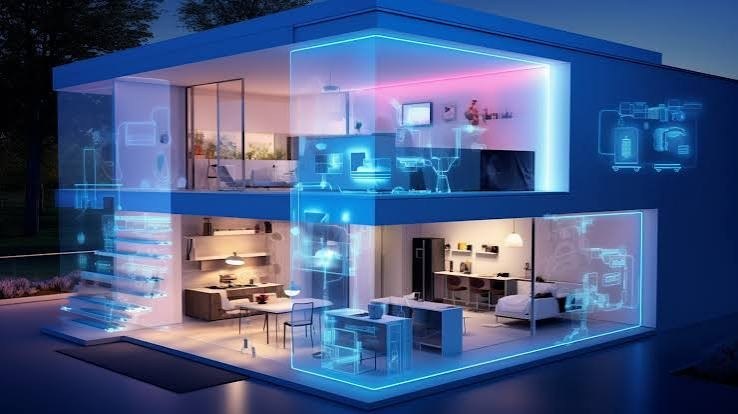
A smart home is a residential property equipped with connected devices and automated systems that allow homeowners to monitor, control and manage different household functions.
Smart home technology combines the Internet of Things (IoT), sensors, wireless communication, software and sometimes artificial intelligence to create connected living environments.
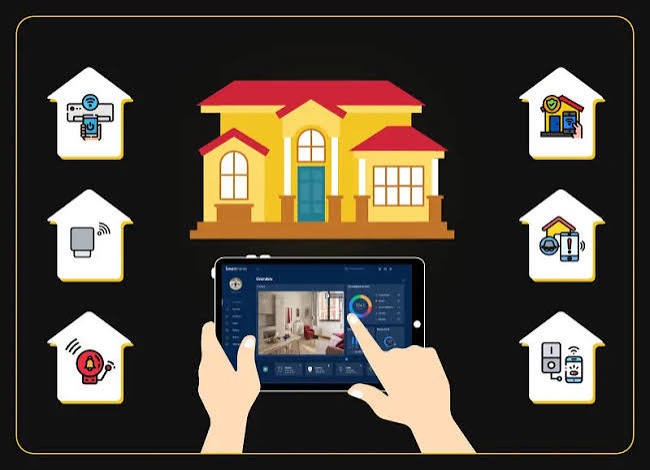
Homeowners can control compatible equipment using smartphones, tablets, voice commands, automated schedules or centralised control panels.
For example, a homeowner can switch off lights remotely, monitor security cameras, adjust air conditioning and control smart door locks using a mobile application.
Common Features of Smart Homes
- Automated lighting systems.
- Smart security cameras.
- Intelligent door locks.
- Smart thermostats and climate controls.
- Connected household appliances.
- Automated curtains and blinds.
- Intelligent energy monitoring.
- Voice-controlled devices.
- Remote property management.
The main purpose of smart home technology is to improve convenience, security, energy management and the overall residential experience.
3. Smart Homes vs. Traditional Homes: Key Technological Differences
The biggest difference between smart homes and traditional homes is the level of automation and connectivity.
Traditional houses generally operate through independent household systems, while smart homes use connected technologies that allow compatible devices to communicate and respond automatically.
A. Lighting Systems
Traditional homes: Lighting is controlled using conventional wall switches. Homeowners must manually switch lights on or off.
Smart homes: Smart lighting can be controlled through smartphones, voice commands, motion sensors and programmed schedules.
Some systems automatically adjust brightness according to occupancy and natural daylight.
B. Security Systems
Traditional homes: Security generally depends on physical locks, conventional alarms, security personnel and standard CCTV installations.
Smart homes: Intelligent security systems can include connected cameras, smart locks, motion detectors, video doorbells and remote monitoring applications.
Homeowners can receive notifications when unusual activity is detected.
C. Temperature and Climate Control
Traditional homes: Cooling, heating and ventilation systems are generally operated manually.
Smart homes: Intelligent climate controls can adjust compatible equipment according to schedules, occupancy and environmental conditions.
D. Household Appliances
Traditional homes: Appliances operate independently and generally require manual operation.
Smart homes: Compatible appliances can connect to home networks and allow remote monitoring, notifications and selected automated functions.
E. Energy Management
Traditional homes: Homeowners often rely on electricity bills and manual checks to understand energy consumption.
Smart homes: Energy monitoring systems can provide information about electricity usage and help coordinate compatible appliances, solar systems and battery storage.
F. Home Access and Control
Traditional homes: Physical keys and conventional access controls are commonly used.
Smart homes: Smart locks and compatible access systems can support digital access, remote monitoring and temporary access permissions.
4. Benefits of Smart Homes Compared with Traditional Homes
Smart homes offer several advantages that make them attractive to modern homeowners and property developers.
1. Greater Convenience
One of the biggest advantages of smart homes is convenience.
Instead of manually controlling individual devices, homeowners can manage multiple household systems through a smartphone or centralised control panel.
Automated routines can also perform repetitive tasks without requiring constant human interaction.
2. Improved Home Security
Smart home security systems provide additional monitoring and access control capabilities.
Connected cameras, motion detectors, smart locks and intelligent alarms can help homeowners monitor their properties remotely.
Some systems also provide instant alerts when unusual activity is detected.
3. Better Energy Management
Smart lighting, occupancy sensors and intelligent energy monitoring can help reduce unnecessary electricity consumption.
For example, lights can automatically switch off when rooms are unoccupied, while compatible appliances can operate according to programmed schedules.
However, actual savings depend on the equipment, household behaviour and how the system is configured.
4. Increased Comfort
Smart homes allow homeowners to create personalised indoor environments.
Lighting, temperature, entertainment systems and automated curtains can be adjusted according to household preferences.
5. Remote Property Management
Smart home technology allows property owners to monitor compatible household systems even when away from their properties.
This can be particularly useful for people managing rental apartments, holiday homes and multiple residential properties.
6. Improved Accessibility
Voice-controlled devices and automated household equipment can make homes easier to use for older adults and people with mobility limitations.
7. Integration with Renewable Energy
Smart energy management systems can work alongside solar panels, battery storage and compatible electrical equipment.
This can help homeowners monitor electricity generation, storage and household consumption.
5. Benefits of Traditional Homes
Although smart homes offer advanced capabilities, traditional homes still have important advantages.
Lower Initial Investment
Traditional homes generally require fewer specialised electronic devices and automation components.
This can reduce the initial cost of furnishing and equipping a property.
Simpler Operation
Conventional electrical switches, locks and appliances are familiar to most homeowners and generally require minimal technical knowledge.
Reduced Dependence on Internet Connectivity
Most traditional household functions can operate without internet access.
Straightforward Maintenance
Traditional systems often require less software maintenance, fewer firmware updates and less specialised technical support.
Greater Independence from Digital Platforms
Traditional appliances and systems are generally less affected by software changes, discontinued cloud services or compatibility problems.
For homeowners who prefer simple and familiar residential systems, traditional homes can remain a practical choice.
6. Smart Home Costs vs. Traditional Home Costs
Cost is one of the most important considerations when comparing smart homes with traditional homes.
The total investment depends on the size of the property, the number of devices, the level of automation and whether professional installation is required.
A traditional home may have lower initial technology costs because it relies on conventional equipment.
A smart home may require additional investment in connected devices, controllers, sensors, networking equipment, installation and configuration.
What Determines Smart Home Installation Costs?
Several factors influence the cost of a smart home installation.
Property size: Larger houses generally require more devices, sensors and automation components.
Level of automation: Basic smart lighting costs less than a fully integrated residential automation system.
Equipment quality: Different manufacturers offer products at different price levels.
Installation requirements: Professional installation and electrical modifications can increase initial costs.
Networking infrastructure: Reliable Wi-Fi coverage, compatible hubs and communication equipment may be required.
Maintenance: Software subscriptions, equipment replacement and technical support may create additional expenses.
Typical Smart Home Investment Categories
| Smart home level | Typical installation |
|---|---|
| Basic | Smart bulbs, plugs and mobile control |
| Intermediate | Smart lighting, cameras, sensors and smart locks |
| Advanced | Integrated lighting, security, curtains and climate control |
| Premium | Whole-home automation, energy management and centralised control |
These are technology categories, not fixed prices. Actual installation costs should be established through a property assessment and equipment quotation.
Are Smart Homes More Expensive Than Traditional Homes?
Smart homes usually require a higher initial investment in automation technology.
However, the long-term value depends on how effectively the systems are used.
Potential benefits include improved energy management, reduced manual work, enhanced security monitoring and greater convenience.
Homeowners should compare the total cost of ownership rather than looking only at the purchase price of individual devices.
7. Smart Homes and Traditional Homes: Cost Comparison
| Cost consideration | Traditional homes | Smart homes |
|---|---|---|
| Initial equipment | Generally lower | Generally higher |
| Installation | Usually straightforward | May require specialist installation |
| Electricity monitoring | Often manual | Can be automated |
| Maintenance | Conventional servicing | Hardware and software maintenance |
| Internet requirements | Not essential for basic functions | Required for many connected features |
| Security upgrades | Conventional systems | Connected monitoring options |
| Automation | Limited | Extensive options |
| Future upgrades | Conventional equipment replacement | Expandable connected systems |
It is important to remember that smart technology does not automatically guarantee lower household expenses. Poorly configured systems, unnecessary subscriptions and additional standby electricity consumption can reduce potential savings.
8. Smart Homes and Traditional Homes in Uganda
The comparison between smart homes and traditional homes is particularly relevant to Uganda’s growing residential and property development sectors.
As modern housing developments, apartments and residential estates continue to evolve, intelligent home technology offers opportunities to improve security, convenience and energy management.
However, local conditions should influence the choice of technology.
Smart Security for Ugandan Homes
Connected security cameras, smart locks and remote monitoring systems can help homeowners monitor their properties.
Solar Energy Integration
Solar energy is an important consideration for many residential properties in Uganda.
Smart energy monitoring can help homeowners understand electricity generation, battery storage and household energy consumption.
Intelligent Lighting
Automated lighting can reduce unnecessary electricity use by switching lights off when rooms are unoccupied.
Water Management
Smart water-level sensors and leak detectors can help homeowners monitor water tanks and identify potential water problems.
Backup Power Management
Smart systems can help monitor compatible backup power equipment and provide useful information about energy availability.
For Ugandan homeowners, it is important to choose equipment that is compatible with available electrical infrastructure and suitable for local operating conditions.
Where essential functions are concerned, consider systems with local control or backup power rather than relying entirely on continuous internet access.
9. Disadvantages and Challenges of Smart Homes
Despite their benefits, smart homes have certain limitations.
Cybersecurity Risks
Connected devices can introduce privacy and security vulnerabilities if they are not properly protected.
Homeowners should use strong passwords, secure wireless networks and regularly updated software.
Internet Dependence
Some smart home functions require internet access, particularly remote monitoring and cloud-based services.
Compatibility Problems
Not all smart home devices work together.
Homeowners should check supported communication standards and platforms before purchasing equipment.
Higher Initial Costs
Advanced automation systems may require significant upfront investment.
Technology Obsolescence
Some devices may eventually become outdated or lose software support.
Maintenance Requirements
Smart home systems may require software updates, troubleshooting and occasional professional servicing.
Planning carefully and selecting reliable equipment can help minimise these challenges.
10. Which Is Better: A Smart Home or a Traditional Home?
There is no universal answer because the best option depends on household requirements, available finances and personal preferences.
A traditional home may be more suitable for homeowners who prioritise simplicity, lower initial costs and minimal technology dependence.
A smart home may be more suitable for people who value automation, remote monitoring, advanced security and intelligent energy management.
For many homeowners, the most practical solution is a combination of both.
A property can maintain reliable conventional systems while introducing smart technology in areas where automation provides meaningful benefits.
This approach offers flexibility without requiring a complete transition to advanced home automation.
11. How to Upgrade a Traditional Home into a Smart Home
You do not need to build a new house to enjoy the advantages of smart home technology.
Many existing properties can be upgraded gradually.
Follow these steps:
Step 1: Identify Your Priorities
Decide whether your main goal is better security, energy management, convenience or entertainment.
Step 2: Establish a Budget
Determine how much you can invest in smart home equipment and installation.
Step 3: Select Compatible Devices
Choose equipment that works with your preferred automation platform.
Step 4: Start with Essential Devices
Consider smart lighting, security cameras, smart plugs and environmental sensors.
Step 5: Improve Your Network
Ensure your property has suitable wireless coverage and secure internet access.
Step 6: Expand Gradually
Introduce smart locks, automated curtains, climate control and intelligent energy management as needed.
Step 7: Prioritise Maintenance and Security
Update software, protect user accounts and regularly check system performance.
A gradual upgrade makes it possible to modernise a traditional home without unnecessary expenditure.
12. The Future of Smart Homes and Residential Technology
The future of residential living will increasingly involve the integration of intelligent technologies.
Artificial intelligence, the Internet of Things, renewable energy and improved device interoperability are creating new opportunities for modern home automation.
Some important developments include:
- AI-powered personalised automation.
- Intelligent electricity management.
- Smart solar and battery integration.
- Advanced security monitoring.
- Automated water management.
- Smart indoor air quality monitoring.
- Predictive equipment maintenance.
- Improved connectivity through Matter-compatible devices.
These technologies are expected to make residential environments more connected, responsive and efficient.
As costs become more accessible and technology improves, smart home solutions may become increasingly common in residential developments around the world.
Conclusion: Making the Right Choice for Modern Living
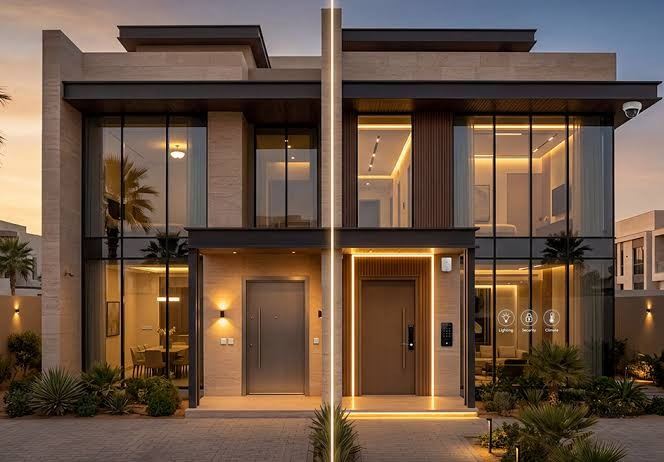
The comparison between smart homes and traditional homes highlights how technology is changing the residential experience.
Traditional homes remain practical, familiar and generally less expensive to equip initially. Smart homes introduce additional capabilities through automation, intelligent security, remote management and energy monitoring.
Although smart homes may require a higher initial investment, they can provide valuable long-term benefits when properly planned and managed.
For homeowners, property developers and investors, the best decision is to evaluate the property’s requirements, available budget and expected benefits before choosing a residential technology solution.
Whether you prefer a traditional home, a fully automated smart home or a combination of both, the ultimate goal should be to create a comfortable, secure, efficient and reliable living environment.
The future of modern housing is not simply about choosing between traditional and smart homes. It is about combining the reliability of traditional living with the advantages of intelligent technology.
Frequently Asked Questions (FAQs)
1. What is the main difference between smart homes and traditional homes?
The main difference is automation and connectivity. Traditional homes rely mainly on manual household controls, while smart homes use connected devices and automated systems to manage various household functions.
2. Are smart homes better than traditional homes?
Smart homes offer additional convenience, remote control, security monitoring and energy management. However, traditional homes can be more affordable initially and easier to maintain. The best choice depends on individual requirements.
3. Are smart homes more expensive to build?
Smart homes generally require additional investment in connected devices, sensors, networking equipment and installation. The actual cost depends on the size of the property and the level of automation.
4. Can traditional homes be converted into smart homes?
Yes. Existing houses can be upgraded with smart lighting, security cameras, intelligent locks, connected plugs and other compatible devices.
5. Do smart homes save electricity?
Smart lighting, occupancy sensors and energy monitoring systems can help reduce unnecessary electricity consumption. Actual savings depend on equipment selection, configuration and household behaviour.
6. Are smart homes safe?
Smart homes can provide additional security monitoring, but connected devices also introduce cybersecurity and privacy risks. Strong passwords, software updates and secure networks are essential.
7. What are the disadvantages of smart homes?
Common disadvantages include higher initial costs, internet dependence, device compatibility problems, cybersecurity risks and ongoing maintenance requirements.
8. Are smart homes suitable for Uganda?
Yes. Smart lighting, security monitoring, solar energy management, water monitoring and automated access control can offer practical benefits for Ugandan homeowners.
9. Can smart homes work without internet?
Some systems support local device communication and automation without internet access. However, remote monitoring and certain cloud-based services require connectivity.
10. What is the best way to start a smart home?
Start by identifying your priorities and budget. Introduce essential devices such as smart lighting, security cameras and smart plugs before expanding into more advanced automation systems.