Introduction
Managing a modern building involves much more than maintaining its physical structure. Building owners and facility managers must coordinate heating, ventilation and air conditioning (HVAC), lighting, electrical systems, security, water management and other essential services while controlling operating costs and maintaining a comfortable environment.
When these systems operate independently, building management can become complicated, inefficient and expensive. Energy may be wasted, equipment faults may go unnoticed, maintenance may be delayed and facility teams may spend valuable time performing routine tasks manually.
This is where Building Automation Systems (BAS) make a significant difference.
Building Automation Systems use intelligent controls, sensors, software and connected devices to monitor and manage building services from a centralised platform. By automating routine operations and providing real-time information, these systems help buildings operate more efficiently, reduce unnecessary energy consumption, improve equipment performance and support better facility management.
For commercial properties, office buildings, hotels, hospitals, educational institutions and residential developments, building automation is becoming an important part of modern infrastructure.
In this guide, we explore how Building Automation Systems improve building operational efficiency, the technologies involved, their major benefits and the factors to consider when implementing an effective automation solution.
What Is a Building Automation System?
A Building Automation System (BAS), also known as a Building Management System (BMS) in many commercial applications, is an integrated technology platform that monitors, controls and optimises building services.
It connects different building systems through controllers, sensors, communication networks and management software. Facility managers can use the platform to monitor equipment, adjust operating settings, receive alerts and analyse building performance.
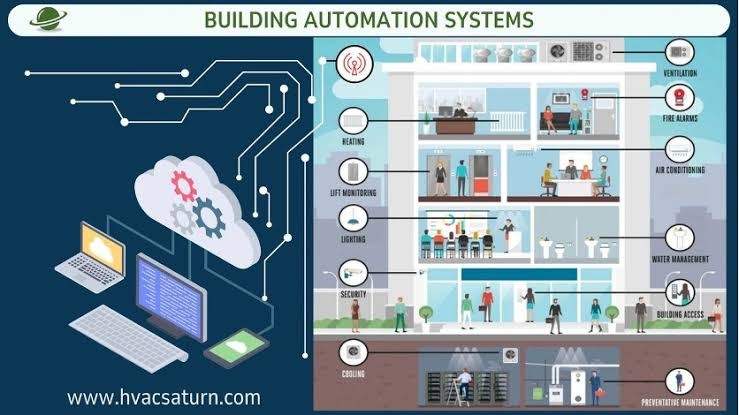
Depending on the building’s requirements, a BAS may control or monitor:
- Heating, ventilation and air conditioning systems.
- Lighting and occupancy controls.
- Electrical power distribution and energy consumption.
- Security and access control systems.
- Fire and life-safety system status and interfaces.
- Water pumps, tanks and distribution systems.
- Indoor air quality and environmental conditions.
- Lifts and other selected building equipment.
- Renewable energy and backup power systems.
The main objective is to ensure that building services work together efficiently rather than operating as disconnected systems.
For example, an automated lighting system can switch off or reduce lighting in an unoccupied office, while the HVAC system adjusts its operation according to occupancy and temperature requirements. This coordination can reduce unnecessary energy use without compromising occupant comfort.
1. Reducing Energy Consumption Through Intelligent Automation
Energy consumption is one of the largest operational expenses in many commercial buildings. Lighting, air conditioning, ventilation, pumps and other electrical equipment can consume significant amounts of electricity, particularly when they operate unnecessarily.
Building Automation Systems improve energy efficiency by monitoring usage and adjusting equipment operation according to actual building requirements.
Automated HVAC control
HVAC systems are essential for maintaining indoor comfort, but poorly managed systems can waste energy.
A BAS can use temperature sensors, occupancy information, time schedules and equipment operating data to regulate cooling and ventilation.
For example:
- Air conditioning can operate according to occupied hours.
- Temperature settings can be adjusted based on room usage.
- Ventilation can respond to indoor air quality measurements.
- Equipment can be scheduled to avoid unnecessary overnight operation.
- Abnormal operating conditions can trigger alerts for investigation.
In a commercial office, these controls can help prevent air conditioning from running at full capacity in empty meeting rooms or unused sections of the building.
Intelligent lighting management
Lighting automation helps ensure that lights operate only when and where they are needed.
Occupancy sensors can detect whether a room is being used, while daylight sensors can measure natural light levels and adjust artificial lighting accordingly.
A BAS can also implement scheduled lighting operation in corridors, offices, parking areas and shared spaces.
This reduces wasted electricity and can extend the useful life of lighting equipment.
Energy monitoring and reporting
A well-designed BAS can collect energy consumption data from meters and connected equipment.
Facility managers can use this information to:
- Identify unusually high energy consumption.
- Compare energy use across floors or departments.
- Detect equipment operating outside expected schedules.
- Monitor energy-saving improvements.
- Develop more informed energy management strategies.
The result is better visibility and greater control over building energy performance.
2. Improving Equipment Performance and Reliability
Building equipment must operate reliably to maintain a safe, comfortable and productive environment. Unexpected equipment failures can interrupt business operations, inconvenience occupants and create expensive repair requirements.
Building Automation Systems improve equipment reliability by continuously monitoring important operating conditions.
Sensors can track temperature, pressure, flow rates, operating status and other equipment parameters. When readings fall outside configured operating limits, the system can notify facility personnel.
For example, if a chilled-water pump begins operating abnormally, the BAS may identify unusual pressure or temperature readings and generate an alert for inspection.
This allows maintenance teams to investigate problems before they develop into major operational disruptions.
Preventing unnecessary equipment operation
Automation also helps prevent equipment from running when it is not required.
Pumps, fans, air conditioning units and other systems can be controlled according to demand, schedules and operating conditions.
Reducing unnecessary operation can:
- Lower energy consumption.
- Reduce mechanical wear.
- Improve equipment service life.
- Reduce maintenance requirements.
- Support more consistent building performance.
However, automation does not eliminate the need for professional inspection, servicing or equipment replacement. It provides better information and control to support effective maintenance.
3. Supporting Predictive and Preventive Maintenance
Traditional building maintenance often depends on fixed schedules or reactive repairs after equipment fails.
Although preventive maintenance remains essential, Building Automation Systems provide additional information that helps maintenance teams make better decisions.
Preventive maintenance
A BAS can support preventive maintenance by monitoring operating hours, equipment status and abnormal conditions.
For example, a system may help facility managers identify when:
- Air filters require inspection or replacement.
- Pumps have accumulated significant operating hours.
- Fans are operating outside expected parameters.
- Cooling equipment is not achieving its intended performance.
- Sensors require calibration.
Maintenance teams can use this information to plan inspections and servicing more effectively.
Predictive maintenance
Predictive maintenance uses equipment data and analytical techniques to identify signs of potential failure.
Where suitable sensors, historical data and analytics are available, a building automation platform can help detect patterns such as increasing vibration, unusual temperature changes or declining equipment performance.
These indicators can prompt further investigation before a breakdown occurs.
The benefits include fewer unexpected interruptions, better maintenance planning and more efficient use of technical staff.
4. Centralising Building Operations and Control
Managing several building systems through separate interfaces can make facility management difficult.
A Building Automation System brings important operational information together through a centralised management platform.
Instead of checking individual equipment controllers, facility managers can access a unified view of connected building services.
A centralised platform may provide:
- Real-time equipment status.
- Temperature and environmental readings.
- Energy consumption information.
- Lighting schedules and operating conditions.
- Equipment alarms and notifications.
- Historical performance reports.
- Selected control functions.
This improves operational visibility and makes it easier to identify problems.
For example, a facility manager responsible for a multi-storey office building can use the BAS interface to review HVAC performance, lighting schedules and selected energy readings without visiting every plant room.
Centralised management is particularly valuable in large commercial properties, hotels, hospitals and multi-building developments.
5. Improving Occupant Comfort and Indoor Environmental Quality
Operational efficiency is not simply about reducing costs. Buildings must also provide comfortable and healthy environments for the people who use them.
Poor temperature control, inadequate ventilation and unsuitable lighting can negatively affect occupant satisfaction and productivity.
Building Automation Systems help maintain suitable indoor conditions by monitoring and adjusting environmental systems.
Temperature management
Temperature sensors can provide information from different rooms and zones. The BAS can use these readings to regulate cooling and heating according to configured requirements.
This allows different areas of a building to operate according to their individual needs.
Indoor air quality monitoring
Where appropriate sensors are installed, automation systems can monitor parameters such as carbon dioxide, humidity and particulate matter.
The system can use this information to alert facility managers or adjust ventilation within the designed operating limits.
This is especially useful in offices, conference rooms, schools, hospitals and other occupied spaces.
Occupancy-based control
Occupancy sensors and room-booking information can help align lighting, ventilation and cooling with actual space usage.
For example, an unoccupied meeting room does not necessarily need the same lighting and cooling settings as a room being used for a large meeting.
This improves resource utilisation while helping maintain occupant comfort.
6. Reducing Building Operating Costs
Building operational costs include electricity, water, maintenance, labour and equipment replacement.
Building Automation Systems help control these expenses by improving the way building services are monitored and operated.
Key cost-saving opportunities include:
Lower energy expenditure: Automated lighting, HVAC scheduling and demand-based controls can reduce unnecessary energy use.
Reduced maintenance disruption: Equipment monitoring can help identify developing problems and support planned maintenance.
Improved staff productivity: Centralised monitoring reduces the need for manual checks across multiple building systems.
Better equipment utilisation: Systems can operate according to actual demand rather than fixed, inefficient operating patterns.
Reduced resource waste: Monitoring water systems and electrical consumption can help identify abnormal usage and potential leaks or faults.
Actual savings depend on the building’s condition, existing equipment, energy tariffs, automation design, operating practices and the quality of implementation.
A professional energy assessment can help establish realistic savings opportunities before a BAS project begins.
7. Improving Security and Building Management Coordination
Security is another important part of building operations.
Building Automation Systems can integrate with selected security technologies to provide facility managers with a more coordinated view of building activity.
Depending on the system design, these integrations may include:
- Electronic access control.
- Security alarm monitoring.
- CCTV status and selected video management interfaces.
- Automated door and gate controls.
- Visitor management systems.
- Lighting responses to selected security events.
For example, an access control system may provide occupancy or access-event information that helps coordinate lighting and HVAC schedules.
However, integration must be carefully designed. Fire detection, emergency alarms and life-safety systems must retain their required independent functions and comply with applicable safety standards and regulations. A BAS should not replace certified fire protection or emergency systems.
8. Enabling Data-Driven Facility Management
One of the most valuable benefits of a Building Automation System is the information it provides.
Without reliable operational data, facility managers may have difficulty understanding why energy costs are increasing, why equipment is underperforming or which areas require attention.
A BAS collects and organises information that can support better operational decisions.
Building performance analysis
Facility managers can review historical data to identify:
- Energy consumption trends.
- HVAC operating patterns.
- Equipment downtime.
- Temperature variations.
- Abnormal system behaviour.
- Areas with unusually high resource consumption.
Performance reporting
Reports can help building owners understand whether their facilities are meeting operational targets.
Useful performance indicators may include:
- Energy consumption per square metre.
- Electricity use during occupied and unoccupied hours.
- HVAC operating hours.
- Equipment availability.
- Number of unresolved alarms.
- Maintenance response times.
- Indoor environmental performance.
These indicators help managers identify opportunities for improvement and measure the results of operational changes.
9. Supporting Sustainable and Environmentally Responsible Buildings
Sustainability has become an important consideration in modern property development and facility management.
Buildings that consume excessive electricity and water can increase operating costs and contribute to environmental impact.
Building Automation Systems support more sustainable operations by improving resource monitoring and reducing unnecessary consumption.
Examples include:
- Automatically adjusting lighting based on occupancy and daylight.
- Optimising air conditioning schedules.
- Monitoring water consumption.
- Identifying abnormal pump operation.
- Coordinating building energy use with solar generation.
- Monitoring backup power systems.
- Supporting energy performance reporting.
In Uganda and other East African markets, these capabilities can be particularly valuable where electricity costs, power reliability and the growing use of solar energy influence building operations.
For buildings with solar photovoltaic systems, battery storage and backup generators, suitable monitoring and integration can help facility managers understand energy availability and coordinate selected loads.
The exact level of control depends on equipment compatibility, electrical design and the capabilities of the automation platform.
10. Improving Operational Efficiency in Different Types of Buildings
Building Automation Systems can improve efficiency across a wide range of property types.
Commercial office buildings
In offices, automation can coordinate lighting, air conditioning, ventilation and access control.
Occupancy-based controls help reduce energy waste in unused areas, while centralised monitoring supports facility management teams.
Hotels and hospitality facilities
Hotels operate throughout the day and require effective coordination of guest comfort, lighting, cooling, water systems and selected security functions.
Room occupancy information can support more efficient control of air conditioning and lighting when rooms are unoccupied, subject to guest comfort and operational requirements.
Hospitals and healthcare facilities
Healthcare buildings have demanding environmental and operational requirements.
Automation can support monitoring of HVAC systems, environmental conditions, pumps and other building services.
Critical healthcare environments require specialist design, appropriate redundancy, careful commissioning and compliance with relevant healthcare and safety requirements.
Shopping malls and retail centres
Shopping centres contain multiple tenants, shared spaces, parking areas and large HVAC and lighting installations.
A BAS can help coordinate operating schedules, monitor energy use and identify equipment that is consuming more energy than expected.
Educational institutions
Schools, universities and training centres can use automation to manage lighting, ventilation and cooling across classrooms, laboratories, libraries and shared facilities.
Systems can be scheduled around teaching hours and occupancy patterns.
Residential developments
Modern residential buildings can use automation to manage shared lighting, water pumps, ventilation, security interfaces and common-area energy consumption.
In larger developments, integrating suitable building services into a central management platform can simplify maintenance and improve visibility across the property.
11. Key Technologies That Make Building Automation Possible
An effective Building Automation System relies on several technologies working together.
Sensors
Sensors collect information about building conditions and equipment operation.
Common examples include temperature sensors, humidity sensors, occupancy detectors, pressure sensors, flow sensors and energy meters.
Controllers
Controllers process information from sensors and execute programmed control sequences.
They can regulate equipment such as air handling units, pumps, fans, lighting circuits and other connected devices.
Communication protocols
Communication protocols allow equipment from different manufacturers to exchange information.
Common building automation protocols include:
- BACnet.
- Modbus.
- KNX.
- LonWorks.
- MQTT, often used in connected and IoT-based architectures.
The correct protocol depends on the equipment, system architecture, integration requirements and project specifications.
Management software
Building management software provides the interface through which facility managers monitor equipment, adjust approved settings, review alarms and generate reports.
Cloud and remote monitoring
Some modern platforms support secure remote access and cloud-based monitoring.
This allows authorised personnel to review building performance from outside the facility.
Remote access should be protected through appropriate authentication, network segmentation, encryption, access permissions and cybersecurity policies.
12. Important Considerations When Implementing a Building Automation System
Although building automation offers significant benefits, successful implementation requires proper planning.
A poorly designed or inadequately commissioned system may fail to deliver the expected operational improvements.
Before investing in a BAS, building owners and developers should consider the following factors.
Assess the building’s operational requirements
Begin by identifying the building systems that need monitoring and control.
Consider the building’s size, occupancy patterns, energy use, operating hours and existing equipment.
Choose an appropriate system architecture
The system should be designed around the building’s operational requirements, future expansion plans and integration needs.
Open communication standards can help improve interoperability, although compatibility must be verified for each device and application.
Prioritise cybersecurity
Connected building systems can introduce cybersecurity risks if they are not properly protected.
Important measures include network segmentation, secure remote access, strong authentication, software updates, access controls and regular security reviews.
Work with qualified professionals
BAS implementation requires expertise in electrical engineering, mechanical services, controls, networking, software integration and commissioning.
Working with experienced professionals helps ensure that the system is designed and installed correctly.
Plan for maintenance and training
Building operators should understand how to use the system, interpret alarms and respond to equipment problems.
Regular maintenance, sensor calibration, software updates and system reviews are also necessary to maintain performance.
Consider future expansion
A building may require additional automation functions as its operational needs change.
Choosing a scalable system can make it easier to add equipment, integrate new technologies and expand monitoring capabilities.
13. The Future of Building Automation and Operational Efficiency
Building Automation Systems are evolving beyond traditional equipment monitoring and scheduled control.
New technologies are making it possible to develop more intelligent, connected and responsive buildings.
Artificial intelligence and advanced analytics
AI-powered analytics can help identify unusual operating patterns, detect potential inefficiencies and support predictive maintenance.
These applications depend on reliable data, appropriate models and human oversight.
Internet of Things (IoT)
IoT devices are expanding the range of building conditions and equipment that can be monitored.
Connected sensors can provide more detailed information about occupancy, environmental conditions, energy consumption and equipment performance.
Smart energy management
Buildings are increasingly integrating solar power, battery storage, smart meters and energy management platforms.
Automation can help coordinate selected building loads with available energy resources and operating requirements.
Digital twins
Digital twins are digital representations of physical buildings or building systems.
When connected to reliable operational data, they can support performance analysis, maintenance planning and simulation of selected building scenarios.
Greater interoperability
Modern buildings increasingly require different technologies to communicate effectively.
Interoperable systems can simplify integration and provide building owners with greater flexibility when upgrading equipment or expanding automation functions.
Conclusion
Building Automation Systems play an important role in improving the operational efficiency of modern buildings.
By integrating HVAC, lighting, energy monitoring, equipment controls and selected building services, automation helps facility managers reduce unnecessary energy consumption, improve equipment reliability, support preventive maintenance and maintain comfortable indoor environments.
The benefits extend beyond electricity savings. A properly designed Building Automation System provides better operational visibility, supports data-driven decisions, improves maintenance planning and helps building owners manage their facilities more effectively.
For property developers, commercial building owners, hotels, hospitals and facility managers in Uganda and across East Africa, investing in suitable building automation technology can support long-term operational performance and more sustainable property management.
As buildings become more connected and intelligent, Building Automation Systems will continue to play an important role in creating efficient, reliable and future-ready facilities.
Frequently Asked Questions (FAQs)
1. What is a Building Automation System?
A Building Automation System is a technology platform that monitors and controls building services such as HVAC, lighting, energy systems and selected equipment. It uses sensors, controllers, communication networks and software to improve building performance and operational efficiency.
2. How do Building Automation Systems improve operational efficiency?
They improve operational efficiency by automating routine processes, reducing unnecessary energy consumption, monitoring equipment performance, identifying abnormal conditions and providing centralised control of building services.
3. What is the difference between BAS and BMS?
BAS stands for Building Automation System, while BMS stands for Building Management System. The terms are often used interchangeably in commercial building projects. In some contexts, BAS emphasises automated control functions, while BMS may refer to the broader platform used to monitor and manage building services.
4. Can a Building Automation System reduce electricity bills?
Yes. A properly designed and operated system can reduce electricity consumption through intelligent lighting control, HVAC scheduling, occupancy-based automation and energy monitoring. Actual savings depend on the building, equipment, energy tariffs and operating practices.
5. Which building systems can be controlled by a BAS?
Depending on the design, a BAS can monitor and control HVAC equipment, lighting, pumps, fans, energy meters and other building services. It can also integrate with selected security, access control and renewable energy systems.
6. Are Building Automation Systems suitable for small buildings?
Yes. Smaller offices, hotels, schools and residential developments can benefit from appropriately scaled automation solutions. The system should match the building’s size, operational requirements and available budget.
7. How does building automation support maintenance?
It provides operating data, equipment status information and alerts that help maintenance teams identify abnormal conditions, plan inspections and investigate developing problems before they cause major disruption.
8. Are Building Automation Systems suitable for buildings in Uganda?
Yes. Building automation can support energy management, HVAC control, equipment monitoring and maintenance planning in Ugandan commercial and residential developments. System selection should consider local power conditions, internet connectivity, available technical support, equipment compatibility and future maintenance requirements.
9. Does a Building Automation System require internet access?
Not necessarily. Many building automation functions can operate over a local control network without continuous internet access. Internet connectivity may be required for selected cloud services, remote monitoring, software updates and external integrations.
10. How much does a Building Automation System cost?
The cost depends on building size, the number of systems being automated, equipment requirements, integration complexity, software, installation and commissioning. A site assessment and technical specification are recommended before requesting quotations.
Final Thoughts
Operational efficiency is essential to the long-term success of any building. By adopting the right Building Automation System, property owners and facility managers can move from reactive building management towards more coordinated, measurable and intelligent operations.