Choosing the right concrete blocks is one of the most important decisions when building a house in Uganda. Concrete blocks form the walls of many residential properties, including bungalows, maisonettes, rental apartments and multi-storey homes. Their quality and suitability can influence the strength, durability, appearance and overall construction cost of a building.
However, not all concrete blocks are manufactured to the same specifications. They differ in dimensions, strength, density, internal structure, manufacturing quality and intended applications. Selecting unsuitable blocks can lead to cracked walls, uneven masonry, excessive mortar consumption, construction delays and expensive repairs.
Whether you are planning to build a family home in Kampala, constructing rental units in Wakiso or developing residential property elsewhere in Uganda, choosing suitable concrete blocks requires careful consideration of your building design, structural requirements and budget.
So, how do you choose the right concrete blocks for house construction?
This guide explains the different types of concrete blocks, how to assess their quality, what dimensions and strength requirements to consider, how to compare suppliers and the common mistakes to avoid when purchasing building materials.
1. Understand the Different Types of Concrete Blocks
The first step in choosing suitable concrete blocks is understanding the different types available in Uganda.
Each type has different characteristics and may be appropriate for particular construction applications.
A. Solid Concrete Blocks
Solid concrete blocks have a largely filled cross-section without the large hollow cavities found in hollow blocks.
They are generally heavier than comparable hollow blocks because they contain more concrete material.
Common residential applications include:
- Selected external walling applications
- Boundary and perimeter walls
- Certain internal masonry applications
- Other applications where solid masonry units are specified
Advantages of solid concrete blocks:
- Provide a substantial masonry unit
- Suitable for applications requiring solid construction units
- Can offer good durability when properly manufactured and installed
- Available in different dimensions depending on the manufacturer
Limitations:
- Generally heavier than comparable hollow blocks
- May require more effort during handling and installation
- Usually consume more concrete material for comparable external dimensions
- Their weight may influence transportation and structural load considerations
Solid blocks should be selected according to the project’s structural requirements rather than simply because they appear stronger.
B. Hollow Concrete Blocks
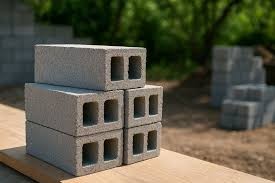
Hollow concrete blocks contain internal cavities that reduce the amount of concrete used in their manufacture.
They are generally lighter than comparable solid blocks and are widely considered for residential wall construction.
Common applications include:
- External walls where specified
- Internal partition walls
- Residential building enclosures
- Selected boundary wall applications
- Specially designed reinforced masonry systems
Advantages of hollow concrete blocks:
- Generally lighter than comparable solid blocks
- Often easier to handle during construction
- Use less concrete material for comparable external dimensions
- May contribute to thermal performance depending on their design and wall construction
- Some systems can accommodate reinforcement in designated cavities
Limitations:
- Not every hollow block is suitable for load-bearing applications
- Poor manufacturing can result in weak face shells or internal webs
- Certain fixing and cutting operations require additional consideration
- Structural applications may require specific reinforcement and installation details
The strength, cavity design and intended application should always be verified before purchasing hollow blocks.
C. Interlocking Concrete Blocks
Interlocking concrete blocks have specially shaped edges or profiles designed to fit together during installation.
Depending on the system, they may be used with conventional mortar or a specified dry-stacking method.
Common applications include:
- Selected residential wall systems
- Boundary walls
- Landscaping
- Garden enclosures
- Specially designed low-rise structures
Their suitability depends on the manufacturer’s system specifications and the building design. Do not assume that every interlocking block is appropriate for ordinary load-bearing residential construction.
D. Special-Purpose Concrete Blocks
Some residential projects require specially shaped concrete masonry units.
Examples include:
- Corner blocks
- Half blocks
- Lintel blocks
- Channel or bond-beam blocks
- Pier blocks
- Other specially dimensioned masonry units
These blocks may help accommodate wall intersections, openings and construction details.
Their selection should follow the approved architectural and structural drawings.
2. Consider the Structural Requirements of Your House
One of the most important considerations when choosing concrete blocks is the structural design of the building.
A residential house may have different wall requirements depending on its size, layout, number of floors and structural system.
For example, a single-storey bungalow may have different walling requirements from a two-storey residential building or a multi-storey apartment development.
Before purchasing concrete blocks, establish:
- Whether the walls are load-bearing or non-load-bearing
- The required wall thickness
- The specified masonry strength
- Whether reinforcement is required
- The building’s number of floors
- The structural arrangement of the house
- Any special requirements for external or internal walls
Load-bearing walls
Load-bearing walls are designed to support loads from the structure above them in addition to their own weight.
Concrete blocks used in load-bearing masonry must meet the strength and dimensional requirements specified by the structural engineer.
Do not select blocks for load-bearing walls based only on their size, weight or appearance.
Non-load-bearing walls
Non-load-bearing walls mainly divide spaces or enclose parts of a building without carrying the primary structural loads from floors and roofs.
Suitable concrete blocks may be used for internal partitions and other walling applications, provided they meet the required performance and stability specifications.
Why professional structural advice matters
The correct block type cannot be determined by looking at the building alone.
The architect and structural engineer should specify suitable masonry materials based on the building’s design, loads, wall arrangement and other technical requirements.
This is particularly important for multi-storey houses, buildings with large openings and structures with unusual layouts.
3. Check the Compressive Strength of Concrete Blocks
Compressive strength is one of the most important characteristics to consider when purchasing concrete blocks.
It refers to the ability of a concrete masonry unit to resist compressive loading under specified testing conditions.
The required strength depends on the intended application and the structural design.
Why block strength matters
Concrete blocks that do not meet the required strength may contribute to:
- Cracking and deterioration
- Reduced masonry performance
- Problems under applied loads
- Increased maintenance requirements
- Construction defects
However, strength is not determined by whether a block is solid or hollow alone.
It is influenced by several factors, including:
- Cement quality
- Aggregate quality and grading
- Mix proportions
- Water content
- Manufacturing method
- Compaction
- Curing
- Block geometry
- Quality-control procedures
How to verify concrete block strength
Before purchasing, consider the following:
- Ask the supplier for the specified compressive strength.
- Request relevant laboratory test reports where available.
- Confirm that the test results relate to the actual block type and dimensions being supplied.
- Check whether the product meets the project specifications.
- Seek professional guidance where the blocks are intended for structural applications.
Do not rely on informal tests such as hitting a block with a hammer or judging its strength by how heavy it feels.
4. Choose the Correct Concrete Block Dimensions
Concrete block dimensions affect wall thickness, construction quantities, mortar consumption, handling and the final appearance of the building.
The correct dimensions should be specified in the architectural and structural drawings.
When selecting concrete blocks, check:
- Length
- Height
- Width or thickness
- Dimensional consistency
- Cavity arrangement for hollow blocks
- Compatibility with the intended wall thickness
Why dimensions matter
Incorrect block dimensions can cause:
- Uneven wall surfaces
- Inconsistent mortar joints
- Difficulty aligning walls
- Excessive cutting and wastage
- Increased plastering requirements
- Changes to wall thickness
- Delays during construction
Check actual and nominal dimensions
Some suppliers may advertise nominal block dimensions, while actual manufactured dimensions may differ slightly.
Ask for clarification and measure representative samples before placing a large order.
Consistency is particularly important when constructing long walls, corners, window openings and door openings.
5. Inspect the Physical Quality of Concrete Blocks
Visual inspection is an important step when purchasing concrete blocks.
Although appearance alone cannot establish compressive strength, it can help identify visible defects and inconsistent manufacturing.
Before accepting blocks, inspect the following characteristics.
A. Surface condition
Look for:
- Major cracks
- Excessive chipping
- Uneven surfaces
- Visible honeycombing
- Poorly formed edges
- Significant surface defects
Minor variations may occur, but widespread defects should raise concerns about product quality.
B. Shape and dimensions
Blocks should be reasonably consistent in shape and dimensions.
Poorly formed blocks can make it difficult to construct straight walls with uniform mortar joints.
C. Hollow block cavities
For hollow blocks, examine the face shells and internal webs.
Check that the cavities are properly formed and that the surrounding concrete is not visibly damaged or excessively irregular.
D. Consistency between units
Inspect several blocks from different parts of the batch rather than selecting only one good-looking sample.
Significant differences between blocks may indicate inconsistent manufacturing.
E. Breakages and handling damage
Check whether the blocks have damaged corners, broken sections or cracks that could affect their use.
Separate unsuitable units before construction begins.
6. Evaluate the Manufacturing and Curing Process
The quality of concrete blocks depends heavily on how they are manufactured.
Even when manufacturers use similar raw materials, differences in batching, mixing, compaction and curing can influence the final product.
Important stages of concrete block manufacturing
1. Material selection
Suitable cement, aggregates and water should be selected for the intended product.
2. Batching
Materials should be measured consistently to achieve the intended mix proportions.
3. Mixing
The materials should be mixed properly to achieve a consistent concrete mixture.
4. Moulding
The mixture is placed into moulds that determine the block’s dimensions and shape.
5. Compaction
Appropriate compaction helps produce properly formed and consistent units.
6. Demoulding
Blocks are removed from their moulds carefully to avoid damaging their shape.
7. Curing
The blocks are cured under suitable conditions to allow the concrete to develop the required strength.
8. Inspection and testing
Finished blocks should be inspected and tested according to the product specifications and applicable requirements.
Why curing is important
Curing supports the development of concrete strength and durability.
Poor curing practices can affect the performance of concrete blocks even when the initial mixture contains suitable materials.
Before purchasing, ask the supplier about production dates, curing arrangements and the readiness of the blocks for delivery and installation.
7. Consider Water Absorption and Moisture Resistance
Moisture is an important consideration in residential construction, particularly for external walls and areas exposed to rain or ground moisture.
Concrete blocks should be suitable for their intended exposure conditions.
Excessive water absorption may contribute to moisture-related problems depending on the block properties, wall detailing, exposure and protective finishes.
When assessing concrete blocks, consider:
- Available water absorption test information
- Density and material characteristics
- Quality of manufacturing
- External wall finishes
- Damp-proofing requirements
- Drainage around the building
- Roof overhangs and rainwater management
A good building design should also include appropriate moisture protection.
Even quality concrete blocks can experience moisture problems if the building lacks proper damp-proofing, drainage and external detailing.
8. Check Compliance With Applicable Uganda Standards
Concrete blocks used in building construction should meet the applicable product requirements and project specifications.
In Uganda, buyers should confirm the relevant Uganda Standards and applicable conformity requirements through the Uganda National Bureau of Standards (UNBS).
This is especially important when purchasing blocks for structural or regulated construction applications.
Ask suppliers about:
- Applicable product specifications
- Relevant test reports
- Product conformity documentation where available
- Declared block dimensions
- Specified compressive strength
- Quality-control arrangements
Do not assume that every concrete block available in the market meets the requirements of every residential building project.
The architect or structural engineer should identify the appropriate material specifications.
9. Compare Solid and Hollow Concrete Blocks for House Construction
Both solid and hollow concrete blocks can be suitable for residential construction, but they have different characteristics.
| Comparison factor | Solid concrete blocks | Hollow concrete blocks |
|---|---|---|
| Internal structure | Largely filled cross-section | Contains internal cavities |
| Weight | Generally heavier | Generally lighter |
| Concrete consumption | Higher for comparable external dimensions | Lower for comparable external dimensions |
| Handling | May require more effort | Often easier to handle |
| Material efficiency | Uses more concrete in comparable units | Uses less concrete in comparable units |
| Potential thermal performance | Depends on density and wall construction | Cavities may contribute to thermal performance |
| Applications | Specified solid masonry applications | Various walling and some reinforced masonry systems |
| Structural suitability | Depends on tested properties and design | Depends on tested properties and design |
Which type should you choose for your house?
Consider solid blocks where the design specifies solid masonry units and their physical characteristics suit the application.
Consider hollow blocks where their strength, cavity design and other properties meet the requirements of the walling system.
The decision should be based on the structural design rather than assumptions that one type is automatically stronger or better.
For a detailed comparison, read the related guide on Solid Concrete Blocks vs Hollow Concrete Blocks: Which Is Better?
10. Consider the Cost of Concrete Blocks Without Compromising Quality
Your construction budget is an important factor when selecting concrete blocks.
However, choosing materials based only on the lowest purchase price can result in additional expenses later.
Concrete block prices in Uganda vary according to:
- Block type
- Dimensions
- Required compressive strength
- Cement and aggregate costs
- Manufacturing quality
- Production process
- Order quantity
- Supplier location
- Transportation and delivery
Compare the total cost of purchasing blocks
When evaluating supplier quotations, consider:
| Cost factor | What to check |
|---|---|
| Unit price | Price per block for the specified product |
| Quantity | Number of blocks required |
| Transportation | Cost of delivering blocks to the site |
| Offloading | Whether labour or equipment charges apply |
| Breakages | Allowance for handling and delivery losses |
| Quality | Whether the blocks meet the required specifications |
| Availability | Whether the supplier can deliver the full quantity |
| Replacement arrangements | How damaged or non-conforming products are handled |
A slightly higher purchase price may represent better value if the product meets the required specifications and reduces material wastage.
Avoid buying blocks based only on appearance
Two concrete blocks may look similar but have different strengths, dimensions and manufacturing quality.
Always request product specifications and supporting information where available.
11. Calculate the Number of Concrete Blocks Required for Your House
Accurate quantity estimation helps prevent material shortages, unnecessary purchases and construction delays.
The number of concrete blocks required depends on the total wall area, block dimensions, openings and construction details.
Follow these steps when estimating quantities.
Step 1: Calculate the total wall area
Multiply the length of each wall by its height.
Wall area = Wall length × Wall height
Calculate all walls separately and add their areas together.
Step 2: Calculate the total area of openings
Measure the doors, windows and other openings.
Subtract their combined area from the total wall area.
Net wall area = Total wall area − Total opening area
Step 3: Determine the coverage of one block
Use the block’s actual laying dimensions and the specified mortar joint to calculate its approximate wall coverage.
Step 4: Estimate the number of blocks
Number of blocks = Net wall area ÷ Coverage per block
Step 5: Add a suitable wastage allowance
Include an allowance for cutting, handling damage, breakages and construction adjustments.
The appropriate allowance depends on the project design, block type and site conditions.
Illustrative calculation
Suppose a house has a net wall area of 120 square metres after deducting door and window openings.
Assume the selected block and mortar-joint arrangement provides coverage of 0.08 square metres per block.
Estimated quantity:
120 ÷ 0.08 = 1,500 blocks.
This is an illustrative calculation, not a universal block requirement. Actual coverage depends on the selected block dimensions and mortar joints. The contractor or quantity surveyor should verify the quantities against the building drawings.
12. Choose a Reliable Concrete Block Supplier in Uganda
The supplier you select can influence the quality, availability and cost of materials used in your house construction project.
A reliable supplier should be able to explain product specifications and provide relevant information about the blocks being offered.
Before making a purchasing decision, consider the following.
Product specifications
Confirm the block type, dimensions and required strength.
Quality consistency
Ask how the supplier maintains consistent production quality.
Manufacturing process
Find out about material selection, compaction, curing and inspection.
Testing and documentation
Request relevant product information and test reports where available.
Production capacity
Establish whether the supplier can provide the required quantity within your construction schedule.
Delivery arrangements
Confirm transportation, offloading, site accessibility and delivery timing.
Transparent pricing
Request a written quotation that clearly identifies the products, quantities and additional charges.
Sample inspection
Inspect representative blocks before placing a large order.
For major construction projects, approve the samples and specifications before arranging bulk procurement.
13. Common Mistakes to Avoid When Choosing Concrete Blocks
Avoid these common mistakes when selecting concrete blocks for house construction.
1. Choosing blocks based only on price
The cheapest product may not meet the required strength or dimensions. Compare quality and specifications before making a decision.
2. Assuming heavier blocks are always stronger
Weight alone is not a reliable measure of compressive strength.
3. Ignoring the structural drawings
The selected blocks must match the intended walling system and structural requirements.
4. Failing to inspect samples
Always inspect representative blocks before committing to a large purchase.
5. Ignoring curing quality
Poor curing can affect the strength and durability of concrete blocks.
6. Purchasing blocks with inconsistent dimensions
Incorrect dimensions can lead to uneven walls, inconsistent joints and additional finishing costs.
7. Failing to consider transportation
A low unit price may be offset by high delivery costs.
8. Ordering without accurate quantity estimates
Poor quantity planning can cause shortages or excessive material purchases.
9. Using unsuitable blocks for structural walls
Load-bearing and other critical masonry applications require blocks that meet the engineer’s specifications.
10. Ignoring storage and handling
Poor storage can damage blocks before they are installed.
14. Best Practices for Storing Concrete Blocks Before Construction
After purchasing quality concrete blocks, proper storage helps maintain their condition before installation.
Consider the following practices:
- Store blocks on firm, level and well-drained ground.
- Keep them organised to minimise unnecessary movement.
- Avoid unstable or excessive stacking.
- Protect the products from contamination by soil and construction waste.
- Separate damaged units from acceptable blocks.
- Handle the products carefully during unloading.
- Follow supplier guidance on storage and readiness for use.
Inspect deliveries immediately so that damaged or non-conforming materials can be identified before masonry work begins.
15. Why Professional Construction Planning Matters
Choosing the right concrete blocks is only one part of building a durable house.
A successful residential construction project requires proper architectural planning, structural design, material selection, cost management, quality control and site supervision.
Professional construction planning helps ensure that:
- Materials meet the building specifications.
- Block dimensions are suitable for the wall layout.
- Structural requirements are properly considered.
- Material quantities are estimated accurately.
- Procurement is coordinated with construction activities.
- Masonry work is properly aligned and executed.
- Defects are identified and corrected early.
- Material wastage and unnecessary expenses are controlled.
Daltrev Co. Ltd. supports construction-related enquiries and project solutions in Uganda.
Explore the company’s construction materials, construction works and construction consultancy pages to learn more about its services.
Frequently Asked Questions About Choosing Concrete Blocks for House Construction
1. Which concrete blocks are best for building a house in Uganda?
The best concrete blocks depend on the structural design, wall application, required strength, dimensions and project budget. Both solid and hollow blocks may be suitable for different residential applications when they meet the specified requirements.
2. Are hollow concrete blocks good for house construction?
Yes. Properly manufactured hollow concrete blocks can be suitable for various residential walling applications. However, their strength, cavity design and suitability for the intended wall must be verified.
3. Are solid concrete blocks stronger than hollow blocks?
Not necessarily. Strength depends on the materials, mix proportions, compaction, curing, manufacturing quality and block geometry. Both types must meet the specified strength requirements.
4. What size concrete blocks should I use for building a house?
The correct block dimensions depend on the architectural drawings, required wall thickness, structural design and intended application. Confirm the specifications with your architect or structural engineer.
5. How can I identify quality concrete blocks?
Inspect their dimensions, surfaces, edges and cavities. Ask about manufacturing and curing processes, and request relevant compressive-strength test reports or product documentation where available.
6. How many concrete blocks are required to build a three-bedroom house in Uganda?
The quantity depends on the building layout, wall heights, block dimensions, wall thickness and the number and size of doors and windows. A contractor or quantity surveyor should calculate the requirement from the approved building drawings.
7. How much do concrete blocks cost in Uganda?
Prices vary depending on block type, dimensions, strength, manufacturing quality, supplier location, order quantity and transportation. Obtain current quotations using identical specifications.
8. Can hollow concrete blocks be used for load-bearing walls?
Some hollow concrete masonry units are designed for structural applications. However, they must meet the specified strength requirements and be used according to the structural design. Not every hollow block is suitable for load-bearing walls.
9. What causes concrete block walls to crack?
Possible causes include poor-quality blocks, unsuitable mortar, foundation movement, excessive loading, poor workmanship, inadequate structural detailing and moisture-related problems. The underlying cause should be investigated before repairs are undertaken.
10. Where can I find concrete blocks for house construction in Uganda?
You can source concrete blocks from manufacturers and construction-material suppliers in Uganda. Before purchasing, compare specifications, inspect samples, verify quality information and confirm delivery arrangements.
Conclusion: Choose Quality Concrete Blocks for a Durable Home
Choosing the right concrete blocks for house construction requires careful consideration of the building’s structural design, walling requirements, block strength, dimensions, manufacturing quality and budget.
Solid and hollow concrete blocks both have useful applications, but neither should be selected without checking its suitability for the intended construction work.
Before purchasing, inspect samples, confirm specifications, request relevant quality documentation and compare suppliers based on the complete delivered cost rather than price alone.
Proper material selection, accurate quantity estimation and professional construction supervision can help reduce wastage, avoid defects and support the development of a durable home.
For construction materials enquiries and professional project support, visit Daltrev Co. Ltd. or contact the team to discuss your residential construction requirements.