Concrete blocks are essential building materials used in residential, commercial and industrial construction throughout Uganda. They are commonly used for house walls, boundary walls, apartments, warehouses, schools, factories, offices and other building projects.
However, the quality of a concrete block is determined long before it reaches a construction site. It begins with the selection of suitable raw materials, accurate batching, proper mixing, effective compaction, correct moulding and adequate curing.
Understanding how concrete blocks are manufactured helps builders, contractors, property developers, construction companies and building-material suppliers make better decisions when purchasing or producing concrete blocks.
For anyone interested in starting a concrete block manufacturing business in Uganda, understanding the production process is equally important. The right equipment, suitable materials, controlled production methods and consistent quality inspections are necessary for producing blocks that meet market and project requirements.
This guide explains the materials used in concrete block manufacturing, the equipment required, the step-by-step production process, different types of concrete blocks, quality control procedures, common manufacturing mistakes and factors affecting production costs in Uganda.
1. What Is Concrete Block Manufacturing?
Concrete block manufacturing is the process of producing masonry units by combining cement, aggregates and water in controlled proportions, placing the mixture into moulds, compacting it into the required shape and allowing it to cure until it develops the necessary properties.
The process can be carried out using manual equipment, semi-automatic machines or fully automatic concrete block production systems.
Depending on the mould design and production method, manufacturers can produce different types of blocks, including:
- Solid concrete blocks.
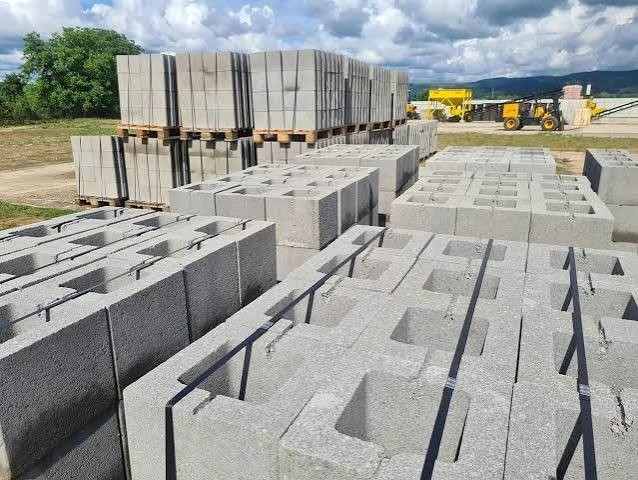
- Hollow concrete blocks.
- Interlocking concrete blocks.
- Decorative concrete blocks.
- Special-purpose masonry units.
- Concrete paving blocks, using appropriate paving-block production equipment and specifications.
The main objective is to produce concrete units with consistent dimensions, suitable strength, good workmanship and the performance characteristics required for their intended applications.
2. Materials Used in Concrete Block Manufacturing
The quality of concrete blocks depends heavily on the materials used during production.
Manufacturers must select suitable raw materials and maintain consistency in their properties and proportions.
2.1 Cement
Cement is the binding material that holds the aggregates together when mixed with water.
During hydration, cement reacts with water and forms compounds that contribute to the hardening and strength development of concrete.
The quality and suitability of cement influence the performance of the finished blocks.
Important considerations include:
- Use cement suitable for the intended concrete application.
- Purchase cement from reliable sources.
- Check packaging and product information.
- Avoid cement that has become damp or contains hardened lumps.
- Store cement in a dry, protected environment.
- Follow the mix design and relevant product requirements.
Using unsuitable or poorly stored cement can affect the consistency and performance of concrete blocks.
2.2 Sand
Sand is an important fine aggregate used in many concrete block mixes.
Its grading, cleanliness and moisture content influence the workability, compaction and properties of the finished product.
Suitable sand should be reasonably clean and free from harmful contaminants such as excessive clay, organic matter and other undesirable substances.
Manufacturers should pay attention to:
- Particle size distribution.
- Cleanliness.
- Consistency between deliveries.
- Moisture content.
- Compatibility with the intended mix design.
Poor-quality sand may contribute to inconsistent production and reduced block performance.
2.3 Coarse Aggregates
Coarse aggregates are used in concrete block production to provide bulk and contribute to the physical properties of the finished units.
Depending on the block type and manufacturing method, manufacturers may use appropriately graded crushed stone, stone dust or other suitable aggregate combinations.
The aggregate size must be compatible with the mould dimensions, block geometry and production equipment.
Important considerations include:
- Appropriate particle size.
- Suitable grading.
- Cleanliness.
- Consistent material quality.
- Good compatibility with the cement and other mix components.
Oversized or poorly graded aggregates can interfere with compaction and produce defects in the finished blocks.
2.4 Water
Water is essential for mixing and initiating the hydration process of cement.
It also influences the consistency and workability of the concrete mixture.
Manufacturers should use clean water that is suitable for concrete production and meets applicable requirements.
Too much water can negatively affect the properties of the hardened concrete, while insufficient water may make the mixture difficult to compact properly.
The correct water content should be determined through an appropriate mix design and adjusted carefully for variations in aggregate moisture.
2.5 Admixtures and Other Additives
Some manufacturers use chemical admixtures or other approved additives to modify particular properties of concrete.
Depending on the product and mix design, these may be used to improve workability or influence other production characteristics.
Admixtures should only be introduced when their suitability has been established. Manufacturers should follow the product manufacturer’s instructions and the applicable project or product specifications.
They should not be used as substitutes for accurate batching, suitable raw materials, proper compaction or curing.
3. Equipment Used in Concrete Block Manufacturing
Concrete block production requires suitable machinery and supporting equipment. The choice depends on the production capacity, available investment, product range and degree of automation.
3.1 Concrete Block Making Machine
<image_placeholder>
A concrete block making machine is the main piece of equipment used to form concrete blocks.
It applies pressure and vibration, or another specified compaction method, to shape the concrete mixture inside moulds.
Machines vary in size, production capacity and automation level.
Common options include:
Manual block-making machines
These require more manual labour during mould filling, operation and handling. They may be considered for small-scale production where output requirements and available resources are limited.
Semi-automatic block-making machines
These combine mechanical operations with some manual handling. They can improve production consistency and reduce certain labour requirements compared with basic manual systems.
Fully automatic block-making machines
These use automated systems for operations such as material feeding, moulding, compaction and product handling, depending on the machine configuration.
They are generally intended for larger production operations requiring higher output and more controlled manufacturing processes.
3.2 Concrete Mixer
A concrete mixer combines cement, aggregates and water into a uniform mixture.
Proper mixing is important because inconsistent material distribution can result in variations between blocks.
The mixer should be suitable for the intended production volume and the characteristics of the concrete mix.
3.3 Block Moulds
Moulds determine the shape, dimensions and configuration of the finished blocks.
Manufacturers use different moulds to produce solid, hollow, interlocking and decorative units.
Moulds should be:
- Correctly designed for the intended product.
- Strong enough for the production process.
- Properly maintained.
- Clean before use.
- Checked regularly for wear and damage.
Damaged or poorly maintained moulds can cause dimensional inconsistencies and surface defects.
3.4 Aggregate Storage Bins
Storage bins are used to keep different aggregate materials separate before batching.
Proper storage helps reduce contamination and makes it easier to control the proportions of materials entering the production process.
3.5 Material Batching Equipment
Batching equipment measures the quantities of cement, aggregates and water used in each production batch.
Depending on the operation, batching may be carried out using weighing systems, calibrated measuring equipment or automated controls.
Accurate batching is important for maintaining consistent product quality.
3.6 Conveyor Systems
Conveyors transport aggregates and other materials between different production stages.
They are particularly useful in larger manufacturing operations where materials need to move continuously between storage, mixing and moulding equipment.
3.7 Pallets and Handling Equipment
Newly moulded blocks may be placed on pallets or other suitable supporting surfaces for transportation to the curing area.
Forklifts, pallet trucks and other handling equipment may be used in larger production facilities.
Handling systems should minimise vibration, impact and damage to freshly manufactured blocks.
3.8 Curing Facilities
Curing areas provide suitable conditions for newly manufactured blocks to develop their required properties.
Depending on the production system, these may include:
- Covered curing areas.
- Protected outdoor curing spaces.
- Controlled moisture environments.
- Specialised curing chambers or systems.
The curing arrangement should protect blocks from excessive drying, heavy rain, physical damage and unsuitable environmental conditions.
3.9 Quality Testing Equipment
Manufacturers may require testing equipment to assess the quality of their finished products.
Depending on the product specification and testing requirements, this can include:
- Measuring tapes and steel rules.
- Callipers.
- Weighing scales.
- Water absorption testing equipment.
- Compression testing machines.
- Other relevant laboratory equipment.
Some manufacturers use independent materials testing laboratories rather than maintaining all testing facilities on site.
4. Step-by-Step Concrete Block Manufacturing Process
Concrete block manufacturing involves several interconnected stages. Each stage contributes to the quality and consistency of the final product.
<image_placeholder>
Step 1: Selection and Inspection of Raw Materials
The manufacturing process begins with selecting suitable cement, sand, aggregates and water.
Materials should be inspected before production to identify contamination, unsuitable grading, moisture variations and other issues that may affect the mix.
Manufacturers should establish reliable material sources and monitor changes between deliveries.
Using consistent raw materials helps reduce variations in the finished blocks.
Step 2: Storage of Raw Materials
After inspection, materials are stored in suitable locations.
Cement should be kept dry and protected from moisture.
Sand and aggregates should be stored separately to prevent contamination and mixing with soil or other unsuitable materials.
Good storage practices help maintain material quality before batching.
Step 3: Material Batching and Measurement
The required quantities of cement, sand, aggregates and water are measured according to the selected mix design.
Accurate batching is important because inconsistent proportions can produce blocks with different characteristics.
For example, changing the aggregate proportions without controlling the mix design can influence density, compaction and strength.
Moisture in the sand and aggregates should also be considered when determining the amount of additional mixing water.
Step 4: Mixing the Concrete Materials
The measured materials are transferred into the concrete mixer.
Cement and aggregates are combined, followed by the controlled addition of water according to the production procedure.
Mixing continues until the materials are sufficiently distributed and the required consistency is achieved.
The mixture used in many machine-made concrete blocks is relatively stiff or low in workability compared with conventional poured concrete. It must still be suitable for the machine’s compaction method and the intended block design.
Poor mixing can result in uneven distribution of cement and aggregates, affecting the consistency of the finished products.
Step 5: Feeding the Mixture into the Block Machine
The prepared concrete mixture is transferred to the block-making machine.
It is placed into a hopper or feeding system that supplies material to the mould.
The quantity of material entering each mould should be controlled to achieve consistent block dimensions and geometry.
Insufficient or excessive filling can result in defects and variations between units.
Step 6: Moulding and Compaction
The mixture is placed inside the selected mould.
The machine then applies the specified compaction method, which may involve vibration, pressure or a combination of both.
Compaction consolidates the mixture and helps it take the shape of the mould.
This stage is particularly important because poor compaction can result in:
- Weak or poorly consolidated sections.
- Surface cavities.
- Inconsistent density.
- Poorly formed edges.
- Dimensional variations.
- Reduced product consistency.
The machine settings should be suitable for the mixture, mould and block design.
Step 7: Demoulding
Once the mixture has been properly compacted, the mould is released.
The newly formed block is removed and transferred to a suitable pallet or supporting surface.
Demoulding should be carried out carefully because fresh blocks may not yet have sufficient handling strength.
Rough handling can cause cracking, broken edges and deformation.
Step 8: Initial Setting and Transfer to the Curing Area
The newly manufactured blocks are transferred to a protected area where they can begin developing sufficient strength for subsequent handling.
They should be placed on stable surfaces and protected from unnecessary disturbance.
The time before further handling depends on the block mix, manufacturing process and environmental conditions.
Step 9: Curing of Concrete Blocks
Curing is one of the most important stages in concrete block manufacturing.
It provides suitable moisture and temperature conditions for cement hydration and strength development.
Proper curing helps blocks develop the required performance characteristics and reduces the risk of premature drying-related defects.
Depending on the production system, curing may involve controlled moisture conditions, covering, suitable water application or specialised curing arrangements.
Manufacturers should follow the applicable curing procedure and product requirements.
There is no single curing duration that automatically applies to every block, mix design and production method.
Step 10: Quality Inspection and Testing
After the blocks have reached the required stage for assessment, representative samples are inspected and tested.
Quality checks may include:
- Visual inspection.
- Dimensional measurements.
- Compressive strength testing.
- Water absorption testing.
- Density assessment where required.
- Inspection of hollow sections and block geometry.
Testing should follow the applicable product standard and approved sampling procedures.
Defective or non-conforming products should be identified and managed appropriately rather than mixed with accepted products.
Step 11: Sorting, Stacking and Storage
Once inspected, acceptable blocks are sorted and stacked in designated storage areas.
They should be stored on stable surfaces and protected from damage, contamination and unsuitable environmental conditions.
Safe stacking and handling reduce breakages and help preserve product quality before delivery.
Step 12: Packaging, Loading and Transportation
The final stage involves preparing the blocks for delivery to construction sites, distributors or customers.
Blocks should be loaded carefully to minimise impact and breakage.
Transportation arrangements should consider the quantity, weight, stacking method, delivery distance and site access.
The objective is to ensure that the blocks arrive in an acceptable condition and correspond to the approved product specifications.
5. Different Types of Concrete Blocks Manufactured in Uganda
Concrete block manufacturers can produce different products depending on the available equipment, mould designs and market requirements.
5.1 Solid Concrete Blocks
<image_placeholder>
Solid concrete blocks have a solid or substantially solid cross-section, according to their product classification.
They are used in masonry applications where the design specifies solid units.
Their suitability depends on the required dimensions, strength and other performance properties.
5.2 Hollow Concrete Blocks
<image_placeholder>
Hollow concrete blocks contain openings that reduce their overall mass compared with equivalent solid units.
They are commonly used in building walls and other masonry applications.
Important manufacturing considerations include the dimensions of the openings, face shells, internal webs and the overall block geometry.
5.3 Interlocking Concrete Blocks
<image_placeholder>
Interlocking concrete blocks are designed with profiles that allow adjacent units to fit together in a specific arrangement.
They are used in selected walling and construction systems.
Their production requires accurate moulding to ensure that the interlocking profiles fit as intended.
5.4 Decorative Concrete Blocks
<image_placeholder>
Decorative blocks are manufactured with patterns, openings or textured surfaces for architectural and aesthetic purposes.
They may be used in screen walls, partitions, ventilation features and other design applications.
The mould must produce consistent patterns and dimensions while maintaining the performance requirements of the intended application.
5.5 Special-Purpose Concrete Masonry Units
Manufacturers may also produce specialised concrete units for particular construction applications.
These may include purpose-designed masonry components and other precast units.
Each product requires suitable moulds, production methods and quality requirements.
6. Factors That Determine Concrete Block Quality During Manufacturing
Producing concrete blocks is not simply a matter of combining cement, sand and water. Several factors influence the quality of the finished units.
Quality of Raw Materials
Unsuitable cement, contaminated sand and poorly graded aggregates can negatively affect block performance.
Manufacturers should select appropriate materials and maintain consistent supply arrangements.
Accuracy of Mix Proportions
Incorrect batching can cause variations in strength, density and production consistency.
Use an established mix design and suitable measuring equipment.
Water Content
The water content must be appropriate for the mix design and compaction method.
Excessive water can negatively affect the hardened concrete, while insufficient water may interfere with mixing and compaction.
Mixing Uniformity
Materials should be mixed adequately to achieve consistent distribution.
Poor mixing can result in variations between blocks from the same production batch.
Machine Performance
The block-making machine should operate correctly and be suitable for the product being manufactured.
Worn moulds, inconsistent vibration and incorrect settings can produce defective units.
Compaction Quality
Effective compaction is necessary to consolidate the mixture within the mould.
Inadequate compaction may lead to cavities, weak sections and dimensional irregularities.
Curing Conditions
Blocks should receive suitable curing conditions to support cement hydration and strength development.
Poor curing can compromise the final product even when the original mix proportions were appropriate.
Storage and Handling
Blocks can be damaged after production through careless handling, poor stacking or unsuitable transportation.
Quality management should therefore continue beyond the manufacturing machine.
7. Quality Control and Testing in Concrete Block Manufacturing
Quality control is essential for producing consistent concrete blocks.
Manufacturers should establish inspection procedures that cover raw materials, production operations and finished products.
Visual Inspection
Examine blocks for:
- Cracks.
- Broken edges.
- Surface cavities.
- Poorly formed corners.
- Uneven surfaces.
- Inconsistent openings.
- Other visible manufacturing defects.
Dimensional Testing
Measure the length, width and height of representative units.
For hollow blocks, assess the relevant face shell, web and opening dimensions according to the applicable specification.
Compressive Strength Testing
This test evaluates the ability of concrete blocks to resist compressive loading.
Representative specimens are tested using an appropriate compression testing method, and results are compared with the required product classification and project specifications.
Water Absorption Testing
Water absorption testing assesses the amount of water absorbed by a block under specified laboratory conditions.
The results help evaluate a property relevant to moisture-related performance and product compliance.
Density Assessment
Density measurements may be used to evaluate consistency and distinguish between different product categories.
However, density alone does not establish compressive strength.
Production Batch Records
Manufacturers should maintain useful records covering:
- Raw material sources.
- Mix proportions.
- Production dates.
- Machine settings where relevant.
- Curing procedures.
- Inspection results.
- Test reports.
- Rejected products and corrective actions.
These records support traceability and help identify problems when production quality changes.
8. Common Mistakes in Concrete Block Manufacturing
Manufacturing errors can affect the strength, dimensions, appearance and durability of finished concrete blocks.
The following mistakes should be avoided.
Using Poor-Quality Raw Materials
Unsuitable cement, contaminated sand or poorly graded aggregates may result in inconsistent products.
Prevention: Inspect materials and use reliable sources that meet the required specifications.
Incorrect Material Proportions
Inaccurate batching can produce variations between production batches.
Prevention: Use an established mix design and suitable measuring equipment.
Adding Too Much Water
Excessive water can negatively affect the properties of hardened concrete.
Prevention: Control water addition and account for moisture already present in aggregates.
Poor Mixing
Inadequate mixing can cause uneven material distribution.
Prevention: Use a suitable mixer and follow a consistent mixing procedure.
Inadequate Compaction
Poor compaction may create cavities, weak sections and poorly formed blocks.
Prevention: Maintain suitable machine settings and ensure that the mould is filled and compacted correctly.
Using Damaged Moulds
Worn or damaged moulds can produce blocks with incorrect dimensions and irregular shapes.
Prevention: Inspect moulds regularly and replace or repair unsuitable components.
Insufficient Curing
Inadequate curing can limit strength development and affect durability.
Prevention: Follow an appropriate curing procedure and protect blocks from premature drying.
Poor Storage and Handling
Rough handling and unstable stacking can damage newly manufactured blocks.
Prevention: Use suitable pallets, safe stacking arrangements and appropriate handling equipment.
Failing to Conduct Quality Tests
Without testing, manufacturers may continue producing blocks that do not meet the required specifications.
Prevention: Establish routine inspections and arrange appropriate laboratory testing.
9. How to Start a Concrete Block Manufacturing Business in Uganda
Concrete block manufacturing can be a business opportunity for entrepreneurs interested in supplying building materials to the construction market.
However, starting a successful operation requires more than purchasing a block-making machine.
The business needs suitable premises, reliable raw materials, appropriate equipment, trained workers, quality management and a clear understanding of customer demand.
Step 1: Conduct Market Research
Identify potential customers and understand the demand for different concrete block types in your target market.
Potential customers may include:
- Building contractors.
- Property developers.
- Individual homeowners.
- Construction companies.
- Hardware and building-material retailers.
- Commercial property developers.
- Infrastructure contractors where suitable products are required.
Research competitor products, delivery arrangements, pricing and customer expectations.
Step 2: Prepare a Business Plan
A business plan should establish:
- Target customers.
- Product range.
- Expected production capacity.
- Machinery requirements.
- Raw material supply arrangements.
- Labour requirements.
- Premises and operating costs.
- Transport arrangements.
- Quality control procedures.
- Sales and distribution strategy.
It should also consider cash flow and the cost of maintaining production equipment.
Step 3: Identify Suitable Premises
The production site should provide enough space for machinery, raw material storage, block curing, finished-product storage and vehicle access.
Consider:
- Accessibility for delivery trucks.
- Reliable water supply.
- Electricity requirements.
- Drainage.
- Ground stability.
- Safe material storage.
- Space for future expansion.
- Applicable planning and environmental requirements.
Confirm relevant local approvals before beginning operations.
Step 4: Select Appropriate Machinery
Choose equipment based on the intended production volume and available investment.
Consider:
- Machine capacity.
- Available mould designs.
- Automation level.
- Power requirements.
- Maintenance needs.
- Spare parts availability.
- Operator training.
- After-sales technical support.
Do not select machinery based only on advertised output figures. Confirm the expected production rate under realistic operating conditions.
Step 5: Establish Reliable Material Sources
Identify suppliers of suitable cement, sand and aggregates.
Check their consistency, quality and delivery arrangements.
Having reliable suppliers helps maintain production continuity and reduces the risk of variations in the finished products.
Step 6: Recruit and Train Workers
Workers should understand material handling, batching, mixing, machine operation, mould maintenance, curing and product inspection.
Training helps reduce accidents, wastage and production defects.
Step 7: Establish Quality Control Procedures
Create procedures for checking incoming materials, monitoring production and assessing finished products.
Where necessary, arrange testing through a competent materials testing laboratory.
Step 8: Develop a Sales and Distribution Strategy
Identify the most effective ways to reach customers.
These may include:
- Direct sales to construction projects.
- Partnerships with hardware retailers.
- Contractor relationships.
- Product catalogues.
- Online marketing.
- Local distribution arrangements.
- Reliable delivery services.
A manufacturing business needs both consistent product quality and a dependable route to market.
10. Equipment Selection: Manual, Semi-Automatic and Fully Automatic Machines
Choosing the correct machine is an important investment decision.
| Equipment type | General characteristics | Considerations |
|---|---|---|
| Manual machine | More manual handling and operation | Lower automation, labour requirements and output constraints |
| Semi-automatic machine | Combines mechanical production with manual operations | Balances machinery investment and operational control |
| Fully automatic machine | Uses automated production and handling systems | Higher capital, maintenance and technical requirements |
The best option depends on the scale of the operation, available capital, product range, labour availability and customer demand.
A manufacturer should also consider the cost of mould replacement, machine servicing, power consumption and spare parts when evaluating equipment.
11. Factors Affecting the Cost of Concrete Block Manufacturing in Uganda
The cost of manufacturing concrete blocks depends on several operational and market factors.
There is no single production cost that applies to every manufacturer because businesses use different materials, machinery, production volumes and operating arrangements.
Raw Material Costs
Cement, sand, aggregates and water contribute to production costs.
Changes in supplier prices, transport expenses and material availability can affect the cost per block.
Machinery Investment
Manual, semi-automatic and fully automatic systems have different purchase and operating costs.
The initial investment should be considered alongside maintenance, spare parts and expected production capacity.
Labour Costs
Workers may be required for material handling, mixing, machine operation, curing, inspection, loading and administration.
Labour requirements depend on the production system and degree of automation.
Electricity and Water
Machines, mixers, conveyors and other equipment may require electricity or other power sources.
Water is also required for mixing and appropriate curing arrangements.
Land and Premises
Rent, site preparation, storage facilities, drainage and other premises-related expenses affect the cost of operating a manufacturing facility.
Maintenance and Repairs
Regular servicing and replacement of worn components are necessary for maintaining equipment performance.
Poor maintenance can lead to breakdowns, production interruptions and additional costs.
Transportation and Delivery
Transporting raw materials to the manufacturing site and delivering finished blocks to customers can represent a significant part of operating costs.
Distance, vehicle capacity, fuel prices and site accessibility all influence delivery expenses.
Production Wastage
Rejected blocks, damaged products, inaccurate batching and poor handling increase the cost of production.
Effective quality control helps minimise avoidable wastage.
Production Volume
Higher production volumes may spread certain fixed costs across more units, but this depends on market demand, machine efficiency and the business’s ability to control operating expenses.
Manufacturers should calculate the actual cost per acceptable block rather than using total production expenditure divided by the number of blocks produced without accounting for rejects.
12. Environmental and Workplace Safety Considerations
Concrete block manufacturing involves cement dust, machinery, moving materials, noise and heavy loads.
Manufacturers should establish appropriate safety and environmental controls.
Dust Management
Cement and aggregate handling can produce dust.
Use suitable dust-control measures, safe material-handling procedures and appropriate personal protective equipment.
Machine Safety
Block-making machines and mixers contain moving components that can cause injuries.
Workers should receive training and operate equipment according to manufacturer instructions.
Machine guards and emergency controls should be maintained.
Manual Handling
Cement bags, aggregates, pallets and finished blocks can be heavy.
Use safe lifting procedures and mechanical handling equipment where appropriate.
Water and Drainage Management
Manage water use and drainage to avoid unnecessary wastage, standing water and uncontrolled discharge.
Noise Management
Machinery may generate noise. Appropriate controls and hearing protection should be provided where required.
General Workplace Organisation
Keep production areas organised and separate pedestrians from moving vehicles and machinery.
Maintain clear access routes and safe storage arrangements.
13. How to Improve Efficiency in Concrete Block Manufacturing
Manufacturers can improve production efficiency through better planning and consistent process control.
Consider the following practices:
Standardise mix designs.
Use established production formulations and control material proportions.
Maintain machinery.
Inspect mixers, moulds, vibration systems and other components regularly.
Train operators.
Ensure workers understand the correct operating procedures.
Control aggregate moisture.
Monitor changes in aggregate moisture so that water addition can be adjusted appropriately.
Improve material storage.
Keep cement dry and prevent contamination of aggregates.
Organise production areas.
Arrange materials, machines and curing spaces to reduce unnecessary movement.
Monitor rejected products.
Record defects and investigate recurring production problems.
Maintain production records.
Use records to monitor material consumption, production output, downtime and product quality.
Plan deliveries.
Coordinate finished-product storage and transportation to reduce breakages and unnecessary handling.
Consistent process control can improve productivity while supporting the quality of finished blocks.
14. Concrete Block Manufacturing Quality Control Checklist
Manufacturers can use this checklist to monitor the main stages of production.
Raw Material Inspection
- Confirm cement suitability and storage condition.
- Inspect sand quality and cleanliness.
- Check aggregate grading and consistency.
- Confirm that mixing water is suitable.
- Record incoming material deliveries.
Production Preparation
- Confirm the approved mix design.
- Check batching equipment.
- Inspect the mixer.
- Inspect moulds for wear and damage.
- Confirm that the block machine is operating correctly.
Manufacturing Operations
- Measure materials accurately.
- Maintain consistent mixing.
- Control water addition.
- Ensure appropriate mould filling.
- Monitor compaction.
- Handle newly formed blocks carefully.
Curing and Storage
- Transfer blocks safely to the curing area.
- Follow the required curing procedure.
- Protect blocks from unsuitable environmental conditions.
- Maintain safe stacking arrangements.
- Prevent unnecessary handling damage.
Quality Inspection
- Inspect surface condition.
- Check block dimensions.
- Inspect hollow sections where applicable.
- Conduct specified strength testing.
- Conduct other required tests.
- Separate non-conforming products.
- Maintain production and test records.
15. Frequently Asked Questions About Concrete Block Manufacturing
How are concrete blocks manufactured?
Concrete blocks are manufactured by combining cement, sand, aggregates and water in controlled proportions. The mixture is fed into moulds, compacted using suitable machinery, demoulded and cured before inspection, storage and delivery.
What materials are used to make concrete blocks?
The main materials include cement, sand, suitable coarse aggregates and water. Some production systems may also use approved admixtures or other additives depending on the mix design and product requirements.
Which machine is used to manufacture concrete blocks?
Concrete block-making machines are used to mould and compact the concrete mixture. They may be manual, semi-automatic or fully automatic, depending on production requirements and investment capacity.
How long does it take to manufacture concrete blocks?
The actual moulding process can take a relatively short time, depending on the machine and production arrangement. However, the complete manufacturing process also includes initial setting, curing, inspection and handling. The time before blocks can be safely handled or accepted for use depends on the mix, curing conditions and applicable product requirements.
Why is curing important in concrete block manufacturing?
Curing supports cement hydration and strength development. It helps concrete blocks develop their intended properties and reduces the risk of premature drying-related defects.
What determines the strength of concrete blocks?
Strength is influenced by cement quality, aggregate grading, mix proportions, water content, mixing uniformity, compaction, curing and manufacturing consistency.
Can concrete blocks be manufactured manually?
Yes. Small-scale operations may use manual block-making equipment. However, production consistency and output depend on the quality of the equipment, materials, operator skill and process control.
What is the difference between solid and hollow concrete blocks?
Solid blocks have a solid or substantially solid cross-section, while hollow blocks contain openings within their structure. Their applications and performance requirements depend on the block classification and construction design.
Is concrete block manufacturing profitable in Uganda?
Profitability depends on customer demand, raw material costs, machinery investment, labour, transport, production efficiency, wastage and selling prices. A detailed business plan and realistic cost analysis are important before investing.
How can manufacturers improve concrete block quality?
Manufacturers can improve quality by selecting suitable materials, using accurate batching, maintaining consistent mixing, applying effective compaction, following proper curing procedures and conducting regular inspections and laboratory tests.
16. Explore Construction Materials and Services with Daltrev Co. Ltd.
Understanding how concrete blocks are manufactured helps builders and property developers make better decisions when selecting construction materials.
Whether you are planning a residential house, commercial building, warehouse, factory or another construction project in Uganda, the quality of materials used can influence construction efficiency, durability and long-term performance.
At Daltrev Co. Ltd., we recognise the importance of appropriate construction materials, effective planning and quality considerations throughout building projects.
For construction-related enquiries, material planning and information about our services, explore:
- Daltrev Construction Materials
- Daltrev Construction Works
- Daltrev Construction Consultancy
- Contact Daltrev Co. Ltd.
Choose construction materials carefully, understand their production quality and make informed decisions for your building project.
Conclusion
Concrete block manufacturing involves several important stages, beginning with raw material selection and ending with quality inspection, storage and delivery.
The process includes accurate batching, proper mixing, mould filling, compaction, demoulding and curing. Each stage contributes to the quality and consistency of the finished blocks.
Manufacturers must use suitable materials, appropriate equipment and controlled production methods to achieve the required product characteristics. They must also establish quality control procedures to identify defects and ensure that products meet applicable standards and project specifications.
For builders, contractors and property developers in Uganda, understanding how concrete blocks are manufactured provides valuable insight into what determines product quality and why careful material selection matters.
Ultimately, reliable concrete block production depends on good materials, suitable machinery, skilled operators, proper curing and consistent quality management.