Concrete paving blocks are among the most practical and attractive materials used for constructing durable outdoor surfaces. In Uganda, they are increasingly used for residential compounds, driveways, walkways, parking areas, commercial premises, shopping centres, industrial yards and public spaces. Their strength, design flexibility and ease of maintenance make them a popular alternative to conventional concrete and other surface-finishing materials.
Whether you are developing a residential property in Kampala, constructing a commercial parking area in Wakiso, improving an industrial compound or landscaping an outdoor space, choosing the right concrete paving blocks can significantly influence the appearance, functionality and long-term performance of your project.
However, not all paving blocks are suitable for every application. Their performance depends on several factors, including concrete quality, block thickness, shape, manufacturing process, ground preparation, installation technique and expected traffic loads.
This guide explores concrete paving blocks in Uganda, including their types, modern designs, applications, benefits, installation process, cost considerations and important quality checks to help property owners, contractors and developers make informed decisions.
What Are Concrete Paving Blocks?
Concrete paving blocks are precast concrete units manufactured in different shapes, sizes, colours and thicknesses for creating paved outdoor surfaces. They are laid individually over a prepared foundation to form a continuous and stable surface.
Unlike a conventional concrete slab, which is generally poured and finished as one continuous surface, block paving consists of separate units arranged in a planned pattern. Depending on the paving system, the blocks are supported by a compacted base and bedding layer, with jointing material filling the spaces between them.
Concrete paving blocks are designed for different loading conditions. Some are suitable for pedestrian walkways and landscaping, while others are manufactured for residential driveways, parking areas, commercial premises and heavier-duty applications.
Their suitability depends on the design requirements of the project rather than appearance alone.
Types of Concrete Paving Blocks in Uganda
Concrete paving blocks are available in several forms. Understanding the differences helps developers and contractors select the appropriate product for the intended application.
1. Rectangular Concrete Paving Blocks
Rectangular paving blocks are among the most widely recognised paving designs. Their simple shape makes them suitable for different laying patterns, including stretcher bond, herringbone and basket-weave arrangements.
They are commonly used for:
- Residential compounds.
- Driveways and parking spaces.
- Pedestrian walkways.
- Commercial outdoor spaces.
- Access paths around buildings.
Their versatility makes them suitable for projects that require a neat, organised and practical paved surface.
2. Interlocking Concrete Paving Blocks
Interlocking concrete paving blocks are designed with shapes that fit together in a coordinated arrangement. Their geometry helps create a connected paving surface that can distribute loads through the paving system when correctly installed.
They are particularly useful for areas exposed to regular movement and traffic.
Common applications include:
- Residential driveways.
- Commercial parking areas.
- Petrol station forecourts.
- Industrial compounds.
- Access roads and service areas.
Interlocking designs must be combined with appropriate block specifications, edge restraints, joint filling and a properly compacted foundation. The shape alone does not guarantee pavement strength.
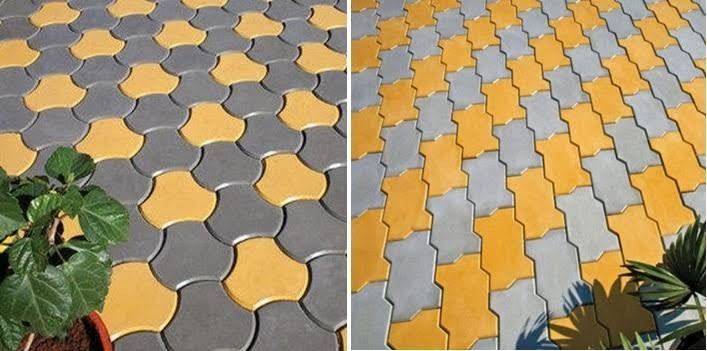
3. Zigzag or S-Shaped Paving Blocks
Zigzag paving blocks, sometimes described as S-shaped or wave-shaped blocks, have profiles that fit together to create a closely connected paving arrangement.
They are commonly considered for areas where vehicles move or turn, provided the product and pavement structure are designed for the expected traffic.
Applications include:
- Driveways.
- Parking areas.
- Commercial compounds.
- Service yards.
- Selected industrial surfaces.
The correct thickness, concrete quality and laying pattern should be established according to the expected loads.
4. Square Concrete Paving Blocks
Square paving blocks offer a balanced and symmetrical appearance. They can be arranged in grid patterns, alternating designs or decorative combinations.
They are commonly used for:
- Garden paths.
- Courtyards.
- Pedestrian walkways.
- Residential compounds.
- Outdoor seating areas.
Square blocks are particularly suitable for projects where appearance and orderly patterns are important.
5. Hexagonal Concrete Paving Blocks
Hexagonal paving blocks have six sides and can create distinctive geometric patterns when installed together.
They are suitable for decorative paving applications such as:
- Garden walkways.
- Landscaped compounds.
- Courtyards.
- Recreational areas.
- Pedestrian spaces.
Their appearance can help create an attractive outdoor environment while providing a practical paved surface.
6. Decorative Concrete Paving Blocks
Decorative paving blocks are manufactured to improve the visual appearance of outdoor spaces. They may feature textured surfaces, multiple colours, patterned finishes or distinctive shapes.
They are commonly used in:
- Residential landscaping.
- Hotel compounds.
- Shopping centres.
- Office entrances.
- Restaurants and outdoor seating spaces.
- Public recreational areas.
When selecting decorative blocks, consider slip resistance, durability, cleaning requirements and suitability for the intended traffic.
7. Permeable Concrete Paving Blocks
Permeable paving systems are designed to allow water to pass through the paved surface and into a specially prepared underlying aggregate structure.
They can help manage surface runoff when properly designed and maintained.
Potential applications include:
- Selected parking areas.
- Landscaped outdoor spaces.
- Pedestrian areas.
- Low-speed access areas.
- Sites requiring additional stormwater management.
Permeable paving is not simply a matter of using blocks with gaps. The entire system, including joint material, bedding, aggregate layers, subgrade and drainage arrangements, must be designed to manage water appropriately.
Concrete Paving Block Designs for Modern Properties
The design of concrete paving blocks influences the appearance and character of an outdoor space. Property owners in Uganda can select from several patterns depending on the building design, landscaping concept and intended use.
Herringbone Pattern
The herringbone pattern involves arranging rectangular paving blocks at alternating angles, commonly 45 or 90 degrees.
<figure> </figure>
This pattern is frequently considered for driveways and areas exposed to vehicle movement because the arrangement can provide good resistance to block movement when correctly installed.
Stretcher Bond Pattern
In a stretcher bond pattern, rectangular blocks are arranged in parallel rows, with joints offset between neighbouring rows.
It creates a simple and organised appearance suitable for walkways, courtyards and residential compounds.
Basket-Weave Pattern
Basket-weave paving uses pairs or groups of rectangular blocks arranged in alternating directions to create a woven appearance.
It is commonly used for decorative courtyards, garden paths and pedestrian areas.
Circular and Fan Patterns
Circular and fan-shaped arrangements can create attractive focal points within paved spaces.
They are suitable for:
- Garden centres.
- Courtyards.
- Building entrances.
- Outdoor seating areas.
- Landscaped residential compounds.
These patterns require careful setting out and accurate cutting or specially shaped units around curved sections.
Mixed-Colour Paving Designs
Different coloured paving blocks can be combined to create borders, pathways, geometric patterns and visual separation between different outdoor areas.
For example, a property owner may use one colour for the main driveway and another shade for pedestrian walkways or decorative borders.
Colour selection should consider the surrounding building finishes, landscape design, maintenance requirements and availability of replacement units.
Applications of Concrete Paving Blocks in Uganda
Concrete paving blocks are used in residential, commercial, industrial and institutional developments. Their versatility makes them suitable for a wide range of outdoor surfaces.
1. Residential Compounds
Homeowners use concrete paving blocks to improve the appearance and functionality of outdoor spaces.
Common applications include:
- Compound paving.
- Garden paths.
- Parking spaces.
- Entrance walkways.
- Outdoor sitting areas.
- Paths connecting different buildings.
A well-designed paved compound can improve accessibility, reduce muddy conditions and create a more organised outdoor environment.
2. Driveways and Vehicle Access Areas
Concrete paving blocks are frequently used for residential and commercial driveways.
They can provide a durable surface when the blocks, foundation and installation method are appropriate for the expected vehicle loads.
Important considerations include:
- Vehicle type and frequency of use.
- Block thickness and strength.
- Ground conditions.
- Base material and compaction.
- Drainage and surface gradients.
- Edge restraint.
- Suitable laying pattern.
Driveways used by heavy vehicles require a more substantial pavement design than areas intended only for passenger cars.
3. Commercial Parking Areas
Shopping centres, office buildings, hotels, restaurants and retail developments may use concrete paving blocks for parking spaces and surrounding outdoor areas.
Their benefits include the ability to create organised parking layouts, designated pedestrian routes and clearly defined traffic areas.
Developers should ensure that the paving system is designed for vehicle loads, turning movements and expected traffic intensity.
4. Industrial Compounds
Industrial facilities, warehouses, factories and workshops may require paved surfaces for vehicle movement, loading, unloading and outdoor operations.
Concrete paving blocks can be considered for selected industrial areas, depending on:
- The weight of vehicles and equipment.
- Frequency of traffic.
- Turning and braking forces.
- Ground conditions.
- Potential chemical exposure.
- Maintenance requirements.
Heavy-duty industrial applications require professional pavement design. A standard decorative paving block should not automatically be assumed suitable for heavy trucks or machinery.
5. Pedestrian Walkways and Footpaths
Concrete paving blocks are useful for constructing pedestrian routes around residential properties, commercial buildings, schools, hospitals, hotels and public facilities.
They can provide a neat walking surface while allowing different colours and patterns to distinguish pedestrian zones.
The surface should be even, stable and appropriately graded to reduce trip hazards and prevent water accumulation.
6. Hotels, Resorts and Recreational Facilities
Hotels, lodges, restaurants and recreational facilities often use decorative paving to improve outdoor presentation and visitor access.
Applications include:
- Entrance areas.
- Garden walkways.
- Outdoor dining spaces.
- Courtyards.
- Swimming pool surroundings.
- Parking areas.
For wet environments, surface texture and slip resistance deserve particular attention.
7. Schools and Institutional Compounds
Educational institutions, hospitals, churches and other public facilities use paved walkways and outdoor circulation areas to improve movement around their premises.
Suitable paving can help create organised access routes and improve the usability of outdoor spaces.
The design should account for pedestrian volumes, accessibility requirements, drainage and maintenance.
8. Public Spaces and Urban Landscaping
Concrete paving blocks can be used in selected public walkways, landscaped areas, pedestrian zones and recreational spaces.
Different shapes, colours and laying patterns allow designers to create attractive surfaces while organising movement through outdoor environments.
Public paving projects should also consider accessibility, drainage, durability and the ability to maintain or replace damaged sections.
Benefits of Using Concrete Paving Blocks
Concrete paving blocks offer several practical advantages when the products and pavement structure are properly selected and installed.
1. Durability
Quality paving blocks can provide long-lasting outdoor surfaces when manufactured with suitable materials and installed on a properly prepared foundation.
Their performance depends on concrete quality, curing, thickness, installation and maintenance.
2. Design Flexibility
Paving blocks are available in different shapes, colours, textures and patterns.
This gives property owners and designers flexibility when planning driveways, walkways, courtyards and landscaped compounds.
3. Ease of Repair
One major advantage of block paving is that individual units can often be lifted and replaced without demolishing an entire paved surface.
This can be useful when repairing underground utility services or replacing damaged sections.
However, repaired areas must be reinstated carefully to maintain surface levels and stability.
4. Practical Maintenance
Concrete paving blocks are generally straightforward to maintain through regular cleaning, joint maintenance and prompt replacement of damaged units.
Weeds, displaced jointing material, settlement and surface staining should be addressed before they develop into larger problems.
5. Effective Surface Drainage When Properly Designed
Paved surfaces can be designed with suitable slopes, drainage channels and collection points to direct rainwater away from buildings and other sensitive areas.
Permeable paving systems can also provide infiltration where site conditions and the drainage design allow.
6. Suitable for Different Property Types
Concrete paving blocks can be used in residential, commercial, institutional and selected industrial developments.
The appropriate product and pavement design will depend on the project’s functional and loading requirements.
How to Choose the Right Concrete Paving Blocks for Your Project
Choosing the correct paving blocks requires more than selecting an attractive shape or colour. Property owners, contractors and developers should evaluate the technical and practical requirements of the project.
1. Identify the Intended Application
Begin by determining how the paved area will be used.
A pedestrian walkway has different requirements from a driveway, commercial parking area or industrial loading yard.
Identify whether the surface will carry pedestrians, motorcycles, passenger vehicles, delivery trucks or heavy equipment.
2. Select the Appropriate Block Thickness
Block thickness should correspond to the expected traffic and the pavement design.
Thicker blocks may be appropriate for heavier traffic, but thickness alone does not determine pavement performance. Concrete quality, base construction, subgrade conditions and installation also matter.
The designer or responsible construction professional should specify the appropriate product.
3. Check Concrete Quality
Quality concrete paving blocks should be manufactured using properly selected materials and controlled production processes.
Important quality considerations include:
- Cement and aggregate quality.
- Correct material proportions.
- Effective mixing.
- Adequate compaction.
- Proper curing.
- Dimensional consistency.
- Appropriate strength and durability.
Where required, obtain test information from the manufacturer or arrange independent testing.
4. Examine Block Dimensions and Shape
Paving blocks should have consistent dimensions and shapes to support proper installation.
Significant variations can create uneven surfaces, irregular joints and difficulties during laying.
Check the dimensions against the product specification and project requirements.
5. Consider Surface Texture and Slip Resistance
Surface texture is particularly important in pedestrian areas, entrances and outdoor spaces exposed to rain.
Select a finish that provides suitable traction while remaining practical to clean and maintain.
6. Evaluate Colour and Appearance
Colour and design should complement the surrounding buildings and landscape.
For larger projects, request samples or inspect completed installations before approving the final design.
7. Consider Drainage Requirements
Poor drainage can cause water accumulation, erosion, settlement and damage to the paving structure.
Evaluate the site’s natural slope, runoff direction, drainage outlets and surrounding ground conditions before installation.
8. Assess Supplier Reliability
When purchasing paving blocks, consider the manufacturer’s production consistency, product specifications, availability, delivery arrangements and willingness to provide quality information.
Avoid selecting products based only on the lowest quoted price.
Concrete Paving Block Installation Process
Correct installation is essential for achieving a stable and durable paved surface. Even good-quality blocks can fail when the foundation is poorly prepared or the laying process is not properly controlled.
The following steps describe a typical installation process. Actual construction details should follow the approved pavement design and site conditions.
Step 1: Site Inspection and Setting Out
The installation team inspects the site and establishes the paving boundaries, finished levels, slopes and drainage arrangements.
Existing underground utilities should be identified before excavation begins.
Step 2: Excavation
The existing soil or unsuitable material is excavated to the required depth.
The excavation depth depends on the paving block thickness, bedding layer, base layers, subgrade condition and expected loading.
Step 3: Subgrade Preparation
The exposed ground is inspected, shaped and compacted as required.
Weak or unsuitable soil may need treatment, replacement or additional ground improvement based on the pavement design.
Step 4: Installation of the Base Layer
Suitable granular base material is placed and compacted in controlled layers.
The base provides structural support and helps distribute loads from the paving surface to the underlying ground.
For vehicle and heavy-duty applications, the pavement design should determine the required materials and layer thicknesses.
Step 5: Edge Restraints
Suitable edge restraints are installed to prevent paving blocks from spreading or moving outward.
They are especially important around driveways, parking spaces and other areas exposed to traffic.
Step 6: Bedding Layer Preparation
A suitable bedding material is spread and levelled to the specified thickness.
The bedding layer provides a consistent surface for laying the blocks. It should not be used to compensate for major irregularities in the underlying base.
Step 7: Laying the Paving Blocks
The blocks are placed according to the approved pattern, alignment and joint spacing.
Installers should work carefully to maintain consistent lines and avoid disturbing the prepared bedding layer.
Step 8: Cutting and Finishing
Blocks around edges, corners, drainage channels and other obstacles may require accurate cutting.
Cutting should be carried out using appropriate equipment and safety precautions.
Step 9: Joint Filling and Compaction
Suitable jointing material is spread over the paved surface and worked into the joints.
The blocks are then compacted using appropriate equipment and protective methods in accordance with the paving specification.
Step 10: Final Inspection
The completed surface is inspected for:
- Alignment and pattern consistency.
- Surface levels.
- Joint filling.
- Stability.
- Edge restraint.
- Drainage performance.
- Damaged or uneven blocks.
Any defects should be corrected before the paved area is put into service.
Factors That Determine Concrete Paving Block Prices in Uganda
Concrete paving block prices in Uganda vary according to product specifications, manufacturing quality, supplier location, order size and delivery arrangements.
There is no single price that applies to every paving project.
The following factors influence the cost.
1. Type and Design of Paving Blocks
Standard rectangular blocks, interlocking blocks and decorative designs may have different manufacturing requirements and prices.
Special shapes and colour combinations may also affect the quotation.
2. Block Thickness and Dimensions
Larger or thicker blocks may require more concrete material and different production arrangements.
The correct specifications should be selected according to the project’s loading requirements.
3. Concrete Quality
Manufacturing quality, cement content, aggregate characteristics, compaction and curing practices can influence production costs and product performance.
Lower-priced blocks should be checked carefully to ensure that they meet the required specifications.
4. Order Quantity
Large orders may benefit from more efficient production and transportation arrangements.
However, any quantity discount should be evaluated against product quality and the complete delivered cost.
5. Transportation and Delivery
The distance between the manufacturing location and project site can significantly influence the overall cost.
Access conditions, loading arrangements, offloading requirements and delivery quantities should be included when comparing quotations.
6. Installation Costs
The total cost of a paving project includes more than purchasing the blocks.
Other expenses may include:
- Site clearing.
- Excavation.
- Soil preparation.
- Base materials.
- Compaction.
- Bedding materials.
- Edge restraints.
- Labour.
- Cutting and finishing.
- Drainage works.
- Equipment hire.
For accurate budgeting, obtain a quotation that separates material supply from installation and associated site works.
How to Calculate the Number of Concrete Paving Blocks Required
Estimating the quantity of paving blocks helps control material purchases and reduce unnecessary wastage.
The basic calculation is:
Paved area ÷ Effective coverage area per block = Number of blocks required
For example, suppose a project requires paving an area of 100 square metres.
If the selected block specification requires 40 blocks per square metre:
100 × 40 = 4,000 blocks.
An additional allowance should be included for cutting, breakages and future replacements. The appropriate allowance depends on the paving layout, site geometry and installation conditions.
This example is illustrative. Always use the actual dimensions and coverage information supplied for the selected product.
For irregularly shaped areas, divide the site into smaller sections, calculate each area separately and add the results.
Common Problems Associated with Concrete Paving Blocks
Paving failures are often associated with poor preparation, unsuitable materials or incorrect installation rather than the blocks alone.
Common problems include:
Uneven Paving Surfaces
Uneven surfaces can result from poor base preparation, inconsistent bedding, inadequate compaction or movement in the underlying ground.
The foundation and levels should be checked before laying begins.
Block Movement and Separation
Paving blocks may spread or become displaced when edge restraints are missing or inadequate.
Correct edge restraint installation and joint filling help maintain the integrity of the paving surface.
Water Accumulation
Standing water may occur when surface gradients are incorrect or drainage arrangements are inadequate.
Proper setting out and drainage design are important before construction starts.
Cracked or Broken Blocks
Cracking and breakage may result from poor concrete quality, inadequate thickness, handling damage or loads beyond the pavement’s design capacity.
Product specifications should match the intended application.
Weed Growth in Joints
Weeds can develop where organic material accumulates in joints or jointing material deteriorates.
Regular cleaning and joint maintenance help manage this problem.
Settlement
Settlement can occur when the subgrade or base is inadequately prepared, poorly compacted or affected by water movement.
Where settlement occurs, the underlying cause should be corrected before reinstating the blocks.
Concrete Paving Blocks vs Cast-in-Place Concrete
Both concrete paving blocks and cast-in-place concrete are useful for outdoor surfaces, but their construction methods and maintenance requirements differ.
| Feature | Concrete paving blocks | Cast-in-place concrete |
|---|---|---|
| Construction | Individual precast units | Concrete placed and finished on site |
| Design | Multiple shapes and patterns | Wide range of finishes and joint layouts |
| Repairs | Individual blocks can often be replaced | Repairs may involve cutting or patching |
| Installation | Requires base preparation and block laying | Requires formwork, placing, finishing and curing |
| Movement | Can accommodate localised adjustments | May develop cracks due to shrinkage or movement |
| Drainage | Can be designed with slopes or permeable systems | Usually requires designed slopes and drainage provisions |
| Best suited for | Compounds, paths, driveways and selected parking areas | Slabs, aprons and other designed concrete surfaces |
The better option depends on the project requirements, structural design, site conditions, maintenance expectations and available budget.
Maintenance of Concrete Paving Blocks
Regular maintenance helps preserve the appearance and performance of paved surfaces.
Recommended practices include:
- Sweep paved areas regularly to remove soil, leaves and debris.
- Clean stains using methods suitable for the paving material.
- Inspect joints and replenish jointing material where necessary.
- Replace cracked or severely damaged blocks.
- Monitor drainage channels and outlets for blockages.
- Investigate areas showing settlement or movement.
- Remove weeds and prevent organic material from accumulating in joints.
- Avoid using inappropriate chemicals or aggressive cleaning methods that may damage the surface.
For commercial and industrial premises, periodic inspections are particularly important because frequent traffic can accelerate wear and expose installation weaknesses.
Important Considerations Before Starting a Paving Project in Uganda
Before purchasing concrete paving blocks or beginning installation, property owners and developers should consider the following:
- Purpose of the paved area: Determine whether it will serve pedestrians, passenger vehicles or heavy traffic.
- Ground conditions: Assess soil stability and any need for ground improvement.
- Drainage: Plan surface gradients and suitable drainage outlets.
- Block specifications: Confirm dimensions, thickness and quality requirements.
- Pavement structure: Establish the correct base and bedding materials.
- Design and appearance: Select suitable colours, shapes and laying patterns.
- Quantity estimates: Calculate the paved area and required block quantities.
- Transportation: Consider delivery access, offloading and storage.
- Installation quality: Use competent installers and inspect each construction stage.
- Maintenance: Plan for cleaning, joint maintenance and future repairs.
For larger commercial, industrial and public projects, professional pavement design and construction supervision can help reduce avoidable failures.
Why Professional Planning Matters in Concrete Paving Projects
A successful paving project requires coordination between material selection, ground preparation, drainage, pavement design and installation.
Professional construction planning helps ensure that the selected blocks are suitable for the intended use and that the underlying pavement structure is properly considered.
This is especially important for large driveways, commercial parking areas, industrial compounds and developments with significant vehicle movement.
Daltrev Co. Ltd. supports construction-related project enquiries and planning considerations. Property owners, developers and contractors can explore the company’s construction materials, construction works and consultancy services when planning building and external development projects.
Frequently Asked Questions About Concrete Paving Blocks in Uganda
1. What are concrete paving blocks used for?
Concrete paving blocks are used for driveways, residential compounds, parking areas, walkways, courtyards, commercial premises, industrial yards and selected public spaces.
2. Which concrete paving blocks are best for driveways?
Interlocking and other appropriately specified paving blocks can be suitable for driveways. The correct selection depends on block strength, thickness, vehicle loads, ground conditions, base preparation and installation quality.
3. What thickness of paving blocks should I use?
The required thickness depends on the expected traffic and pavement design. Pedestrian paths generally have different requirements from vehicle parking areas and industrial yards. A construction professional should specify the appropriate thickness for the project.
4. Are concrete paving blocks durable?
Yes. Properly manufactured and installed concrete paving blocks can provide durable surfaces. Their service life depends on concrete quality, curing, pavement design, ground preparation, drainage, loading and maintenance.
5. Are interlocking paving blocks better than ordinary paving blocks?
Interlocking blocks can provide useful load-distribution and movement-resistance characteristics when correctly designed and installed. However, the best choice depends on the product specification and intended application rather than the shape alone.
6. Can concrete paving blocks be used for commercial parking areas?
Yes. They can be used in commercial parking areas when the blocks, foundation, drainage and installation system are designed for the expected vehicle traffic.
7. Do concrete paving blocks allow rainwater to drain through?
Ordinary concrete paving blocks are generally not designed to allow significant water infiltration through the units themselves. Permeable paving systems use specially designed blocks or joints and a suitable underlying drainage structure.
8. How many concrete paving blocks are required per square metre?
The quantity depends on the dimensions and laying arrangement of the selected blocks. Use the manufacturer’s coverage specification or calculate the number based on the effective area covered by each unit.
9. What affects concrete paving block prices in Uganda?
Prices are influenced by block type, dimensions, thickness, concrete quality, colour, order quantity, supplier location and transportation costs.
10. Can damaged concrete paving blocks be replaced?
Yes. One advantage of block paving is that individual damaged units can often be removed and replaced without reconstructing the entire surface. The underlying cause of damage should also be addressed.
11. How do I maintain concrete paving blocks?
Regular sweeping, cleaning, joint maintenance, drainage inspections and timely replacement of damaged blocks help maintain paved surfaces.
12. Where can I get assistance planning a concrete paving project in Uganda?
Property owners and developers can seek guidance from experienced construction professionals who can help assess site conditions, material specifications, drainage, quantities and installation requirements.
Conclusion
Concrete paving blocks are a practical and versatile solution for improving outdoor surfaces in Uganda. Their availability in different shapes, colours, patterns and specifications makes them suitable for residential compounds, driveways, commercial parking areas, walkways, industrial premises and landscaped spaces.
However, achieving a durable paved surface requires more than selecting attractive blocks. Concrete quality, block thickness, ground preparation, base construction, drainage, edge restraints, joint filling and installation workmanship all influence the final result.
Before starting a paving project, assess its intended use, compare product specifications, obtain reliable quotations and ensure that the installation follows an appropriate pavement design.
For construction-related enquiries and professional project support, visit Daltrev Co. Ltd. and explore its construction materials, construction works and consultancy services.
Plan your paving project carefully to achieve an attractive, functional and durable outdoor surface.