Interlocking paving blocks are a popular solution for constructing durable, attractive and functional outdoor surfaces. They are widely used in residential compounds, driveways, parking areas, commercial premises, walkways, industrial yards and landscaped environments. Their ability to fit together in organised patterns makes them suitable for different paving applications when the correct blocks and installation methods are used.
In Uganda, property owners, contractors and developers increasingly consider interlocking paving blocks when improving compounds, constructing vehicle access areas and developing commercial outdoor spaces. Compared with conventional concrete surfaces, block paving offers design flexibility and makes it possible to replace individual damaged blocks without necessarily reconstructing the entire paved area.
However, achieving a strong and long-lasting interlocking paved surface requires more than purchasing quality blocks. Proper site preparation, suitable foundation materials, effective compaction, drainage, edge restraints, joint filling and regular maintenance are equally important.
This comprehensive guide explains the benefits of interlocking paving blocks, their applications, installation process, maintenance requirements, cost factors and how to choose the right paving solution for your project in Uganda.
What Are Interlocking Paving Blocks?
Interlocking paving blocks are precast concrete units manufactured in specific shapes and dimensions that fit together to form a continuous paved surface.
They are installed individually over a prepared bedding layer supported by a compacted foundation. Their shape, joint arrangement and laying pattern help create a connected paving system that distributes loads across the surface when correctly designed and installed.
Unlike a conventional concrete slab, which is poured as one continuous structure, interlocking paving consists of individual units. This allows sections of the pavement to be lifted, repaired or replaced when necessary.
Interlocking blocks are manufactured in different shapes, colours, textures and thicknesses to suit pedestrian, residential, commercial and selected industrial applications.
Their suitability depends on factors such as concrete quality, block dimensions, traffic loading, ground conditions, pavement design and installation workmanship.
Types of Interlocking Paving Blocks
Interlocking paving blocks are available in different designs. The appropriate type depends on the appearance required and the intended use of the paved area.
1. Zigzag Interlocking Paving Blocks
Zigzag paving blocks are manufactured with a distinctive interlocking profile that allows neighbouring units to fit together.
They are commonly considered for areas exposed to regular vehicle movement, provided the block specification and pavement foundation are appropriate.
Applications include:
- Residential driveways.
- Commercial parking spaces.
- Service yards.
- Access areas.
- Selected industrial compounds.
Their geometric arrangement can help resist relative movement when the complete pavement system is properly constructed.
2. S-Shaped Interlocking Paving Blocks
S-shaped blocks have curved profiles that fit into neighbouring units. They create a closely connected paving pattern and are available in different dimensions and finishes.
They can be used for driveways, parking areas, access paths and other outdoor surfaces depending on their specifications.
3. Rectangular Interlocking Paving Blocks
Rectangular blocks are versatile units that can be installed in several patterns, including herringbone, stretcher bond and basket weave.
They are commonly used in:
- Residential compounds.
- Pedestrian walkways.
- Driveways.
- Commercial premises.
- Outdoor courtyards.
Their simple shape makes them suitable for both practical and decorative paving projects.
4. Square Interlocking Paving Blocks
Square paving blocks can be arranged in regular grid patterns or combined with other shapes to create decorative designs.
They are suitable for courtyards, walkways, landscaped spaces and selected residential outdoor areas.
5. Decorative Interlocking Paving Blocks
Decorative interlocking blocks are designed to improve the appearance of paved surfaces through distinctive shapes, colours and textures.
They are commonly used around hotels, offices, shopping centres, restaurants, residential properties and recreational facilities.
When selecting decorative blocks, consider durability, surface texture, slip resistance and the expected traffic.
Benefits of Interlocking Paving Blocks
Interlocking paving blocks offer several advantages for residential, commercial and infrastructure-related developments.
1. Durability and Strength
Quality interlocking paving blocks can provide durable outdoor surfaces when manufactured using suitable concrete materials and installed on an appropriately designed foundation.
Their performance depends on concrete quality, block thickness, compaction, curing, ground conditions and the expected traffic loads.
For vehicle areas, selecting the correct block specification and pavement structure is particularly important.
2. Effective Load Distribution
Interlocking paving systems work through the interaction of individual blocks, jointing material, edge restraints and the supporting foundation.
When correctly designed, the system helps distribute loads across the paved area rather than concentrating all the loading on one individual unit.
The effectiveness of this arrangement depends on the block shape, laying pattern, joint filling, base construction and pavement design.
3. Attractive Designs and Patterns
One of the main advantages of interlocking paving blocks is their design flexibility.
They are available in different shapes, colours and finishes, allowing property owners to create attractive outdoor spaces.
Popular patterns include:
- Herringbone.
- Basket weave.
- Stretcher bond.
- Circular arrangements.
- Fan patterns.
- Mixed-colour geometric designs.
These options make interlocking paving suitable for both functional and decorative projects.
4. Easier Repairs and Replacement
Individual interlocking blocks can often be lifted and replaced when damaged.
This is particularly useful when underground water pipes, electrical cables or drainage systems require maintenance beneath the paved surface.
Instead of demolishing a large concrete section, contractors can remove the affected blocks, carry out the necessary repairs and reinstate the paving.
The reinstated area must be properly compacted and levelled to prevent future settlement.
5. Practical Maintenance
Interlocking paving blocks are generally straightforward to maintain.
Regular sweeping, cleaning, joint maintenance and inspection can help preserve their appearance and performance.
Damaged or displaced blocks can often be replaced individually, although the underlying cause of movement or damage should also be corrected.
6. Versatility
Interlocking paving blocks can be used in many environments, including:
- Residential compounds.
- Driveways.
- Commercial parking areas.
- Office compounds.
- Hotels and lodges.
- Shopping centres.
- Schools and institutions.
- Selected industrial yards.
- Pedestrian walkways.
- Landscaped outdoor spaces.
Different block specifications allow the paving system to be adapted to the intended application.
7. Reduced Surface Disruption During Repairs
Because paving blocks are installed as separate units, sections can be removed and reinstated during underground service repairs.
This can reduce the amount of permanent surface demolition associated with certain maintenance activities.
8. Long-Term Value
A well-designed and properly installed interlocking pavement can provide long-term value through durability, repairability and reduced disruption during maintenance.
However, the total cost of ownership depends on initial construction quality, maintenance practices, loading conditions and drainage performance.
Applications of Interlocking Paving Blocks in Uganda
Interlocking paving blocks are suitable for several types of construction and property development projects.
1. Residential Compounds
Homeowners use interlocking paving blocks to create attractive and functional outdoor spaces.
Common applications include:
- Compound paving.
- Vehicle parking spaces.
- Garden paths.
- Building entrances.
- Outdoor sitting areas.
- Paths connecting different structures.
A properly paved compound can improve accessibility, reduce muddy conditions and create a neat appearance around the property.
2. Residential and Commercial Driveways
Driveways require surfaces that can accommodate repeated vehicle movement.
Interlocking paving blocks can provide a suitable driveway solution when the blocks, base materials, drainage and installation methods are designed for the expected vehicle loads.
Important considerations include vehicle weight, turning movements, block thickness, foundation preparation and edge restraint.
3. Commercial Parking Areas
Shopping centres, office buildings, hotels, supermarkets and retail developments may use interlocking paving for parking areas and outdoor circulation spaces.
Different colours and patterns can be used to identify parking bays, pedestrian routes and traffic movement areas.
The pavement structure must be appropriate for the expected number and type of vehicles.
4. Industrial Compounds
Factories, warehouses, workshops and distribution facilities may require paved areas for vehicle access, equipment movement and outdoor operations.
Interlocking paving blocks can be considered for selected industrial applications, but heavy-duty areas require careful pavement design.
Design considerations include:
- Vehicle axle loads.
- Traffic frequency.
- Turning and braking forces.
- Ground stability.
- Drainage.
- Potential exposure to oils or chemicals.
- Maintenance requirements.
Not every interlocking block is suitable for heavy trucks or industrial machinery.
5. Hotels, Lodges and Resorts
Hospitality developments often use interlocking paving to improve the appearance and accessibility of outdoor spaces.
Applications include entrances, parking areas, courtyards, garden paths, outdoor dining areas and recreational spaces.
Decorative colours and patterns can help complement the architectural style of the property.
6. Schools, Hospitals and Institutional Premises
Institutions use paved walkways and access areas to improve movement around their buildings.
Interlocking paving can help create organised pedestrian routes and accessible outdoor spaces when the surface is properly levelled and designed.
Special attention should be given to accessibility, slip resistance, drainage and trip hazards.
7. Public Walkways and Landscaping
Interlocking blocks are also suitable for selected pedestrian routes, landscaped spaces, recreational areas and public compounds.
Their variety of designs allows landscape architects and contractors to create practical and attractive outdoor environments.
Interlocking Paving Block Designs and Laying Patterns
The laying pattern influences the appearance and performance of the finished pavement.
Selecting a suitable pattern should consider the type of block, expected traffic and design requirements.
Herringbone Pattern
The herringbone pattern involves arranging rectangular blocks at alternating angles, commonly 45 or 90 degrees.
It is frequently used in driveways and parking areas because the arrangement can provide good resistance to relative block movement when installed correctly.
Stretcher Bond Pattern
Stretcher bond involves laying rectangular blocks in parallel rows with joints offset between neighbouring rows.
It creates a simple and organised appearance suitable for walkways, compounds and selected light-duty applications.
Basket-Weave Pattern
Basket-weave paving involves arranging pairs or groups of blocks in alternating directions to create a woven appearance.
It is commonly used in courtyards, garden paths and decorative paved areas.
Circular and Fan Patterns
Circular and fan patterns create decorative focal points in outdoor environments.
They can be used around garden features, building entrances, courtyards and landscaped spaces.
Accurate setting out and appropriate cutting are important for achieving a consistent finish.
Mixed-Colour Patterns
Different block colours can be combined to create borders, geometric designs and visual separation between paved areas.
For example, a developer may use one colour for a driveway and another for pedestrian paths or parking bay markings.
Interlocking Paving Blocks Installation Process
Proper installation is essential for achieving a stable, durable and attractive paved surface.
The process involves preparing the site, constructing the foundation, installing the blocks and completing the joints and finishing works.
Step 1: Site Inspection and Assessment
Before installation begins, the site should be inspected to understand the ground conditions, drainage requirements, existing structures and intended use of the paved area.
The contractor should establish whether the surface will carry pedestrians, passenger vehicles, delivery trucks or heavier traffic.
This information helps determine the pavement design and required materials.
Step 2: Setting Out the Paved Area
The installation team establishes the boundaries, dimensions, levels, slopes and drainage arrangements.
Accurate setting out helps avoid irregular edges, incorrect gradients and unnecessary cutting.
Existing underground utilities should be identified before excavation.
Step 3: Excavation
The existing surface and unsuitable soil are excavated to the depth specified by the pavement design.
Excavation depth depends on the block thickness, bedding layer, base construction, subgrade conditions and expected loading.
Step 4: Subgrade Preparation and Compaction
The exposed ground is shaped and compacted as required.
Weak or unstable areas may require additional treatment or replacement with suitable material.
Proper subgrade preparation provides a stable foundation for the pavement layers.
Step 5: Installation of the Base Layer
Suitable granular material is placed and compacted in controlled layers.
The base provides structural support and helps distribute loads from the paving surface to the underlying ground.
The required base thickness and material depend on soil conditions, drainage and traffic loading.
For commercial and heavy-duty applications, the pavement should be designed by a competent professional.
Step 6: Installing Edge Restraints
Edge restraints help prevent paving blocks from spreading outward under traffic and other forces.
They are important around driveways, parking areas, pathways and exposed pavement boundaries.
The restraints should be installed securely and in accordance with the paving design.
Step 7: Preparing the Bedding Layer
A suitable bedding material is spread over the compacted base and levelled to the required thickness.
The bedding layer provides a consistent surface for placing the blocks.
It should not be used to correct major defects or unevenness in the base.
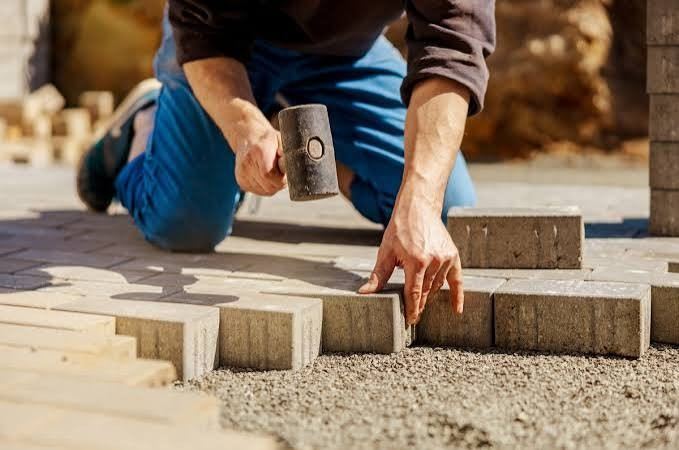
Step 8: Laying the Interlocking Paving Blocks
The paving blocks are placed according to the approved pattern.
Installers should maintain consistent alignment and joint spacing while avoiding disturbance of the prepared bedding layer.
The laying pattern should suit the expected traffic and product specification.
Step 9: Cutting Blocks at Edges and Corners
Some blocks may need to be cut to fit around boundaries, drainage channels, inspection chambers and other structures.
Accurate cutting produces a neat finish and reduces unnecessarily large gaps.
Appropriate cutting equipment and protective measures should be used.
Step 10: Filling the Joints
Suitable jointing material is spread over the surface and worked into the spaces between the blocks.
Proper joint filling is important because it contributes to the stability of the paving system.
The specified joint material should be used rather than assuming that any available sand is suitable.
Step 11: Compaction of the Paved Surface
The completed paving is compacted using appropriate equipment and protective methods in accordance with the manufacturer’s instructions and project specification.
This helps seat the blocks into the bedding layer and supports effective joint filling.
Compaction should not damage the block surfaces.
Step 12: Final Inspection and Cleaning
The completed surface is inspected for:
- Alignment and pattern consistency.
- Uneven or displaced blocks.
- Proper joint filling.
- Surface levels and gradients.
- Edge restraint stability.
- Drainage performance.
- Cracked or damaged units.
The surface is cleaned and any identified defects are corrected before the area is opened for use.
Materials and Equipment Required for Interlocking Paving Installation
A successful paving project requires suitable materials, equipment and competent installation personnel.
Materials
Common materials include:
- Interlocking concrete paving blocks.
- Approved sub-base and base aggregates.
- Suitable bedding material.
- Jointing material.
- Edge restraint components.
- Drainage materials where required.
- Geotextile or other ground separation materials where specified by the design.
Material selection should follow the pavement specification and site conditions.
Equipment
Typical equipment includes:
- Excavation equipment.
- Plate compactors or rollers appropriate to the work.
- Levelling equipment.
- Measuring tapes and setting-out tools.
- String lines and straightedges.
- Wheelbarrows and shovels.
- Block-cutting equipment.
- Protective compaction mats where required.
- Personal protective equipment.
The equipment used should be appropriate for the size and complexity of the project.
Maintenance of Interlocking Paving Blocks
Regular maintenance helps preserve the appearance, stability and functionality of interlocking paved surfaces.
Although these surfaces can be relatively easy to maintain, neglect can lead to weed growth, joint deterioration, staining, settlement and block displacement.
1. Regular Sweeping
Sweep the paved area regularly to remove dust, soil, leaves and other debris.
Removing organic material helps reduce staining and weed development.
2. Periodic Washing
Clean paving blocks using suitable water pressure and cleaning methods.
Avoid excessive pressure or inappropriate chemicals that may damage the surface or remove jointing material.
For stubborn stains, use a cleaning product compatible with the paving material and follow the manufacturer’s guidance.
3. Maintaining Jointing Material
Jointing material can gradually be displaced by cleaning, weather and surface movement.
Inspect the joints periodically and replenish material where required.
Maintaining properly filled joints helps preserve the integrity of the paving system.
4. Removing Weeds
Weeds may grow in joints where organic material and moisture accumulate.
Remove unwanted vegetation promptly and address the source of recurring growth.
Where suitable, use an appropriate weed-control method that will not damage the paving or surrounding landscape.
5. Replacing Damaged Blocks
Cracked, broken or severely damaged blocks should be replaced when necessary.
Before replacing them, inspect the underlying bedding and foundation to determine whether the damage was caused by settlement, poor support or excessive loading.
Simply replacing a block without correcting the underlying problem may result in repeated damage.
6. Monitoring Surface Settlement
Inspect the pavement for depressions, uneven areas and displaced blocks.
Settlement may indicate poor compaction, unsuitable ground conditions, water movement or inadequate base construction.
Affected sections should be lifted, the underlying problem corrected and the blocks reinstated properly.
7. Maintaining Drainage Systems
Keep drainage channels, gullies and outlets clear of debris.
Poor drainage can cause water accumulation, erosion and deterioration of the supporting pavement layers.
Check that water flows towards the intended collection points rather than towards buildings.
8. Managing Heavy Loads
Avoid exposing paving designed for light traffic to vehicles or equipment beyond its intended capacity.
If site operations change, review whether the existing pavement structure remains suitable.
Factors Affecting Interlocking Paving Block Prices in Uganda
The cost of interlocking paving blocks varies according to their specifications, manufacturing quality, quantity, supplier location and transportation requirements.
When budgeting for a project, consider the following factors.
1. Block Type and Shape
Different interlocking designs may have different manufacturing requirements.
Special shapes and decorative designs may cost differently from standard rectangular blocks.
2. Block Thickness and Dimensions
Thicker or larger blocks may require different material quantities and production arrangements.
Select dimensions and thickness according to the pavement design rather than appearance alone.
3. Concrete Quality
Concrete quality, raw material selection, mixing, compaction and curing influence product performance and manufacturing costs.
Very low prices should be evaluated carefully to avoid purchasing products that do not meet project requirements.
4. Colour and Surface Finish
Coloured or textured paving blocks may have different production costs from standard grey units.
Special colour combinations and custom finishes may also influence pricing.
5. Quantity Required
The total number of blocks affects material procurement, production and transportation arrangements.
Large projects should be measured accurately to reduce wastage and unnecessary deliveries.
6. Transportation and Delivery
Delivery charges depend on the distance to the site, road access, order quantity, loading and offloading arrangements.
When comparing suppliers, consider the total delivered price rather than the factory price alone.
7. Installation Costs
The overall project cost includes more than the paving blocks.
Other costs may include:
- Site clearing.
- Excavation.
- Subgrade preparation.
- Base materials.
- Compaction.
- Bedding materials.
- Edge restraints.
- Labour.
- Cutting and finishing.
- Drainage works.
- Equipment hire.
Request a detailed quotation that clearly identifies the materials, labour and site preparation requirements.
Common Interlocking Paving Installation Mistakes to Avoid
Poor installation can lead to pavement movement, settlement, water accumulation and premature deterioration.
The following mistakes should be avoided.
1. Poor Site Preparation
Installing blocks over weak, loose or unsuitable soil can lead to settlement and uneven surfaces.
The subgrade should be properly assessed and prepared before the base is installed.
2. Inadequate Base Compaction
A poorly compacted foundation may move under traffic and cause the paving blocks to sink or become uneven.
Base materials should be placed and compacted according to the project specification.
3. Incorrect Drainage Gradients
Poor surface gradients can cause standing water and damage to the supporting pavement layers.
Drainage should be planned before installation begins.
4. Missing or Weak Edge Restraints
Without effective edge restraints, blocks may spread or become displaced, especially in areas exposed to vehicle movement.
Install suitable restraints around the pavement boundaries.
5. Inconsistent Bedding Layer
Uneven bedding can produce an irregular finished surface.
The bedding material should be evenly prepared over a properly finished base.
6. Incorrect Joint Filling
Insufficient or unsuitable jointing material can reduce the stability of the paving system.
Use the material specified for the selected paving system and maintain properly filled joints.
7. Using Unsuitable Blocks
Blocks designed for pedestrian areas should not automatically be used for heavy vehicle traffic.
Always match product specifications to the intended loading conditions.
8. Poor Installation Workmanship
Incorrect alignment, uneven laying, careless cutting and inadequate compaction can affect the appearance and performance of the completed pavement.
Use competent installers and inspect work at each important stage.
Interlocking Paving Blocks vs Ordinary Concrete Paving Blocks
Although the terms are sometimes used interchangeably, interlocking paving blocks are generally designed with profiles that fit together in a connected arrangement.
Ordinary concrete paving blocks may include units with simpler shapes that do not have the same interlocking geometry.
| Feature | Interlocking paving blocks | Ordinary concrete paving blocks |
|---|---|---|
| Shape | Designed to fit together | May have simple or decorative shapes |
| Installation | Requires a planned interlocking arrangement | Depends on the block type and laying system |
| Movement resistance | Can provide useful resistance when correctly installed | Depends on shape, jointing and pavement construction |
| Applications | Driveways, parking areas, walkways and selected industrial surfaces | Walkways, courtyards, landscaping and other suitable areas |
| Repair | Individual units can often be lifted and replaced | Individual units can often be replaced |
| Design | Available in different profiles and patterns | Available in different shapes and finishes |
The most suitable product depends on the intended application, concrete quality, thickness, pavement design and installation requirements.
How to Choose a Reliable Interlocking Paving Block Supplier in Uganda
Selecting a reliable supplier is important for ensuring that the paving materials meet the project’s requirements.
Before placing an order, consider the following:
- Product specifications: Confirm the dimensions, thickness and intended application of the blocks.
- Manufacturing quality: Ask about the production process, material control, compaction and curing.
- Testing information: Request relevant product test reports where required.
- Consistency: Inspect samples for uniformity in dimensions, shape and finish.
- Availability: Confirm whether sufficient quantities can be supplied for the project.
- Delivery arrangements: Establish delivery schedules, transport charges and offloading responsibilities.
- Pricing: Compare quotations using equivalent specifications.
- Product suitability: Ensure the blocks are appropriate for the expected pedestrian or vehicle traffic.
For large projects, consider inspecting samples or completed installations before approving the product.
Why Professional Planning and Supervision Matter
Interlocking paving projects require coordination between site preparation, material selection, drainage, pavement design and installation.
Professional planning helps establish the correct pavement structure for the intended use. It also supports accurate quantity estimates, cost planning and construction quality control.
This is particularly important for commercial parking areas, industrial compounds, large residential developments and sites exposed to regular vehicle movement.
Daltrev Co. Ltd. supports construction-related project enquiries and planning considerations. Property owners, developers and contractors can explore the company’s construction materials, construction works and consultancy services when planning their projects.
Frequently Asked Questions About Interlocking Paving Blocks
1. What are interlocking paving blocks?
Interlocking paving blocks are precast concrete units designed to fit together in a planned arrangement to create a stable paved surface.
2. What are the main benefits of interlocking paving blocks?
Their main benefits include design flexibility, durability when correctly installed, repairability, practical maintenance and suitability for different residential and commercial applications.
3. Are interlocking paving blocks suitable for driveways?
Yes. They can be used for driveways when the block specifications, thickness, foundation, drainage and installation method are suitable for the expected vehicle loads.
4. How long do interlocking paving blocks last?
Their service life depends on concrete quality, pavement design, ground conditions, installation workmanship, traffic loads, drainage and maintenance. Properly designed and installed paving can provide long-term service.
5. What is the best pattern for interlocking paving blocks?
The herringbone pattern is commonly considered for vehicle areas because it can provide good resistance to relative block movement. Other patterns, such as stretcher bond and basket weave, may be suitable for different applications.
6. How are interlocking paving blocks installed?
Installation generally involves site inspection, setting out, excavation, subgrade preparation, base construction, edge restraint installation, bedding preparation, block laying, joint filling, compaction and final inspection.
7. Do interlocking paving blocks require maintenance?
Yes. Maintenance includes sweeping, cleaning, replenishing jointing material, removing weeds, replacing damaged blocks and checking drainage.
8. Can interlocking paving blocks be used in industrial areas?
They can be used in selected industrial areas when the product specifications and pavement structure are designed for the expected loads and operating conditions. Heavy-duty applications require professional assessment.
9. Why do interlocking paving blocks sink?
Settlement can result from inadequate subgrade preparation, insufficient base compaction, water movement, unsuitable ground conditions or excessive loading.
10. Can individual interlocking paving blocks be replaced?
Yes. Individual blocks can often be lifted and replaced. The underlying cause of damage should be corrected to prevent the problem from recurring.
11. What determines the price of interlocking paving blocks in Uganda?
Prices depend on block dimensions, thickness, design, concrete quality, colour, order quantity, supplier location and delivery costs.
12. Are interlocking paving blocks better than cast-in-place concrete?
Neither option is universally better. Interlocking paving offers individual block replacement and design flexibility, while cast-in-place concrete may be appropriate for continuous slabs and other applications. The right option depends on site conditions, structural requirements, maintenance expectations and budget.
Conclusion
Interlocking paving blocks provide a versatile solution for constructing attractive and functional outdoor surfaces in Uganda. Their different shapes, colours, patterns and specifications make them suitable for residential compounds, driveways, commercial parking areas, walkways, hotels, institutional premises and selected industrial applications.
However, the quality of the finished pavement depends on more than the blocks themselves. Proper site preparation, suitable foundation materials, adequate compaction, drainage, edge restraints, joint filling and regular maintenance are essential for achieving a stable and durable surface.
Before starting your paving project, assess the intended use, compare product specifications, obtain detailed quotations and ensure that the installation follows an appropriate pavement design.
For construction-related enquiries and project support, visit Daltrev Co. Ltd. and explore its construction materials, construction works and consultancy services.
Choose suitable paving materials, plan the installation carefully and maintain your paved surface to achieve lasting value.