
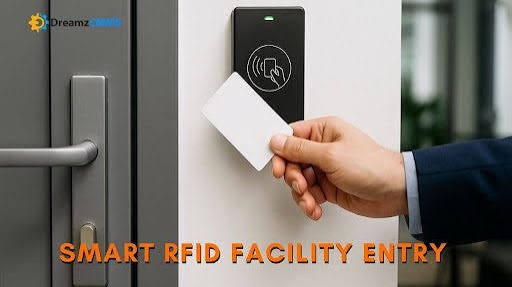
Controlling who enters and leaves a building is an important part of protecting people, property, equipment and confidential information. Traditional keys can be lost, copied or shared, making it difficult for property owners and facility managers to maintain effective access control. Modern RFID access control systems provide a more flexible way to manage entry into offices, commercial buildings, hotels, schools, warehouses, factories and residential properties.
RFID (Radio Frequency Identification) technology allows authorised users to access secured areas using credentials such as proximity cards, key fobs or compatible mobile devices. Instead of relying on conventional keys, the system uses radio-frequency communication to identify a credential and determine whether access should be granted or denied.
In Uganda, RFID access control systems are increasingly relevant to businesses, institutions, property developers and organisations seeking better control over their premises. They can help manage employee access, restrict entry into sensitive areas, monitor access activity and integrate with other electronic security systems.
This guide explains how RFID access control systems work, their main components, where they are used, their benefits, installation requirements and important considerations when choosing a system for your property.
What Is an RFID Access Control System?
An RFID access control system is an electronic security solution that uses radio-frequency identification technology to control access through doors, gates, turnstiles and other secured entry points.
The system identifies an authorised RFID credential when it is presented near a compatible reader. The reader communicates with an access control panel or controller, which checks the credential against stored permissions. If the credential is authorised, the controller activates an electronic locking mechanism to allow entry.
RFID credentials commonly include:
- Proximity cards: Cards presented near a reader to request access.
- RFID key fobs: Small electronic credentials attached to key rings.
- Smart cards: Cards that may support more advanced authentication and security functions.
- Mobile credentials: Compatible smartphones or devices that communicate with supported access readers.
Unlike traditional locks, which generally rely on physical keys, RFID systems allow administrators to manage access permissions electronically. A lost card can often be deactivated without replacing the entire locking system.
How Do RFID Access Control Systems Work?
RFID access control systems operate through communication between an RFID credential, a reader, an access controller and an electronic locking device.
The process usually follows these steps:
1. An authorised user receives an RFID credential
Each authorised employee, tenant, visitor or other user is assigned a compatible RFID card, key fob or supported mobile credential.
The credential contains identification information or secure authentication capabilities that allow the system to recognise it.
2. The user presents the credential to the reader
When the user approaches a secured entrance, they hold their card or key fob close to the RFID reader.
The reader generates a radio-frequency field or communicates with the credential using the technology supported by the system. The credential responds with the information required for identification or authentication.
3. The reader communicates with the access controller
The reader sends the credential information to the access control panel or controller.
Depending on the system design, the reader may communicate using technologies and protocols such as Wiegand or OSDP. The controller then evaluates the credential and the permissions assigned to it.
4. The system verifies access permissions
The controller checks whether the credential is authorised to enter the specific door or restricted area.
Access permissions can be configured according to factors such as:
- User identity or assigned credential.
- Approved doors and access points.
- Working hours and permitted entry schedules.
- User groups and departments.
- Temporary or permanent access rights.
- Security restrictions for sensitive areas.
For example, an employee may be authorised to enter the main office and their department but restricted from accessing a server room or records storage area.
5. The electronic lock releases
If the credential is valid and the user has permission, the controller activates the locking mechanism.
Depending on the door design, this may involve an electromagnetic lock, electric strike or compatible electronic lock.
If the credential is invalid or lacks permission, the door remains secured and access is denied.
6. The system records the access event
Many RFID access control systems maintain electronic records of access activity.
Depending on the configuration, these records may include the credential used, the access point, the date, the time and whether entry was granted or denied.
These records help authorised administrators review access activity, investigate incidents and manage security procedures. However, an access log records the use of a credential; it does not necessarily prove which person physically presented it.
Main Components of an RFID Access Control System
An effective RFID access control installation requires several components working together. The exact equipment depends on the number of doors, security requirements and the type of building.
1. RFID cards and key fobs
<text> </text>
These are the credentials issued to authorised users. Each credential must be compatible with the installed reader and access control platform.
Cards and key fobs can be assigned individual permissions, making it possible to manage access for employees, tenants, contractors and visitors.
2. RFID card readers
RFID readers are installed near controlled entrances. They detect and communicate with compatible credentials.
Readers may be designed for indoor or outdoor use, depending on their enclosure rating and environmental requirements.
3. Access control panel
The access control panel or controller processes access requests and applies the configured permissions.
It acts as the decision-making component of the system, determining whether a credential should be granted access to a particular entrance.
4. Electronic door locks
Electronic locking devices secure the controlled entrance until an authorised access request is received.
Common options include:
- Electromagnetic locks.
- Electric strikes.
- Electronic mortise locks.
- Compatible electronic cabinet and gate locks.
The correct lock depends on the door construction, security requirements, escape routes and applicable fire and life-safety requirements.
5. Exit buttons and door sensors
Exit buttons allow people to leave controlled areas where the door design requires an electronic release mechanism.
Door position sensors can report whether a door is open or closed. Some systems can also identify events such as a door being held open or forced open.
Emergency exit arrangements must remain compliant with applicable fire and life-safety requirements. Access control must never prevent safe evacuation.
6. Power supply and backup
RFID readers, controllers and electronic locks require suitable power supplies.
Backup power, such as batteries or an appropriately designed UPS, can help maintain system operation during electricity interruptions. The required backup capacity depends on the equipment and the expected operating period.
7. Access management software
Access management software allows authorised administrators to register users, assign credentials, configure access schedules, manage doors and review activity reports.
Larger installations may use centralised software to manage multiple buildings or access points from one location.
Types of RFID Access Control Technology
Not all RFID access control systems use the same technology. Understanding the differences helps property owners choose compatible and appropriate equipment.
Low-frequency RFID systems
Low-frequency RFID systems commonly operate at 125 kHz.
They are widely associated with basic proximity access cards and key fobs. These systems can be suitable for straightforward entry control, but older implementations may use static identification data that is vulnerable to copying or emulation.
They should not automatically be considered suitable for high-security applications.
High-frequency RFID systems
High-frequency RFID commonly operates at 13.56 MHz.
This category includes several technologies used in contactless cards and smart credentials. Depending on the card and reader, these systems can support more advanced authentication and security features.
For example, some smart-card technologies use cryptographic authentication rather than relying only on a basic card identifier.
The actual security level depends on the credential, reader, controller, system configuration and how cryptographic keys are managed.
NFC-enabled access systems
Near Field Communication (NFC) is closely related to high-frequency RFID technology.
Some access control systems support compatible NFC-enabled smartphones or credentials, allowing users to unlock authorised doors using their mobile devices.
However, NFC compatibility should not be assumed for every RFID reader. The reader, credential platform, smartphone and access management software must support the same technology.
Active RFID systems
Active RFID credentials use an internal power source to transmit signals.
They can support applications requiring longer detection ranges, depending on the system design. However, they are not the typical choice for ordinary close-range office door access.
Where Are RFID Access Control Systems Used?
RFID technology can be applied in different environments where entry needs to be restricted, monitored or managed electronically.
1. Offices and corporate buildings
<text> </text>
Offices use RFID access control to manage employee entry and restrict access to sensitive areas.
A system can be configured to allow employees into designated departments while limiting access to executive offices, server rooms, financial records areas and other restricted spaces.
It can also support employee access management when staff join, change roles or leave an organisation.
2. Hotels and hospitality facilities
Hotels, lodges and resorts can use compatible RFID-based electronic locking systems to manage guest access to rooms and selected facilities.
RFID credentials may also be used for authorised staff access to housekeeping areas, stores, offices and other operational spaces.
Hotel systems must be selected carefully to ensure compatibility with property management software and the required guest access workflow.
3. Schools, colleges and universities
Educational institutions can use RFID access control to manage entry into administrative offices, laboratories, computer rooms, libraries, staff areas and other restricted facilities.
Access permissions can be assigned to authorised staff, students and visitors according to institutional requirements.
Security planning should also consider safeguarding, visitor management and emergency evacuation.
4. Hospitals and healthcare facilities
Hospitals require effective control over areas containing medical equipment, medicines, patient records and specialised facilities.
RFID access control can help restrict entry into authorised departments, laboratories, pharmacies, records rooms and equipment storage areas.
Healthcare installations must balance security with patient access, emergency response and privacy. Access logs and associated personal information should be protected appropriately.
5. Warehouses and storage facilities
Warehouses use electronic access control to restrict entry into inventory areas, loading zones, stores and high-value goods storage facilities.
RFID credentials can help facility managers assign access permissions to employees, supervisors, contractors and authorised visitors.
When integrated with other security measures, access control can contribute to a more organised warehouse security strategy.
6. Factories and industrial facilities
Manufacturing facilities often contain expensive machinery, restricted production areas, hazardous environments and confidential operational information.
RFID access control can help manage entry into:
- Production departments.
- Machinery control rooms.
- Electrical rooms.
- Maintenance workshops.
- Raw material stores.
- Finished goods warehouses.
- Restricted management offices.
Industrial systems should be selected with consideration for dust, moisture, temperature, vibration and the operating environment.
7. Apartments and residential estates
Apartment buildings and gated residential estates can use RFID cards or key fobs to control access through selected entrances.
Applications may include:
- Main building entrances.
- Parking access points.
- Pedestrian gates.
- Shared recreational facilities.
- Management offices.
- Restricted utility rooms.
Property managers can issue credentials to residents and authorised personnel and deactivate credentials when access is no longer required.
8. Shopping malls and commercial centres
Shopping malls and commercial properties may use RFID access control to manage staff-only entrances, management offices, security rooms, maintenance areas and restricted service corridors.
The technology can help separate public areas from operational spaces that should only be accessed by authorised personnel.
9. Banks and financial institutions
Banks and financial institutions require carefully designed access control because they handle valuable assets, confidential information and sensitive operations.
RFID systems can support controlled entry into staff areas, records rooms, equipment rooms and selected restricted departments.
They should form part of a broader security strategy that may include CCTV, alarms, visitor management and additional authentication for high-risk areas.
10. Data centres and server rooms
Data centres and server rooms require strong access restrictions because unauthorised entry can expose critical infrastructure and confidential information.
RFID access control can be used as one layer of security, with more advanced systems combining smart credentials, PIN verification, biometrics, CCTV monitoring and detailed access logging.
For sensitive environments, basic proximity cards alone may not provide sufficient protection.
Benefits of RFID Access Control Systems
RFID access control offers several practical advantages over conventional key-based entry systems.
Improved access management
Administrators can assign permissions to individual users, departments or groups. This makes it easier to control who can enter specific areas.
Reduced dependence on physical keys
Users can access authorised doors with compatible cards or key fobs rather than carrying several conventional keys.
Easier credential cancellation
When a card or key fob is lost, stolen or no longer required, an administrator can deactivate it through the access management system, provided the installation supports credential management.
This reduces the need to replace physical locks whenever a key is misplaced.
Flexible access schedules
Access permissions can be configured according to working hours, shifts, departments and other operational requirements.
For example, a contractor may receive temporary access to a maintenance area during an approved period.
Access activity records
Configured systems can maintain records of access attempts and events. These records can support security reviews, internal investigations and operational management.
Scalability
RFID access control can be designed for a single door or multiple entry points across a larger property.
A properly selected platform can allow additional readers and controlled doors to be added as requirements grow, subject to system capacity and compatibility.
Integration with other security systems
RFID access control can be integrated with compatible CCTV, alarm systems, visitor management platforms, intercoms and building management solutions.
Integration can improve coordination between different security functions, although compatibility must be confirmed before equipment is selected.
RFID Access Control vs Traditional Key Locks
| Feature | RFID access control | Traditional key locks |
|---|---|---|
| Entry method | Card, key fob or supported mobile credential | Physical key |
| Access permissions | Can be assigned electronically | Usually controlled by key distribution |
| Lost credential | Can often be deactivated | May require lock replacement or rekeying |
| Access records | Available on suitably configured systems | Not normally available |
| Scheduled access | Supported by many systems | Not normally supported |
| Multiple doors | Can be centrally managed on compatible platforms | Each lock is generally managed separately |
| Power requirements | Electronic components require power | Mechanical locks generally do not |
| Initial installation | Usually more complex | Usually simpler |
RFID systems offer more flexible access administration, while traditional locks may be appropriate for doors that do not require electronic monitoring or centralised permissions.
The right choice depends on the building’s security requirements, budget, infrastructure and operational needs.
RFID vs NFC vs Biometric Access Control
These technologies are related to electronic access management, but they serve different purposes.
| Technology | How it works | Common applications |
|---|---|---|
| RFID | Uses radio-frequency communication with compatible credentials | Offices, apartments, warehouses and commercial buildings |
| NFC | Uses short-range communication between compatible devices | Smartphone credentials and selected card-based access systems |
| Biometrics | Uses physical or behavioural characteristics for identity verification | High-security offices, restricted departments and controlled facilities |
Some modern access control systems combine two or more technologies.
For example, a facility may require an RFID smart card and a PIN before granting access to a restricted room. Another installation may use a mobile credential with biometric verification on a supported device.
The appropriate configuration depends on the level of security required and the privacy implications of the information being processed.
Important Security Considerations When Choosing RFID Systems
Although RFID access control improves access management, the technology must be selected and configured properly.
Choose secure credentials
Older RFID systems may rely on static card identifiers that can be copied or emulated.
For sensitive applications, consider credentials that support stronger cryptographic authentication. Ask the supplier about the exact card technology, reader compatibility and security capabilities rather than choosing a system based only on the word RFID.
Protect communication between system components
The communication between readers, controllers and management platforms should be appropriate for the security requirements.
Where supported, secure reader-to-controller communication, such as OSDP Secure Channel, can offer advantages over older or less protected arrangements.
Establish procedures for lost cards
Organisations should have a clear process for reporting lost or stolen credentials and disabling them promptly.
Restrict administrator access
Access management software should use strong administrator passwords, appropriate user permissions and secure configuration practices.
Maintain emergency exit arrangements
Electronic security must not compromise safe evacuation. Door locks, exit buttons, emergency releases and fire alarm interfaces must be designed according to the applicable life-safety requirements.
Protect access records and personal information
Access records may contain personal information. Organisations should limit access to these records, establish appropriate retention periods and comply with Uganda’s Data Protection and Privacy Act, 2019, where applicable.
Biometric information, if added to an access control system, requires particular attention because it is sensitive personal data.
RFID Access Control System Installation in Uganda
Installing an RFID access control system requires proper planning, equipment selection, electrical work, configuration and testing.
The installation process should be based on the building layout and the security requirements of the property.
Step 1: Assess the property
The first step is to identify the entrances, doors, gates and restricted areas that require electronic access control.
The assessment should consider the number of users, entry points, operating hours, door construction and expected security level.
Step 2: Determine the access requirements
The property owner or facility manager should establish who needs access and which areas each user group should be permitted to enter.
For example, office employees may require access to general workspaces, while management and IT personnel may need additional permissions.
Step 3: Select compatible RFID equipment
The system designer should select readers, cards, controllers, locks, power supplies and management software that work together.
Compatibility is particularly important when selecting RFID frequencies, credential technologies and electronic locking devices.
Step 4: Prepare doors and electrical infrastructure
The installation team prepares the required mounting points, cable routes, power connections and door hardware.
Door modifications should be carried out carefully to maintain the door’s operation, security and emergency exit functionality.
Step 5: Install readers and electronic locks
RFID readers are installed near the controlled entrances, while compatible locking devices are fitted to the doors or gates.
Controllers, power supplies, exit devices and door sensors are also installed according to the system design.
Step 6: Configure users and access permissions
The access management platform is configured, and authorised users are registered.
Cards and key fobs are assigned to users, while permissions are set according to their roles and access requirements.
Step 7: Test the complete system
Testing should confirm that authorised credentials work correctly, unauthorised credentials are rejected and access records are generated as expected.
The installation team should also test door sensors, exit devices, backup power and emergency release arrangements.
Step 8: Train administrators and hand over the system
Property managers or designated administrators should understand how to register users, issue credentials, change permissions, deactivate lost cards and review access records.
Proper handover helps ensure the system remains useful after installation.
How Much Does RFID Access Control Installation Cost in Uganda?
The cost of installing an RFID access control system in Uganda depends on the size and complexity of the project. There is no single price that applies to every building.
A basic single-door installation will generally have different requirements from a multi-door system serving a hotel, office complex, hospital or industrial facility.
Important cost factors include:
1. Number of controlled doors: Each additional access point may require a reader, locking device, controller capacity, cabling and other accessories.
2. Type of RFID technology: Basic proximity systems and more advanced smart-card solutions have different equipment and security requirements.
3. Electronic locking devices: The cost depends on whether the installation requires electromagnetic locks, electric strikes, electronic mortise locks or specialised gate locks.
4. Building structure: Existing doors, frames, walls and cable routes can affect installation labour and materials.
5. Access management software: Some systems require additional software, licensing, user capacity or centralised management features.
6. Integration requirements: Connecting access control with CCTV, alarms, intercoms or other platforms can increase project complexity.
7. Backup power: Battery backup and UPS requirements depend on the number of devices and the expected operating period.
8. Installation and configuration: Labour, programming, testing, administrator training and commissioning contribute to the total project cost.
For an accurate quotation, property owners should arrange a site assessment and define the number of doors, users, security requirements and integration needs before selecting equipment.
Common RFID Access Control Problems and Their Solutions
Like other electronic security systems, RFID installations can experience technical problems if equipment is poorly configured, damaged or inadequately maintained.
RFID card is not detected
Possible causes include an incompatible card, damaged credential, faulty reader or incorrect card configuration.
Solution: Test the card against a compatible reader, verify credential settings and inspect the reader’s power and connections.
The reader detects the card but the door does not open
This may be caused by an access permission problem, controller configuration issue, wiring fault or malfunctioning electronic lock.
Solution: Check the access permissions, controller status, lock power supply and connection between the controller and locking device.
The system works intermittently
Unstable power, damaged cables, electrical interference or faulty equipment may cause inconsistent operation.
Solution: Inspect the power supply, cable connections and installation environment. Use suitable power protection where required.
Lost or stolen RFID cards
A lost credential may create a security risk if it remains active.
Solution: Deactivate the credential promptly, review relevant access records and issue a replacement card.
Access records are missing
Incorrect system configuration, communication problems or software issues may affect event recording.
Solution: Check controller communication, time settings, software configuration and data storage.
Electronic locks fail to release during an emergency
This is a serious life-safety concern that may result from incorrect lock selection, poor wiring or improper emergency release configuration.
Solution: Have the system inspected and corrected by a qualified professional. Emergency egress and fire alarm interfaces must be tested as part of commissioning and maintenance.
How to Choose the Best RFID Access Control System for Your Property
Before purchasing an RFID access control system, consider the following factors:
- Building type: Identify whether the system is intended for an office, hotel, school, hospital, warehouse, factory or residential property.
- Number of entry points: Determine how many doors, gates and restricted areas require access control.
- Credential security: Understand whether the system uses basic proximity identifiers or more secure smart-card authentication.
- User capacity: Select a platform that can accommodate current users and anticipated future growth.
- Access management: Consider whether you need time-based permissions, centralised administration and detailed reporting.
- Integration: Confirm compatibility with existing CCTV, alarms, intercoms and other security equipment.
- Power backup: Establish how the system will operate during electricity interruptions.
- Maintenance support: Choose equipment that can be maintained and supported over its expected service life.
- Emergency safety: Confirm that the locking arrangement supports safe evacuation and complies with applicable requirements.
- Data protection: Establish how user details and access records will be collected, stored, accessed and retained.
A professional assessment can help prevent compatibility problems, unnecessary costs and security weaknesses.
Why Professional RFID Access Control Installation Matters
An RFID access control system is only effective when its components are correctly selected, installed and configured.
Poor installation can result in unreliable card detection, doors that fail to lock properly, weak credential security, inaccurate access records and problems during power interruptions.
Professional installation helps ensure that readers, controllers, electronic locks, exit devices and power supplies operate as a coordinated system.
It also helps ensure that the system is appropriate for the building’s access requirements, security objectives and emergency procedures.
For property owners, developers and organisations in Uganda, working with an experienced security systems provider can make it easier to plan an installation that meets current needs while allowing for future expansion.
RFID Access Control Systems from Daltrevco
Daltrevco recognises the importance of effective building security and reliable access management for modern properties.
Whether you are planning security improvements for an office, commercial building, hotel, school, warehouse, industrial facility or residential development, choosing the right access control solution begins with understanding the property’s layout, users and security requirements.
An appropriately designed RFID access control system can help manage entry permissions, reduce dependence on conventional keys and provide better visibility into access activity.
Contact Daltrevco to discuss your building security requirements and the appropriate access control solutions for your project in Uganda.
Frequently Asked Questions About RFID Access Control Systems
1. What is an RFID access control system?
An RFID access control system is an electronic security solution that uses radio-frequency identification technology to control entry into secured areas. Users present compatible cards, key fobs or mobile credentials to a reader, which communicates with an access controller to determine whether entry should be allowed.
2. How does RFID door access control work?
An RFID reader detects a compatible credential and sends the required identification or authentication information to an access controller. The controller checks the user’s permissions and activates the electronic lock if access is authorised.
3. What is an RFID access card?
An RFID access card is an electronic credential that communicates with a compatible reader using radio-frequency technology. It allows authorised users to request entry without inserting a conventional key into a lock.
4. What is the difference between RFID cards and RFID key fobs?
Both can be used as electronic access credentials. RFID cards are usually flat cards, while key fobs are smaller devices designed to attach to key rings. Their functionality depends on the credential technology and reader compatibility.
5. Where are RFID access control systems used?
They are used in offices, hotels, schools, hospitals, warehouses, factories, shopping malls, apartment buildings, banks, data centres and other facilities requiring controlled entry.
6. Are RFID access control systems secure?
They can provide effective access management when properly designed and configured. Security depends on credential technology, authentication methods, communication protection, controller security and administrative procedures. Older systems that rely on static identifiers may be vulnerable to copying.
7. Can RFID access cards be duplicated?
Some older or poorly secured RFID credentials may be copied or emulated. More advanced smart-card technologies can support stronger cryptographic authentication. The security of a system depends on the specific technology and implementation.
8. What happens when an RFID access card is lost?
An administrator can usually deactivate the lost credential through the access management software. A replacement credential can then be registered and assigned the required permissions.
9. Can RFID access control work without internet?
Many systems can perform local access control without a continuous internet connection. However, remote administration, cloud-based management and certain integrations may require network connectivity.
10. Can RFID access control work during a power outage?
The system’s ability to operate during an outage depends on its backup power arrangement. Batteries or UPS equipment can provide temporary power when properly sized and maintained.
11. Can RFID access control be integrated with CCTV?
Yes. Compatible access control and CCTV platforms can be integrated to help security personnel associate access events with relevant camera footage. Compatibility and configuration should be confirmed before installation.
12. Can RFID access control be used in hotels?
Yes. Compatible RFID-based electronic locking systems can manage guest room access and selected staff-only areas. The equipment should be compatible with the hotel’s operational and property management requirements.
13. Is RFID better than traditional key locks?
RFID can offer more flexible access permissions, easier credential cancellation and electronic access records. Traditional locks may be simpler and more appropriate for doors that do not require centralised access management.
14. What is the difference between RFID and NFC access control?
RFID is a broad family of radio-frequency identification technologies. NFC is a related short-range communication technology commonly used in compatible smartphones and contactless credentials. Not every RFID reader supports NFC.
15. Can RFID access control be used for apartment buildings?
Yes. It can control entry through main doors, pedestrian gates, parking entrances and shared facilities. Residents and authorised staff can be assigned individual credentials.
16. Does RFID access control record who enters a building?
A configured system can record the credential used, access point, time and access result. However, the record does not necessarily establish the identity of the person physically using the credential, since credentials may be shared or stolen.
17. How many doors can an RFID access control system manage?
This depends on the controller, software, network architecture and system capacity. Some platforms support a single door, while larger systems can manage multiple buildings and many controlled access points.
18. Does RFID access control require regular maintenance?
Yes. Maintenance may include inspecting readers, locks, cables, power supplies, backup batteries, software, door sensors and emergency release devices. Regular testing helps maintain reliable operation.
19. How much does RFID access control installation cost in Uganda?
The cost depends on the number of controlled doors, type of RFID technology, electronic locks, building structure, software, integration requirements and installation work. A site assessment is recommended for an accurate quotation.
20. Who should install an RFID access control system?
A competent security systems installer should assess the property, select compatible equipment, install the electronic components, configure access permissions and test the complete system, including emergency exit arrangements.
Conclusion
RFID access control systems provide a flexible way to manage entry into modern buildings and restricted facilities. By using compatible cards, key fobs or mobile credentials, organisations can control access permissions, reduce dependence on physical keys and maintain electronic records of access activity.
From offices and hotels to hospitals, warehouses, factories and residential estates, RFID technology can support different security requirements when the system is properly selected and installed.
For property owners and businesses in Uganda, the most important step is choosing an access control solution that matches the building layout, security needs, user requirements and future expansion plans.
Contact Daltrevco to discuss suitable access control solutions for your property and plan a reliable approach to managing building security.

