
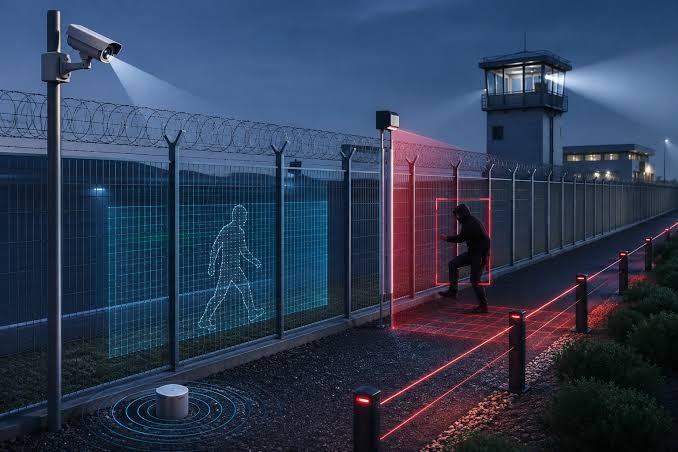
Industrial and commercial facilities face security risks that extend beyond their buildings. Factories, warehouses, distribution centres, office complexes, shopping centres and other large properties often have extensive boundaries, multiple access points, outdoor storage areas and valuable assets that require continuous protection.
A security breach can begin long before an intruder reaches a building. Someone may attempt to climb a perimeter fence, cut through a boundary, enter through an unsecured gate or move through an exposed outdoor area. Without effective perimeter monitoring, security personnel may only become aware of an intrusion after the individual has already entered the property.
This is why perimeter intrusion detection systems are an important part of modern industrial and commercial security.
A perimeter intrusion detection system identifies suspicious activity along or around a property’s boundary and sends an alert to a security control point. Depending on the technology, it can detect fence climbing, cutting, movement across restricted zones, opening of gates and other potential intrusion activities.
For businesses and industrial property owners in Uganda, perimeter intrusion detection can strengthen security around factories, warehouses, commercial buildings, logistics facilities, construction sites and large estates.
This guide explains how perimeter intrusion detection systems work, the technologies available, their benefits, installation requirements, integration with CCTV and alarm systems, and the factors that influence installation costs in Uganda.
What Is a Perimeter Intrusion Detection System?
A perimeter intrusion detection system is a security solution designed to identify unauthorised activity around the boundary of a property before intruders gain access to protected buildings or operational areas.
It uses sensors, detection devices, monitoring equipment and alarm technology to identify suspicious activity along a fence, wall, gate, outdoor boundary or designated restricted zone.
When a potential intrusion is detected, the system communicates an alert to an alarm control panel, monitoring station or security management platform.
Depending on the installation, the alert may activate a siren, display the affected zone, trigger CCTV recording or notify authorised security personnel.
Perimeter intrusion detection systems are commonly used in:
- Manufacturing plants and factories.
- Warehouses and distribution centres.
- Industrial parks.
- Commercial office complexes.
- Shopping centres.
- Logistics and transport facilities.
- Construction sites.
- Fuel and energy facilities.
- Agricultural processing facilities.
- Large residential and commercial estates.
- Institutional compounds.
Unlike security devices that primarily protect building interiors, perimeter intrusion detection focuses on identifying threats at the property’s outer boundary and other designated external areas.
How Do Perimeter Intrusion Detection Systems Work?
Although different technologies use different detection methods, most perimeter intrusion detection systems follow a similar operating process.
1. Establishing the Protected Perimeter
The first step involves identifying the areas that need monitoring.
These may include boundary fences, walls, gates, vehicle entrances, pedestrian access points and exposed outdoor sections.
The property’s layout determines where sensors and detection devices should be installed.
2. Monitoring for Suspicious Activity
Sensors are positioned along the protected boundary or within designated outdoor detection zones.
Depending on the technology, they may monitor:
- Fence vibration.
- Physical disturbance.
- Infrared beam interruption.
- Movement within a defined detection area.
- Changes in microwave signals.
- Opening of monitored gates.
- Attempts to cut, climb or interfere with selected perimeter structures.
3. Identifying a Potential Intrusion
When a sensor detects activity that meets its programmed criteria, it sends a signal to the connected control equipment.
Modern systems may use signal processing and adjustable detection thresholds to distinguish potential intrusion events from ordinary environmental activity.
The reliability of detection depends on the selected technology, installation quality, environmental conditions and configuration.
4. Activating an Alarm
The control panel processes the signal and initiates the programmed response.
This may include:
- Activating an outdoor or indoor siren.
- Displaying the affected perimeter zone.
- Sending an alert to authorised users.
- Notifying a monitoring station where a monitoring service is in place.
- Triggering a compatible CCTV camera to record the relevant area.
5. Security Personnel Respond to the Alert
Security personnel can investigate the affected area using CCTV footage, on-site patrols or other available security procedures.
The objective is to identify and assess a possible intrusion before it develops into a more serious security incident.
Types of Perimeter Intrusion Detection Systems
There are several perimeter detection technologies available for industrial and commercial applications. Each has different strengths, limitations and installation requirements.
The best option depends on the property’s size, boundary design, operating environment and security objectives.
1. Fence-Mounted Intrusion Detection Systems
Fence-mounted detection systems are installed directly onto or along suitable perimeter fences.
They identify disturbances associated with activities such as climbing, cutting or tampering with the fence.
Depending on the system, detection may use vibration sensors, specialised cables or other technologies designed to monitor physical disturbance.
Key benefits include:
- Monitoring of long fence boundaries.
- Detection of certain attempts to climb or interfere with a fence.
- Identification of the affected detection zone.
- Integration with compatible alarm and CCTV systems.
- Suitability for selected industrial and commercial compounds.
Fence-mounted systems are commonly considered for factories, warehouses, logistics facilities and large secured properties.
However, fence movement caused by wind, loose fittings, vegetation or nearby activity must be considered during system design to minimise unwanted alarms.
2. Infrared Beam Perimeter Detection Systems
Infrared beam systems use transmitter and receiver units to establish one or more detection beams across a protected area.
When an object interrupts the beam, the system registers a detection event.
Depending on the design, systems may use multiple beams or additional processing to reduce unwanted activations.
Advantages include:
- Clearly defined detection zones.
- Protection across selected outdoor pathways and boundaries.
- Suitability for certain gates and restricted access routes.
- Integration with alarm systems.
- Useful for monitoring narrow external areas.
Infrared beams are often installed around industrial compounds, outdoor storage areas, commercial properties and selected access routes.
Their performance can be affected by poor alignment, vegetation, environmental conditions, obstacles and unsuitable installation positions.
3. Microwave Perimeter Detection Systems
Microwave perimeter systems use electromagnetic signals to monitor a defined detection area.
Some systems use transmitter and receiver arrangements, while others use different configurations to monitor movement within a protected zone.
When movement changes the received signal in a way that meets the system’s detection criteria, an alarm event may be generated.
Advantages include:
- Monitoring of selected outdoor detection zones.
- Suitability for certain long or open boundaries.
- Potential integration with alarm and surveillance systems.
- Application in selected industrial environments.
Microwave detection requires careful consideration of the detection area. Nearby moving objects, vegetation, reflective surfaces and environmental conditions can influence performance depending on the equipment.
4. Buried Perimeter Intrusion Detection Systems
Buried perimeter detection systems use specialised sensors installed underground along a protected boundary or access route.
Depending on the technology, they may identify disturbances associated with footsteps, digging or movement above the monitored area.
Advantages include:
- Concealed installation.
- No visible detection equipment along the protected section.
- Potential use in selected high-security applications.
- Monitoring of designated outdoor zones.
Buried systems may be considered for industrial compounds, sensitive facilities and selected large properties where visible fence-mounted equipment is unsuitable.
Their installation requires careful planning around soil conditions, drainage, underground services, landscaping and vehicle movement.
5. Fibre-Optic Perimeter Detection Systems
Fibre-optic perimeter detection systems use specialised optical sensing cables to identify physical disturbances along a protected route.
Depending on the technology, the system can analyse changes in optical signals caused by vibration, movement or interference with the cable.
Advantages include:
- Potential monitoring of long perimeter sections.
- Detection of certain fence or boundary disturbances.
- Reduced dependence on electrical sensing cables along the monitored section in some designs.
- Ability to divide a perimeter into identifiable zones, depending on the system.
Fibre-optic systems are useful in selected industrial and infrastructure applications where long boundaries require specialised monitoring.
6. Outdoor Motion Detection Systems
Outdoor motion detectors monitor movement within a defined external area.
Depending on the equipment, they may use passive infrared, microwave or dual-technology detection.
They can be installed around:
- Building entrances.
- Loading bays.
- External storage areas.
- Restricted outdoor zones.
- Parking areas.
- Equipment compounds.
Outdoor motion detectors are useful as part of a layered perimeter security strategy, although they should not automatically be treated as complete boundary protection.
Correct placement and environmental suitability are essential because animals, vegetation, sunlight, temperature changes and other outdoor conditions can contribute to unwanted alarms.
7. Electric Fence Security Systems
Electric fencing is another perimeter security technology commonly used to protect industrial, commercial and residential properties.
An electric fence uses energised conductors and a suitable energiser to deliver controlled electrical pulses.
Modern security electric fence systems may also monitor conditions such as voltage changes, wire cutting or tampering and communicate alarm events to a compatible control unit.
Benefits include:
- Physical and psychological deterrence.
- Monitoring of certain fence interference events.
- Integration with compatible alarm equipment.
- Suitability for selected long property boundaries.
Electric fencing should be designed, installed and maintained according to applicable safety requirements and equipment instructions. It should not compromise safe access or emergency arrangements.
Comparing the Main Perimeter Detection Technologies
| Technology | Main detection method | Common applications |
|---|---|---|
| Fence-mounted sensors | Fence vibration or disturbance | Industrial fences and secured compounds |
| Infrared beams | Interruption of detection beams | Gates and open boundary sections |
| Microwave systems | Changes in electromagnetic signals | Selected outdoor detection zones |
| Buried sensors | Ground disturbance or movement | Concealed perimeter monitoring |
| Fibre-optic systems | Changes in optical signals | Long or specialised boundaries |
| Outdoor motion detectors | Movement within a defined zone | External building areas |
| Electric fence monitoring | Fence interference and electrical condition changes | Secured property boundaries |
Not every technology is suitable for every property. Some facilities benefit from combining different detection methods to address weaknesses in individual technologies.
Benefits of Perimeter Intrusion Detection Systems for Industrial and Commercial Facilities
Industrial and commercial properties often have large outdoor areas that cannot be protected effectively using indoor security equipment alone.
Perimeter intrusion detection helps extend security monitoring to these vulnerable areas.
1. Early Detection of Potential Intrusions
One of the most important benefits is the ability to identify suspicious activity at the property’s boundary.
For example, a fence-mounted sensor may detect an attempt to interfere with a fence before an intruder reaches a warehouse or factory building.
Early detection gives security personnel an opportunity to investigate the affected area.
2. Protection of Valuable Industrial Assets
Factories and industrial facilities may contain expensive machinery, production equipment, electrical installations, raw materials and finished goods.
A perimeter detection system helps monitor external access routes that could be used to reach these assets.
3. Improved Warehouse Security
Warehouses often store goods worth substantial amounts and may have loading bays, multiple entrances and large boundary fences.
Perimeter detection can help protect:
- External storage yards.
- Loading and unloading areas.
- Warehouse boundaries.
- Vehicle access points.
- Equipment storage areas.
- Restricted operational zones.
4. Better Security for Commercial Complexes
Shopping centres, office parks and commercial developments often have several pedestrian entrances, vehicle entrances and outdoor areas.
Perimeter detection can help security teams monitor designated boundaries and vulnerable sections.
5. Reduced Reliance on Physical Patrols Alone
Security guards remain important, but continuously patrolling every part of a large facility can be challenging.
Perimeter detection systems provide electronic monitoring that can alert security personnel when suspicious activity occurs.
They support security patrols rather than replace them.
6. Integration with CCTV Surveillance
When integrated with compatible CCTV equipment, perimeter alarm events can help security teams identify where to direct their attention.
For example, a detection event in a particular fence zone may be associated with a nearby camera view.
This can make it easier to investigate incidents and review recorded footage.
7. Improved Security Management
Modern perimeter systems may provide event logs, zone identification and alarm history.
These features can help facility managers and security teams review incidents, identify recurring problem areas and improve security procedures.
8. Protection Beyond Building Entrances
Traditional access control and magnetic door sensors primarily monitor doors, gates and other controlled openings.
Perimeter intrusion detection can extend monitoring to the wider property boundary, including fence lines, open external areas and selected restricted zones.
Applications of Perimeter Intrusion Detection Systems in Uganda
Different facilities have different security requirements. The system should be selected according to the assets being protected, the property’s physical layout and the nature of potential threats.
1. Manufacturing Plants and Factories
Factories may have large compounds containing production buildings, machinery, raw materials, electrical equipment and outdoor storage facilities.
Perimeter intrusion detection can monitor boundary fences, gates and selected external areas.
For industrial environments, sensor selection should account for machinery vibration, dust, weather exposure and vehicle movement.
2. Warehouses and Distribution Centres
Warehouses often operate across large compounds with loading areas and multiple vehicle access points.
Perimeter systems can help monitor vulnerable sections of the boundary and identify suspicious activity around storage areas.
3. Industrial Parks
Industrial parks may contain several businesses, shared access roads and extensive perimeter boundaries.
A coordinated security strategy may combine perimeter sensors, vehicle access control, CCTV cameras and centralised monitoring.
The system design should clearly define which organisation is responsible for each monitored area.
4. Commercial Office Complexes
Office complexes may have underground parking, boundary walls, landscaped areas, pedestrian routes and several vehicle entrances.
Perimeter detection can help monitor selected external areas and support the wider access control system.
5. Shopping Centres and Retail Developments
Shopping centres may have service entrances, delivery yards, outdoor storage areas and extensive parking facilities.
Perimeter sensors can help identify suspicious activity around restricted sections of the property.
6. Fuel and Energy Facilities
Fuel depots, energy installations and related facilities may require carefully planned perimeter security because of the importance of their infrastructure and stored materials.
Detection systems should form part of a broader security and operational safety plan.
7. Construction Sites
Construction sites often contain equipment, building materials, machinery and temporary structures.
Suitable temporary or permanent perimeter detection systems may help monitor exposed sections of the site, depending on the stage of construction and available infrastructure.
8. Large Residential and Mixed-Use Estates
Large residential estates and mixed-use developments may have extensive boundaries, pedestrian entrances and vehicle access points.
Perimeter monitoring can complement access control, CCTV and gate security systems.
Perimeter Intrusion Detection vs CCTV Surveillance
CCTV and perimeter intrusion detection are complementary technologies, but they serve different purposes.
CCTV cameras capture video footage and provide visual monitoring. Perimeter intrusion detection systems identify activity that meets their detection criteria and generate alerts.
| Feature | Perimeter intrusion detection | CCTV surveillance |
|---|---|---|
| Primary purpose | Detect potential intrusion activity | Provide visual monitoring and recording |
| Detection method | Sensors and detection technology | Video cameras and, where supported, video analytics |
| Alert generation | Based on sensor events | Depends on camera analytics or monitoring |
| Boundary monitoring | Can monitor fence lines and defined zones | Monitors areas within camera views |
| Investigation | Identifies affected detection zone | Provides visual evidence |
| Best use | Early warning and perimeter monitoring | Visual verification and incident review |
Why combine both systems?
A perimeter detection system may identify a possible intrusion, while CCTV allows security personnel to examine the area.
Using both technologies can improve situational awareness and help security teams respond more effectively.
Perimeter Intrusion Detection vs Electric Fencing
Electric fencing and perimeter intrusion detection are related but different security solutions.
Electric fencing provides a physical deterrent and may include monitoring for fence interference. Perimeter intrusion detection focuses on identifying suspicious activity around the boundary.
| Feature | Electric fencing | Perimeter intrusion detection |
|---|---|---|
| Main function | Deterrence and selected fence monitoring | Detection of potential intrusion activity |
| Physical barrier | Uses energised conductors | Depends on the existing boundary structure |
| Detection options | Depends on energiser and monitoring equipment | Includes several sensor technologies |
| Installation | Conductors, posts, energiser and monitoring equipment | Sensors, detection equipment and control systems |
| Integration | Can connect to compatible alarm systems | Can integrate with CCTV and alarm platforms |
Some facilities may benefit from using electric fencing alongside additional perimeter sensors and CCTV, provided the technologies are properly designed and integrated.
How to Choose the Right Perimeter Intrusion Detection System
Selecting the correct system requires an understanding of the property, its vulnerabilities and the operating environment.
The following considerations can help facility owners make informed decisions.
1. Size and Shape of the Property
A small commercial compound may require a relatively simple solution, while a large factory or industrial park may need several detection zones and different sensor technologies.
The total perimeter length and boundary layout influence the equipment required.
2. Type of Perimeter Boundary
The physical structure of the boundary affects technology selection.
Consider whether the property uses:
- Chain-link fencing.
- Welded mesh fencing.
- Concrete perimeter walls.
- Metal fencing.
- Electric fencing.
- Open boundaries with designated detection zones.
Some sensors are designed for particular fence types and may not work effectively on unsuitable structures.
3. Environmental Conditions
Outdoor equipment must withstand the conditions in which it will operate.
In Uganda, installation planning should consider:
- Heavy rainfall.
- Humidity.
- Dust.
- Temperature variation.
- Vegetation growth.
- Wind and fence movement.
- Insects and animals.
- Nearby roads and vehicle movement.
Equipment should have suitable environmental protection ratings for its installation location.
4. Detection Requirements
Different facilities require different forms of detection.
For example, a warehouse may prioritise fence climbing and cutting detection, while a logistics facility may need monitoring around vehicle entrances and external storage areas.
The technology should be selected according to the specific risks.
5. False Alarm Management
False alarms can occur when environmental activity resembles an intrusion event.
Potential causes include vegetation, wind, animals, machinery, loose fencing and poorly configured sensors.
A good design considers these factors and uses suitable equipment, installation methods and detection settings.
6. Integration with Existing Security Systems
Consider whether the new perimeter system should integrate with:
- CCTV cameras.
- Intruder alarm control panels.
- Access control systems.
- Electric fencing.
- Gate automation.
- Vehicle access control.
- Security monitoring platforms.
Compatibility should be confirmed before purchasing equipment.
7. Future Expansion
Industrial and commercial facilities may expand over time.
Choose a system that can accommodate additional detection zones, cameras, gates and security devices where required.
8. Maintenance and Technical Support
Perimeter systems require routine inspection to maintain their performance.
Consider the availability of replacement equipment, technical support, software updates where applicable and ongoing maintenance arrangements.
Perimeter Intrusion Detection System Installation Process
Professional installation is important because perimeter security equipment must be designed around the physical layout and operating conditions of the property.
A typical installation involves the following stages.
Step 1: Site Assessment and Security Survey
The installer examines the entire property to identify vulnerable areas and determine the most suitable detection approach.
The assessment may consider:
- Total boundary length.
- Existing fence or wall condition.
- Number of gates.
- Vehicle and pedestrian access points.
- Outdoor storage areas.
- Nearby roads and buildings.
- Environmental conditions.
- Existing security equipment.
Step 2: Perimeter Security Design
The security design identifies the technology to be used and the areas that require monitoring.
For large facilities, the boundary may be divided into multiple zones so that security personnel can identify the location of an alarm event.
Step 3: Equipment Selection
Suitable sensors, detection devices, control equipment and communication components are selected.
The equipment should be compatible with the boundary design, operating environment and existing security infrastructure.
Step 4: Installation of Detection Equipment
Sensors and other detection devices are installed at the approved positions.
This may involve:
- Mounting fence sensors.
- Installing infrared beam transmitters and receivers.
- Positioning microwave detection equipment.
- Installing buried sensing cables.
- Mounting outdoor motion detectors.
- Connecting gate monitoring devices.
Installation should follow the equipment manufacturer’s instructions and relevant safety requirements.
Step 5: Connecting the Control and Communication Systems
Detection equipment is connected to the appropriate control panels or monitoring platforms.
Communication links are tested to ensure that alarms can reach the intended security control point.
Step 6: Integration with CCTV and Other Security Systems
Where required, the perimeter detection system is integrated with CCTV cameras, access control, electric fencing and other compatible security technologies.
The installer verifies that the systems communicate and perform their programmed functions.
Step 7: Configuration and Commissioning
The installer configures detection zones, alarm thresholds and response settings.
Each zone should be tested using approved procedures to confirm that the system detects the intended events and communicates alerts correctly.
Step 8: Training and Handover
Security personnel and facility managers should be shown how to:
- Monitor the system.
- Identify alarm zones.
- Acknowledge and investigate alerts.
- Review event records.
- Report faults.
- Follow maintenance procedures.
A clear handover helps ensure that the system is used correctly.
Factors That Affect the Cost of Perimeter Intrusion Detection Systems in Uganda
The cost of installing a perimeter intrusion detection system in Uganda varies significantly according to the property’s size, selected technology and installation complexity.
A small commercial property and a large industrial facility will have very different requirements.
The following factors influence the total investment.
1. Length of the Protected Perimeter
The longer the boundary, the more detection equipment, cabling and installation work may be required.
Large industrial compounds generally require more extensive system design than smaller commercial premises.
2. Type of Detection Technology
Fence-mounted sensors, infrared beams, microwave systems, buried detection equipment and fibre-optic systems have different equipment and installation requirements.
The technology selected has a significant effect on the project budget.
3. Existing Fence or Wall Infrastructure
A property with a suitable, well-maintained perimeter fence may require less preparation than one with damaged fencing or an unsuitable boundary structure.
Some technologies require specific fence conditions or additional supporting infrastructure.
4. Number of Detection Zones
Dividing a property into multiple zones can improve the ability to identify the location of an alarm event.
However, additional zones may require more sensors, control equipment and configuration work.
5. Integration with CCTV and Alarm Systems
Connecting perimeter detection to CCTV cameras, alarm panels and monitoring platforms may require additional equipment and programming.
6. Power and Communication Requirements
Some systems require electrical power, communication cables, network connections or backup power arrangements.
The availability of suitable infrastructure affects installation costs.
7. Site Conditions
Difficult terrain, long cable routes, drainage requirements, vegetation, existing structures and access limitations may increase installation complexity.
8. Maintenance Requirements
The long-term cost of a perimeter system should also include inspection, testing, repairs and replacement of components where necessary.
Property owners should request a site assessment and itemised quotation rather than rely on a generic installation price.
Common Challenges in Perimeter Intrusion Detection Systems
Even advanced perimeter security systems can experience problems if they are poorly designed, installed or maintained.
Understanding these challenges helps businesses improve system performance.
1. False Alarms Caused by Environmental Conditions
Wind, vegetation, animals, rain and nearby activity may trigger unwanted alerts in some perimeter detection technologies.
Solution: Select equipment suitable for the environment, maintain the surrounding area and configure detection settings according to manufacturer guidance.
2. Poor Sensor Placement
Sensors installed in unsuitable positions may create blind spots or unreliable detection.
Solution: Conduct a proper site survey and follow the recommended installation specifications.
3. Damaged or Poorly Maintained Fencing
Fence-mounted systems depend on the condition of the supporting fence.
Loose posts, damaged mesh and poorly secured fittings can affect sensor performance.
Solution: Inspect and repair the fence regularly and maintain the detection equipment according to its requirements.
4. Vegetation Interference
Overgrown plants may obstruct infrared beams, interfere with outdoor sensors or move against monitored fences.
Solution: Include vegetation management in the perimeter maintenance programme.
5. Inadequate Power Backup
A power interruption may affect system operation if suitable backup arrangements are not available.
Solution: Assess backup power requirements and use compatible batteries, uninterruptible power supplies or other approved backup solutions where appropriate.
6. Communication Failures
Poor network connections or damaged communication cables may prevent alarm signals from reaching the security control point.
Solution: Inspect communication links, test signal transmission and provide suitable redundancy where required.
7. Poor Integration with CCTV
An alarm may occur without the relevant camera view being available to security personnel.
Solution: Confirm camera coverage, system compatibility and event-to-camera mapping during commissioning.
8. Failure to Maintain the System
Dust, moisture, physical damage, loose connections and outdated configurations can reduce system reliability.
Solution: Establish a scheduled maintenance programme and test every detection zone periodically.
Integrating Perimeter Intrusion Detection with Other Security Systems
Modern commercial and industrial security relies on multiple technologies working together.
Perimeter intrusion detection is more effective when integrated with other suitable systems.
1. CCTV Security Systems
CCTV cameras provide visual monitoring of the perimeter.
When integrated with detection equipment, an alarm event may trigger camera recording, display or an alert to the security control room.
This helps security personnel investigate the affected zone.
2. Access Control Systems
Access control systems regulate who can enter buildings and restricted areas.
They can complement perimeter detection by controlling authorised access through selected pedestrian entrances and doors.
3. Automatic Gate Access Control
Automatic gates and vehicle access systems regulate entry through designated vehicle entrances.
Integrating gate monitoring with perimeter detection can help identify suspicious activity around controlled access points.
4. Intruder Alarm Systems
A perimeter detection system can be connected to a compatible alarm platform that manages alerts from external sensors and internal detection devices.
This creates a more coordinated intrusion detection arrangement.
5. Electric Fence Security Systems
Electric fencing can provide a physical deterrent while compatible monitoring equipment identifies selected fence faults or interference events.
Additional perimeter sensors can be used to monitor areas that electric fencing alone does not adequately cover.
6. Security Control Room Systems
Large facilities may use a central security control room to monitor CCTV, alarms, access control and perimeter detection.
A unified monitoring arrangement can help security teams understand where incidents occur and coordinate responses.
Best Practices for Maintaining Industrial Perimeter Security Systems
Installing a perimeter detection system is only the beginning. Regular maintenance is necessary to ensure that the equipment remains operational.
Industrial and commercial facility managers should adopt the following practices:
- Inspect perimeter fences and walls regularly.
- Test detection zones according to the maintenance schedule.
- Remove vegetation that interferes with sensors.
- Check sensor mounting and alignment.
- Inspect cables, connectors and protective enclosures.
- Test power supplies and backup batteries.
- Confirm communication between sensors and control equipment.
- Review alarm logs for recurring false activations.
- Check CCTV camera coverage along protected boundaries.
- Repair damaged fencing promptly.
- Update system configurations when the property layout changes.
- Maintain records of inspections, faults and repairs.
For large facilities, preventive maintenance should be assigned to responsible personnel or included in a suitable technical maintenance arrangement.
Why Professional Perimeter Security Planning Matters
Industrial and commercial perimeter security requires more than installing sensors along a fence.
The system must be designed around the physical boundary, environmental conditions, operational activities and potential security risks.
Professional planning helps businesses:
- Identify vulnerable boundary sections.
- Select appropriate detection technologies.
- Reduce unnecessary alarm activations.
- Avoid gaps in detection coverage.
- Integrate perimeter equipment with CCTV and alarms.
- Establish suitable alarm zones.
- Plan power and communication infrastructure.
- Develop a practical maintenance programme.
For businesses in Uganda, Daltrevco can be contacted to discuss suitable security solutions for commercial and industrial facilities, including the integration of perimeter monitoring with wider building security systems.
Frequently Asked Questions About Perimeter Intrusion Detection Systems
1. What is a perimeter intrusion detection system?
A perimeter intrusion detection system is a security solution that monitors a property’s boundary or designated outdoor areas for suspicious activity. It uses technologies such as fence sensors, infrared beams, microwave detection and buried sensors to identify potential intrusion events.
2. How does a perimeter intrusion detection system work?
Sensors monitor selected boundary areas and detect activity that meets their programmed criteria. When a potential intrusion is identified, the system sends an alert to a control panel or monitoring platform, which activates the configured response.
3. Which perimeter intrusion detection system is best for factories?
The best system depends on the factory’s boundary design, environmental conditions and security requirements. Fence-mounted sensors, infrared beams, microwave systems and fibre-optic detection may be suitable for different industrial applications.
4. Are perimeter intrusion detection systems suitable for warehouses?
Yes. They can help monitor warehouse boundaries, loading areas, vehicle entrances, outdoor storage sections and other vulnerable parts of the property.
5. What is a fence-mounted intrusion detection system?
A fence-mounted intrusion detection system uses sensors installed on or along a suitable fence to identify disturbances such as climbing, cutting or tampering.
6. What is the difference between infrared and microwave perimeter detection?
Infrared beam systems detect interruptions in a beam between transmitter and receiver units. Microwave systems use electromagnetic signals to monitor a defined detection area and identify qualifying changes in the received signal.
7. Can perimeter intrusion detection systems work with CCTV cameras?
Yes. Compatible systems can link alarm events to CCTV recording, camera displays or security notifications. This allows security personnel to investigate potential intrusions visually.
8. Can perimeter detection systems operate during power outages?
Operation during a power outage depends on the system’s power design. Suitable backup batteries, uninterruptible power supplies or other backup arrangements may be required to maintain operation.
9. Do perimeter intrusion detection systems generate false alarms?
They can. Wind, animals, vegetation, machinery, environmental changes and unsuitable sensor positioning may cause unwanted activations. Correct equipment selection, installation and maintenance help reduce false alarms.
10. Can perimeter intrusion detection systems be integrated with electric fencing?
Yes, where compatible equipment is used. Electric fencing can provide a physical deterrent, while additional sensors can monitor selected boundary disturbances and other areas.
11. Are perimeter intrusion detection systems suitable for outdoor environments?
Yes. Many systems are specifically designed for outdoor use. However, equipment must be selected according to environmental exposure, weather conditions and manufacturer specifications.
12. How much does perimeter intrusion detection installation cost in Uganda?
The cost depends on perimeter length, detection technology, number of zones, existing infrastructure, power requirements, equipment quality and installation complexity. A site assessment is necessary to prepare an accurate quotation.
13. Can perimeter intrusion detection systems protect large industrial compounds?
Yes. Suitable systems can be designed for large industrial boundaries using multiple sensors and detection zones. The design must account for perimeter length, site conditions, communication infrastructure and maintenance requirements.
14. How often should perimeter detection systems be maintained?
The inspection frequency depends on the equipment and operating environment. Regular testing, physical inspections and preventive maintenance should follow manufacturer recommendations and the facility’s security requirements.
15. Do perimeter intrusion detection systems replace security guards?
No. They support security personnel by providing electronic monitoring and alerts. Guards and security teams remain important for investigating alarms, responding to incidents and managing access.
Strengthen Your Industrial and Commercial Security with Perimeter Intrusion Detection
Protecting an industrial or commercial property requires attention to every part of the premises, including its external boundaries. A security breach can begin at a fence, gate or exposed outdoor area before an intruder reaches the main building.
Perimeter intrusion detection systems help identify suspicious activity around these vulnerable areas and alert security personnel so that potential incidents can be investigated.
Whether you operate a factory, warehouse, office complex, shopping centre, logistics facility or large commercial property, the right perimeter detection technology can strengthen your overall security strategy.
For effective protection, consider combining suitable perimeter sensors with CCTV cameras, intruder alarms, access control, electric fencing and appropriate physical security measures.
Contact Daltrevco to discuss your industrial or commercial security requirements and explore suitable perimeter intrusion detection solutions for your facility in Uganda.

