
Large properties and industrial facilities face security challenges that cannot always be addressed by installing cameras, perimeter walls or conventional burglar alarms alone. Factories, warehouses, distribution centres, construction sites, commercial estates and institutional compounds often have extensive outdoor spaces, multiple entry points and valuable assets that require continuous protection.
An intruder may attempt to enter through a perimeter fence, approach a restricted storage area, interfere with external equipment or gain access through an unattended service entrance. Without an effective detection system, suspicious activity around these areas may go unnoticed until damage, theft or unauthorised access has already occurred.
This is where outdoor security sensors become an important part of modern property protection.
Outdoor security sensors are designed to monitor external environments and detect movement, physical disturbances or other suspicious activity within designated security zones. When integrated with CCTV surveillance, intruder alarm systems, electric fencing and security control equipment, they help businesses improve perimeter monitoring and respond more effectively to potential security incidents.
For organisations in Uganda, investing in the right outdoor detection technology can strengthen security arrangements around factories, warehouses, commercial buildings, industrial parks and large residential estates.
This guide explains how outdoor security sensors work, the different technologies available, where they should be installed, how to select the right equipment and what determines the cost of installation.
What Are Outdoor Security Sensors?
Outdoor security sensors are electronic detection devices designed to monitor areas outside buildings and identify activity that may indicate an attempted intrusion or unauthorised access.
They are different from ordinary indoor security sensors because they must operate in exposed environments where equipment can be affected by rainfall, humidity, dust, sunlight, wind, insects, vegetation and temperature variations.
Depending on the technology, outdoor sensors can detect:
- Human movement within a designated detection zone.
- Interruption of an invisible infrared beam.
- Vibration or physical interference with perimeter fencing.
- Opening of external gates, doors and equipment enclosures.
- Changes in microwave detection fields.
- Disturbances along selected underground boundaries.
When a sensor identifies an event that meets its detection settings, it sends a signal to a compatible alarm panel, security controller or monitoring system. The connected system can then generate an alarm, send a notification or activate another configured response.
Outdoor security sensors are particularly useful for properties where the external perimeter is extensive or where valuable assets are stored outside the main building.
Why Large Properties Need Dedicated Outdoor Security Detection Systems
A large industrial or commercial property has different security requirements from a small office or residential building.
It may contain several buildings, long perimeter fences, vehicle entrances, loading bays, outdoor storage areas, electrical installations and restricted utility compounds. Monitoring all these locations manually can be difficult, particularly outside normal operating hours.
Dedicated outdoor detection systems help address several security weaknesses.
1. Monitoring Long Perimeter Boundaries
A perimeter fence or wall is often the first physical barrier protecting a property. However, a barrier does not automatically detect someone attempting to climb, cut, cross or tamper with it.
Perimeter sensors can monitor selected boundary sections and generate alerts when qualifying disturbances occur.
This is especially useful for factories, warehouses, industrial compounds and commercial estates with extensive boundaries.
2. Protecting Outdoor Equipment and Valuable Assets
Industrial properties frequently have equipment installed outside buildings. These assets may include generators, transformers, fuel storage installations, compressors, machinery and maintenance equipment.
Outdoor motion detectors and other suitable sensors can monitor access to these areas and alert security personnel when unexpected movement is detected.
3. Detecting Suspicious Activity Before Entry into Buildings
A security system that only monitors internal doors may identify an incident after an intruder has already entered the building.
Outdoor detection can provide an additional layer of monitoring around external approaches, building entrances and vulnerable access points.
4. Reducing Unmonitored Security Gaps
Large properties may have sections that are difficult to observe from security offices or CCTV cameras.
Correctly positioned sensors can provide detection coverage in selected areas where visual monitoring alone may be insufficient.
5. Supporting Security Teams
Outdoor sensors do not replace guards or physical security procedures. Instead, they provide electronic alerts that help security teams identify areas requiring attention.
When connected to a suitable monitoring platform, they can help personnel prioritise investigations and coordinate responses.
Types of Outdoor Security Sensors Used in Industrial and Commercial Facilities
Selecting the correct sensor technology is essential because different devices detect different types of activity. A motion sensor designed for a building entrance, for example, may not be the best solution for monitoring a long perimeter fence.
The following technologies are commonly considered when designing outdoor security systems.
1. Outdoor Passive Infrared (PIR) Motion Sensors
<image-placeholder />
Passive infrared sensors detect changes in infrared energy within their detection fields. They identify movement by recognising changes in the heat patterns of objects moving through the monitored area.
Outdoor PIR sensors are commonly installed around external walls, entrances, walkways, loading areas and restricted outdoor spaces.
Typical applications include:
- Monitoring movement around warehouse entrances.
- Detecting activity near factory buildings.
- Protecting outdoor storage compounds.
- Monitoring external service corridors.
- Securing approaches to restricted areas.
Outdoor PIR equipment should be specifically designed for exterior use. Direct sunlight, hot surfaces, animals and moving vegetation can affect detection performance if the sensor is poorly positioned or configured.
2. Dual-Technology Outdoor Motion Sensors
Dual-technology sensors combine two detection methods, commonly passive infrared and microwave detection.
The purpose is to improve detection reliability by using more than one detection condition. Depending on the model, the alarm may require both technologies to identify movement before generating an alert.
These sensors can be suitable for:
- Commercial building exteriors.
- Industrial entrances.
- Warehouse loading zones.
- Restricted equipment areas.
- Selected outdoor storage locations.
They can help reduce certain types of nuisance alarms, but they do not eliminate false alarms completely. Correct installation and environmental adjustment remain essential.
3. Active Infrared Beam Sensors
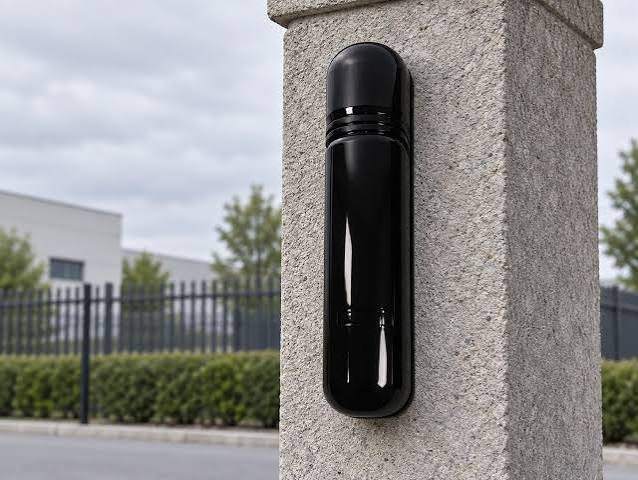
Active infrared beam sensors use a transmitter and receiver to create an invisible detection barrier.
When an object interrupts the beam, the receiving unit identifies the interruption and sends a signal to the connected security system.
They are particularly useful where a defined detection line is required.
Common applications include:
- Factory perimeter boundaries.
- Warehouse compounds.
- Commercial property entrances.
- Restricted pedestrian passages.
- Outdoor storage areas.
- Security-sensitive access corridors.
For large facilities, several beam sets can be installed along different boundary sections to create multiple detection zones.
Proper alignment is important. Dust, fog, heavy rain, physical obstructions and movement of mounting structures may affect the performance of certain systems.
4. Microwave Perimeter Detection Sensors
Microwave sensors use electromagnetic signals to monitor movement within a defined detection area. They identify changes in the received signal that meet the equipment’s detection criteria.
Some microwave systems are designed to monitor open outdoor areas or create detection zones along selected boundaries.
Potential applications include:
- Industrial compounds.
- Large commercial properties.
- Restricted utility facilities.
- Warehouse perimeters.
- Selected outdoor security zones.
Microwave detection requires careful site planning because the detection field can extend beyond the intended area if the system is incorrectly positioned. Nearby objects, environmental conditions and site activity must be considered during installation.
5. Fence-Mounted Vibration Detection Sensors
Fence-mounted sensors monitor physical disturbances along a perimeter fence.
Depending on the system, they can detect vibration associated with climbing, cutting, shaking or tampering.
They are particularly valuable for properties that use long metal or other suitable perimeter fencing.
Typical applications include:
- Manufacturing facilities.
- Warehouses and distribution centres.
- Industrial parks.
- Construction sites.
- Restricted infrastructure compounds.
- Large commercial estates.
The detection system must be compatible with the fence structure. Fence condition, mounting quality, wind exposure and surrounding activity influence how the sensors should be configured.
6. Fibre-Optic Perimeter Detection Systems
Fibre-optic perimeter systems use specialised optical sensing technology to identify disturbances along a protected cable route.
Depending on the system design, the cable may detect vibration or other physical disturbances associated with activity along a fence or boundary.
They can be considered for extensive perimeter protection where continuous monitoring along a long boundary is required.
Potential applications include:
- Large industrial facilities.
- Critical infrastructure.
- Extensive warehouse compounds.
- Utility installations.
- High-security commercial premises.
The actual detection capability, event-location accuracy and sensitivity depend on the specific technology and system configuration.
7. Buried Perimeter Intrusion Sensors
Buried detection systems are installed underground to monitor disturbances near a protected boundary.
Different systems use different technologies, including pressure-sensitive, seismic, vibration-based and other sensing methods.
They may be useful where visible detection equipment is unsuitable or where a property needs additional protection along selected underground boundaries.
Applications include:
- Sensitive industrial compounds.
- Restricted infrastructure facilities.
- Large commercial estates.
- Selected high-security sites.
Soil composition, moisture, installation depth, vehicle movement and landscaping can influence detection performance. A professional site assessment is important before choosing this type of technology.
8. Outdoor Gate and Door Contact Sensors
Outdoor-rated magnetic contact sensors monitor the opening and closing of gates, external doors, cabinets and other access points.
They typically consist of a magnetic contact arrangement that detects when the protected components move apart.
They are useful for:
- Industrial vehicle gates.
- Warehouse service doors.
- External electrical cabinets.
- Fuel storage enclosures.
- Restricted equipment rooms.
- Utility access points.
For outdoor use, the sensors must have suitable environmental protection and be installed to accommodate the movement and structure of the protected gate or door.
Outdoor Security Sensors for Different Industrial and Commercial Applications
The right sensor arrangement depends on the type of facility, the assets being protected and the possible routes through which unauthorised access could occur.
Outdoor Security Sensors for Factories
Factories often contain large production buildings, machinery yards, storage compounds and multiple vehicle entrances.
An industrial outdoor security system may use:
- Fence-mounted vibration sensors along suitable perimeter sections.
- Infrared beam detectors near restricted boundaries.
- Outdoor motion sensors around building entrances.
- Gate contact sensors for restricted access points.
- CCTV integration for visual verification.
The design should account for normal factory activity, vehicle movement, nearby machinery and environmental conditions.
Outdoor Security Sensors for Warehouses
Warehouses require protection around external walls, loading bays, delivery yards and storage areas.
Suitable sensors can monitor restricted sections, detect movement outside operating hours and alert security personnel when unexpected activity occurs.
Where CCTV is installed, integration can help security teams view the relevant camera when an alarm is triggered.
Outdoor Security Sensors for Industrial Parks
Industrial parks may contain several facilities, shared roads, multiple gates and long boundary sections.
A coordinated detection arrangement can divide the property into security zones and help management monitor different sections independently.
Depending on the site, the solution may include perimeter detection, outdoor motion sensors, gate monitoring and centralised alarm reporting.
Outdoor Security Sensors for Construction Sites
Construction sites may store expensive machinery, tools, fuel and building materials outdoors.
Outdoor sensors can help monitor temporary boundaries, equipment storage locations and restricted access routes.
The system should be designed to accommodate changing site layouts, temporary fencing, construction vehicles and other routine activities.
Outdoor Security Sensors for Commercial Estates
Commercial estates, shopping complexes and office compounds often contain parking facilities, service entrances, landscaped areas and external equipment.
Sensors can be installed to monitor selected vulnerable zones and provide alerts when movement occurs in restricted areas.
Outdoor Security Sensors for Schools and Institutions
Schools, universities and other institutions may have extensive grounds, several buildings and multiple entrances.
Outdoor detection can help monitor selected external areas, equipment storage compounds and restricted access points.
The installation should consider normal student, staff and visitor movement to avoid unnecessary alarms.
How to Design an Effective Outdoor Security Sensor System
Installing several sensors around a property does not automatically create an effective security system. Good design requires understanding the site’s vulnerabilities and matching detection technologies to the areas that need protection.
The following considerations are important.
1. Divide the Property into Security Zones
Instead of treating the entire property as one detection area, divide it into manageable zones.
Examples include:
- Main perimeter boundary.
- Vehicle entrances.
- Pedestrian entrances.
- Warehouse loading bays.
- Outdoor equipment yards.
- Restricted utility areas.
- External building approaches.
Zone identification helps security personnel understand where an alert originates and makes it easier to investigate incidents.
2. Identify Likely Intrusion Routes
Review the property for vulnerable locations such as poorly lit boundaries, concealed sections, damaged fencing, isolated gates and areas with limited surveillance.
Sensor placement should prioritise these areas according to the property’s security risk assessment.
3. Match Detection Technology to Each Area
Different locations require different approaches.
For example, infrared beams may be suitable for a narrow boundary passage, while fence-mounted sensors may be more appropriate for a compatible perimeter fence.
Outdoor motion sensors may be better suited to monitoring the approach to a warehouse entrance.
4. Account for Normal Site Activity
Factories and warehouses have legitimate outdoor movement involving staff, delivery vehicles, maintenance teams and security patrols.
Sensor placement and configuration must distinguish expected activity from the events the system is intended to detect.
5. Plan Power and Communication
Large properties may have long distances between detection devices and the main security control point.
The design should account for cable routes, wireless coverage, power availability, backup power and communication reliability.
6. Provide a Clear Alarm Response Procedure
Detection equipment is only one part of the security process.
The facility should establish procedures for receiving alerts, identifying affected zones, checking CCTV footage, contacting security personnel and documenting incidents.
Outdoor Security Sensor Installation Process
Professional installation involves more than mounting devices on external walls or fences. The equipment must be correctly selected, positioned, connected, configured and tested.
Step 1: Site Inspection and Security Assessment
The process begins with an examination of the property.
This includes evaluating perimeter length, boundary construction, access points, vulnerable areas, lighting, vegetation, environmental exposure and existing security equipment.
Step 2: Detection Zone Planning
The property is divided into detection zones according to the areas requiring protection.
The proposed layout identifies sensor locations, coverage areas, mounting requirements and communication routes.
Step 3: Equipment Selection
The appropriate technology is selected based on detection requirements, environmental exposure, range, power needs and compatibility with the alarm system.
Step 4: Infrastructure Preparation
Depending on the installation, this may involve preparing mounting points, poles, brackets, cable conduits, junction boxes and power connections.
Step 5: Sensor Installation
The sensors are installed according to the manufacturer’s requirements, with attention to mounting height, alignment, orientation and environmental protection.
Step 6: Alarm and Network Integration
The devices are connected to compatible alarm panels, controllers or monitoring platforms.
Each sensor should be assigned an identifiable zone or location so that alerts can be understood easily.
Step 7: Configuration and Calibration
Detection settings are adjusted according to the site conditions and the equipment manufacturer’s recommendations.
The objective is to achieve the required detection coverage while reducing unnecessary activations.
Step 8: System Testing and Commissioning
Each sensor should be tested to confirm that it detects the intended activity and communicates correctly with the connected security system.
Where integration is provided, the associated alarm notifications, CCTV responses and other configured functions should also be verified.
Step 9: Handover and Maintenance Planning
The facility manager or security team should receive guidance on system operation, alarm response, routine inspection and fault reporting.
Maintenance arrangements should be established according to the equipment and the property’s environmental conditions.
Integrating Outdoor Security Sensors with CCTV, Alarms and Access Control
A modern industrial security system should not depend on one technology alone. Outdoor sensors can provide detection, while other equipment helps verify events and control access.
Integration with CCTV Surveillance Systems
CCTV cameras provide visual monitoring, while outdoor sensors detect activity based on their specific sensing technology.
When compatible systems are integrated, a sensor event may trigger a camera recording, display a relevant camera view or create an event marker.
This helps security personnel investigate the cause of an alarm rather than relying on the sensor alert alone.
Integration with Intruder Alarm Systems
Outdoor sensors can be connected to compatible intruder alarm panels to generate alerts when configured detection conditions occur.
Different zones can be assigned to separate sections of the property, allowing the security team to identify the location of an event.
Integration with Electric Fence Systems
Electric fencing can form part of a property’s physical perimeter security arrangement. Compatible monitoring equipment and external detection sensors can provide additional information about activity along selected boundary sections.
It is important to distinguish electric fence voltage monitoring from dedicated perimeter intrusion detection. The two systems provide different functions.
Integration with Access Control Systems
Access control systems manage authorised entry through gates, doors and other controlled points.
Outdoor sensors monitor activity around designated areas.
When the technologies are integrated appropriately, security teams can compare access events with detection alerts and investigate activity that does not correspond to an authorised entry.
Integration with Security Lighting
Some systems can activate compatible external lighting when movement is detected.
This can improve visibility around selected areas and assist CCTV monitoring. Lighting responses should be configured to avoid unnecessary activation from routine environmental movement.
Factors That Determine Outdoor Security Sensor Installation Costs in Uganda
The cost of an outdoor security sensor installation depends on the scale and technical requirements of the project.
A small commercial compound may require only a few outdoor motion detectors, while a large factory may need multiple perimeter detection zones, specialised equipment, extensive cabling and integration with existing security infrastructure.
The main cost factors include:
1. Type of detection technology
PIR sensors, dual-technology detectors, infrared beams, fence-mounted vibration systems and advanced perimeter detection technologies have different equipment and installation requirements.
2. Size and perimeter length
Large properties generally require more equipment, longer cable routes, additional mounting structures and more extensive configuration.
3. Number of detection zones
A system divided into multiple independently monitored areas may require additional controllers, input modules or other supporting equipment.
4. Environmental protection requirements
Outdoor equipment must be suitable for exposure to moisture, dust, heat and other site conditions. Higher environmental protection specifications can influence equipment costs.
5. Power infrastructure
The installation may require power supplies, backup batteries, solar arrangements where suitable, electrical conduits or other supporting infrastructure.
6. Communication requirements
Wired communication, wireless links, network equipment and long-distance connections can affect the overall project cost.
7. Installation complexity
Uneven terrain, high mounting positions, long boundaries, difficult access and existing structures may increase installation time and labour requirements.
8. Integration with existing systems
Connecting sensors to CCTV, intruder alarms, access control or a central monitoring platform may require compatible equipment, programming and testing.
9. Maintenance and after-installation support
The long-term budget should account for inspection, testing, cleaning, battery replacement and repairs where necessary.
For an accurate quotation, property owners should arrange a site assessment to determine the appropriate equipment, coverage requirements and installation scope.
Common Outdoor Security Sensor Problems and Their Solutions
Outdoor sensors operate in environments where conditions can change frequently. Understanding common problems helps facility managers maintain reliable detection.
False Alarms Caused by Environmental Movement
Moving branches, animals, insects, wind and changing sunlight can cause unwanted activations in some outdoor detection technologies.
Solution: Review sensor positioning, clear unnecessary obstructions and adjust settings according to manufacturer instructions.
Sensor Misalignment
Infrared beam detectors and other directional sensors may stop operating correctly if their mounting structures move or become misaligned.
Solution: Inspect mounting points and carry out alignment tests as part of routine maintenance.
Poor Detection Coverage
Incorrect sensor placement, unsuitable detection range or obstacles can create gaps in the monitored area.
Solution: Reassess the detection layout and test coverage across all designated zones.
Moisture and Dust Damage
Equipment without suitable environmental protection may experience faults when exposed to moisture, dust and other outdoor conditions.
Solution: Use appropriately rated outdoor equipment and inspect protective enclosures and cable entries.
Power and Communication Failures
A damaged cable, depleted battery, power interruption or wireless communication problem can prevent a sensor from sending alerts.
Solution: Check power supplies, communication links, batteries and connections. Configure backup arrangements where appropriate.
Excessive Nuisance Alarms
Poor sensitivity settings or failure to account for normal site activity can result in repeated unnecessary alarms.
Solution: Review the site’s operating patterns and configure each detection zone to suit its actual environment.
Outdoor Security Sensor Maintenance: Best Practices for Industrial Facilities
Regular maintenance helps keep outdoor detection systems operating as intended.
Property managers should establish an inspection programme covering the following areas:
- Inspect sensor housings for cracks, corrosion and physical damage.
- Clean lenses and protective covers according to manufacturer instructions.
- Remove vegetation and other obstructions from detection areas.
- Check infrared beam alignment where applicable.
- Inspect fence-mounted sensors and their fixing points.
- Check electrical connections, cables and protective conduits.
- Test batteries and backup power supplies.
- Verify communication with alarm panels and monitoring platforms.
- Review alarm records for recurring faults and false activations.
- Test integrated CCTV and alarm responses.
- Document maintenance activities and replacement components.
The inspection schedule should reflect the manufacturer’s guidance, the equipment type and the conditions at the installation site.
How to Choose an Outdoor Security Sensor Installation Company in Uganda
Selecting the right installation provider is as important as choosing the equipment.
A suitable provider should understand the difference between indoor detection and outdoor perimeter monitoring and should be able to assess the security requirements of the property.
Before choosing a company, consider the following:
- Technical understanding: Can the provider explain the differences between PIR, microwave, infrared beam and fence-mounted detection technologies?
- Site assessment: Will the proposed solution be based on the actual property layout and vulnerabilities?
- Equipment suitability: Are the proposed sensors designed for the intended outdoor environment?
- System compatibility: Can the equipment integrate with existing alarm panels, CCTV and other security systems?
- Installation planning: Does the proposal explain sensor locations, detection zones, cabling and power requirements?
- Testing and commissioning: Will every sensor and configured integration be tested?
- Maintenance planning: Is there a clear process for inspections, fault reporting and repairs?
- Documentation: Will the property owner receive equipment information, zone identification and operating guidance?
Avoid selecting a system based on equipment price alone. A lower-cost installation may not provide the detection coverage, environmental protection or integration required by a large property.
Why Consider Daltrevco for Security Solutions in Uganda?
Protecting a large property requires a coordinated approach to security technology. Outdoor sensors, CCTV cameras, intruder alarms, electric fencing and access control should be considered in relation to the site’s actual security requirements.
Daltrevco is a point of contact for property owners, businesses and organisations exploring building and security technology solutions in Uganda.
When planning outdoor security for a factory, warehouse, commercial building, industrial compound or large estate, consider the following priorities:
- Identifying vulnerable external areas.
- Selecting suitable outdoor detection technologies.
- Planning effective perimeter monitoring.
- Connecting detection equipment to compatible alarm systems.
- Considering CCTV integration for event verification.
- Providing appropriate maintenance and operational procedures.
Contact Daltrevco to discuss your outdoor security requirements and explore suitable detection solutions for your property.
A properly planned security system can help improve awareness of suspicious activity, strengthen perimeter monitoring and support better protection of people, buildings and valuable equipment.
Frequently Asked Questions About Outdoor Security Sensors
1. What are outdoor security sensors?
Outdoor security sensors are electronic devices designed to detect movement, physical disturbances or other specified activities in external areas. They are used around property boundaries, building entrances, warehouses, factories and restricted outdoor zones.
2. Which outdoor security sensors are best for industrial facilities?
The appropriate technology depends on the site’s security requirements. PIR sensors may suit building approaches, infrared beams can monitor defined detection lines, and fence-mounted vibration systems can monitor suitable perimeter fences. Large facilities may require several complementary technologies.
3. Can outdoor security sensors detect intruders before they enter a building?
Yes. Sensors installed around external boundaries, entrances and restricted outdoor zones can detect qualifying activity before an intruder reaches the main building. Their effectiveness depends on placement, coverage and correct configuration.
4. Are outdoor security sensors suitable for warehouses?
Yes. They can monitor loading bays, external walls, delivery areas, storage compounds, gates and other vulnerable sections of a warehouse property.
5. Do outdoor security sensors work at night?
Many outdoor sensors can detect activity in darkness because their sensing technologies do not rely on visible light. However, camera-based verification and certain systems may require appropriate lighting.
6. What is the difference between PIR and microwave outdoor sensors?
PIR sensors detect changes in infrared energy, while microwave sensors use electromagnetic signals to identify movement-related changes within their detection fields. Some dual-technology devices combine both methods.
7. What are infrared beam security sensors used for?
They create an invisible detection line between a transmitter and receiver. When an object interrupts the beam, the system generates a detection signal. They are commonly used around boundaries, entrances and restricted outdoor passages.
8. Can outdoor sensors detect someone climbing a fence?
Certain fence-mounted vibration detection systems can detect disturbances associated with climbing, cutting or tampering. Their performance depends on the fence structure, technology and configuration.
9. Can outdoor security sensors be connected to CCTV?
Yes, compatible sensors and CCTV systems can be integrated. Depending on the equipment, an alarm event may trigger camera recording, display a relevant camera view or create an event notification.
10. How many outdoor security sensors does a large property require?
The number depends on the property size, boundary layout, access points, detection technology and security risks. A site assessment helps determine the number and positioning required.
11. Are outdoor security sensors affected by rain and wind?
Some outdoor sensors are designed to withstand normal weather exposure, but environmental conditions can still affect detection performance. Suitable weather-rated equipment, correct mounting and careful configuration are essential.
12. Can outdoor sensors work with electric fencing?
Yes. Compatible detection sensors can complement an electric fence system. However, electric fence monitoring and dedicated intrusion detection are separate functions and should be planned accordingly.
13. Do outdoor security sensors require internet connectivity?
Not all outdoor security sensors require internet access. Some operate through wired connections to a local alarm panel, while others use wireless or network-based communication. Remote notifications and cloud-based monitoring may require additional connectivity.
14. How much does outdoor security sensor installation cost in Uganda?
The cost depends on sensor technology, property size, detection range, number of zones, cabling, power infrastructure, installation complexity and system integration. A site-specific quotation is necessary.
15. How often should outdoor security sensors be maintained?
Maintenance should follow the manufacturer’s recommendations and account for local environmental conditions. Regular inspection, cleaning, alignment checks and functional testing help identify faults early.
16. Can outdoor security sensors replace security guards?
No. Sensors provide electronic detection and alerts, but security personnel are still needed to assess incidents and follow appropriate response procedures. The technologies work best together.
17. What is the difference between outdoor motion detection and perimeter intrusion detection?
Outdoor motion detection identifies movement within a particular area, while perimeter intrusion detection focuses on disturbances or attempted access along a protected boundary. A complete security plan may use both technologies.
Conclusion
Outdoor security sensors play an important role in protecting large properties and industrial facilities where perimeter monitoring, early detection and coordinated security responses are essential.
From outdoor PIR motion detectors and dual-technology sensors to infrared beams, fence-mounted vibration systems and advanced perimeter detection solutions, different technologies address different security requirements.
For factories, warehouses, industrial parks, construction sites, commercial estates and large institutional properties in Uganda, choosing the right combination of sensors can help reduce unmonitored areas and strengthen the overall security arrangement.
The most effective solution is one that is designed around the property’s layout, operating environment and security risks, with appropriate integration into CCTV, intruder alarms and other security technologies.
Contact Daltrevco to explore outdoor security sensor solutions for your facility and develop a more effective approach to protecting your property’s perimeter and external assets.

