
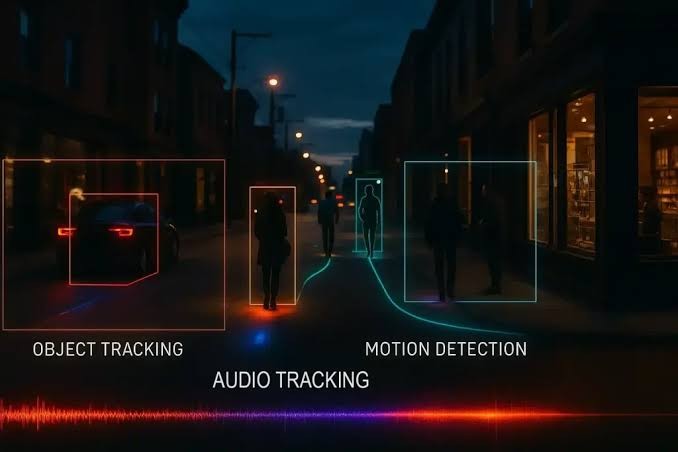
Modern security challenges require more than simply installing CCTV cameras and recording footage. Businesses, institutions and property owners need surveillance systems that can identify unusual activities, recognise relevant events and provide timely notifications when potential security threats occur. This is where video analytics in CCTV systems becomes increasingly important.
Traditional CCTV systems primarily capture and store video footage for security monitoring and investigations. However, intelligent video analytics takes surveillance further by analysing video streams and identifying specific activities automatically. Depending on the technology installed, these systems can detect movement, track people or vehicles, identify objects entering restricted areas and send alerts when predefined conditions are met.
For commercial buildings, warehouses, factories, shopping centres, offices, residential estates and other properties in Uganda, video analytics can improve situational awareness and make security monitoring more efficient.
At Daltrevco, we recognise the importance of selecting security solutions that match the specific risks and operational requirements of each property. Understanding how video analytics works can help property owners make better decisions when planning or upgrading their CCTV surveillance systems.
This guide explains what video analytics is, how motion detection and object tracking work, the types of intelligent alerts available, the benefits for different properties and the important considerations when choosing an analytics-enabled CCTV system in Uganda.
What Is Video Analytics in CCTV Systems?
Video analytics is technology that automatically analyses video footage from CCTV cameras to identify movement, objects, activities and events based on programmed rules or artificial intelligence.
Instead of requiring security personnel to watch every camera continuously, video analytics helps surveillance systems identify events that may require attention.
Depending on the camera, recorder and software capabilities, video analytics can perform tasks such as:
- Detecting movement within a monitored area.
- Identifying people and vehicles.
- Tracking objects as they move through a camera’s field of view.
- Detecting entry into restricted zones.
- Identifying objects left behind or removed.
- Detecting people crossing virtual boundaries.
- Monitoring activity in designated areas.
- Generating notifications when specified events occur.
Some systems use basic pixel-change or movement detection, while more advanced systems use artificial intelligence and deep-learning algorithms to distinguish between people, vehicles and other objects.
The capabilities available depend on the equipment, software, camera positioning and system configuration. Not every CCTV camera supports advanced video analytics.
How Does Video Analytics Work in CCTV Systems?
Video analytics works by examining video images captured by surveillance cameras and applying programmed rules or trained algorithms to identify relevant events.
The analysis may take place within the camera, on a network video recorder (NVR), on a dedicated video analytics server or through a cloud-based platform.
The general process involves several stages.
1. Video Capture
CCTV cameras capture video footage from designated areas such as entrances, corridors, parking spaces, warehouses, reception areas and building perimeters.
The quality of the captured footage influences the accuracy of video analytics. Camera resolution, lighting, viewing angle, image clarity and installation height all affect how effectively the system can identify activity.
2. Video Processing
The system analyses incoming footage to identify changes, movement, objects and patterns.
Basic analytics may detect changes between video frames, while advanced systems can use AI models to classify objects such as people, vehicles and other relevant categories.
3. Event Identification
The analytics software compares detected activities against predefined rules.
For example, a system may be configured to identify a person entering a restricted warehouse area outside approved operating hours.
4. Alert Generation
When an event meets the configured conditions, the system can generate an alert.
Depending on the equipment and software, notifications may appear on a monitoring screen, trigger an audible warning, send a mobile notification or activate another connected security function.
5. Video Recording and Review
The event may be recorded, bookmarked or associated with a timestamp to make investigation easier.
This helps security personnel locate relevant footage without manually searching through hours of recordings.
Key Types of Video Analytics Used in CCTV Systems
Different analytics technologies serve different security and operational purposes. Understanding their capabilities helps property owners choose the right surveillance solution.
1. Motion Detection
<PRIVATE_PERSON>otion detection is one of the most common features in modern CCTV systems. It identifies movement within a camera’s field of view and can trigger recording, notifications or other configured actions.
For example, a camera installed at a business entrance can detect movement after working hours and notify authorised personnel.
Motion detection is useful for:
- Monitoring building entrances and exits.
- Detecting movement around perimeter fences.
- Monitoring corridors and restricted areas.
- Triggering event-based video recording.
- Identifying unexpected activity in warehouses.
- Reducing the need to review continuous footage manually.
However, basic motion detection can sometimes generate false alerts. Moving trees, rain, insects, changing lighting conditions and shadows may trigger unnecessary notifications.
More advanced systems can use object classification and configurable detection zones to reduce irrelevant alerts.
2. Object Detection and Classification
Object detection identifies objects within a video image and determines their likely category.
Depending on the system, categories may include:
- People.
- Cars.
- Motorcycles.
- Buses.
- Trucks.
- Bicycles.
- Other supported object types.
This feature helps distinguish between different types of movement.
For example, a commercial property may need to monitor pedestrian activity near its main entrance while separately tracking vehicles entering a parking area.
Object classification can help security teams prioritise relevant events instead of responding to every movement detected by a camera.
3. Object Tracking
Object tracking allows a CCTV system to follow a detected person or vehicle as it moves within the camera’s field of view.
Once an object is identified, the system can maintain a tracking record across subsequent video frames. Some advanced systems can also support tracking between multiple cameras when the software and camera arrangement are compatible.
Object tracking is useful for:
- Following vehicle movement within parking facilities.
- Monitoring pedestrian movement through large premises.
- Observing activity in warehouses and industrial facilities.
- Tracking movement around restricted areas.
- Supporting investigations after suspicious incidents.
- Understanding movement patterns within monitored spaces.
For example, a warehouse security team may use object tracking to review the movement of a vehicle from an entrance to a loading area.
It is important to understand that tracking within one camera’s view is different from identifying the same individual across multiple cameras. Cross-camera tracking requires compatible equipment and more advanced software. It does not necessarily establish a person’s identity.
4. Line Crossing Detection
Line crossing detection identifies when a person or vehicle crosses a virtual line configured within a camera’s monitoring area.
The virtual line can be positioned across an entrance, perimeter boundary, driveway or restricted passage.
A security system may be configured to send an alert when a person crosses the line in a particular direction.
Common applications include:
- Monitoring restricted building entrances.
- Detecting movement across property boundaries.
- Controlling access to warehouse loading areas.
- Monitoring vehicle entry and exit points.
- Identifying unauthorised movement through designated zones.
Line crossing detection is especially useful where security personnel need to monitor specific movement routes.
5. Intrusion Detection and Restricted Area Monitoring
Intrusion detection analytics identifies people or vehicles entering designated restricted areas.
A virtual detection zone can be created around sensitive locations such as server rooms, equipment storage areas, warehouses, factories and perimeter sections.
When an object enters the designated area, the system can generate an alert.
Some systems can also distinguish between people and vehicles or apply different rules depending on the time of day.
For example, a factory may configure its CCTV system to generate alerts when someone enters a restricted production area outside authorised operating hours.
6. Loitering Detection
Loitering detection identifies when a person or vehicle remains within a designated area longer than a configured period.
This feature can help security teams identify unusual activity around:
- Building entrances.
- Parking areas.
- Loading bays.
- Perimeter boundaries.
- Restricted access points.
- Reception and waiting areas.
For instance, a commercial building may configure an alert when a person remains near a restricted entrance for an unusually long period.
Loitering alerts should be treated as prompts for assessment rather than proof of suspicious behaviour. Legitimate visitors, deliveries and other normal activities can also trigger them.
7. People Counting and Occupancy Monitoring
People-counting analytics estimates the number of people entering or leaving a monitored area.
It can be useful for shopping centres, offices, hotels, educational institutions and other buildings that need to understand occupancy patterns.
Applications include:
- Monitoring visitor numbers.
- Understanding peak entry and exit periods.
- Supporting crowd management.
- Estimating occupancy in designated areas.
- Reviewing movement trends.
- Supporting operational planning.
The accuracy of people counting depends on camera placement, viewing angle, crowd density, lighting and the analytics software.
People counting is not automatically the same as identifying individuals.
8. Abandoned Object and Object Removal Detection
Some advanced video analytics systems can detect when an object is left unattended or removed from a designated area.
Abandoned-object detection may be useful in transport facilities, commercial buildings, reception areas and warehouses.
Object-removal detection can help monitor valuable equipment, stock storage areas and restricted locations.
These functions require careful configuration because ordinary operational activities may also involve objects being placed or removed.
How Intelligent CCTV Alerts Work
Intelligent alerts are notifications generated when a CCTV analytics system detects an event that matches predefined rules.
Instead of notifying security personnel about every movement, a properly configured system can focus attention on specific activities.
For example, a business may configure its surveillance system to send notifications when:
- A person enters a restricted area.
- A vehicle crosses a designated virtual line.
- Movement occurs in a monitored area after business hours.
- A person remains near a restricted entrance for too long.
- An object is removed from a designated location.
- A camera loses its connection.
- An analytics-enabled camera detects a configured security event.
Depending on the system, alerts can be delivered through:
- CCTV monitoring software.
- Network video recorders.
- Mobile surveillance applications.
- Desktop security dashboards.
- Email notifications.
- Supported alarm or building management integrations.
The actual notification options depend on the manufacturer, software, network configuration and equipment compatibility.
Real-Time Security Notifications
Real-time notifications help authorised users respond to important events without constantly watching surveillance screens.
For example, a warehouse manager may receive an alert when a person enters a restricted storage section outside normal operating hours.
Event-Based Recording
Some CCTV systems can be configured to record continuously, while others can use analytics events to trigger or mark recordings.
Event-based recording can make footage easier to review and may reduce storage requirements in suitable applications. However, the recording strategy should be selected according to the property’s security needs.
For high-risk locations, continuous recording may be more appropriate than relying exclusively on motion-triggered recording.
Automated Security Responses
Where compatible equipment and software are available, video analytics can trigger additional security actions.
Examples include:
- Activating an audible warning.
- Sending an alert to a monitoring station.
- Displaying a relevant camera feed.
- Triggering a connected alarm input.
- Activating configured lighting.
- Creating an event record for investigation.
These functions must be properly integrated and tested. A CCTV analytics event does not automatically activate every alarm or access control system.
Benefits of Video Analytics in CCTV Systems
Video analytics can improve surveillance by helping security teams identify relevant activity more efficiently.
1. Improved Security Monitoring
Traditional surveillance may require personnel to monitor multiple camera feeds continuously.
Video analytics helps identify predefined events automatically, allowing security teams to concentrate on situations that may require investigation.
2. Faster Identification of Security Events
When configured correctly, intelligent alerts can notify authorised personnel when specific activities occur.
This can reduce the time spent discovering an incident through manual footage review.
3. Reduced Unnecessary Alerts
Advanced analytics can distinguish between supported object categories, such as people and vehicles.
This may reduce false alerts compared with basic motion detection, although it cannot eliminate them completely.
4. More Efficient CCTV Monitoring
Security personnel can use event-based search, timestamps and analytics filters to locate relevant recordings more quickly.
This is particularly valuable for large properties with many cameras and extensive recording periods.
5. Better Perimeter Monitoring
Line crossing and intrusion detection can help identify movement around property boundaries, restricted entrances and other sensitive locations.
6. Improved Operational Visibility
People counting, vehicle monitoring and occupancy analytics can provide information that supports building operations, visitor management and facility planning.
7. Better Incident Investigation
Object tracking and event bookmarks can help investigators review how an incident developed and identify relevant footage.
However, analytics results should always be reviewed alongside the original video and other available evidence.
Applications of Video Analytics in Different Properties in Uganda
Video analytics can support different security requirements depending on the type of property, its layout and the risks being managed.
1. Commercial Buildings and Office Complexes
<PRIVATE_PERSON>Commercial buildings often have multiple entrances, reception areas, parking facilities, corridors and restricted offices.
Video analytics can help monitor movement, detect entry into restricted areas, identify unusual activity and support visitor flow management.
2. Warehouses and Storage Facilities
Warehouses often contain valuable stock, equipment and goods awaiting dispatch.
Video analytics can help monitor loading bays, storage sections, entrances and vehicle movement.
Useful features include:
- Intrusion detection.
- Line crossing detection.
- Object tracking.
- Loitering detection.
- Vehicle classification.
- Object removal detection, where supported.
3. Factories and Industrial Facilities
Factories require surveillance across production areas, equipment storage sections, loading zones and external perimeters.
Analytics can help identify unauthorised entry, monitor movement around restricted areas and provide event notifications.
CCTV analytics should complement, not replace, appropriate industrial safety controls and supervision.
4. Shopping Centres and Retail Businesses
Retail properties experience regular pedestrian and vehicle movement.
Video analytics can support people counting, occupancy monitoring, movement analysis and security alerts around designated areas.
Where analytics are used for operational or behavioural monitoring, businesses should consider privacy and appropriate access to collected information.
5. Hotels and Hospitality Facilities
Hotels may use video analytics to monitor entrances, parking areas, reception surroundings and other appropriate common areas.
Features such as intrusion detection and vehicle monitoring can support security operations.
Camera placement should respect guest privacy. CCTV should not be installed in private spaces such as guest bedrooms and bathrooms.
6. Schools and Educational Institutions
Schools and other educational facilities can use analytics-enabled CCTV to monitor entrances, external boundaries, corridors and other appropriate shared areas.
Restricted-area alerts can help security teams identify unauthorised movement.
The use of surveillance in educational environments requires particular attention to children’s privacy and appropriate handling of recorded footage.
7. Residential Estates and Apartment Buildings
Residential estates and apartment complexes may have multiple gates, pedestrian entrances, parking areas and shared facilities.
Video analytics can support vehicle monitoring, entrance surveillance, intrusion detection and movement alerts around designated restricted areas.
8. Hospitals and Healthcare Facilities
Hospitals have public areas, staff-only sections, equipment storage rooms and controlled-access locations.
Video analytics can help monitor suitable common areas and detect entry into restricted spaces.
Healthcare facilities must take particular care to protect patient confidentiality and avoid inappropriate surveillance of sensitive areas.
Video Analytics vs Traditional CCTV Motion Detection
Although traditional motion detection and advanced video analytics both identify activity in video footage, they do not necessarily perform the same functions.
| Feature | Basic Motion Detection | Advanced Video Analytics |
|---|---|---|
| Movement detection | Yes | Yes |
| Person classification | Usually limited or unavailable | Available on supported systems |
| Vehicle classification | Usually limited or unavailable | Available on supported systems |
| Object tracking | Generally unavailable | Available on supported systems |
| Line crossing | Available on some systems | Commonly supported |
| Intrusion detection | Available on some systems | Commonly supported |
| People counting | Usually unavailable | Available on supported systems |
| Intelligent event alerts | Basic | More configurable |
| False alert reduction | Limited | Potentially improved through classification and filtering |
The distinction is not always absolute. Some modern cameras offer advanced analytics, while some recorders provide intelligent detection features even when connected cameras have limited processing capabilities.
The best option depends on the complete CCTV system rather than the camera specification alone.
Edge-Based vs Server-Based Video Analytics
Video analytics can be processed in different locations depending on the system design.
Edge-Based Video Analytics
Edge-based analytics processes video directly within the camera or another device near the video source.
Advantages include:
- Reduced need to transmit every video stream to a central analytics server.
- Potentially faster event processing.
- Reduced central processing requirements.
- Local event detection where supported.
However, camera processing capacity and available analytics functions vary between models.
Server-Based Video Analytics
Server-based analytics processes video streams on a dedicated computer or central video management platform.
This approach may support more complex analytics and centralised management across multiple cameras.
Potential advantages include:
- Centralised analytics management.
- Support for multiple camera feeds.
- More advanced processing capabilities, depending on the platform.
- Easier administration across large surveillance installations.
The system requires sufficient processing capacity, suitable network infrastructure and compatible software.
Cloud-Based Video Analytics
Some providers offer cloud-based video analytics, where video or selected event data is processed through an online platform.
Cloud solutions may support remote management and centralised access, but they depend on suitable internet connectivity, bandwidth, service availability and appropriate data protection arrangements.
Property owners should evaluate whether video is continuously uploaded, whether only selected events are transmitted and how long information is retained.
How to Choose the Right Video Analytics CCTV System in Uganda
Choosing an analytics-enabled CCTV system requires more than selecting cameras with AI or motion detection advertised on the packaging.
The system must match the property’s security objectives and operating environment.
1. Identify Your Security Requirements
Start by identifying what the CCTV system should detect.
For example:
- A warehouse may require intrusion detection and vehicle tracking.
- An office building may need restricted-area monitoring.
- A shopping centre may benefit from people counting.
- A residential estate may require perimeter alerts and vehicle monitoring.
- A factory may need monitoring around equipment storage and loading areas.
Defining the required outcomes helps avoid paying for analytics features that are not useful.
2. Check Camera Compatibility
Not every CCTV camera supports advanced video analytics.
Check whether the camera supports the required functions, including people detection, vehicle classification, line crossing, intrusion detection or object tracking.
Also confirm whether the NVR or video management software supports those features.
3. Consider Camera Resolution and Image Quality
Camera resolution influences the amount of visual detail available to the analytics software.
However, higher resolution alone does not guarantee accurate detection.
Lens selection, lighting, viewing distance, camera angle, image compression and installation position are also important.
4. Evaluate Day and Night Performance
Security monitoring must account for changing lighting conditions.
Consider cameras with suitable low-light performance, infrared illumination or other appropriate night surveillance capabilities.
Test analytics performance during both daytime and nighttime conditions.
5. Assess Network Infrastructure
IP-based CCTV systems depend on suitable network infrastructure.
For larger installations, evaluate:
- Network bandwidth.
- Ethernet cabling.
- PoE switch capacity.
- Network reliability.
- Storage connectivity.
- Network segmentation.
- Remote access security.
Insufficient bandwidth or poor network design can affect video quality, remote viewing and analytics performance.
6. Check Recording and Storage Capacity
Analytics does not remove the need for an appropriate video storage plan.
Consider the number of cameras, recording resolution, frame rate, compression, retention period and whether continuous or event-based recording is required.
For important security areas, avoid relying solely on event-triggered recording without assessing the risk of missed detections.
7. Evaluate Integration Capabilities
If the property already has burglar alarms, access control, electric fencing or central monitoring, determine whether the proposed analytics system can integrate with the existing equipment.
Compatibility should be confirmed at the device, software and interface level.
8. Consider Future Expansion
A CCTV installation may need additional cameras, monitoring stations or analytics functions in the future.
Choose a system that can accommodate realistic expansion without requiring unnecessary replacement of the entire installation.
Important Installation Considerations for Video Analytics Systems
Correct installation is essential to achieving useful analytics results.
Even advanced CCTV software can perform poorly when cameras are incorrectly positioned or configured.
Important considerations include:
Camera positioning: Cameras should provide a clear view of the areas where detection is required. Avoid positioning cameras where important objects are frequently hidden by walls, vehicles, equipment or other obstructions.
Detection zones: Configure analytics zones around relevant entrances, boundaries, corridors and restricted locations. Avoid including unnecessary areas that could generate irrelevant alerts.
Lighting: Ensure that monitored areas have sufficient lighting or suitable low-light camera capabilities.
Camera angle: Select an angle that allows the system to identify the relevant activity. Extremely high or obstructed viewpoints may make classification difficult.
Detection sensitivity: Adjust sensitivity and detection rules to reduce unnecessary notifications without making the system too insensitive to relevant activity.
Network configuration: Provide suitable bandwidth, stable connections and appropriate network security.
Testing: Test each analytics function under normal operating conditions, including different lighting conditions and expected patterns of movement.
User permissions: Restrict access to surveillance footage, analytics settings and security notifications to authorised personnel.
Professional planning and configuration help ensure that the CCTV system performs according to the property’s actual security requirements.
Common Challenges of CCTV Video Analytics and How to Address Them
Video analytics can improve surveillance, but its performance depends on the environment and system configuration.
1. False Motion Detection Alerts
Problem: Moving trees, insects, shadows, rain and changing lighting may trigger unnecessary alerts.
Solution: Configure detection zones, adjust sensitivity, use supported person or vehicle classification and test the system under different environmental conditions.
2. Missed Object Detection
Problem: A camera may fail to detect a person or vehicle because of poor lighting, obstructions, distance or an unsuitable camera angle.
Solution: Review camera positioning, improve lighting, select suitable camera specifications and test the required detection functions.
3. Inaccurate Object Tracking
Problem: The system may lose track of an object when it moves behind an obstruction or leaves the camera’s field of view.
Solution: Improve camera coverage and consider compatible multi-camera tracking solutions where required.
4. Too Many Notifications
Problem: Excessive alerts can overwhelm security personnel and cause important notifications to be overlooked.
Solution: Refine event rules, use schedules, configure detection zones and prioritise notifications according to risk.
5. Poor Night-Time Analytics Performance
Problem: Low illumination, glare, shadows and unsuitable infrared lighting can reduce detection accuracy.
Solution: Select cameras designed for the site’s lighting conditions and test analytics at night before relying on the system.
6. Network and Connectivity Problems
Problem: Unstable network connections may interrupt live video, remote access or cloud-based analytics.
Solution: Use appropriate network equipment, check bandwidth requirements, secure network infrastructure and consider backup connectivity where necessary.
7. Incompatible CCTV Equipment
Problem: Cameras, recorders and analytics software from different manufacturers may not support every required feature when combined.
Solution: Confirm compatibility before purchasing and test the intended integration.
Video Analytics and Data Privacy in Uganda
Video analytics may involve processing information about identifiable people, including their movements and activities.
Businesses and institutions using analytics-enabled CCTV should consider privacy, data protection and responsible surveillance practices.
Uganda’s Data Protection and Privacy Act, 2019, together with applicable regulations, provides an important framework for handling personal data.
Property owners should consider the following:
- Have a legitimate and clearly defined reason for using surveillance.
- Inform people about CCTV monitoring where appropriate.
- Position cameras to avoid unnecessary recording of private spaces.
- Restrict footage access to authorised personnel.
- Use secure passwords and appropriate access controls.
- Establish suitable video retention and deletion procedures.
- Protect recorded footage against unauthorised access or disclosure.
- Review whether the analytics features collect more information than necessary.
Advanced features such as facial recognition require additional care because they may involve biometric personal data.
Video analytics should be configured responsibly and should not be used to make unsupported assumptions about a person’s intentions or behaviour. An automated alert is an indication that an event may require review, not proof that wrongdoing has occurred.
Factors That Affect the Cost of Video Analytics CCTV Systems in Uganda
The cost of installing an analytics-enabled CCTV system varies depending on the property’s size, security requirements, equipment specifications and installation complexity.
Important cost factors include:
- Number of cameras: Larger properties generally require more cameras and supporting equipment.
- Camera specifications: Resolution, low-light performance, lens type and built-in analytics capabilities affect equipment selection.
- Analytics features: Basic motion detection may be included in some systems, while advanced object classification and tracking may require specialised cameras or software licences.
- Recording equipment: The type and capacity of the NVR or server influence the overall system cost.
- Storage requirements: Longer retention periods and higher recording quality require additional storage capacity.
- Network infrastructure: Switches, cabling, network equipment and connectivity may add to installation requirements.
- Software and licensing: Some platforms require additional licences or subscriptions for advanced analytics.
- Integration requirements: Connecting CCTV analytics with alarms, access control or central monitoring may increase system complexity.
- Installation conditions: Building layout, mounting height, cable routes and site accessibility affect labour and installation requirements.
- Maintenance and support: Ongoing servicing, software updates and equipment support should be considered when planning the investment.
For an accurate quotation, property owners should arrange a site assessment to determine the most appropriate equipment, camera positions, analytics features and infrastructure requirements.
Why Professional CCTV Installation Matters
An analytics-enabled CCTV system requires more than connecting cameras to a recorder.
Professional planning helps ensure that the equipment, network, software and detection settings work together effectively.
A properly planned installation should consider:
- Property layout and security risks.
- Camera coverage and blind spots.
- Required analytics functions.
- Recording and storage capacity.
- Network infrastructure.
- Power supply and backup requirements.
- System compatibility.
- Privacy and footage access.
- Testing and user training.
For businesses and property owners in Uganda, Daltrevco can be contacted to discuss suitable CCTV surveillance and integrated security solutions based on individual property requirements.
Whether you are planning a new surveillance installation or considering an upgrade to an existing CCTV system, selecting the right equipment and configuration is essential.
Why Consider Daltrevco for CCTV and Security System Solutions?
Selecting a suitable security system is an important decision for any property owner. The right solution should address actual security risks while remaining practical to operate and maintain.
Daltrevco focuses on helping property owners and organisations explore suitable security and property protection solutions.
When planning an analytics-enabled CCTV installation, it is important to consider the property’s layout, number of cameras, monitoring requirements, recording needs and desired intelligent detection features.
Contact Daltrevco through www.daltrevco.com to discuss your CCTV and security system requirements and explore a suitable solution for your property.
Frequently Asked Questions About Video Analytics in CCTV Systems
1. What is video analytics in CCTV systems?
Video analytics is technology that automatically analyses CCTV footage to detect movement, classify objects, track people or vehicles and identify predefined events that may require attention.
2. How does motion detection work in CCTV cameras?
Motion detection identifies changes between video frames or movement within a monitored area. When configured conditions are met, the camera or recording system can trigger recording or send an alert.
3. What is the difference between motion detection and video analytics?
Basic motion detection identifies movement, while advanced video analytics can perform additional tasks such as person detection, vehicle classification, object tracking, line crossing and intrusion detection.
4. Can CCTV cameras identify people and vehicles automatically?
Some modern CCTV cameras and analytics platforms can detect and classify people and vehicles. The available functions depend on the camera model, software and configuration.
5. What is object tracking in CCTV?
Object tracking is a video analytics feature that follows a detected person or vehicle as it moves through a camera’s field of view. Advanced systems may also support tracking across compatible cameras.
6. Can video analytics send alerts to a mobile phone?
Yes. Supported CCTV systems can send notifications through mobile applications when configured events occur. This depends on the camera, recorder, software and connectivity.
7. Can video analytics detect intruders?
Video analytics can identify movement into designated restricted areas and generate alerts. However, the system cannot always determine whether someone is genuinely an intruder, so alerts should be reviewed by authorised personnel.
8. Can CCTV analytics work at night?
Yes. Suitable cameras can support analytics at night using low-light imaging, infrared illumination or other supported technologies. Performance depends on lighting, camera specifications and installation conditions.
9. Does video analytics reduce false alarms?
Advanced analytics can reduce unnecessary alerts by distinguishing supported objects, such as people and vehicles, from irrelevant movement. However, false detections can still occur.
10. What is line crossing detection in CCTV?
Line crossing detection identifies when a person or vehicle crosses a virtual line configured within a camera’s monitoring area. It can be used to monitor entrances, exits and restricted boundaries.
11. What is intrusion detection in CCTV systems?
Intrusion detection identifies when an object enters a designated restricted zone and generates an alert based on configured rules.
12. Can video analytics track a vehicle through multiple cameras?
Some advanced platforms support multi-camera tracking when the cameras, software and network infrastructure are compatible. Basic camera analytics may only track objects within an individual camera’s field of view.
13. Can video analytics count people entering a building?
Yes. Supported people-counting systems can estimate the number of people entering and leaving monitored areas. Accuracy depends on camera placement, crowd conditions and software capabilities.
14. Does video analytics require internet access?
Not always. Analytics processed locally within a camera, recorder or on-site server may work without internet if the system has power and is correctly configured. Remote notifications and cloud-based functions generally require connectivity.
15. Can video analytics work with existing CCTV cameras?
It depends on the cameras, recorder and analytics software. Some existing IP cameras and recording systems support analytics upgrades, while others may require replacement or additional equipment.
16. Can video analytics be integrated with burglar alarms?
Yes, some systems can integrate CCTV analytics with compatible burglar alarm equipment. The required interfaces, supported functions and configuration should be confirmed before installation.
17. Is AI video analytics better than traditional CCTV?
AI video analytics can provide additional capabilities such as object classification and intelligent event detection. However, traditional CCTV may be sufficient for properties that mainly require recording and basic monitoring. The best choice depends on security requirements and budget.
18. Is video analytics suitable for warehouses and factories?
Yes. It can support intrusion detection, vehicle monitoring, restricted-area alerts, object tracking and surveillance of loading and storage areas.
19. How much does a video analytics CCTV system cost in Uganda?
The cost depends on the number and type of cameras, analytics capabilities, recording equipment, storage, network infrastructure, software licensing and installation requirements. A site assessment is recommended for an accurate quotation.
20. Does video analytics guarantee complete property security?
No. Video analytics improves surveillance and helps identify predefined events, but it cannot guarantee that every incident will be detected or prevented. It should form part of a broader security strategy that may include access control, alarms, perimeter protection and appropriate security procedures.
Conclusion: Improve CCTV Surveillance with Intelligent Video Analytics
Video analytics is transforming modern CCTV surveillance by helping security systems identify movement, classify objects, track people and vehicles and generate alerts when predefined events occur.
Features such as motion detection, line crossing, intrusion detection, object tracking and people counting can improve security monitoring across commercial buildings, warehouses, factories, shopping centres, offices, residential estates and institutions.
However, the effectiveness of these technologies depends on selecting compatible equipment, positioning cameras correctly, configuring detection rules and providing suitable network and recording infrastructure.
For property owners and businesses in Uganda, investing in the right analytics-enabled CCTV system can improve security visibility, support faster incident investigation and make surveillance operations more efficient.
Contact Daltrevco through www.daltrevco.com to discuss suitable CCTV and integrated security solutions for your property.

