Concrete products are essential building materials used in residential, commercial, industrial and infrastructure construction projects across Uganda. From concrete blocks and paving blocks to precast slabs, culverts, kerbstones, concrete pipes and drainage channels, these products support the construction of durable buildings and infrastructure.
However, one of the most common questions asked by property developers, contractors and individual builders is: How much do concrete products cost in Uganda?
The cost of concrete products varies depending on several factors, including the type of product, dimensions, concrete strength, raw materials, manufacturing process, order quantity, transportation and supplier location. Two products that appear similar may have different prices because of differences in quality, specifications and production methods.
Understanding these factors is important when preparing a construction budget, comparing suppliers and selecting suitable building materials.
Whether you are constructing a residential house in Kampala, developing commercial property in Wakiso, building an industrial facility or undertaking an infrastructure project, knowing what determines concrete product prices can help you make informed purchasing decisions.
This guide explains the main factors affecting concrete product prices in Uganda, the cost considerations for different product categories, how to compare supplier quotations and practical ways to manage construction material expenses without compromising quality.
1. Understanding Concrete Product Prices in Uganda
Concrete product prices refer to the amounts charged for manufactured or precast concrete materials used in construction.
These products are made using cement, aggregates, water and, where required, reinforcement or approved admixtures. They are manufactured in different shapes, sizes, strengths and finishes to serve specific construction purposes.
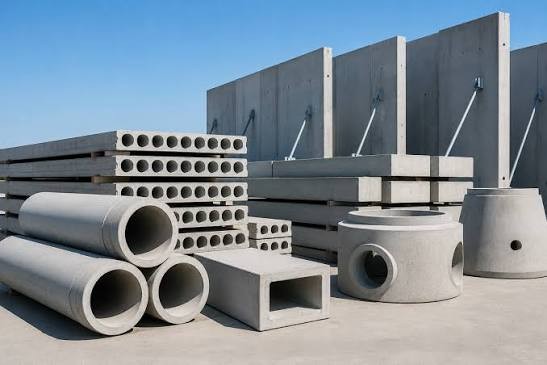
Common concrete products available for construction projects in Uganda include:
- Solid concrete blocks.
- Hollow concrete blocks.
- Interlocking concrete blocks.
- Concrete paving blocks.
- Precast concrete slabs.
- Concrete lintels.
- Precast concrete beams and columns.
- Concrete kerbstones.
- Concrete pipes.
- Precast concrete culverts.
- Drainage channels.
- Concrete manhole rings and covers.
- Concrete fence posts.
- Concrete wall panels.
- Other specialised precast concrete components.
Each product has different material, manufacturing, handling and installation requirements. Consequently, there is no single price that applies to all concrete products.
For accurate budgeting, buyers should compare products with equivalent dimensions, strength requirements, intended applications and delivery conditions.
2. Main Factors That Determine Concrete Product Prices in Uganda
Several factors influence the price of concrete products. Understanding them helps buyers evaluate quotations and identify the most suitable products for their construction projects.
2.1 Cost of Raw Materials
The cost of raw materials is one of the biggest factors affecting concrete product prices.
Concrete manufacturing requires several essential materials, including:
Cement: Cement is a major component of concrete and helps bind the aggregates together. Changes in cement prices can directly affect production costs.
Sand: Sand contributes to the concrete mixture and must meet the requirements of the intended product. Its source, cleanliness, grading and transportation distance can influence its cost.
Aggregates: Coarse aggregates such as crushed stone or gravel provide strength and bulk to concrete. Their quality, size distribution and availability affect production expenses.
Water: Clean water is required for mixing and curing concrete. Its quality and availability are important for consistent production.
Reinforcement steel: Some precast products, including reinforced concrete beams, slabs, pipes and specialised structural components, require steel reinforcement. Steel prices and reinforcement quantities can significantly affect their final costs.
Admixtures: Approved chemical or mineral admixtures may be required to achieve particular concrete properties, such as workability, setting characteristics or durability.
When the cost of these materials increases, manufacturers may adjust their prices to maintain production and operating requirements.
2.2 Type of Concrete Product
Different concrete products have different manufacturing requirements.
For example, the production of a standard concrete block is generally different from manufacturing a reinforced concrete culvert or a large precast structural beam.
Some products require simple moulds and relatively straightforward production processes, while others need specialised equipment, reinforcement, more complex moulds and additional quality control.
The following considerations influence prices:
- Product shape and design.
- Manufacturing complexity.
- Required concrete strength.
- Reinforcement requirements.
- Surface finish.
- Dimensional accuracy.
- Special performance requirements.
Buyers should therefore avoid comparing the price of different concrete products simply because they are made from concrete.
2.3 Product Dimensions and Thickness
The size of a concrete product has a direct influence on its material requirements and manufacturing cost.
Larger or thicker concrete products generally require more concrete and may need additional reinforcement or more substantial moulds.
For example, a large concrete slab will usually require more material than a smaller slab of similar composition and specification.
For concrete blocks, dimensions and wall thickness affect the quantity of concrete used and the product’s intended application.
For culverts and drainage channels, dimensions, wall thickness, loading requirements and reinforcement details can significantly influence the final price.
When requesting quotations, always provide the required dimensions and technical specifications.
2.4 Concrete Strength and Quality Requirements
Concrete strength is an important consideration when determining the cost of concrete products.
Different construction applications require different performance characteristics. A product intended for a structural application may have more demanding specifications than one intended for a non-structural application.
Factors that can influence the cost include:
- Required concrete strength.
- Approved mix design.
- Cement and aggregate quality.
- Water-cement ratio.
- Reinforcement requirements.
- Compaction methods.
- Curing procedures.
- Testing and inspection requirements.
Products manufactured to meet demanding project specifications may require more controlled production processes and additional testing.
However, buyers should not assume that a higher price automatically means better quality. The product should be assessed against measurable specifications, applicable standards and its intended use.
2.5 Manufacturing Process and Production Technology
The manufacturing process can significantly affect concrete product prices.
Some concrete products are manufactured using relatively simple moulding techniques, while others require specialised machinery and controlled production procedures.
Production costs may include:
- Labour.
- Machinery operation.
- Electricity and fuel.
- Mould preparation.
- Mixing and batching.
- Concrete compaction.
- Curing.
- Product inspection.
- Equipment maintenance.
- Factory or production-yard overheads.
Mechanised production may improve consistency and increase output, but the initial investment, maintenance and operating costs can also influence product prices.
For specialised precast products, manufacturing complexity and production efficiency are particularly important.
2.6 Order Quantity and Bulk Purchasing
The quantity ordered can influence the unit price of concrete products.
Large orders may allow manufacturers or suppliers to organise production and transportation more efficiently. This can create opportunities for quantity-based pricing.
For example, a contractor purchasing concrete blocks for an entire housing development may receive different pricing from someone purchasing a small number of blocks for a minor renovation.
However, bulk purchasing does not always guarantee a lower unit price. The discount depends on production capacity, availability of materials, delivery requirements and supplier pricing arrangements.
When requesting quotations, provide:
- Total product quantity.
- Required delivery schedule.
- Number of delivery locations.
- Product specifications.
- Expected frequency of orders.
- Any special packaging or handling requirements.
This helps suppliers prepare more accurate quotations.
2.7 Transportation and Delivery Distance
Transportation is an important factor affecting concrete product prices in Uganda.
Concrete products can be heavy, and transporting them over long distances may increase the overall cost.
Delivery expenses may depend on:
- Distance from the supplier to the construction site.
- Road conditions.
- Vehicle capacity.
- Product weight and dimensions.
- Loading and unloading arrangements.
- Number of delivery trips.
- Fuel prices.
- Accessibility of the site.
For example, a supplier located near a construction project may offer a lower delivered cost than a supplier located far away, even if the second supplier has a lower factory price.
Buyers should therefore compare the delivered price rather than considering the product price alone.
2.8 Location of the Supplier
The supplier’s location can affect the availability and cost of concrete products.
Construction projects in Kampala, Wakiso, Mukono, Entebbe and other parts of Uganda may have different supply and transportation arrangements.
The distance between the production facility, supplier’s storage location and construction site can influence delivery expenses.
Other location-related factors include:
- Availability of raw materials.
- Access to production facilities.
- Local demand.
- Road infrastructure.
- Delivery vehicle availability.
- Regional supply conditions.
Before selecting a supplier, consider both the product quality and the total cost of delivering it to your project.
2.9 Reinforcement and Special Components
Some concrete products require additional materials and manufacturing processes.
For example, reinforced concrete culverts, beams, slabs and specialised structural components may require steel reinforcement.
The cost of these products can depend on:
- Reinforcement diameter and quantity.
- Steel grade and specifications.
- Cutting and bending requirements.
- Reinforcement positioning.
- Concrete cover.
- Fabrication labour.
- Structural design complexity.
Other specialised components may require embedded fittings, lifting anchors, jointing systems or additional finishing.
These requirements should be clearly included in the quotation.
2.10 Curing, Quality Control and Testing
Proper curing and quality control are essential for producing durable concrete products.
Manufacturers must provide suitable curing conditions to support strength development and minimise defects.
Depending on the product and project requirements, quality control may involve:
- Inspection of raw materials.
- Verification of concrete mix proportions.
- Monitoring production procedures.
- Checking product dimensions.
- Inspecting surface finish.
- Monitoring curing.
- Concrete strength testing.
- Product-specific performance testing.
- Inspection before delivery.
Testing and quality assurance activities may add to manufacturing costs, but they help reduce the risk of purchasing products that fail to meet project specifications.
Buyers should evaluate the quality documentation and inspection arrangements offered by suppliers rather than choosing products based on price alone.
3. Concrete Product Prices by Product Category in Uganda
The cost of concrete products varies according to their design, dimensions, specifications, production method and delivery requirements.
The following sections explain the main cost considerations for common concrete products used in Uganda.
3.1 Concrete Block Prices in Uganda
Concrete blocks are widely used in residential, commercial and industrial building construction.
They are available in different types, including:
- Solid concrete blocks.
- Hollow concrete blocks.
- Interlocking concrete blocks.
- Specialised masonry units.
- Decorative concrete blocks.
The price of concrete blocks depends on several factors.
Dimensions: Larger blocks generally require more concrete than smaller blocks.
Wall thickness: The thickness of the block affects material consumption and its intended application.
Concrete quality: The approved mix design and required strength influence production costs.
Manufacturing method: Manual and mechanised production processes may have different cost structures.
Quantity: Bulk orders may create opportunities for more competitive unit pricing.
Delivery: Transportation and offloading affect the final delivered cost.
When buying concrete blocks, check their dimensions, appearance, consistency, strength requirements and suitability for the intended wall construction.
Read more in our guide to concrete block manufacturing in Uganda.
3.2 Concrete Paving Block Prices in Uganda
Concrete paving blocks are used for driveways, walkways, parking areas, compounds, commercial spaces and other paved surfaces.
Their prices may depend on:
- Block thickness.
- Shape and design.
- Concrete strength.
- Surface finish.
- Colour requirements.
- Production method.
- Order quantity.
- Delivery distance.
Paving blocks intended for pedestrian walkways may have different requirements from those used in areas exposed to regular vehicle traffic.
The selected paving unit should be suitable for the expected loads, sub-base preparation and installation method.
3.3 Precast Concrete Slab Prices
Precast concrete slabs are used in selected floor systems, roofing applications and other structural or architectural installations.
Their cost may depend on:
- Slab dimensions.
- Thickness.
- Reinforcement.
- Concrete strength.
- Manufacturing method.
- Lifting and handling requirements.
- Transportation.
- Installation requirements.
Some slab systems also require additional structural components or site-cast concrete to complete the floor system.
The final price should therefore be assessed as part of the complete designed installation rather than the slab alone.
3.4 Concrete Culvert Prices in Uganda
Concrete culverts are used in drainage systems, road construction and water-crossing infrastructure.
They are manufactured in different shapes and sizes depending on the required water flow and structural loading conditions.
Important cost factors include:
- Culvert diameter or internal dimensions.
- Wall thickness.
- Reinforcement.
- Concrete strength.
- Product length.
- Manufacturing complexity.
- Loading requirements.
- Transportation and installation.
Large reinforced concrete culverts generally have different manufacturing and handling requirements from smaller drainage components.
The engineer should determine the appropriate culvert dimensions and specifications based on the drainage design and expected loading.
3.5 Concrete Pipe Prices
Concrete pipes are used in drainage, stormwater management, sewerage and other infrastructure applications where specified.
Their cost depends on:
- Pipe diameter.
- Pipe length.
- Wall thickness.
- Reinforcement requirements.
- Joint design.
- Concrete quality.
- Manufacturing process.
- Loading and transportation requirements.
Buyers should confirm that the selected pipe is suitable for the intended application and expected external loads.
3.6 Concrete Kerbstone Prices
Concrete kerbstones are used to define road edges, parking areas, paved surfaces, walkways and landscaped spaces.
Their prices are influenced by:
- Kerbstone dimensions.
- Shape and profile.
- Concrete strength.
- Surface finish.
- Production method.
- Quantity ordered.
- Delivery distance.
Projects with large quantities of standard kerbstones may benefit from planned procurement and coordinated deliveries.
3.7 Concrete Lintel Prices
Concrete lintels are used above door and window openings to support the loads specified by the structural design.
Their prices depend on:
- Length.
- Width and depth.
- Reinforcement.
- Concrete strength.
- Design requirements.
- Manufacturing method.
- Handling and delivery.
Lintels must be appropriately designed for the opening, loading conditions and required bearing arrangements. Buyers should not select lintels based on dimensions alone.
3.8 Precast Concrete Drainage Channel Prices
Precast drainage channels help manage surface water in residential developments, commercial properties, industrial facilities and infrastructure projects.
The cost depends on:
- Channel dimensions.
- Concrete thickness.
- Reinforcement.
- Shape and profile.
- Cover requirements.
- Hydraulic requirements.
- Loading conditions.
- Transportation and installation.
The drainage design should consider expected water flow, channel gradients, connections and discharge arrangements.
4. Why Concrete Product Prices Differ Between Suppliers in Uganda
Buyers sometimes receive different quotations for what appears to be the same concrete product.
This does not necessarily mean that one supplier is overcharging or that another is offering a better deal.
Price differences may result from variations in product specifications, manufacturing processes, material sourcing and delivery conditions.
Differences in Product Quality
Suppliers may use different raw materials, mix designs, production procedures and curing arrangements.
A product manufactured to a demanding specification may cost more than a similar-looking product that has not been produced to the same requirements.
Differences in Manufacturing Equipment
Some suppliers use mechanised production equipment, while others use different levels of manual or semi-mechanised processes.
The production method can influence consistency, output, labour requirements and overhead costs.
Differences in Order Quantities
One supplier may offer competitive pricing for a large order but charge more for small quantities.
Another supplier may have different minimum order requirements.
Differences in Transportation Arrangements
Some quotations include delivery, while others cover collection from the production facility.
The difference can be significant when products are heavy or the project site is far from the supplier.
Differences in Product Specifications
Two concrete blocks, culverts or paving units may look similar but differ in thickness, strength, reinforcement and manufacturing tolerances.
Always request quotations based on the same technical requirements.
5. How to Calculate the Total Cost of Concrete Products for a Construction Project
Preparing a realistic concrete product budget requires more than multiplying the unit price by the required quantity.
The total procurement cost should account for the product price, delivery, handling, wastage and any additional requirements.
A simple budgeting formula is:
Total procurement cost = Product quantity × Unit price + Transportation + Loading and offloading + Other applicable costs.
For example, assume a construction project requires 5,000 concrete blocks.
The procurement calculation would be:
| Cost item | Calculation |
|---|---|
| Required quantity | 5,000 blocks |
| Unit purchase price | Supplier’s quoted price per block |
| Product cost | 5,000 × unit price |
| Transportation | Quoted delivery cost |
| Loading and offloading | As applicable |
| Additional requirements | Any agreed extra charges |
| Total budget | Sum of applicable costs |
This is an illustrative calculation structure, not a statement of current market prices.
Allow for Breakages and Wastage
Some products may be damaged during manufacturing, transportation, storage or installation.
The procurement plan should include a reasonable allowance based on the product type, supplier handling arrangements and project conditions.
However, excessive ordering should be avoided because it can increase costs and create storage challenges.
Consider the Cost of Installation
Some products require additional work before they can perform their intended function.
For example:
- Paving blocks require suitable ground preparation, bedding and jointing.
- Culverts require excavation, bedding, positioning and backfilling.
- Concrete blocks require appropriate mortar and masonry workmanship.
- Precast slabs may require lifting equipment and structural connections.
The project budget should account for these associated activities.
6. How to Get Accurate Concrete Product Quotations in Uganda
Getting accurate quotations helps prevent unexpected construction costs and makes it easier to compare suppliers.
When requesting prices, provide clear information about the products you need.
Step 1: Identify the Required Products
Specify whether you require concrete blocks, paving blocks, culverts, pipes, slabs, kerbstones, lintels or other precast products.
Avoid using general descriptions where different product types may have different specifications.
Step 2: Provide Product Dimensions
Include the required length, width, height, thickness, diameter or other relevant measurements.
For specialised products, attach drawings or technical specifications.
Step 3: State the Required Quantity
Provide the number of units or total volume required.
For large projects, include the expected procurement schedule and whether deliveries will be made in stages.
Step 4: Specify Quality and Strength Requirements
State the required concrete strength, applicable standards, reinforcement details and other technical requirements where relevant.
For structural products, use the approved engineer’s specifications.
Step 5: Confirm Delivery Location
Provide the project location and site access information.
This allows suppliers to estimate transportation and handling costs more accurately.
Step 6: Request a Detailed Quotation
Ask suppliers to indicate:
- Product description.
- Dimensions and specifications.
- Unit price.
- Total product cost.
- Delivery charges.
- Loading and offloading arrangements.
- Applicable taxes and other charges.
- Payment terms.
- Expected delivery period.
- Quotation validity.
Step 7: Compare Quality and Total Cost
Do not select a supplier based only on the lowest unit price.
Compare the technical specifications, quality assurance arrangements, delivery reliability and total cost.
7. How to Reduce Concrete Product Costs Without Compromising Quality
Managing construction costs is important, but choosing poor-quality concrete products can lead to repairs, replacements and additional expenses.
The following strategies can help control procurement costs while maintaining the required quality.
7.1 Plan Material Requirements Early
Prepare a detailed material schedule before purchasing.
Accurate quantity estimates help avoid emergency purchases, unnecessary orders and repeated transportation expenses.
7.2 Purchase Appropriate Quantities
Where practical, coordinate orders to benefit from efficient production and delivery arrangements.
However, confirm storage space and project schedules before purchasing large quantities.
7.3 Compare Multiple Supplier Quotations
Request quotations from different suppliers using the same specifications.
This allows you to compare equivalent products rather than choosing based on misleading price differences.
7.4 Select the Correct Product Specifications
Avoid purchasing products that are unsuitable for their intended applications.
Using unnecessarily demanding specifications can increase costs, while selecting products below the required specification can compromise safety and durability.
The engineer or project designer should establish the appropriate requirements.
7.5 Consider Transportation Costs
A supplier with a slightly higher product price may offer a lower total delivered cost if the production location is closer to the construction site.
Compare transportation and handling charges before making a decision.
7.6 Avoid Last-Minute Procurement
Late material orders may create delays, emergency transportation expenses and difficulties securing the required quantities.
Prepare a procurement schedule that matches the construction programme.
7.7 Inspect Products Before Accepting Delivery
Check product dimensions, visible defects, quantities and compliance with the agreed specifications.
Where necessary, request relevant test documentation and arrange independent inspection.
7.8 Work With Reliable Construction Professionals
Professional construction planning, quantity estimation, supervision and procurement coordination can help reduce material wastage and prevent avoidable expenses.
8. Quality Checks to Perform Before Buying Concrete Products
Before accepting concrete products, buyers should verify that they meet the project’s requirements.
The following checklist can help.
Dimensions and appearance
- Check that the products have the specified dimensions.
- Inspect for significant cracks and visible damage.
- Look for excessive honeycombing or poorly compacted areas.
- Check the consistency of shape and finish.
- Confirm that the products are suitable for the intended application.
Material and production quality
- Request information about the raw materials used.
- Confirm the relevant product specifications.
- Ask about manufacturing and curing procedures.
- Check the availability of applicable test results.
- Verify that reinforcement is provided where specified.
Delivery and handling
- Check the delivered quantities.
- Inspect products for transportation damage.
- Confirm that the products have been handled and stored appropriately.
- Ensure that damaged or non-compliant products are addressed before acceptance.
Compliance
- Confirm applicable Uganda Standards with the Uganda National Bureau of Standards (UNBS).
- Check project specifications and relevant engineering requirements.
- Request product documentation where required.
Visual inspection is useful, but it cannot establish concrete compressive strength on its own. Specified testing should be used where structural performance or product compliance must be verified.
9. Importance of Choosing the Right Concrete Products for Your Project
Selecting appropriate concrete products affects the quality, functionality and long-term performance of a construction project.
Different applications require different product characteristics.
For example:
- Concrete blocks must be suitable for the intended masonry application.
- Paving blocks must be appropriate for pedestrian or vehicle loading.
- Culverts must meet drainage and structural requirements.
- Concrete pipes must suit the intended flow and loading conditions.
- Precast slabs must comply with the structural design.
- Kerbstones must be suitable for the required installation and exposure conditions.
- Concrete lintels must be appropriate for their openings and design loads.
Choosing products based on their intended function helps reduce construction problems and unnecessary replacement costs.
10. Concrete Product Procurement for Different Construction Projects in Uganda
Concrete product requirements vary according to the type and size of the development.
Residential Construction Projects
Residential buildings commonly require:
- Concrete blocks.
- Concrete lintels.
- Paving blocks.
- Precast drainage components.
- Concrete fence posts.
- Other approved precast products.
Homeowners and residential contractors should consider product quality, quantities, delivery arrangements and compatibility with the approved building design.
Commercial Construction Projects
Commercial buildings may require larger quantities of concrete products, including:
- Concrete blocks.
- Precast slabs.
- Concrete stair components.
- Paving blocks.
- Kerbstones.
- Drainage channels.
- Specialised structural components.
Procurement planning is particularly important where construction activities must be coordinated with tight commercial development schedules.
Industrial Construction Projects
Industrial developments may require products with specialised dimensions, strength and loading characteristics.
These can include:
- Reinforced concrete culverts.
- Precast drainage channels.
- Concrete pipes.
- Heavy-duty paving products.
- Structural precast components.
- Specialised foundations and equipment supports.
The relevant engineers should establish the required specifications before procurement.
Road and Infrastructure Projects
Infrastructure projects often require substantial quantities of concrete products for drainage, roadworks and associated construction activities.
Common products include:
- Concrete culverts.
- Concrete pipes.
- Kerbstones.
- Paving blocks.
- Drainage channels.
- Manhole components.
The final cost depends on product specifications, quantities, delivery locations and installation requirements.
11. Common Mistakes to Avoid When Comparing Concrete Product Prices
Comparing prices without considering the complete product specification can lead to poor procurement decisions.
Avoid the following mistakes:
1. Comparing products with different dimensions
A smaller block or thinner slab should not be directly compared with a larger product of a different specification.
2. Choosing the cheapest product without checking quality
Low prices do not automatically represent good value. Confirm the product’s suitability and quality.
3. Ignoring transportation charges
A low factory price may become expensive once delivery is included.
4. Failing to request technical specifications
Always clarify the dimensions, strength requirements, reinforcement and intended application.
5. Ordering incorrect quantities
Poor quantity estimation can result in shortages, excess stock or unnecessary transportation expenses.
6. Ignoring storage requirements
Concrete products should be stored appropriately to avoid damage before installation.
7. Failing to inspect delivered products
Check the products against the agreed specifications before accepting delivery.
8. Overlooking installation costs
The purchase price does not necessarily include all the work required to install a product.
12. How Daltrev Co. Ltd. Supports Construction Projects in Uganda
Successful construction depends on selecting suitable materials, planning procurement properly and coordinating construction activities effectively.
Daltrev Co. Ltd. recognises the importance of reliable construction solutions for residential, commercial, industrial and infrastructure developments.
Whether you are planning a building project, sourcing concrete products or evaluating construction material requirements, it is important to consider product specifications, quantities, delivery arrangements and overall project objectives.
Explore our construction materials services to learn more about our construction materials-related solutions.
You can also explore our construction works and construction consultancy services for information about our wider construction support.
For enquiries about your construction requirements, visit the Daltrev Co. Ltd. contact page.
Frequently Asked Questions About Concrete Product Prices in Uganda
1. How much do concrete products cost in Uganda?
Concrete product prices in Uganda vary according to product type, dimensions, concrete strength, raw materials, manufacturing process, quantity and delivery location. Buyers should request current quotations based on their specific technical requirements.
2. What determines the price of concrete blocks in Uganda?
Concrete block prices depend on block dimensions, thickness, concrete quality, manufacturing method, order quantity and transportation costs. The required strength and intended application also influence the specification and price.
3. Are precast concrete products more expensive than ordinary concrete products?
Not necessarily. Precast products have different manufacturing, handling and quality control requirements. Their overall cost depends on design complexity, production quantities, transportation and installation arrangements.
4. Why do concrete product prices differ between suppliers?
Suppliers may use different raw materials, production equipment, mix designs, quality control procedures and delivery arrangements. They may also quote different product dimensions and specifications.
5. Does buying concrete products in bulk reduce the price?
Bulk purchasing may reduce unit costs where suppliers can achieve production and delivery efficiencies. However, the actual discount depends on the product, quantity, availability and supplier’s pricing arrangements.
6. What is included in the price of concrete products?
A quotation may include only the product price or may also include loading, transportation and offloading. Buyers should confirm exactly what is included before comparing supplier quotations.
7. How can I identify quality concrete products?
Check dimensions, appearance, visible defects, product specifications and available quality documentation. For products requiring verified structural performance, request the relevant test results and confirm compliance with applicable standards.
8. Are concrete product prices affected by transportation?
Yes. Concrete products are often heavy, so transportation distance, road conditions, vehicle capacity, loading and offloading can significantly influence the total delivered cost.
9. Which concrete products are commonly used in building construction in Uganda?
Common products include concrete blocks, paving blocks, lintels, precast slabs, kerbstones, concrete pipes, culverts, drainage channels and manhole components.
10. How can I get an accurate quotation for concrete products?
Provide the product type, dimensions, required quantity, technical specifications, delivery location and preferred delivery schedule. Request an itemised quotation that clearly separates product prices and additional charges.
Conclusion
Concrete product prices in Uganda are influenced by several factors, including raw material costs, product dimensions, concrete strength, manufacturing processes, reinforcement, order quantities, transportation and quality control requirements.
Understanding these factors helps builders, contractors, property developers and procurement professionals prepare realistic construction budgets and make better purchasing decisions.
The cheapest product is not always the most economical option. Quality, suitability, durability, delivery reliability and installation requirements should all be considered when selecting concrete products.
For successful construction, plan material procurement early, compare quotations using consistent specifications, inspect products before acceptance and ensure that all materials meet the relevant project requirements.
Daltrev Co. Ltd. supports construction projects through construction-related services, materials enquiries and project solutions.
Choose suitable construction materials, plan your procurement carefully and build with quality in mind.