
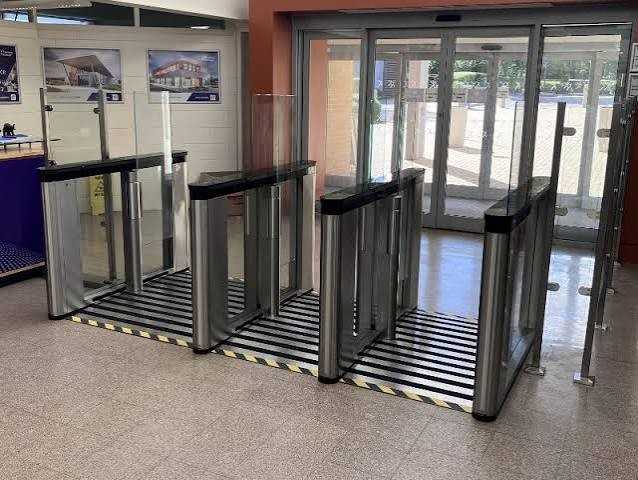
Controlling who enters and leaves a building is an essential part of maintaining security, protecting property and managing the movement of people. For offices, schools, universities, factories and other institutions, traditional security measures such as reception desks, manual registers and security guards may not provide the level of access management required in busy environments.
Turnstile access control systems offer a modern and organised way to manage pedestrian entry and exit. By allowing authorised individuals to pass through designated access points, turnstiles help prevent unauthorised entry, reduce congestion and improve accountability.
In Uganda, where organisations are increasingly investing in modern building security, turnstile access control systems provide a practical solution for managing access to offices, educational institutions, commercial buildings, industrial facilities and restricted areas.
At Daltrevco, we recognise the importance of combining effective access management with reliable security technology. This guide explains how turnstile access control systems work, the available types, their benefits, installation requirements and the factors to consider when choosing a suitable solution for your premises.
What Are Turnstile Access Control Systems?
A turnstile access control system is a pedestrian security solution designed to regulate movement through an entrance or exit. It uses a mechanical or motorised barrier that allows people to pass after their access credentials have been verified.
Unlike an ordinary doorway, a turnstile controls the movement of individuals one person at a time, depending on its design. It can be connected to different access control technologies, including:
- RFID access cards and proximity cards
- Fingerprint recognition systems
- Facial recognition terminals
- PIN code keypads
- QR codes and visitor credentials
- Mobile access credentials
- Centralised access control software
When an authorised person presents valid credentials, the system verifies their permission and releases the turnstile for passage. If access is denied, the barrier remains locked.
Turnstile systems can also record access events, making it easier for authorised administrators to monitor entry activity and manage access permissions.
How Do Turnstile Access Control Systems Work?
Turnstile systems operate through a combination of access credentials, electronic controllers, sensors and mechanical barriers.
The exact operation depends on the type of turnstile and the access control technology connected to it.
A typical operation follows these steps:
1. User presents access credentials
An individual approaches the turnstile and presents an authorised card, fingerprint, PIN, QR code or other approved credential.
2. The access control system verifies identity or permission
The connected reader communicates with the access controller or access management system to determine whether the individual has permission to enter.
3. The controller authorises or denies access
If the credential is valid and the user has the required access permission, the controller sends an instruction to release the turnstile.
4. The individual passes through
The barrier opens or rotates to allow the authorised person to pass through the designated lane.
5. The system records the access event
Depending on the system configuration, the software records information such as the credential used, access point, date and time, and whether entry was granted or denied.
6. The turnstile resets
After passage, the barrier returns to its secured position and prepares for the next authorised user.
This process helps organisations establish controlled entry points and maintain more organised pedestrian movement.
Types of Turnstile Access Control Systems
Different buildings have different security requirements, entrance layouts and pedestrian traffic levels. Choosing the right turnstile depends on the level of security required, available space, number of users and the nature of the premises.
The most common types include the following.
1. Tripod Turnstile Systems
Tripod turnstiles use three rotating horizontal arms arranged around a central mechanism. When a person is authorised, the mechanism releases the arms, allowing one individual to pass through.
They are commonly used in locations that require controlled pedestrian movement without installing a full-height barrier.
Typical applications include:
- Office building entrances
- Staff entrances
- Fitness centres
- Schools and training institutions
- Factories and industrial facilities
- Employee access points
Tripod turnstiles are generally compact and suitable for entrances where space is limited. They can be integrated with RFID cards, biometric readers and other access control technologies.
2. Full-Height Turnstile Systems
Full-height turnstiles use tall rotating barriers that extend from the floor towards the top of the structure. Their design makes it more difficult for people to climb over or bypass the controlled entrance.
They are particularly suitable for premises that require stronger pedestrian access restrictions.
Typical applications include:
- Industrial facilities
- Warehouses
- Manufacturing plants
- Restricted commercial premises
- Utility installations
- Staff-only compounds
Full-height turnstiles are often installed at outdoor or perimeter entrances where a more substantial physical barrier is required.
3. Optical Turnstile Systems
Optical turnstiles use sensors and electronically controlled barriers to manage pedestrian movement. They often feature glass or acrylic barrier panels that open when authorised access is confirmed.
Unlike conventional tripod systems, optical turnstiles are designed to provide a modern appearance while maintaining controlled entry.
Typical applications include:
- Corporate offices
- Banks and financial institutions
- Government buildings
- Modern commercial developments
- Corporate headquarters
- Reception areas
Optical turnstiles are particularly suitable for organisations that want an attractive entrance combined with electronic access management.
4. Swing Barrier Turnstiles
Swing barrier turnstiles use retractable or swinging panels that open to allow authorised individuals to pass.
They are often used in environments where wider pedestrian lanes are required.
Typical applications include:
- Universities
- Hospitals
- Office buildings
- Shopping centres
- Public institutions
- Facilities used by people with mobility challenges
Swing barriers can provide wider passageways for wheelchairs, visitors and authorised movement of equipment, depending on the installation design.
5. Flap Barrier Turnstiles
Flap barrier turnstiles use retractable panels, commonly made from glass or durable plastic, to control pedestrian entry.
The panels remain closed until an authorised credential is verified. Once permission is granted, they retract to create a passage.
Typical applications include:
- Corporate offices
- Universities
- Airports and transport facilities
- Commercial buildings
- Government institutions
- High-traffic reception areas
Flap barriers can support organised pedestrian flow where many people enter and leave a building throughout the day.
Turnstile Access Control Systems for Offices
Office buildings often receive employees, clients, contractors, suppliers and other visitors. Without a structured entry management system, it can be difficult to monitor who accesses different areas of the premises.
Turnstile access control systems help businesses establish controlled entry points and improve workplace security.
For office environments, turnstiles can be integrated with employee access cards, biometric readers or facial recognition systems. This allows authorised staff to enter while restricting access to individuals without permission.
Key applications include:
- Main employee entrances
- Corporate reception areas
- Restricted office departments
- Server rooms and sensitive work areas
- Staff-only access points
- Commercial building entrances
For a busy office, optical or flap barrier turnstiles may provide an attractive and organised entrance. Tripod turnstiles can be considered where a compact and practical access point is required.
The system should also provide a suitable method for managing visitors, contractors and temporary access permissions.
Turnstile Access Control Systems for Schools and Universities
Educational institutions need effective ways to manage the movement of students, teachers, staff, parents and visitors.
During school opening hours, break periods and major events, large numbers of people may move through the same entrances. Uncontrolled access can make it difficult to monitor entry and protect restricted areas.
Turnstile access control systems help schools and universities regulate pedestrian movement and establish clearer access procedures.
Benefits for schools
- Help restrict entry to authorised students and staff.
- Support more organised movement through designated entrances.
- Reduce opportunities for unauthorised individuals to enter controlled areas.
- Help monitor access activity through electronic records.
- Support the management of staff and student access permissions.
- Improve the organisation of entrances during busy periods.
Benefits for universities and colleges
Universities often operate large campuses with multiple buildings, departments, laboratories, libraries and administrative facilities.
Turnstiles can be installed at selected access points to regulate entry into:
- Main campus entrances
- Student accommodation facilities
- Libraries and study centres
- Computer laboratories
- Research facilities
- Examination centres
- Administrative buildings
For educational institutions, the access control system should be designed around student movement patterns, emergency evacuation procedures and the need for accessible entrances.
Turnstiles should not replace appropriate safeguarding procedures, supervision or emergency access arrangements.
Turnstile Access Control Systems for Other Institutions
Beyond offices and educational facilities, turnstile systems can serve organisations that need structured pedestrian access management.
Government buildings
Government offices may use turnstiles to regulate access to administrative departments, staff-only areas and other restricted sections.
Hospitals and healthcare facilities
Hospitals can use controlled access points to manage entry into selected administrative, staff-only or restricted areas. However, patient movement, emergency response and accessibility must remain priorities.
Banks and financial institutions
Turnstiles can help control access to staff areas, secure offices and other restricted sections of financial facilities.
Factories and industrial facilities
Industrial premises can use turnstiles to manage employee entry, restrict access to operational areas and support workforce access monitoring.
Commercial buildings
Shopping centres, business complexes and other commercial developments can use turnstiles at selected entrances to improve pedestrian access management.
Key Benefits of Turnstile Access Control Systems
Investing in a suitable turnstile access control system offers several operational and security benefits.
1. Improved Access Control
Turnstiles help ensure that individuals pass through designated access points using approved credentials. This reduces reliance on informal entry procedures and makes it easier to enforce access restrictions.
2. Reduced Unauthorised Entry
Because the barrier only releases when access is authorised, turnstiles can make unauthorised pedestrian entry more difficult.
The level of protection depends on the turnstile design, installation quality, credential technology and how well the system is managed.
3. Better Employee and Student Monitoring
When connected to suitable access management software, turnstiles can record entry and exit events.
Organisations can use these records to review access activity, investigate incidents and support attendance management where the system has been appropriately configured.
4. Improved Pedestrian Flow
Turnstiles create designated passageways that help organise how people enter and leave a building.
For busy offices, universities and institutions, multiple turnstile lanes can help manage pedestrian movement more efficiently when correctly designed for the expected traffic.
5. Integration with Modern Security Systems
Turnstile systems can be integrated with other security technologies, including:
- CCTV surveillance systems
- Biometric access control systems
- RFID card readers
- Facial recognition systems
- Visitor management platforms
- Alarm systems
- Centralised security management software
Integration depends on equipment compatibility, software support and system configuration.
6. Improved Accountability
Electronic access records can help administrators establish when credentials were used at controlled entrances.
This improves visibility into access activity and supports more structured security management.
7. Flexible Access Permissions
Administrators can assign different access permissions to employees, students, visitors and contractors.
For example, an employee may be authorised to enter the office throughout working hours, while a visitor may receive temporary access to a designated area.
Important Features to Consider When Choosing a Turnstile System
Not every turnstile is suitable for every building. Before purchasing or installing a system, consider the following features.
Access Control Compatibility
Choose a turnstile that supports the access control technology required by your organisation.
This may include RFID cards, fingerprint recognition, facial recognition, PIN codes or mobile credentials.
Pedestrian Capacity
Consider how many people are expected to use the entrance during peak periods.
A small office may require fewer lanes than a university or large commercial building. The number and configuration of turnstiles should match the expected pedestrian traffic.
Durability and Construction
Turnstiles should be constructed from materials suitable for the installation environment.
Stainless steel is commonly used in commercial and institutional turnstiles because of its durability and suitability for regular use. Outdoor installations may require additional weather protection.
Emergency Operation
Turnstiles must be selected and configured to support safe evacuation and emergency access.
Depending on the design, the system may require automatic unlocking, barrier release or another approved emergency arrangement. Emergency operation should be coordinated with the building’s fire safety and evacuation procedures.
Accessibility
Consider whether the entrance must accommodate wheelchair users, people with mobility challenges and individuals carrying equipment.
A suitable wider swing barrier or accessible passage lane may be required alongside standard turnstiles.
Software and Reporting
For organisations that need access records, choose a system with suitable management and reporting capabilities.
Confirm whether the software supports user management, access permissions, event logs and the reporting functions your organisation requires.
Power Supply and Backup
Turnstile systems rely on electrical power and electronic controls. Consider backup power requirements and confirm how the system behaves during a power interruption.
Maintenance Requirements
Choose equipment for which appropriate technical support, replacement components and maintenance services can be arranged.
Turnstile Access Control System Installation Process
Professional installation is important because turnstiles involve mechanical components, electrical connections, access control devices and safety considerations.
A typical installation process involves the following stages.
1. Site assessment
The installation team evaluates the entrance layout, available space, expected pedestrian traffic and the security requirements of the building.
2. Selection of the appropriate turnstile
The suitable system is selected based on the building’s requirements. Options may include tripod, full-height, optical, flap or swing barrier turnstiles.
3. Entrance preparation
The installation area is prepared to provide a stable mounting surface and appropriate space for pedestrian movement.
Civil works may be necessary depending on the floor condition and equipment design.
4. Mechanical installation
The turnstile is positioned, aligned and secured according to the manufacturer’s installation requirements.
5. Electrical and access control connections
The equipment is connected to its power supply, controller and selected access control readers.
Where required, the system is connected to management software or other security equipment.
6. System configuration
User credentials, access permissions, operating modes and other relevant settings are configured.
7. Testing and commissioning
The installation is tested to confirm that authorised credentials release the barrier correctly and unauthorised access is denied.
Emergency operation, sensors and other safety functions should also be checked.
8. User training and handover
Relevant administrators and security personnel are shown how to operate the system, manage users and respond to common issues.
How Much Do Turnstile Access Control Systems Cost in Uganda?
The cost of installing turnstile access control systems in Uganda varies depending on the equipment, number of access lanes, selected technology and complexity of the installation.
A basic tripod turnstile installation will generally have different requirements from a multi-lane optical or full-height turnstile system.
Rather than relying on a single price, organisations should consider the following cost factors.
Type of turnstile: Tripod, flap, optical, swing barrier and full-height systems have different equipment and installation requirements.
Number of lanes: A single entrance lane will have different costs from a facility requiring several controlled pedestrian lanes.
Access control technology: RFID card readers, biometric devices, facial recognition terminals and other authentication technologies affect the overall system cost.
Software and management features: Advanced access management platforms may require additional software, licences or configuration.
Installation complexity: Floor preparation, mounting requirements, wiring and the entrance layout can influence installation costs.
Integration with other security systems: Connecting turnstiles to CCTV, alarms, visitor management or existing access control infrastructure may increase project requirements.
Power backup: Backup power equipment may be required to support continued operation or an approved emergency operating arrangement.
Maintenance and technical support: Organisations should consider the long-term cost of inspection, servicing and replacement components.
For an accurate quotation, the site should be assessed to determine the most suitable turnstile type, number of lanes, access technology and installation requirements.
Contact Daltrevco to discuss a turnstile access control solution for your office, school or institution in Uganda.
Common Turnstile Access Control Problems and Their Solutions
Like other electronic security systems, turnstiles may develop faults through regular use, poor maintenance, electrical problems or incorrect configuration.
Some common issues include:
Turnstile Fails to Release
Possible causes:
- Invalid or expired access credentials
- Reader communication problems
- Controller faults
- Power supply interruptions
- Incorrect access permissions
Recommended solution: Check the credential, access permissions, power supply and communication between the reader and controller. Persistent faults should be inspected by a qualified technician.
Turnstile Does Not Lock Properly
Possible causes:
- Mechanical wear
- Damaged internal components
- Incorrect configuration
- Sensor or controller faults
Recommended solution: Inspect the mechanism and control settings, and arrange professional servicing where necessary.
Access Cards Are Not Being Recognised
Possible causes:
- Damaged cards
- Reader faults
- Incorrect card enrolment
- Credential compatibility problems
Recommended solution: Test with an authorised working credential and verify that the card technology is supported by the reader.
Turnstile Operates Intermittently
Possible causes:
- Unstable electrical supply
- Loose connections
- Communication interruptions
- Worn mechanical components
Recommended solution: Check the power supply and system connections. A technician should inspect recurring operational problems.
Slow Pedestrian Movement
Possible causes:
- Too few access lanes
- Slow credential verification
- Poor entrance layout
- Incorrect system configuration
Recommended solution: Review the expected pedestrian capacity, access verification process and number of lanes. High-traffic environments may need additional lanes or a different turnstile design.
Turnstile Access Control System Maintenance
Regular maintenance helps preserve the performance, reliability and lifespan of a turnstile installation.
Recommended maintenance activities include:
- Inspecting mechanical barriers and moving components.
- Cleaning turnstile surfaces and access readers.
- Checking electrical connections and power supplies.
- Testing RFID cards and biometric readers.
- Checking sensors and safety functions.
- Reviewing access control software and system logs.
- Testing emergency release arrangements.
- Replacing worn or damaged components.
- Checking backup power equipment where installed.
The maintenance frequency should follow the manufacturer’s recommendations and reflect the amount of daily use.
Busy entrances in schools, factories and commercial buildings may require more frequent inspections than low-traffic installations.
Turnstile Access Control Systems vs Traditional Security Guards
Security guards remain important for monitoring visitors, responding to incidents and handling situations that automated systems cannot resolve.
However, turnstile systems offer a more structured way to control routine pedestrian access.
| Feature | Turnstile access control | Traditional security guards |
|---|---|---|
| Entry authorisation | Uses configured credentials | Usually relies on manual verification |
| Access records | Can create electronic records | May require manual registers |
| Pedestrian movement | Provides designated passage lanes | Depends on manual supervision |
| Visitor management | Can integrate with visitor systems | Often handled manually or through separate software |
| Human response | Limited to configured system functions | Can assess and respond to unusual situations |
| Best use | Controlled routine entry | Supervision, assistance and incident response |
For many organisations, the most effective approach is to combine turnstile access control with trained security personnel and CCTV surveillance.
Why Choose Daltrevco for Turnstile Access Control Solutions?
Choosing an appropriate access control solution requires more than selecting a turnstile. The equipment must suit the building, the expected number of users and the organisation’s security requirements.
Daltrevco provides a point of contact for organisations exploring modern security and building technology solutions in Uganda.
When planning a turnstile access control project, it is important to consider:
- The most suitable turnstile design for the premises.
- The access control technology required.
- The number of pedestrian lanes needed.
- Integration with existing security systems.
- Safe emergency operation and accessibility.
- Future expansion and maintenance requirements.
Whether you are planning security improvements for an office, school, university, factory or commercial property, contact Daltrevco to discuss your requirements and identify a suitable access control solution.
Frequently Asked Questions About Turnstile Access Control Systems
1. What is the main purpose of a turnstile access control system?
Its main purpose is to regulate pedestrian entry and exit by allowing authorised individuals to pass through a controlled barrier. It helps organisations manage access and reduce unauthorised entry.
2. Which turnstile is best for office buildings?
Optical, flap and tripod turnstiles are common options for office buildings. The best choice depends on the entrance design, expected traffic, security requirements and desired appearance.
3. Are turnstile access control systems suitable for schools?
Yes. Schools, colleges and universities can use turnstiles to manage student, staff and visitor movement through designated entrances. The installation should account for safeguarding, accessibility and emergency evacuation.
4. Can turnstiles use fingerprint recognition?
Yes. Compatible turnstiles can be integrated with fingerprint readers to verify authorised users before releasing the barrier.
5. Can turnstiles work with RFID cards?
Yes. RFID and compatible proximity card readers are commonly used with turnstile access control systems. The reader and card technology must be compatible.
6. Can a turnstile system be connected to CCTV?
Yes. Compatible turnstile systems can be integrated with CCTV surveillance to support security monitoring and incident investigation. The level of integration depends on the equipment and software.
7. Do turnstiles record entry and exit times?
They can. When connected to suitable access management software, turnstiles can record access events, including credential use, dates and times.
8. Are full-height turnstiles more secure than tripod turnstiles?
Full-height turnstiles provide a taller physical barrier and are generally more difficult to climb over. They may be more suitable for restricted outdoor or industrial entrances, while tripod systems are often appropriate for controlled indoor entrances.
9. Can turnstiles control both entry and exit?
Yes. Many turnstile systems can be configured to control entry and exit, depending on the design, number of lanes and access control requirements.
10. What happens when electricity goes off?
The response depends on the turnstile model and its configuration. Some systems may require backup power, while others have specific emergency release arrangements. The installation must ensure safe evacuation and emergency access.
11. Can visitors use turnstile access control systems?
Yes. Visitors can be provided with temporary credentials such as authorised access cards, QR codes or other approved credentials, depending on the visitor management system.
12. How many turnstiles does an office or school need?
The number depends on the expected pedestrian traffic, peak entry and exit periods, available space and required security arrangements. A site assessment helps determine the appropriate number of lanes.
13. Do turnstile systems require regular maintenance?
Yes. Regular inspection and servicing help maintain mechanical operation, reader performance, electrical connections and safety functions.
14. Can turnstiles be installed outdoors?
Yes. Outdoor-rated turnstile models are available. The selected equipment should be suitable for exposure to rain, dust, temperature changes and other environmental conditions at the installation site.
15. How much does turnstile installation cost in Uganda?
The cost depends on the turnstile type, number of lanes, access control technology, installation work, software and system integration. A site assessment is recommended before preparing a quotation.
Conclusion: Invest in Reliable Turnstile Access Control Systems
Turnstile access control systems provide offices, schools, universities and other institutions with a practical way to regulate pedestrian movement and improve building security.
From compact tripod turnstiles to optical, flap, swing barrier and full-height systems, different solutions are available to meet different access management requirements.
By selecting the right equipment and integrating it with suitable access control technology, organisations can improve entry management, maintain access records and create more organised entrances.
For businesses and institutions planning to upgrade their security infrastructure, Daltrevco can help you explore suitable access control solutions for your premises in Uganda.
Contact Daltrevco today to discuss turnstile access control systems for your office, school, university or commercial facility.

